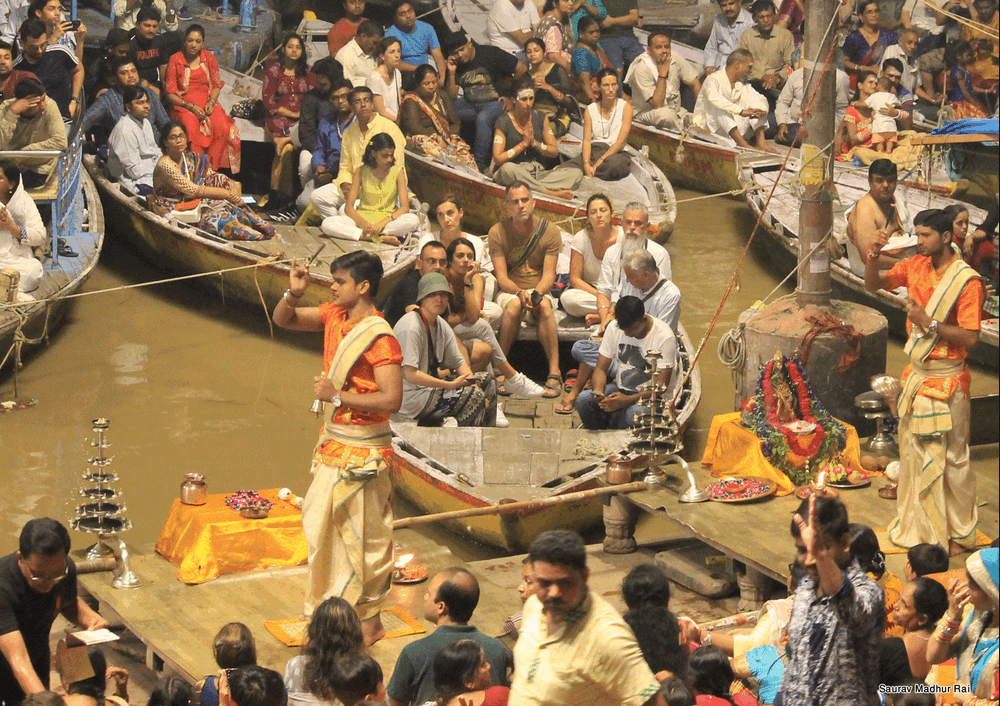
The banks of the Ganga have witnessed the rise and fall of empires. For millions, Ganga is not only a river but also a goddess, a symbol of spiritual rebirth.
We use Google Cloud Translation Services. Google requires we provide the following disclaimer relating to use of this service:
This service may contain translations powered by Google. Google disclaims all warranties related to the translations, expressed or implied, including any warranties of accuracy, reliability, and any implied warranties of merchantability, fitness for a particular purpose, and noninfringement.
The river is the heartbeat of the earth, which beats with life and liquid energy. The river keeps flowing, it doesn't stop. It is an uncontrollable dynamic force of nature, which gives a sense of freedom. So yes, the fluid motion of a river is like the rhythm of our lives – ever-changing, yet eternally constant.
The Buddhist text says, 'Raindrops fall on the mountains and turn into rivers through Kholsakholsi.' Therefore, water is the primordial mother, in whose womb life grows . Existence bursts forth from its depths and life is in its essence . However, this water also becomes hot sometimes.
There are many rivers in India, but the Ganga River has its own uniqueness. Ganges is India's national river and life-giving, important water source. In Hindu belief, the river Ganges is considered the purest form of the liquid form of Lord Vishnu. While discussing the river Ganga, I am reminded of that ancient hymn in which a mango filled its palm with Ganga water and whispered in a soft voice - O river, daughter of sage Jahnu / You save the pious souls / But, they are saved by their own good deeds / ... You hold the dead in your arms / O Bhagirathi, you are the most compassionate mother (translated from Sanskrit to Nepali) '
This hymn It has been part of Bengal's oral tradition for centuries. But, dear reader! Did you know ? Who wrote this Ganga Stotra? After reading the answer, for a moment you become shocked . It is not written by a Brahmin or a Hindu, but by a thirteenth century writer 'Daraf Khan Ghazi'. And, interestingly, famous Bengali linguist Kumar Chattopadhyay identified 'Daraf Khan Ghazi' as 'Zafar Khan Ghazi' .
The same Ghazi, who is infamous in history for conducting a brutal military campaign from Bengal for the first phase of expansion of Islam in India. However, we grew up listening to the same Ganga Stotra . I know that the water of the Ganga, which my mother used to chant at the place of worship at home, she had filled it in a big plastic bottle from her pilgrimage to 'Varanasi'. And, that was the most beloved form of his faith towards Ganga . As soon as she said 'Varanasi', mother's eyes lit up with the light of Bhaktiras like the water of the Ganga lit up with golden aura when the sun shines on it. Today, I remember that bright and warm aura even after his death.
I was yearning to relive that moment in my mother's beloved city of Varanasi and to experience the same river Ganges flowing through the heart of the city with spiritual power. According to the geographical structure, the river Ganga of Banaras (Varanasi) flows around the city of Banaras with a distinctive crescent shape, which in Hindu belief is compared to the moon adorned in the Jata of Mahadev, and is sometimes considered to be the actual form of the sound 'Om'.
Anyway, I wanted to see Banaras once in my life . So, burdened with thousands of questions in my mind, I reached Banaras on the day of Dev Diwali to experience the same river Ganga. It was evening after sunset. The ghats and riverbanks on the Ganges looked alive in the light of millions of lamps. As if it is a divine beauty-canvas of a skilled painter . The surface of the river Ganga was shining like molten gold, the water of the river glittered in the light of the lamp . The architecture of the ancient city of Banaras looked even more charming in that golden light.
I think, such interplay of water and light is a living symbol of a spiritual transformation . After all, the light represents the light of the soul. On that holy festival of Dev Diwali, millions of lamps seemed to be dancing with the waves of the Ganges. As if the light of each lamp is whispering the secrets of the soul's eternal journey . Mother used to say, 'The continuous flow of the Ganges embodies the cycle of life and rebirth.' As I stood at the Manikarnika ghat that day, I felt my mother's words echoing in the flickering light of millions of lamps. The burning lamps were saying, 'Life is a light, the light burns, then goes out and only burns again in eternity .' At that moment, only the Ganga water in my palm and my mother's words in my heart remained . I closed my eyes and kept trying to re-experience that lost mother's love from me in silence .
Two years after my mother passed away, the pain in me is still there . Kunni Kyn's mind was pounding with an unimaginable desire to see her mother's reflection just once. So, deeply, I kept staring at the water flowing in the Ganga, but there was no reflection of my mother.
But, since that day, I could understand the river Ganga as the mother of the world, who leads countless souls to salvation. It was after that moment, I realized standing in the holy waters of the Ganges – death is not the end but a cycle of change, where the journey of the soul continues, endlessly – endlessly – in search of self-existence.
000
Banaras is an ancient city on the western bank of the Ganges River, which stretches over 6.4 km . Here the river Ganges takes a sharp bend, giving the city and the river a semi-circular shape. It is said that this shape is similar to the crescent moon adorned in the Jata of Lord Shiva. It is believed that the water of the river Ganga has the power to wash away all material waste and moral sins, that is why many Bengali Hindus consider it a great misfortune not to die near the river.
They spend at least three nights on the banks of the river for a beautiful death, drowning in water up to their navels and continuously chanting 'Ganga Nai Vishnup, Ganga Nai Brahma' . It is the decade of 1820s, when people thought that the eclipse of the sun was "swallowed by the planet Rahu" and in the belief that this process would be thwarted, drowning in the river Ganges while chanting the mantra of the sun was considered the best state of devotional path .
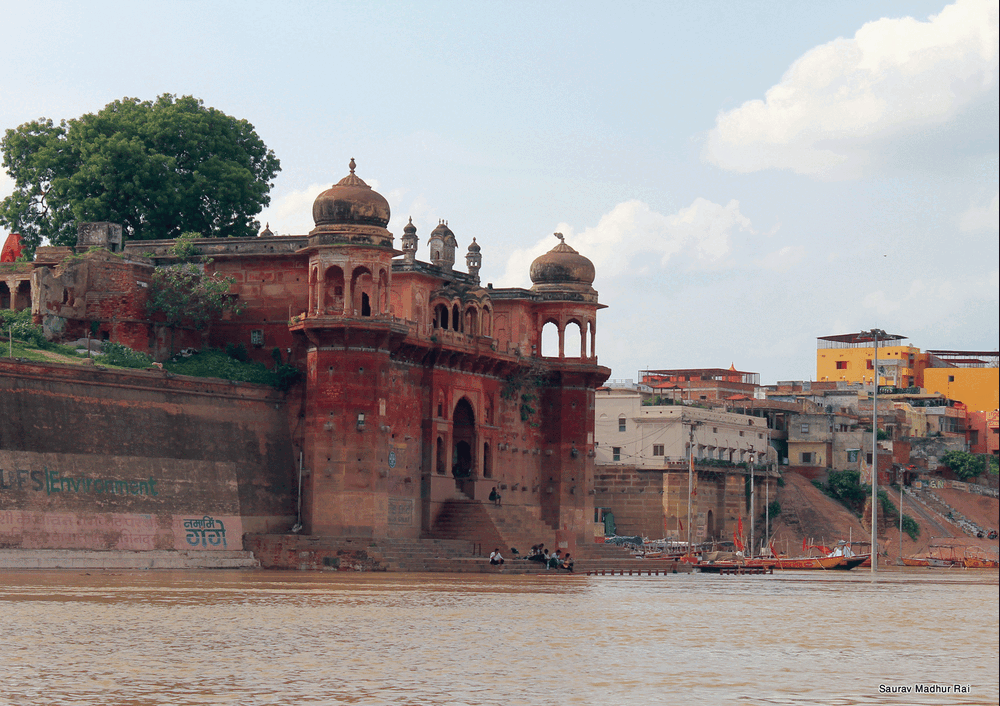
Similarly, the writer Aldous Hux has reached Banaras one day to be a witness of faith. After seeing India in the color of superstition in geographical phenomena like solar eclipse, he blasted Indian belief in the essay 'Banaras'. However, Huxley was so fascinated by the beauty of the river Ganga, he wrote on Ganga - a river of cultural and spiritual importance. He wrote many articles on the river Ganges.
7th century India can be read through the eyes of the Chinese traveler Xuanzang in 'The Great Tang Records'. In ancient India, Xuanzang saw people drowning in the Ganges River and immolating themselves. That was the mentality of ancient India, which was intertwined with the idea of a new and beautiful birth after erasing the sins accumulated throughout the life, which changed with time .
The story of Swami Agehananda Bharti, a Hindu monk of Austrian origin and a scholar of Indian culture and language, is also interesting. Leopold Fischer came to the ancient Indian city of Varanasi from Austria to become a Dashanami Sannyasin Hindu monk, he was ordained by Swami Viswinanda . At that time, a pyre of a young woman and her dead baby was burning at Manikarnika Ghat (one of the 80 major ghats of Varanasi).
Guru decorated Leopold Fischer's Diksha-Vedi on the same pyre . The atmosphere echoed with the chanting of Fiser's 'funeral' ritual, sprinkling black and white towards the sky. The Guru sprinkled the ashes of that pyre on the seven main senses of Fiser's body, Fiser was made to take a dip in the river Ganga . It was Fisar Swami Agehananda Bharati who emerged from the womb of the Ganges, who covered the new body forever in an ocher garment.
If you want to understand the mythological and cultural significance of the river Ganga, you should see the Shilakhanda sculpture of the Pallava dynasty 'Ganga Avarta' (built in Mahabalipuram, Tamil Nadu). Classical dances 'Bharatanatyam' and 'Odissi' are also said to be inspired by the mythology of the Ganga River. Since history, the banks of the Ganges have been the path for thousands of lives, civilizations and cultures to thrive. The water of the Ganga has not only quenched the thirst of millions of animals for ages, it has also helped agriculture and industry tremendously .
In a similar context, there is a similar story of Muhammad bin Tughlaq. After Muhammad bin Tughlaq moved his capital from Delhi to Daulatabad (Devagiri), he was given the 'sweet' water of the Ganges even though it took him many days from the northern valley. The same was the hobby of the Mughal emperor Akbar, who was satisfied only with the water of the Ganges. History is a witness - Zafar Khan Ghazi destroyed the ancient temples there and built a magnificent mosque after killing the Triveni shrine and Saptagram port for the propagation of Islam. However, the water of the Ganga washed away Ghazi's cruel mentality in such a way that Ghazi eventually became a Sufi monk. By learning Sanskrit, Zafar Khan Ghazi became a vivid example of presenting the common culture of Hindus and Muslims. Those who know
say that Ganga water has remarkable self-purification properties. Life speaks in the waters of the Ganga and it is full of the essence of life . Scientific discovery is - Ganga water has low BOD (biochemical oxygen demand) and high DO (dissolved oxygen), this water contains beneficial microorganisms (bacteriocages: beneficial viruses that kill bacteria), which work tirelessly to maintain the purity of the water . As the river flows, its rapid agitation aerates the water and infuses life-giving oxygen into the waters of the Ganga . Even outside of science, the mystery of the Ganga remains . It is a miracle of nature and proof of humanity's reverence.
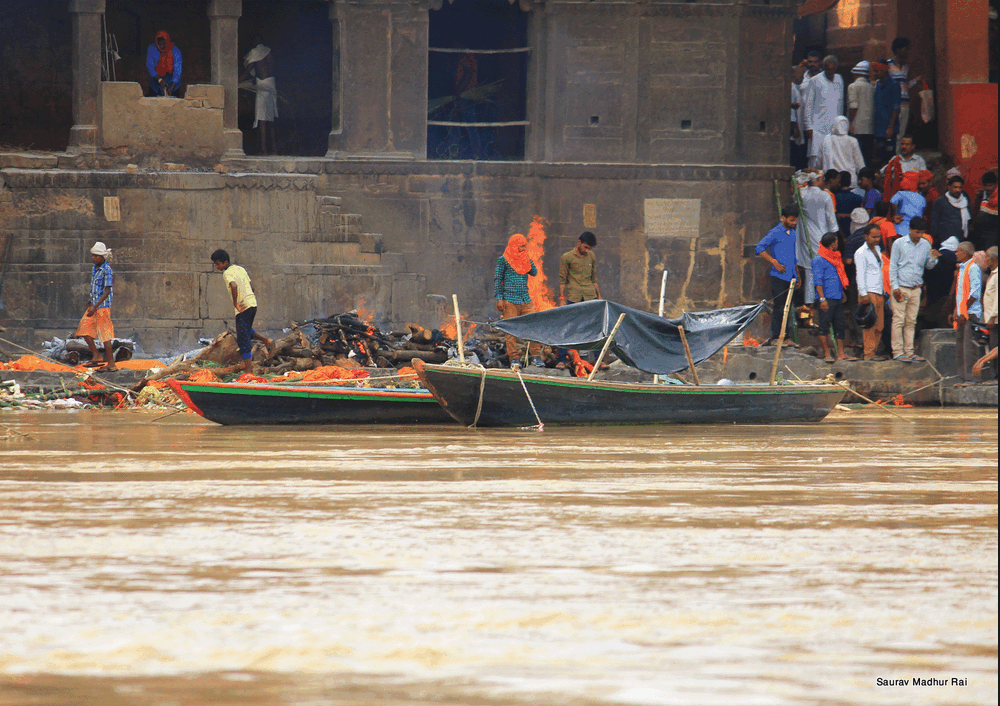
The ghats of the Ganges are also the final resting place for humans, where pyres burn and the remnants of a living story turn to ashes. The last remains are embraced by the Ganges like a mother in the bosom of the surface of the water, and merges into eternity. When the mortal remains merge into the waters of the Ganges, they become one with the earth . And our bodies, born from the soil, return to the soil, merge into the eternal flow.
It is a Hindu belief that dying on the banks of the Ganges opens the door to salvation. The same salvation, which Buddha called 'Nirvana' after attaining Nirvana. And that was the only way to get rid of the cycle of rebirth.
According to the beliefs written in the Hindu scriptures, the water of the Ganges has the power to revive . It seems that while flowing continuously at its own pace, it is also carrying hopes and dreams for the insatiable beings who are looking for spiritual knowledge renewal and salvation along the shores.
The river is a medium that reflects the profound and complex nature of human existence, from which countless lives have been inspired and transformed.
If you consider nature as God, then Ganga is worshipful . Ganga-worship has been an enduring feature of the diverse cultural landscape of the Indian subcontinent for centuries, where Ganga is worshiped as a goddess. Ganga's permanent abode is believed to be the Himani (glacier) of the High Himalayas, which is in the Garwal Himalayas (Uttarakhand). That head of the Ganga is 20 thousand feet above sea level. From there, the Gangotri flows and disappears into a deep gorge. Pilgrims climb the mountain to see the huge glacier, which is very difficult.
Through thickets and bumpy paths one reaches the old glacier valley, where the path appears very narrow and scary. After walking the difficult path passing through the rocks, you will find a snow-covered path, where your feet will be suddenly buried in the snow. On reaching the Garwal Himalayas, the traveler finds a golden world decorated with mountain flowers, weeds and rock formations like walls, where the holy river descends. Therefore, Ganga is not only a river, but also a philosophical boundary, whose pure water is giving spiritual, cultural and physical nourishment to humanity.
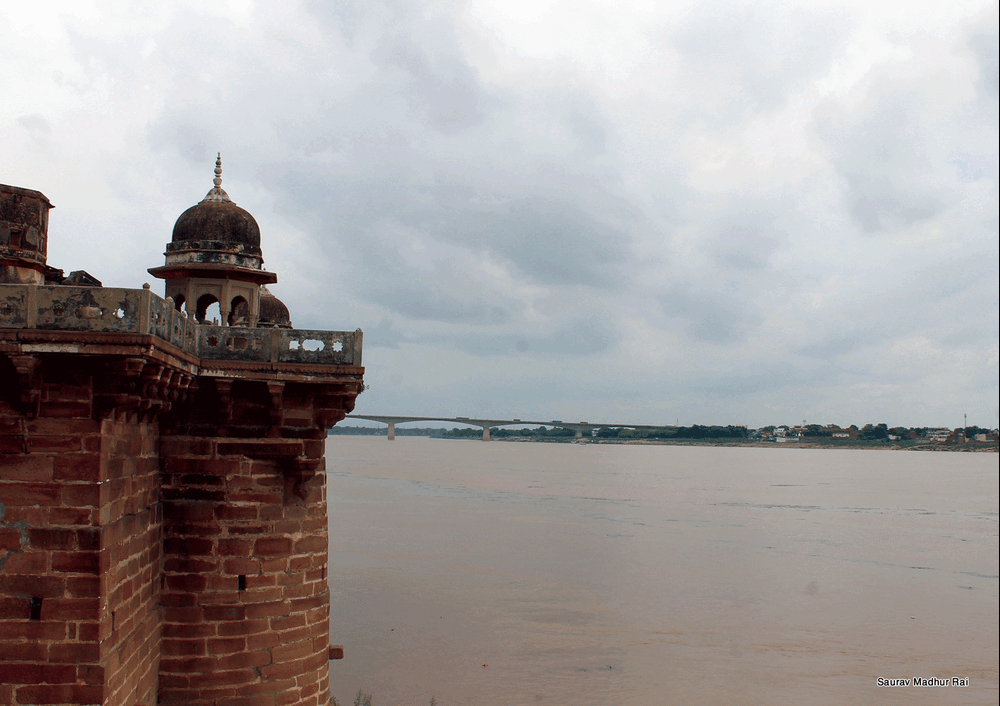
If we want to understand the origin of the 2525 km long river Ganga, we have to understand the Himalayan glacier. First Gangotri and Santopat .
There is a hole in the Gangotri glacier - Gomukh, from where the Bhagirathi river originates after the snow melts. The speed of Bhagirathi river is very fast, which becomes more fierce when it meets the river Bhilangana originating from the Khatlinga Himani . Seeing such a terrible movement of the river Bhagirathi, the river has been given the nickname 'mother-in-law' in the folklore of Uttarakhand.
The river Vishnuganga is born from the melting of snow from the Santopat Himani near the Badrinath temple. Dhauliganga, which originates from the melted snow from the Kamet mountains of Uttarakhand, joins the Vishnuganga, i.e. Vishnuprayag river. Since the depth of the two rivers is the same, the name of the other river is Alaknanda.
Alaknanda's move is very quiet. In the folklore of Uttarakhand, Alaknanda's nickname is 'Buhari'.
Folk-tales say that 'mother-in-law' i.e. Bhagirathi river and 'daughter-in-law' i.e. Alaknanda, who were walking on the mountain road at a very fierce speed, and 'daughter-in-law' i.e. Alaknanda accepted each other after coming to 'Devprayag'. Now the river flowing after the confluence of these two rivers is named - 'Ganga', whose story ends only when it reaches the Bay of Bengal in India .
When a river merges with the sea, it loses its individual name and identity. When the entire life-journey is over, the human being loses his existence and becomes one in the universe .
'Ramanan said Walmiki was the final destination of the Ganga and Dead body's final destination. "I addressed that the light shining in the earth, who shines in the earth," the light showing the way to heaven. '. Ganga flows in ancient tales and levripers in his hollow, and nbsp;. Rasicway has a lemore story that the entire river drank to save the all the road from Ganges, the entire river. The love of the Ganga, Knocking, and the love of Ganga, calm, and the harness of the calf! Bakeing Kathakthath from Intislest is that the Ganges & Nbsp ;.
is a Witness of the rise and fall of the Eriots of the Ganges and nbsp;. Millions are not the only rivers of Ganges for millions, the symbol of spiritual rebirth. The past and the current flows in his flow and nbsp;. Storylal Nations have written in a famous book 'District Officer India' in the Lango and Nbsp;. ' The flow of the river flows for irrigation and flood control in
Ganga is blocked by the river. One is one 'Furku Dam', which has been made in the east branch of Bangladesh to enter Bangladesh from India & Nbsp ;. There are tenants for decades between India and Bangladesh due to the dispute of Ganga's water distroction. The water of Ganga, who first was pure and clean, has now been suffering from pollution toxicity, and Nbsp ;. Toxic amount of industrial waste and sewage system has made its flow to die due to its flow. So when can you live the load of Ganga human and industrial pollution, when can you live?
now 13 rivers of India are completely dried up and nbsp;. India's extinct rivers that were lost, which was full of life, have now become like a forgotten story, now? It is unmocked that most of the people in India, it is unable to think about the physical death of the Dearet River, and Nbsp ;. Now be serious disrespects about the resurrection, renewal and resurrection and NBSP;.