Once upon a time, fathers were the epitome of strictness. For children, they were soldiers of discipline and guardians of tradition! However, fathers themselves are breaking down the walls of their own identities and becoming for their children – reflections of compassion and cooperation. Bahru used to be a 'ruler', now he has become a friend.
We use Google Cloud Translation Services. Google requires we provide the following disclaimer relating to use of this service:
This service may contain translations powered by Google. Google disclaims all warranties related to the translations, expressed or implied, including any warranties of accuracy, reliability, and any implied warranties of merchantability, fitness for a particular purpose, and noninfringement.
When the foundation of the institution of 'family' was laid, many stories were written about the two pillars of the center, Ba and Amma, in literature, Puranas or cinema, where they are portrayed as sacred and unique, sensitive and tender. The changing meaning of society - political system, socio-cultural traditions are also affecting family relationships.
is changing in the flow of that effect - the relationship between father and son. That relationship is now climbing the ladder of dialogue, friendship and companionship. On the occasion of Kushe Aunsi (Father's Face Day), 'Koseli' has tried to discuss the many dimensions of father-son relationship.
...
In the wheel of time, the days that pass are not exactly. The product of human society and civilization does not remain the same. Sometimes this relationship traveled on a wide highway, sometimes a nagbelly walked in a narrow-wet lane. These are linked to many forms – social values, culture, lifestyle, intuition and the speed of human impulses.
The dimensions of father-son relationship are changing in every era. The changing economy-political system, socio-cultural tradition of the society is also affecting the family relationship. The relationship between father and child changes in the flow of that effect.
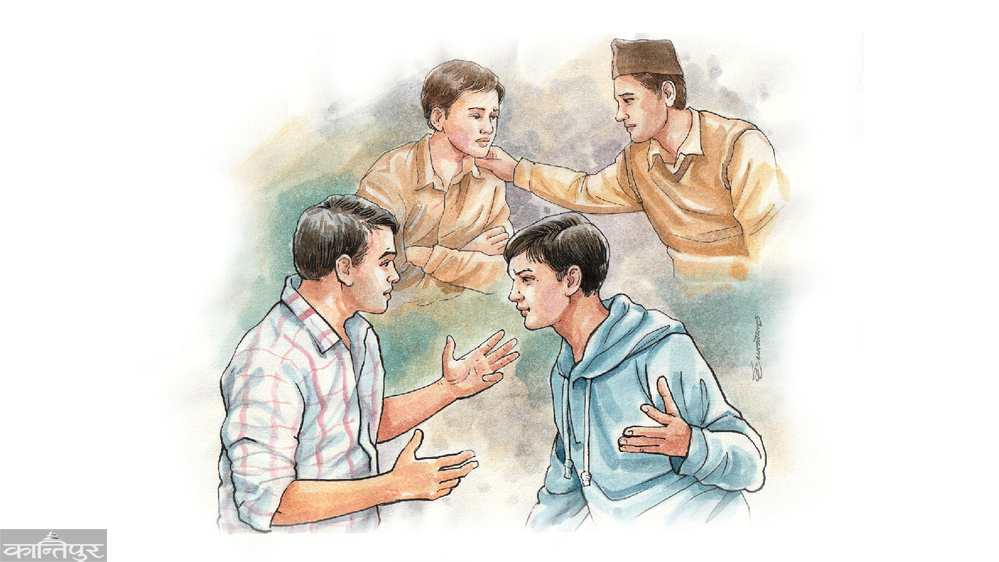
At that time, the fathers were carrying books with 'prohibition' written on them. They were - Ukusmukus for the children, status quo and traditions! However, the sons respected their father very much. However, now the social scene has changed. Fathers themselves are breaking down all the walls of inhibitions and creating for their children - a free image of choice and decision. Bahru has now become a friend from a ruler.
...
They meet in a long journey of joy and pain - parents' happiness, happiness, light and darkness! The memories are alive - the mother telling stories with her children lying in her arms and the father climbing the heights of life with the children on his back. In fact, the bright light of the children and the true world are these precious moments.
In the long period of civilization, parents were - images of existence, symbols of creativity. When the foundation of the 'family' institution was laid, many stories were written about the two pillars of the center, father and mother, in literature, Puranas or cinema, where they are portrayed as sacred and unique, sensitive and tender. Thousands of stories of their love, sacrifice and selfless service fill millions of pages of books.
Mother has always been gentle and ideal. Instead, Babu was portrayed as a 'kathoratam' character. Patriarchy has created a different world, where fathers are independent and rule over others. Political-social analyst Ahuti writes, "Today's mothers are the oppressed created by the great oppression of the patriarchy, the liberation of the oppressed mothers is necessary.... The mother is present all the time, the father is absent." (My mother is not great, Kantipur).
In the long cycle of patriarchy, mothers lived through great sensitive stories of pain, sacrifice, love and emotion. Ba continued to press on the commentary of the 'ruler'. Like ba means - the head of the house, a decision-maker who teaches dignity! An obedient child who is afraid of his children! However, at present there has been a change in this definition of father and son. Anthropologists, sociologists say - Ba is no longer a ruler, but a dear friend and adviser. In modern times, the relationship between father and son is changing into friendship.
But the generations of fathers and sons are not understanding each other. Bahru narrates stories of struggle, deprivation and suffering to children. She says - my children did not understand me. The children who consider freedom and personal dreams as the main thing say - they don't understand us. In fact, it is a deep conflict and distance between technology and lifestyle. Bas has – a world of feeling and experience. Children have it – the glittering world of the Internet and globalization. There is still an attachment to the old tradition and the pressure of the new age. Children are immersed in a vast sea of 'career' and stress. In this fast-paced world, there is hardly any communication between children and fathers, which creates a deep emotional gap in the relationship. Earlier sons used to follow their father's path, now they are choosing their own path - freedom and dreams. When the joint family breaks up and turns into a single family, there is a disappearance of intimacy.
...
In Ubela Baa's world there was only taboo. But now the walls of prohibition are rusted. Khagendra Sangraula, the author of the book 'Ghoda, Ishwar ar Mera Ba' reviews the path taken back to the past. He gets lost in the puzzle of the relationship between his father eight decades ago and his son four decades ago. Born in Panchthar, Subang Gurungchap, Khagendra's father was Lakshmi Prasad Sangraula, an astrologer. There was no exchange of feelings or conversation with
Ba. Lakshmi Prasad had a monopoly on speech - silent listeners of mothers, children and fathers! Mother Bhagiratha's voice was soft, father's surprisingly loud! The silence of the house used to be broken - when the father scolded and reprimanded the children or during the Panchayan Puja or in the evening sitting on the couch and reciting verses from Ramayana-Mahabharata! He sees a change in the clothes of his son who was born in a remote village and grew up in a small town and grew up in the capital city.
During the time of Khagendra, the king had a monopoly on the dialect of the country, and the dialect of his house was a monopoly of Bako. In the country, the king used to give orders, but the deprived subjects were forced to obey the orders silently. At home, he used to be tortured, he was forced to accept the torture silently. There was no double talk with Ba, there was no possibility of dispute and disagreement. If he had to ask for something from his father, he would convey it through his mother.
time changed. In the childhood of Khagendra's son, the king's monopoly on speech was somewhat relaxed. Due to the influence of system, time and education, my son and I spoke with our father eye to eye. The awakened people began to speak to the king of the throne, making eye contact. My son used to argue with his father and show differences of opinion," Khagendra, who was poor compared to when he was alive, "When my father did not fulfill any of his son's demands, he would run out of the gate saying to his sister, 'Daz, our father is not good'. By the way, what would have been the result if I had called my father 'This'!' During the reign of Khagendra's son, the king's monopoly on the language of the country was broken, and the father's monopoly on the language of the house was also broken. Khagendra's conclusion is, "During my son's time, the right to question, argue and have differences of opinion was shared between us father and son." It is a happy journey towards equality and mutual respect between father and son.'
A witness to the journey towards respect and love in father-son relationship - poet Biplava Pratik. Biplav's song 'Har Raat Sapniima...' playing on the radios in Bhadaure rain takes the listeners down a long tunnel of sadness. Kavi Prateek wrote this song Pita-Smaran- in 044, when father Pashupatinath was living alone in a mud house at Deupatan. In that mud house, the mud on the pillow where his father slept was torn. Biplav wrote this song in the nightmare of that cracked mud, monsoon and lightning - when the lightning thundered in the sky, he was scattered on the earth remembering his father - did the house collapse? Did the house collapse and take him?
That sudden tension found an outlet in the poem - 'I'm thinking of fire and storm/I'm holding the ground/Every evening the wind blows in the city/Perhaps it has blown away in the village?' Even after long years since the literary father left the earth, his memories are still alive. They are repeatedly impoverished – in brain cells.
This symphony-in the city, flashes of father-remembering come and go as fast as lightning. It was his father's inspiration to become such a revolutionary poet. Biplav wrote the first poem about Vladimir Ilyich Lenin at the expense of his father Krishna Prasad 'Proletarian', in Lenin-Shatvarshi. In the memory of his father, Biplav keeps walking towards the street of his childhood. Biplav, a witness of many colors in life, dwells on the complicated relationship between father and son. Biplav has written a novel by 'fictionalizing' some part of the time he lived through
- 'Avijit'. I used to respect and love Ba a lot. His words were Brahmavakya for me. I only remember him loving me, being friendly. There is no record of him hitting me with a stick except once when he was provoked by someone in the family,' Biplav Pita says in his memories. "My happiness and progress was his wish," he melts when he remembers his father. He never faced harsh discipline or reprimand during his childhood. Instead, his father provided him with opportunities to participate in various cultural gatherings, from newspapers from Hindustan to Russian libraries, which helped to build the foundations of his thinking.
Biplav thinks that today's generation has been able to live a free life because of the strict discipline that most of the generations of yesterday had to suffer from their fathers. Fathers must have felt that their children should not have to suffer the pain they had to suffer. It is also a good thing for the parents who have reached the status not to think that 'we who grew up in hardships should also taste hardships'. But, it doesn't seem to give the right path to the society," he says, "I mostly see the problem of children entering the tunnel of loneliness, being victims of anxiety and maximum children becoming detached from their parents." According to Biplav's understanding, if the children of today practice being friendly with their children, the new generation does not have to fill the tag of 'lost generation' and the country will be prosperous with advanced, happy children wrapped in a rainbow of happiness.
In the past, fathers were mere figures of fear, whom children desperately craved. now? Father-child relationship is more than friends. As he swims in his memory wave, the author Vasant Thapa sees a sea of fear. "We grew up in a time when fathers dominated. They were just afraid for the children.
Perhaps the image and duty of a father was the same at the time,' Vasant says, 'Perhaps I was also in the same frame of the father - in the role of having to say yes, but we did not raise our hands on the children, my behavior with my sons and daughters was relaxed. But, let's look at the present time - my son is afraid of his son. Father and son are not friends now, they are more than that. The changing relationship between father and son is not just a matter of their personal choice. He - he was the father - a link between the family and the rest of the world, who was omniscient, protective and authoritative for his children. But, nowadays that role of father has changed.
According to anthropologist Suresh Dhakal, the father-son relationship is guided by changing meaning-political order, changing socio-cultural traditions. Such a difference can be seen even if you look at the father-son relationship of the same generation. Now the father-son relationship has changed from saying and believing to the level of advice. Fathers who want their children to follow their own interests have now reached the level of respecting and supporting their children's interests,' says Suresh.
Now the structure of the family has changed. In the family structure that changed from joint to single, the relationship between father and son also entered the stage of independent and independent decision making. "Nowadays, fathers are also involved in the role of raising children, which has started to show a difference in the patriarchal thinking and behavior of fathers," says Suresh. The impact of father's labor migration and children's study migration is on the relationship between father and son, which can be the subject of further study. Even though the levels of the relationship have changed, this anthropologist continues to worry about what they will do in life. In the feudal system, the father-son relationship had one link - property. According to sociologist Chaitanya Mishra, the main means of production under feudalism was land, which was transferred from one generation to another. Therefore, one of the main reasons why the son generation respects the father generation is the land under the father.
This happens under the tradition of giving ancestral property to the son. That is why individualism is weak in feudalism. Only by living in a group or family can a person have rights over the means of production. That is why sons should not only obey their father, but the son must bring the daughter-in-law as the father says, he cannot bring as he wants. Do not interrupt the father in the family or in the neighborhood. Other things can be done only by accepting the house price. This is also the reason behind the tradition of respecting the father," Mishra writes in the book "Badlindo Nepali Samaj", "The son does not have to obey only on the basis of what the father gave birth to. The main reason for this is the social, economic and political basis. Basically, if the father is cut off and disrespected, he has to accept it because of the fear that the father will not give him the property. Mishra writes, 'After a certain age, the father starts to care less about his son. So the son is also customary to ignore the father. The father does not believe that his son should be given property, not to let his father. 'Story of
Primitive' B '. There was the whole sky for Kirat. Mudum says, while drinking the urine of Parung (Parung), and he had pregnant with tigers, people, plants, including vegetatives. In the murm, the sky is considered Parung and Sumani in Sumni. & Nbsp;
Mudes' Self is understanding of Social Social Fair, Bhonga Raj Chamling, but, are the gums anonymous. There are many primitive 'habits in the mumumi buttons (Mants), but his name is not known. As Khi Khi was according to the mudum, the primitive Baju Chi is whose seeds are the children of Parung and Sumi, but who was their Ba Who? Their Baal was sweating. This means not identifying. 'How are the promoted' bars are anonymous and alive in cultural memory? & NBSP; States of
Raj Raj Raj (Limbu), as described in Yakthung (Limbu), the tiger and man gave birth to tigers and people in pregnant. It means to say, know who the Father is. & Nbsp;
are now half of the ban. The Kirat Rai is still classified in two parts in 2 parts - half a man, of the half-male. The area inside the original pole is considered to be women, that is called (a lid. The only parent is not the original parent, not the original parent, "says Vagiraj. & NBSP.
is a long story of the Father's relationship in good. Changing sociology has rewrite the perimeter of this relationship. It looks in a mirror of a changing landscape - old and new society. Burgles are deeply a brighter trip like the sea. That relationship is now climbing the dialogue, friendship and the gift of the concubine.

