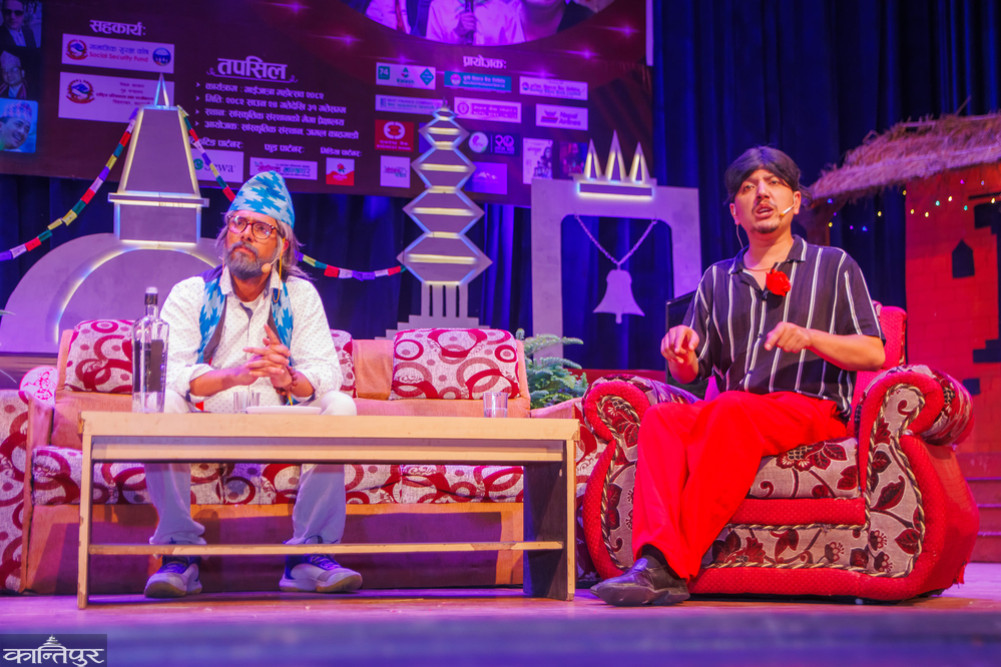
Except for exceptions, only mimicry is found at the center of all the Gaijatra programs, it seems that comedians also need the help of the top leader's face to make the audience laugh, the current satires have neither created a new character, nor a new theme.
We use Google Cloud Translation Services. Google requires we provide the following disclaimer relating to use of this service:
This service may contain translations powered by Google. Google disclaims all warranties related to the translations, expressed or implied, including any warranties of accuracy, reliability, and any implied warranties of merchantability, fitness for a particular purpose, and noninfringement.
What should comedy be? Bhairav Aryal, the pinnacle of satirical writing, has said, 'The goal of today's humorist should be to raise satire from the light level of farce to carry and nourish serious and profound feelings of life and the world.' But, looking at Nepali humor, a serious question arises - why are we still stuck in the tradition of making fun of those who are at the bottom of the society? Look at television serials, movies, Gaijatre Farhasan and comedy-shows - 'jokes' based on marginalized communities, linguistic accents or lifestyles are mainstream. The real purpose of satire is to question the ruling and powerful, not to mock the weak and deprived. What should be the path of humor today?
000
Manoj Gajurel (intermediary), Mexam Goudel (Ravi Lamichhane) and Suman Karki in the same Durga Prasai disguise, Ashish Khanal as Balen! Subodh Gautam KP Sharma Oli Banda Sandesh Subedi Pushpa Kamal Dahal was seen as 'Prachanda' in the '82 years Gaijatra' held at Nepal Pragya Foundation.
Whether it is the 'Gaizatra Festival 2082' organized by the Cultural Institute at the National Dance Hall or the Gaizatra comedy presented through digital media, everywhere you look there is only mimicry! The same leader, the same avatar! The same corruption, the same gold scandal! The same glasses of Balen Shah, laughing is becoming the main thing!
Thankfully, this time Manoj Gajurel did not take the stage imitating a famous face. If they had gone up, the 2082 Gaijatra would have been limited to mimicry. If we look at Gaijatra programs except for exceptions, only mimicry can be found at the center of all of them. Let's have a look at the 'Mundreko Comedy Gaijatra 2082' publicized from Jitu Nepal's YouTube channel. In this cattle drive of about 1 hour, Jitu imitated Sher Bahadur Deuba and satirized.
, comedians also need the support of the top leader's face to make the audience laugh. Today's satires have neither created new characters nor new themes. The style of laughing is also the same.
Comedian Harivansh Acharya says that there is an increase in people who understand mimicry as satire. He feels that diversity is disappearing from satire. "Now humor itself has only turned towards mimicry. KP Oli, Sher Bahadur, Prachanda all. Because of that, there was no novelty in satire, no variety,' says Harivansh.
Let's look at the example of 'Middleman in the Bedroom' presented in '082 Salko Gaijatra'. Gajurel's jumbo team has satirized the top leaders to corruption through this program. It is also satirized how the middleman is holding the leader in his lap and shaking him. Prachanda enters the stage waving a kum. With his entry, the issue of visit visa comes up. Topics range from volatility, to gold scandals, to Rolex watches. Then another artist appears on the stage with Oli's words.
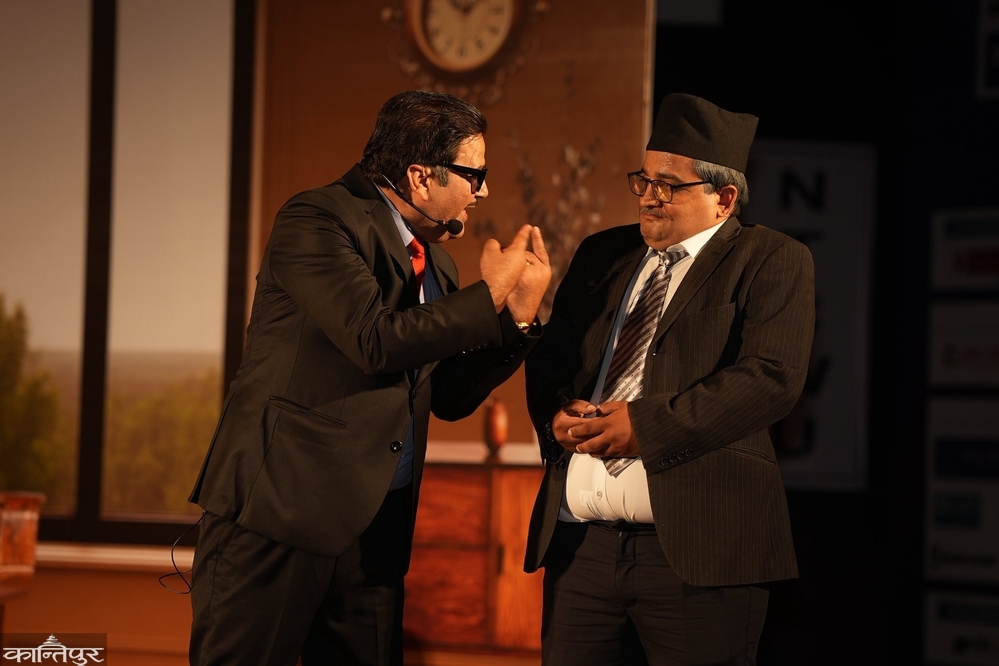
In response to the middleman's question, 'Didn't you say not to take bribes or even give food?' Did I say that I will not let you do it in secret?' Topics ranging from Shiva Chamling to Viddhashram and Vidya come to be associated with this character. Then another artist takes the stage singing a rap. "I can't do it in a minute today, what do you understand about the meeting?" The character, wearing the form of Balen, satirizes the mayor of Kathmandu and the topic of the meeting. He imitates Balen's style and shakes everyone by discussing topics ranging from the need for employees in the metropolitan city to Facebook statuses.
, especially the characters and themes presented by these artists on the stage, are being staged by real characters in front of Nepali people throughout the year. Now, when the same subject and the same character are shown, how ironic is the satire?
Comedian Prabhat Lama says that this kind of character is repeated on the stage because the leadership is increasing the discrepancy. Our political environment is the same. People are still suffering because of the same leaders. That's why the laughter is less when we talk about the same topic!' says Lama.
Today's comedians are of the opinion that they should build their own brand apart from Pushpa Kamal Dahal, KP Sharma Oli and Sher Bahadur Deuba, Harivansh. He adds, "They should be known by their own brand rather than by the brand of others."
Harivansh brought many characters like Hari Bahadur, Vanpale and others to life through satire. He covered different topics through that character. But today's artists do not seem to have built such a strong character. Manoj Gajurel himself is known for his mimicry of many characters. But the character he created himself has not become a brand.
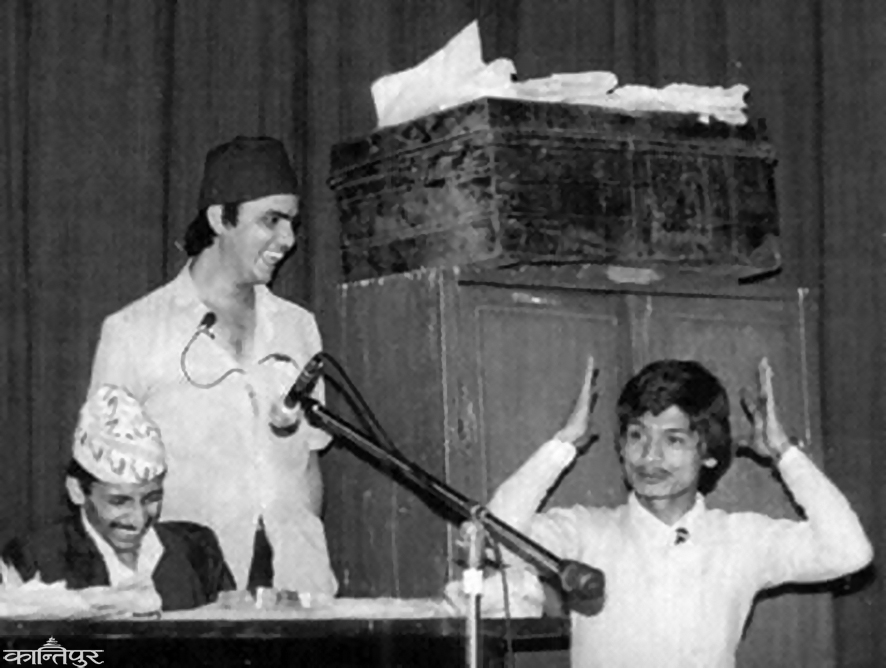
He himself has become a brand of satire. They are continuing the 'Gaizatra program' by gathering the young generation. But today's programs and themes do not seem to attract the audience as they did in the old generation.
At the time of Harivamsa, the audience looked forward to the month of August. Because in this month, 'Gaizatra program' was often organized. Spectators used to line up from 4 am to buy the tickets while soaking in the water. "Even when the audience asked us for tickets, we could not arrange them. It was a craze at that time,' says Harivansh, 'Perhaps there were not many satirical programs at that time. That's why Gaijatra was like a big festival. Now, even when invited, the audience does not come to watch the satire.
There is an analysis of the Harivansh who was selling the special interest of the audience who watched the 'Gaizatra program' during the Panchayat period. He still hasn't forgotten the throngs of spectators that came when Satyamohan Joshi, Suryavikram Gyawali started the 'Gaizatra Program' from Pragya Pratishthan. At that time, once a year there was an atmosphere of humor. Harivansh himself v. no. He made a program in 2033 and reached Pragya. At that time, the satire script should have been written. The program could be done only after the script was passed. Satya Mohan Joshi, Madhav Ghimire, Vijay Bahadur Malla etc. had to sit in front of all the scholars and show satire. Scholars used to be cautious about saying things that should not be said. They were invited to perform only after they suggested some adjustments.
Harivansh finds strength in the satire of that time when he is a 'censor'. At that time, the script had to be submitted to the magistrate's office as well. It was seen word by word that it would be a satire on the palace and the system. But to avoid censorship, the script was initially submitted with a simple theme. After passing the 'censor', satires with political content were published.
Harivansh narrated a similar incident. Mah created the program with the idea of satirizing the Panchayat system by raising the characters of 'Prashasan Narayan' and 'Panchnarayan'. The dialogue was to be said, 'Panchnarayanji, in what year were you born?' As written, Panchnarayan should say 2017 but the censors did not allow 2017 to be used. There was also a warning that the program would not be allowed if the order was violated. All the tickets for the event scheduled to be held in Pokhara had been sold. What to do in that situation? They maintained that Panchnarayan was born between 2016 and 2018. By twisting and writing, satire became artistic. Harivansh says that even though satire was artistic during the time of
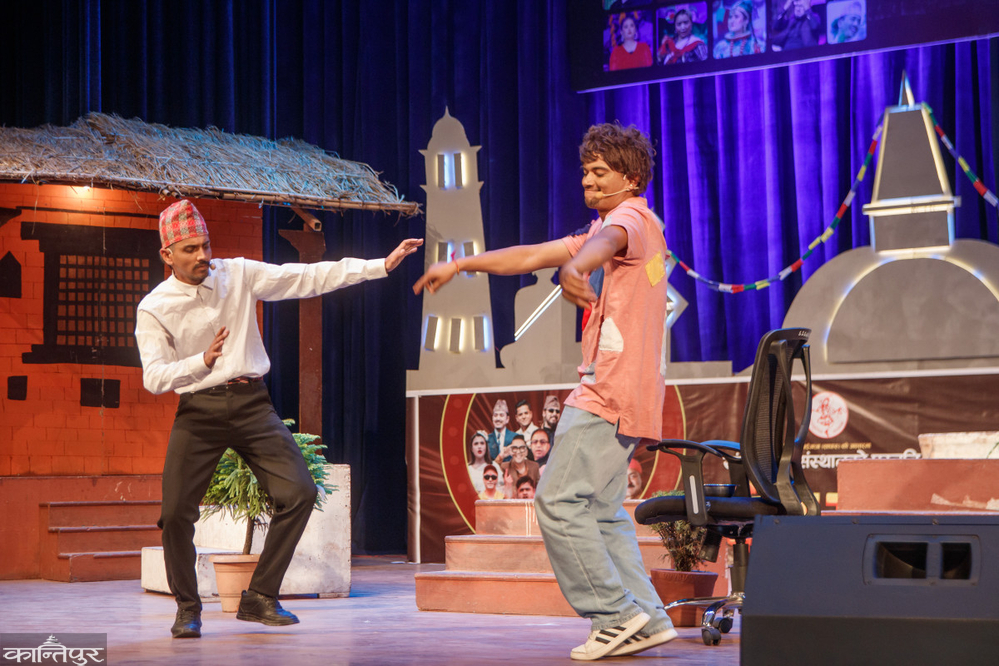
censorship, the art is disappearing in today's humor with freedom of speech. "Nowadays, satire is done directly by taking someone's name. Calling names directly sounds like insulting. That is anger. Satire is not journalism, now it is becoming like satire journalism. "Po can be written directly in the newspaper," he says. It is easy to satirize directly by naming everyone, but there is no art in it.'
Agreeing with Harivansh, artist Yaman Shrestha says that there are many aspects of art in the satire of his father's time. "There was a lot of risk in our fathers' tent. You can't talk about such things, you have to talk when you are caught and locked up. That's why they used to satirize in a very artistic way," he says, "now anything is going to be satirical. They directly said that you are corruption. At that time, this should have been said.'
is now starting to be practiced in various genres even in satire, says Yemen. "Our fathers used to satirize so that the person they satirized would not be offended," he says. As Yaman said, now if there is any politician in the audience, they are satirizing him by his name. Even if they have a smile on their faces, you can watch old 'Gaizatra programs' on YouTube to see how their faces change color when they are hurt by sarcasm.
Another example of satirical content being strong during the 'censor' period is Mahkai Yamlok. In it, a Nepali revolutionary dies and reaches Yamalok. A Nepali 'gatekeeper' sits at the gate of Yamlok. At the same time justice reaches Yamaloka. Vikas also died and reached Yamalok. And there is a dialogue between them, "Where did the development go in Nepal, it has died and come to Yamalok." Mah satirized that BP could not do anything in politics while also bringing the "model democracy" to Yamalok.
At that time BP Koirala was also present in Pragya to see Yamalok. He was invited as a writer rather than a former prime minister. BP was placed in the wave of Natikaji, Bachu Kailash, Shiv Shankar. Other former prime ministers were in line behind the king. After the presentation, BP praised that 'their satire is amazing'. Even Ganeshman Singh used to say that 'they have remained democratic' when he satirized the topics that others could not talk about. At that time, Mah was seen as an opponent by the system, while politicians saw him as a relative.
Today's artists seem to be neither fierce opponents of the system, nor able to shoot the sharp arrows of satire. In particular, they have found the subject to laugh, but they have not yet measured the effect that satire can have. Especially when he is imitating Balen, he should not only break the trend he is repeating, but also have the ability to make him responsible through the same presentation. Not only touching the subject matter, but also having the ability to go deep and question the state power should be in satire.
Today's satires seem to be stuck in superficial themes. Let's go back to the 081 Gaijatra program for example. Unstable politics, cooperative issue, foreign employment to gold scandal. Last year too, an attempt was made to make the audience laugh on a similar issue. The weakness of current satire is not being able to strike a blow while digging into the depth of the issue. They don't become sensitive to gender, caste, and color as soon as they laugh at it.
Comedian Shailendra Singhada is giving a misogynistic performance. His presentation last year on the issue of cricketer Sandeep Lamichhane and Gaushala-26 was very insensitive. While raising the issue of Namita Sunita and the names of the victims in the Nirmala murder case, Comedian Sinkha had to reveal the identity of Gaushala-26. When Sitaji was abducted in the Treta Yuga, the name did not have to be kept secret. At Dwapara, Draupadi's name was not kept secret. Namita, Sumita and Nirmala Pant were murdered and raped in Kali Yuga and their names were not kept secret. His photo was also publicized,'' he said while doing a stand-up comedy, 'now there was a procession in Hadigaon which was nowhere else. What animal is this creature called Gaushala-26?' He gave such a presentation to make the audience laugh without understanding the sensitivity of the issue.
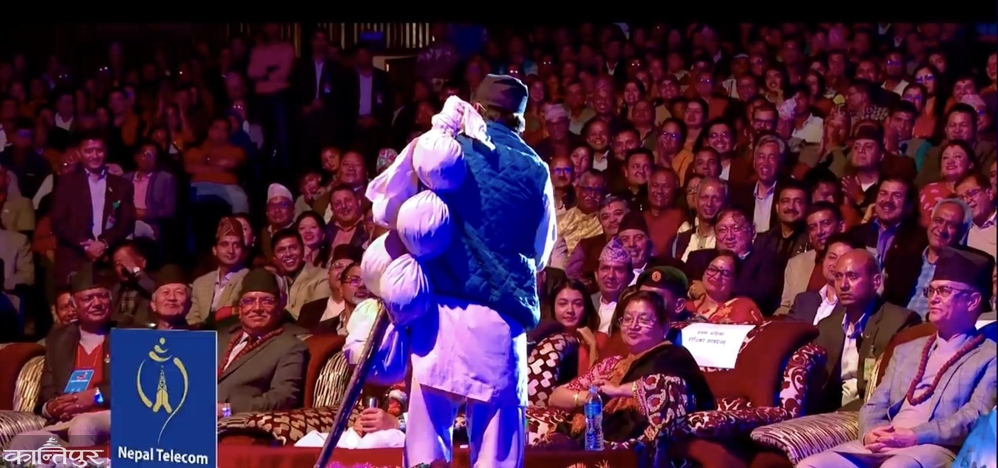
On the same stage, Manoj Gajurel expressed the pain of the people. At that time, Manoj played a character (Manakumar) who was cheated by the co-operative and satirized everything from refugees to co-operative scandals. Manakumar is a character who has lost his mental balance after being cheated by the robbers and fraudsters of the country, so he keeps repeating, 'I am not crazy.' Manakumar's son, who was growing happiness in a harsh land, lost his life in the Balkumari incident. His son's dream of going to Korea was killed there. Man Kumar was saying to the minister who was sitting in the audience, "O minister, laugh, laugh with joy. Not one man died for you. The whole world is dead to me. Laugh, laugh with shame.'
This year, artist Kamal Villager's ``Sreepech'' filled with ``Vedatantra'' through horse riding shows the influence of power and power from the suffering of the earthlings. Be it the character assumed by Bharatmani Paudel in 'Gaizatra Mahotsav 2082' or the avatar changed by Himesh Pant, the themes presented in '82 years of Gaizatra' were necessary, but they were inferior in terms of the debate it could have created in the society.
Harivansh tells us that the quality of the present-day satire has been lost by focusing on numbers. Earlier, we used to make 2 programs in a year. Now we have to create new content every week. Focusing on quantity has lost quality. In particular, creation is not due to taxes. It seems that it has reduced the quality," he says. "Now there is satire but the laughter has disappeared. When you go to see a comedy, you have to laugh. The audience has to laugh from the inside.'