From the era of autocratic Rana rule through many 'tantras' to now the federal democratic republic, is there still some independence for the Nepali cartoon sector? The question keeps coming up.
We use Google Cloud Translation Services. Google requires we provide the following disclaimer relating to use of this service:
This service may contain translations powered by Google. Google disclaims all warranties related to the translations, expressed or implied, including any warranties of accuracy, reliability, and any implied warranties of merchantability, fitness for a particular purpose, and noninfringement.
What should comedy be? Bhairav Aryal, the pinnacle of satirical writing, has said, 'The goal of today's humorist should be to raise satire from the light level of farce to carry and nourish serious and profound feelings of life and the world.' But, looking at Nepali humor, a serious question arises - why are we still stuck in the tradition of making fun of those who are at the bottom of the society? Look at television serials, movies, Gaijatre Farhasan and comedy-shows - 'jokes' based on marginalized communities, linguistic accents or lifestyles are mainstream. The real purpose of satire is to question the ruling and powerful, not to mock the weak and disadvantaged. What should be the path of humor today?
The cartoon becomes easily acceptable as it also expresses the pain of the common people with a sense of humor and sarcasm. Although cartoons seem to always speak the language of satire and protest, fundamentally they also hope for reform. Therefore, cartoons play an indirect role in social reform and nation building. Cartoons are an attractive and effective genre for the general public as they raise their voice against disharmony in an artistic way through color and line.
Nepali cartoon field has gone through many ups and downs since the time of Chandman Singh Maske, who was sentenced to imprisonment for writing cartoons in 1997. From the era of autocratic rule through many 'tantras' to the federal democratic republic, is there still some freedom left for the Nepali cartoon sector? The question keeps coming up.
cartoons are considered a powerful medium of expression. Therefore, if there is no freedom of speech, cartoons cannot have a strong presence. The state is still continuing to bring psychological terror to cartoonists from time to time by passing or trying to pass laws that restrict freedom of expression. Due to this, the quality of Nepali cartoons is sure to deteriorate. Such steps of the state will create serious obstacles in the development of Nepali cartoons, which are a little behind compared to world cartoons. Also, compared to world cartoons, Nepali cartoons look more dignified and civilized. Even a casual cartoon connoisseur can easily realize this. Despite this, the efforts to control Nepali cartoons from time to time cannot be considered natural.
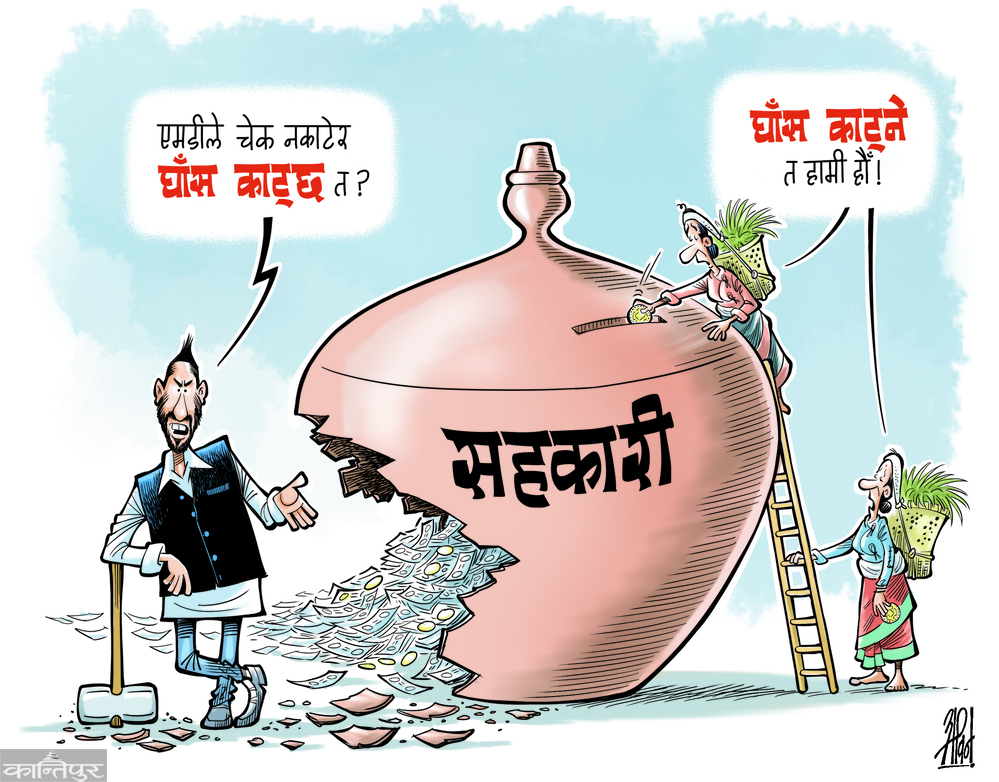
Around the year 2078, even the then KP Oli had publicly expressed objection to the cartoon created by this cartoonist. Since then I have had to face many questions on this issue in many places and still have to come clean about that cartoon from time to time. We have faced such comments from a person like the Prime Minister who is sitting in the highest position of the state power, but it creates mental panic for the new talents who are looking for their future in the field of Nepali cartoons. It discourages them at the very beginning stage of their 'career'. Some may think this situation is normal, but such actions have a very negative impact on the development and expansion of Nepali cartoons. Having said that, it is not all negativity, I have also had experiences of some sitting ministers and some former ministers asking me to make their cartoons. Remembering those moments, one feels that our leaders have matured in their approach to cartoons. Such episodes also give cartoonists a really positive energy.
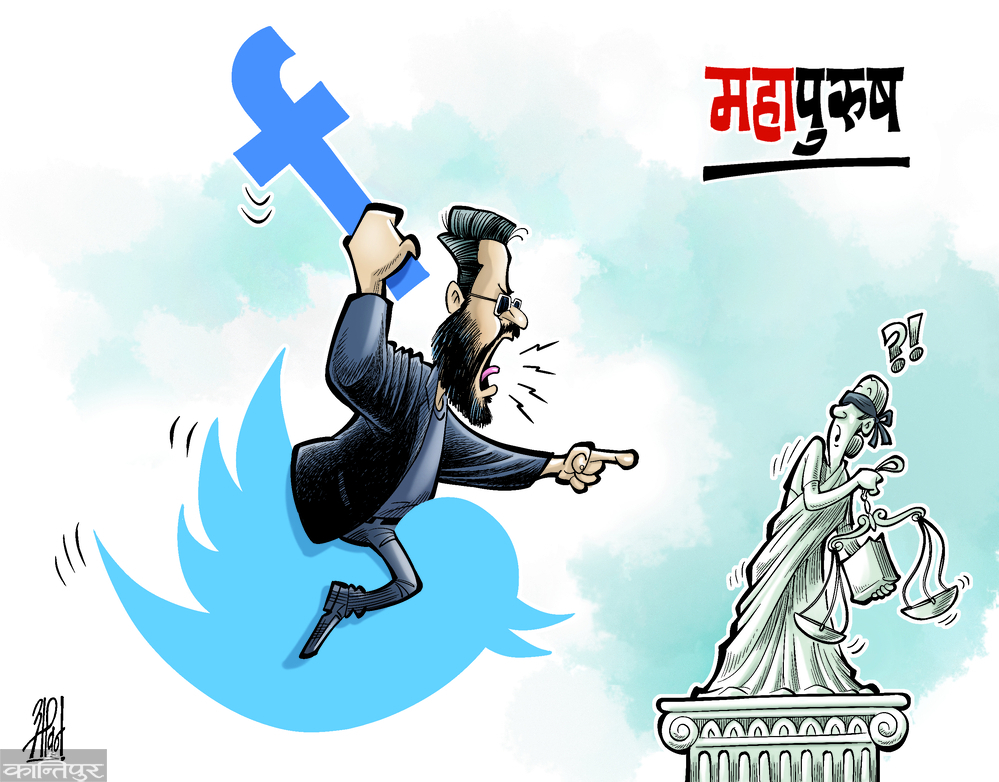
cartoon itself is a very sensitive genre. In some countries, there have been many riots and cartoonists have been killed because of cartoons. If the cartoonist does not pay attention to the sensitivities of the cartoon while creating it, there is a possibility that it will have a negative impact on the society. If we evaluate the recent Nepali cartoons, we find that Nepali cartoons are coming in a careful and balanced manner in this regard. However, sometimes it is seen that the cartoonists are being pressured by raising controversy unnecessarily. Especially such activities are often seen in social networks. In recent times, social networks have become a way of life. Therefore, the activities on social media are also guiding the direction of our society. Currently, there is a situation where cartoons made about certain people or certain parties are put on social media and face fierce reactions. Such violent activities are also having a negative impact on the creativity of the cartoonist. Keeping up with such activities is a challenging task for cartoonists.
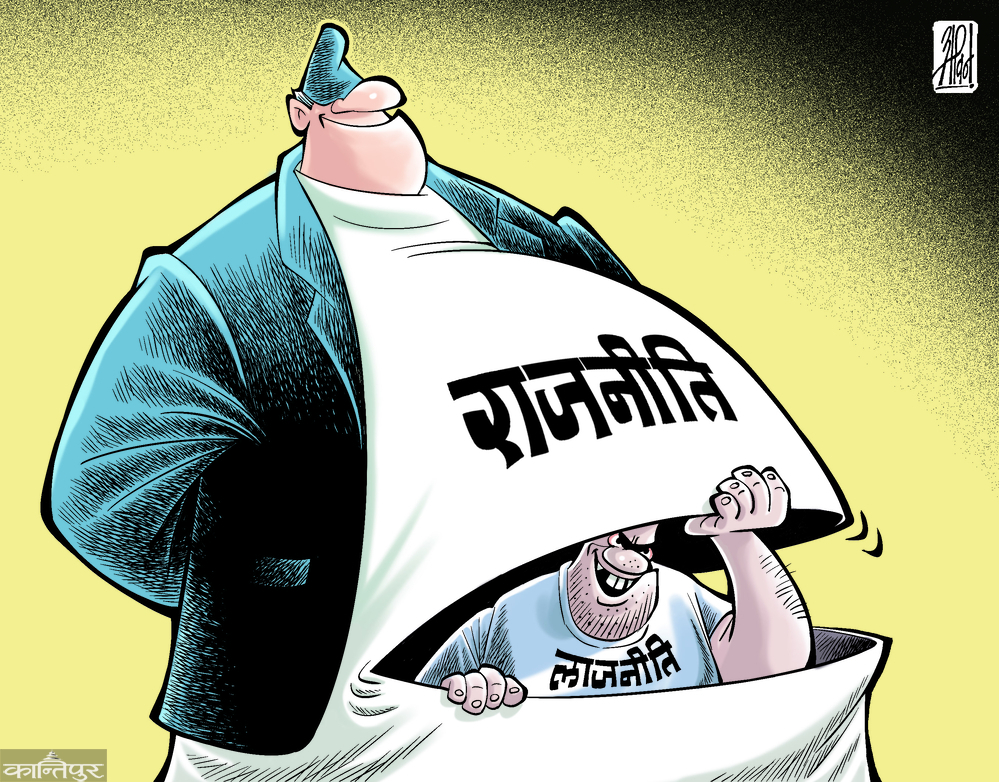
Why would someone try to become a cartoonist after facing such difficulties? In my opinion the only answer can be 'complacency'. Every conscious citizen is suffering from seeing, experiencing and enduring the anomalies existing in the country. The cartoonist, on the other hand, gets to express that pain through cartoons and gets a kind of self-satisfaction. Now another question arises, can life be lived only by self-satisfaction? In the present time, the development of information technology in the world is progressing at a rapid pace. Its significant impact is also appearing in the communication sector. The latest generation has started showing interest in online media rather than print media. We can also feel that the print media market is shrinking.
print media is shutting down and online media is starting to open new ones day by day. Dozens of online magazines are now operating effectively. Most of them have almost no place for cartoons online. I even think that if the print media cartoonists had not been active on social media, the present generation would probably not have seen Nepali cartoons. So I think it is too late for the online media to seriously consider this issue. If the online media also give priority to cartoons like the print media, the new generation will easily get a taste of Nepali cartoons, and many cartoonists will also get job opportunities. Therefore, one of the main reasons why the Nepali cartoon writing profession cannot move forward towards professionalism can also be considered as online media not giving a place to cartoons.
In recent times, the use of pictures made by AI (Artificial Intelligence) as 'cartoons' is also increasing in online media. Not only does this affect creators who want to make a career out of cartooning, but it also doesn't sit well with the media to emphasize artificiality like AI. A cartoon is not only a painting but also contains the thoughts and analytical skills of the cartoonist. Therefore, the general reader cannot get the taste of the cartoonist's original creations from artificial creations created by AI.
cartoon is a genre of expressing your thoughts through pictures. If the drawing aspect is weak, the cartoon may not be effective, no matter how complex the idea. Therefore, it is necessary for a cartoonist to master the art of painting along with the style of expressing ideas. In terms of ideas, we find that the current Nepali cartoons are at the international level. But it seems that Nepali cartoons are far behind in terms of painting. Comparing with the cartoons of the past, it is found that the presentation of ideas in Nepali cartoons is getting modified and refined. But it is sad to say that Nepali cartoons could not develop significantly in terms of painting.
If we look at the creations of some of our leading cartoonists made in the thirties and forties, we find very high-quality paintings despite the disadvantages of technology at that time. Even if those cartoons are to be considered as the base, the painting aspect of Nepali cartoons should have made a lot of leaps. But the situation doesn't seem like that. The main quality of cartoon art is exaggerated art. This is where most of the Nepali cartoons seem weak. AI can be helpful in eliminating such weaknesses in painting and increasing efficiency.
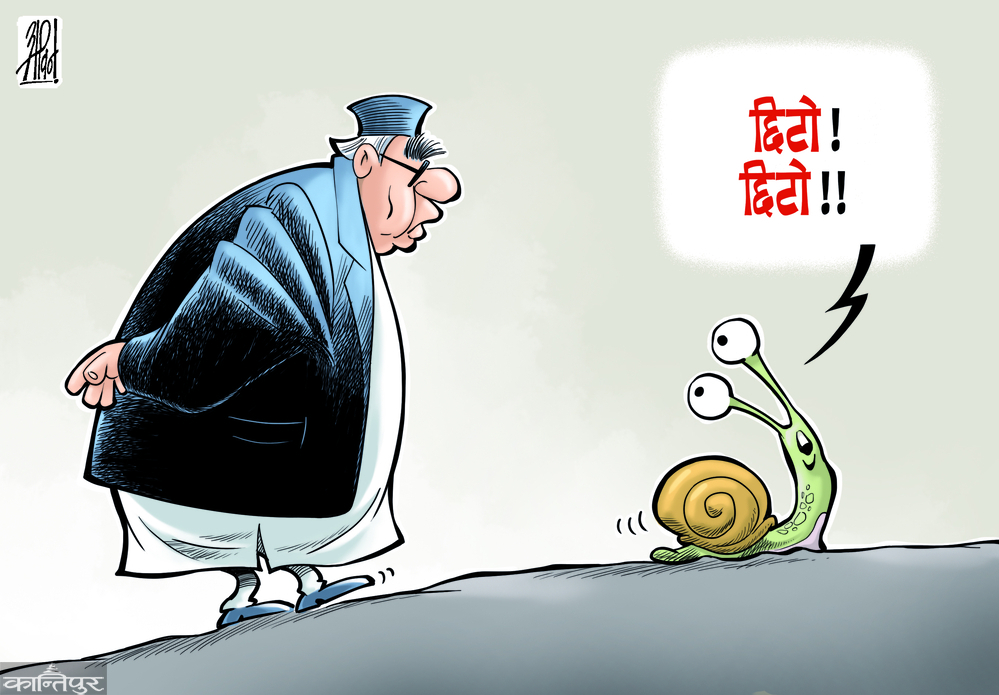
On this basis, we can consider AI as an opportunity to enhance efficiency. In the current times when AI is making its dominant presence in the entire field, even cartoonists have to face many challenges to secure their position. Now no one of ordinary talent seems to be able to secure his position. So now everyone has to work harder to improve their skills and abilities. These things also apply to cartooning. Due to this, the painting aspect in Nepali cartoons seems to be getting more refined. On this basis, AI can be seen as an opportunity. Writing
cartoons is a challenging task in itself. On top of that, the challenge has been increasing in a more comprehensive manner in recent times. Due to such challenges, new talents have not been able to appear significantly in this field and it seems that there is an increasing possibility of existing talents also going away. Therefore, unless the bodies concerned with the cartoon sector take necessary steps to facilitate the environment, the cartoon sector will definitely go into decline. It is the responsibility of all of us to uplift the Nepali cartoon sector, which is far behind compared to international cartoons. The arrival of the new generation is very important for the development and expansion of every sector.
The presence of the new generation in the Nepali cartoon sector seems disappointing. While some of the cartoonists of the older generation have been displaced from the cartoonist profession and the current generation can also embrace it as a financially secure profession, it can be considered natural that the arrival of the new generation is not satisfactory. Therefore, cartoonists must identify and solve the problems to prevent the danger of migration from the cartoon writing profession, and to make it feel like an attractive and safe profession for the new generation.

