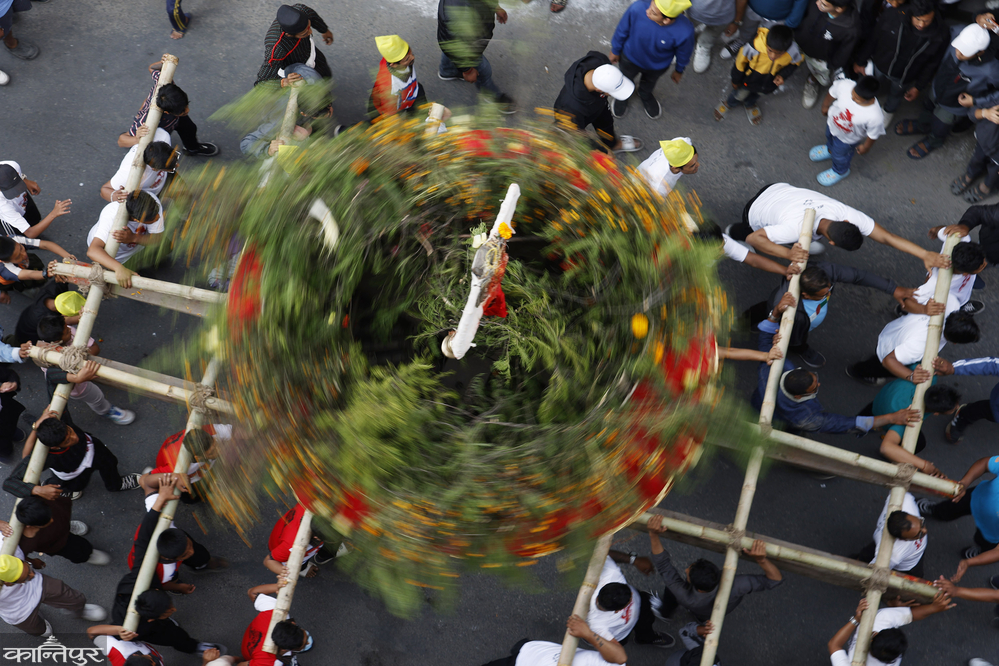
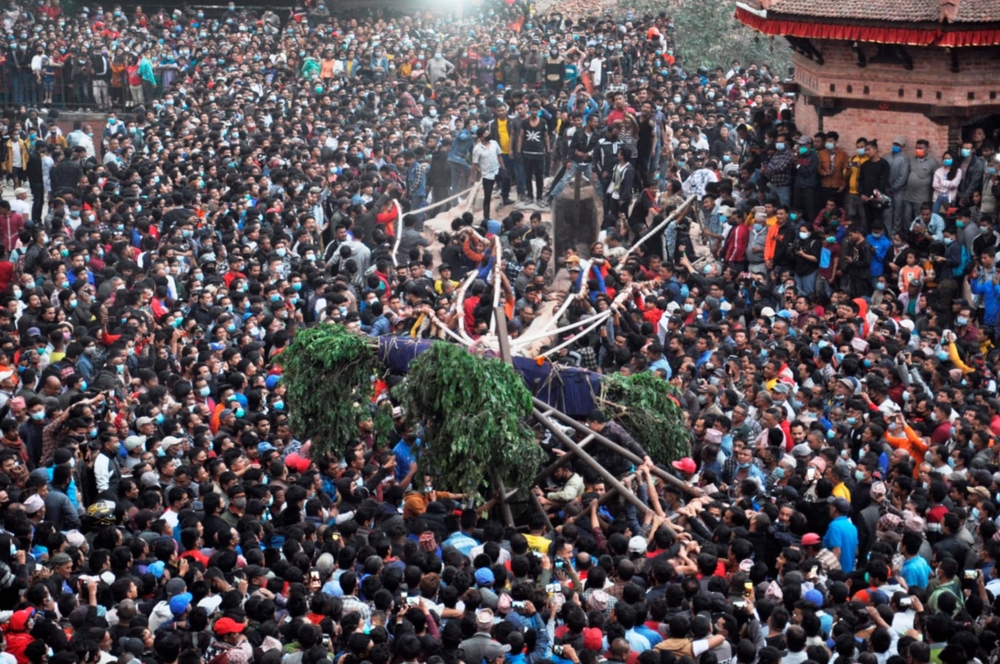
The city is vibrant because the Jatras are also lively. Jatra is going on, let's say - these wonderful souls have survived. Jatras, like human life, have their own rhythm.
We use Google Cloud Translation Services. Google requires we provide the following disclaimer relating to use of this service:
This service may contain translations powered by Google. Google disclaims all warranties related to the translations, expressed or implied, including any warranties of accuracy, reliability, and any implied warranties of merchantability, fitness for a particular purpose, and noninfringement.
Kathmandu Valley means folklore, pilgrimages and festivals. One of the grand aspects that keep the valley alive is the cultural splendor of festivals, dances, feasts and music. The Svanigah (valley) has a special glory of living jatras, where the joy, laughter and dreams of people revel in the festive dark-light streets. Along with the sound of bells and Dafa hymns that resonate daily in the streets and temples, the colors of the Jatra blend into the atmosphere, creating a picturesque landscape in the city.
Whether they are permanent residents of the valley or 'outsiders' observing the city, they are filled with awe at the joy of the Jatras. The streets, roads, streets of Jatramay city are colorful with fun. The sky is bright despite the rain clouds. Jatramaya city looks beautiful even in the crowd and sea of people. Dancing lakhs with heavy crowns decorated with many arts on their faces, chariots moving in the crowd of thousands, Abir-Jatra, Dhime all seem magnificent. The tunes playing in the dafa, streets and falchas keep people entertained, leading them to ecstasy and excitement.
There is a popular belief that deities reside in the doubles, falchas and sattals of Swanig. It is said that she dances to the tune of music, sits in a dark corner and listens to the music of khin baza or flute played in the morning and evening. Jatra has entered again in the city of 'deities swaying'. And, sitting on the falchas, the birds are recalling the legends of Jatra. Gathamug (Gathemangal), the first Jatra of the year, has just been celebrated in the Jagal Valley. The excitement of that Jatra is ending and another Jatra is entering. Now there is Jatrai-Jatra in the valley's monsoon-calendar. And, each Jatra has a Raithane Lokakhyan or folk belief. The city is vibrant because the
Jatras are also lively. Jatra is going on, let's say – these wonderful souls have survived. Like human life, Jatras also have their own rhythm. If we look at our Jatra and cultural practice only from one perspective, its scope is small.
They are not just festivals that repeat in the ancient calendar, they are living heritages that take on new life and memory every year, are an integral part of our lives and are - seasonal rituals, which have their own life cycle.
Kathmandu Valley's Nakhah ie Jatras are cultural festivals. And, culture is related to the life and livelihood of local residents. Jatras have the greatest connection - with the life of the Kathmandu Valley. All the Jatras celebrated in the valley are associated with agriculture and its mainstay, monsoon. It is connected with the origin of human civilization, the history of political changes and production systems.
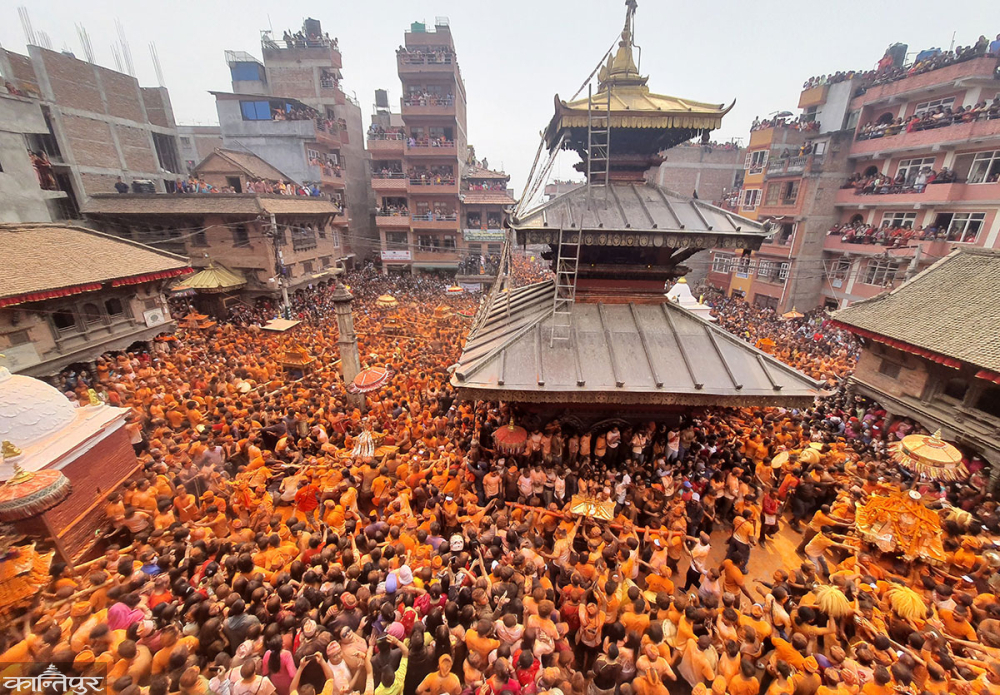
In the bowl-shaped Kathmandu (25 km radius), pilgrimages have been going on since ancient times, says architect and cultural historian Sudarshanraj Tiwari, author of "Handigaon: The Capital of Ancient Nepal". According to his study, the choreography of our Jatra is directly related to water and sustenance. "The Satyanarayan Jatra of Handigaon is also connected with water," he says, "There is a story that the Kailashkut building was built by bringing water from Budhanil Kanth." Jatras were conducted in the city to organize the water system. The understanding of the then rulers was that people should also participate. Jatras were also held to keep the urban system running and to mobilize people to clean the city.'
As recorded in the Lichchavian records, there were settlements on thumkas, tars and high hills within the valley. That is why Jatras used to take place in this valley. And those Jatra rituals were directly connected with our life. Within the sanctum sanctorum of Jatras was the agricultural culture and paddy crops of the valley. The complete life cycle of Jatras and Jatras revolves around the agricultural cycle. Jatra is not just a pastime, but when we delve into its cultural-historical aspects and myths, we realize that it was the closest part of life. In fact, there was no life without Jatra. Looking back to ancient times, the connection between pilgrimage and life can be read.
The conclusion of geological studies is that there was a huge lake in the ancient times in the Kathmandu Valley. The myths prevalent in the city's legends and stories also tell a similar story. Buddhist myth says that the name of this lake was Nagbas (Naghrad, Nagdah).
However, one of the many stories of the valley has an impactful story - after Manjushree's Khadga hit, the lake water flowed from Chobhar, 20,000 years ago. And, human settlement began. The soil of the valley was very muddy and fertile due to waterlogging. And, the main product here became - paddy. The main food and food culture of the valley was also based on rice - rice, chiura, zand, alcohol....
The way of life of the valley dwellers also revolved around the rice crop. Their entire lives were dependent on paddy. Like preparing the crop, planting the crop when the time is right, taking care after planting the crop, harvesting the crop, storing it. And, engaging in rice-based economic exchange.
In the opinion of cultural expert Suresh Kiran, human labor alone was not enough to make the paddy crop better. "There was a belief that divine help was also necessary for that," he says, "because rain, water, lightning, thunder and lightning were seen as divine actions at that time and are still seen - even if it does not rain, it is customary to worship the deity." At that time, whatever rituals were done to get divine support, they developed as culture later.'
are the same rituals of yesteryear – present-day Jatras. After Gathamugah (Gathemangal) is celebrated as the first Jatra of the year in the valley, the Jatras start in full swing. Gathamug: Kathmandu does not celebrate any festival for about two months. As far as it is said, for those two months, even the instrument should not be played in this valley. Why? Because that is the time - agricultural work, that is, paddy crop. At that time, the face of the farmers shows the desperation of the crops.
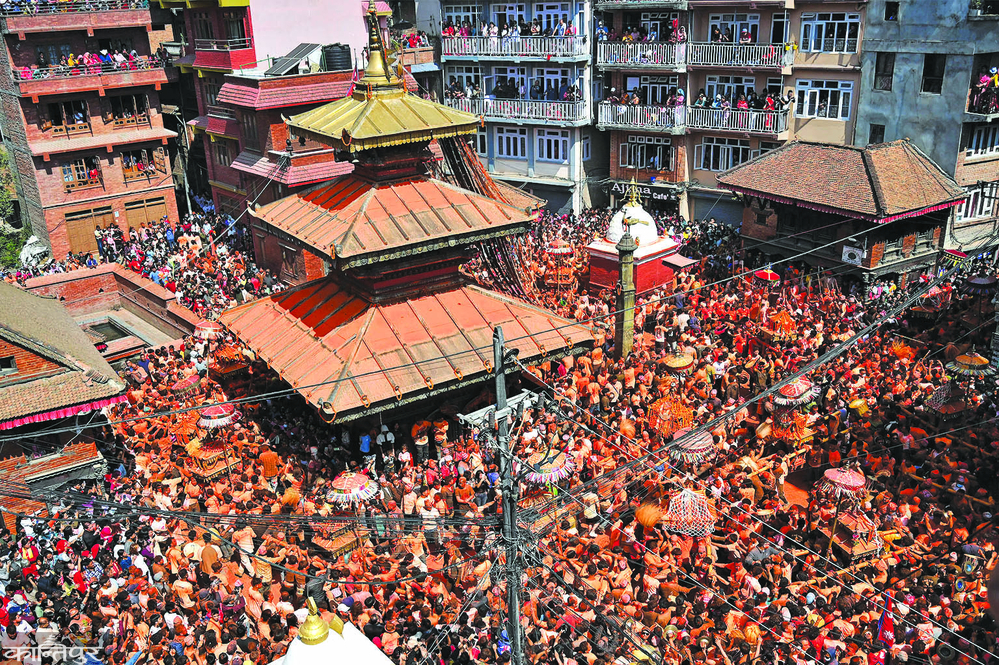
Planting paddy is called 'Sinajya' in the Newa language, meaning work that is carried out by dying. Sinajya requires a lot of effort, labor and physical energy. But how to get that power? Before starting Sinajya, on the day of Akshaya Tritiya, ghosts are dragged from house to house by means of special tantric power. Stories say that after the ghost enters the house, the man who works in the field can eat food like the ghost. He who can eat a lot has a strong body, he does not get sick. And, as long as the paddy crop continues, the house-security is done by the same ghost. At that time, the farmer does not even have time to take care of the house.
When the work of planting the crops is done, the ghost that is kept to watch over the house should be banished. Gathamug: Jatra is the day of exorcism. Even though it is called 'ghost exorcism day' in a symbolic sense, it is actually house-cleaning. If the house is dirty, disease will occur. It is believed that one of the mosquito's teeth will break on the day of Gathamug, which means mosquitoes will also decrease,' says Suresh Kiran, 'There is some free time after the crop work, at that time people are engrossed in religious activities and for a month they go to various viharas, chaityas etc. to perform puja.'
Fursdilo That one month is called 'Gulla Parv', which is going on now. It was called 'Gunila', later it became 'Gulla' because it was full of qualities, 'la' meaning month. In 'Gulla', people wander towards Swayambhu, singing deuta-katha to the tune of flute. Paddy crop requires saprin rain. Valley residents worship Sithidya and Bungdya (Red Matsyendranath) to pray for 'rain' before planting crops. "Gulla festival is celebrated with the hope that such calamities will not be caused because rain can cause floods, landslides and lightning," says Suresh.
Nagapanchami is celebrated on the fifth day of Gulla festival. In fact, Nag Panchami is not a wish that 'snake (snake) should not cause pain', it is a festival that is celebrated thinking of snake as the water god. Water is of great importance in paddy cultivation. That is why water-god i.e. serpent is worshipped. Written stories say that when Kathmandu was a lake, snakes were the main inhabitants, so snake-puja is a special ritual performed in honor of the ancestors. Thus, on the one hand, the people of the valley worship by calling for rain for the paddy crop, and at the same time, they celebrate the Gulla festival, saying that the rain will not cause calamity.
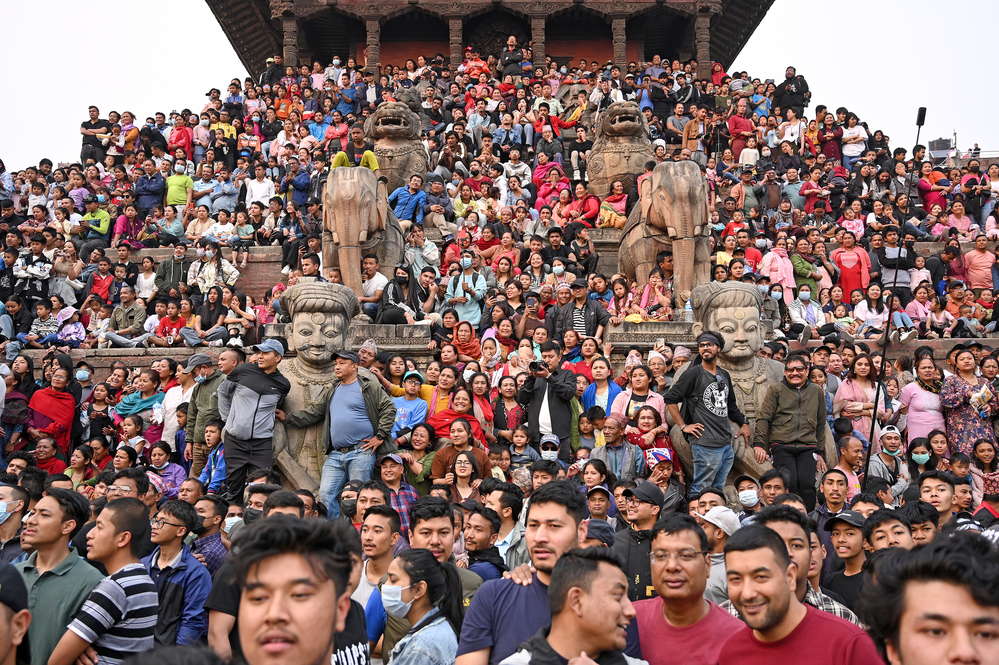
While the Gulla festival is going on, the people of the valley celebrate Gaijatra, wishing that 'the departed relatives may rest in heaven'. Gaijatra starts on the day after Shravan Purnima i.e. Bhadra Krishna Pratipada, which has traditional, religious and cultural features. There is a myth of Gaijatra – King Pratap Malla started this Jatra to get rid of the queen who was suffering from childlessness. Cultural experts also say that - Gaijatra was celebrated 300 years before the reign of Pratap Malla. Pilgrims celebrating Gaijatra by dancing Ghintang-Ghisi in the valley remember the death of their deceased relatives. Through satire, political-social inconsistencies are also attacked in Gaijatra.
Gulla festival is celebrated while going on – Nagpanchami, Kalki Jayanti, Gaura festival, Rishitarpani, Rakshabandhan, Krishna Janmashtami, Nrisimha Jatra, Bhimsen Jatra, Pitruunsi....
One and a half months after planting the rice in the valley, the rice is ripe. And, water is not necessary. So now the Indrajatra starts - saying 'There is no need for water, even if the rain stops'.
It was Indra Jatra, when Gorkha King Prithvi Narayan Shah attacked Kathmandu, blockaded it for months - B.S. In 1825. Will you celebrate Indra Jatra at that time when the price is high? The discussion was going on. Finally, Jayaprakash Malla ordered - Let's run the Jatra! According to historian Baburam Acharya, people did not participate in the Jatra that year.
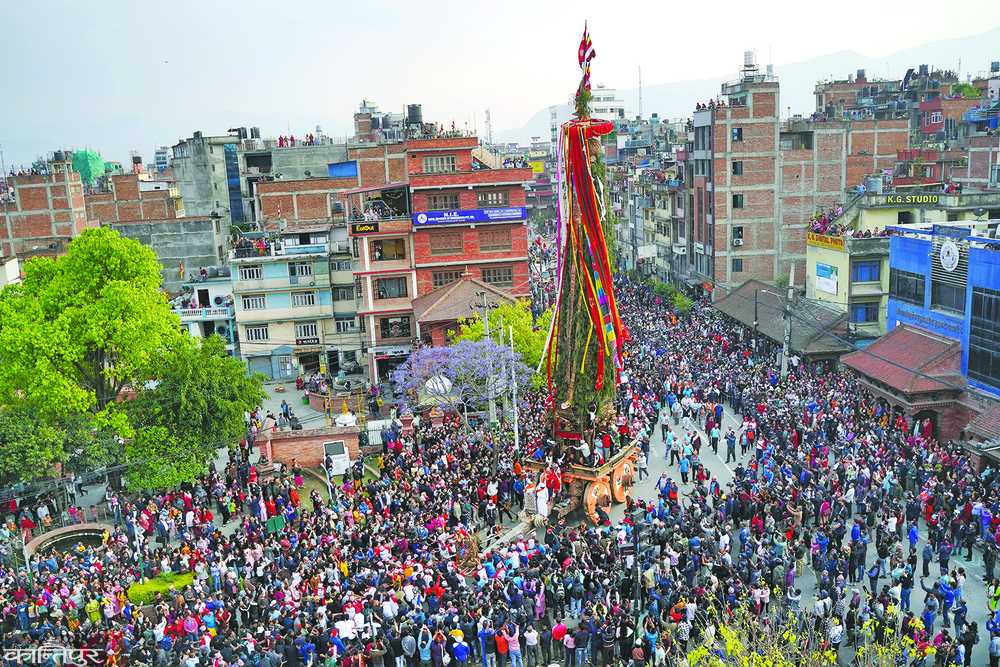
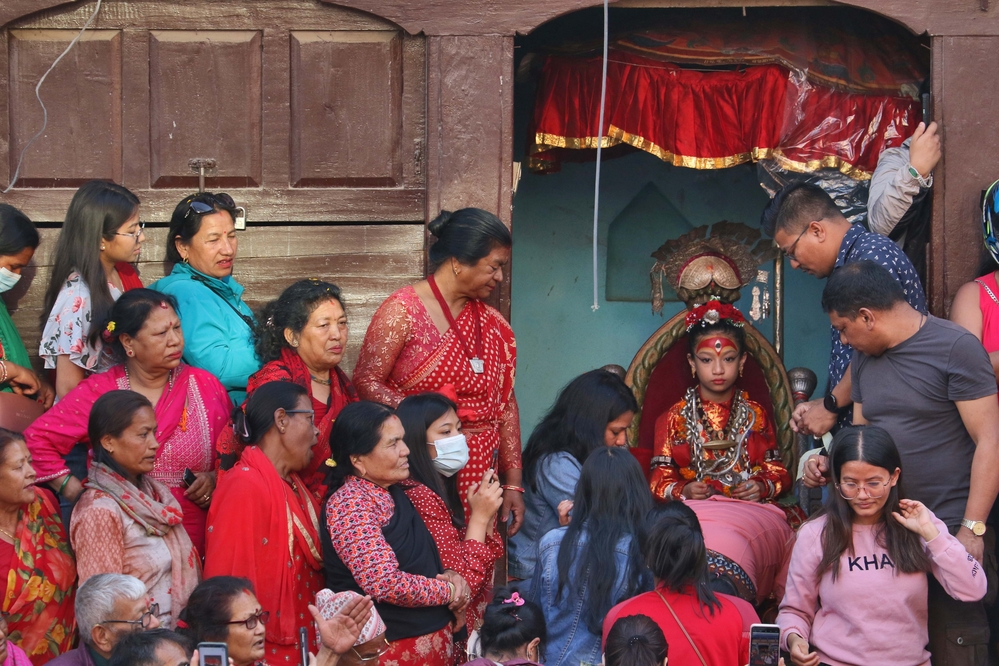
This Jatra is celebrated in Kathmandu for 8 days with great enthusiasm and gaiety – worshiping the rain god Indra, where both Hindus and Buddhist Newars participate in the Jatra with joy. On the day of Bhadra Shukla Dwadashi, the Indra Jatra begins after the lingotthan in front of the Indrapur temple at Kalbhairavachhe in Kathmandu Durbar Square, where the chariot procession of the living goddess Kumari proceeds to the special Lakhenach. Lakhe of Majipat is performed in various chowks and alleys of the city. Dramas and dances such as Lakhe, Pulukisi, Di Pyakhan, Mahakali Pyakhan, Savahbhaku Pyakhan etc. add to the merriment. All over the city, the stars are playing softly.
Dhime-Dhun, Dafa-Bhajan, Kumari-Rathayatra keep making Kathmandu musical and festive. Historian Maheshraj Pant said, "Bhadgaon's special Jatra is biscuit, Patan's red Machhindranath and Kathmandu's brand Indrajatra."
Nature and culture are at their best during Indrajatra. All over the world, day and night are equal - no summer, no winter, no rain, no drought! 'Indrajatra is at the center of the balance point of nature, environment and culture,' botanist, culture scholar Tirtha Bahadur Shrestha said, 'this beautiful autumn season leads Kathmandu to jatra, dance and music.' Journalist Sapna Maharjan, who lives in Jhonche, remembers the same - the days of old, dressed in a hakupatasi with a black floor and a red border, flowers sewn into her hair, she used to walk behind the puja-rows of the Kumari Rath. Holding her father's hand, she used to stand in the street near Indra Chowk and watch the Indra Jatra. Back then, the city was cool and bustling. Now the city seems to have changed, because he does not see such a vibrant city. The symbolic Indra would have been bound, the Father would show. Indra, covered with anger, was not visible. Sapna was surrounded by questions and curiosity - why is Indra tied up? Father used to tell the legend - Indradev is the king of heaven, clad in blue clothes, face like gold, third eye on his forehead, adorned with jewels, sitting on his left with his wife Shachi and the elephant Airavata. Indra's mother Bashundhara wanted Parijat flower to fast. Indra traveled to Kathmandu to pick that flower that cannot be found in heaven. The people of the valley caught Indra, who was picking Parijat in the Khyah Kyab (garden) between Bishnumati and Marutol. People realized that Indra is not Raithane.
He was then tied up and made to stand in a public place. When her son did not return, the worried mother came down to Kathmandu in the guise of Dakini and saw her son Indra tied to the Marutol. The people freed him when they realized that he was Indradevata. In the joy of freeing her son, Indra's mother agreed to some conditions of the Kathmanduites - to give fog to help the rice ripen, to take the Kathmanduites to heaven after death, and to meet their deceased relatives. Thus Vasundhara exchanged Indra for the mist.
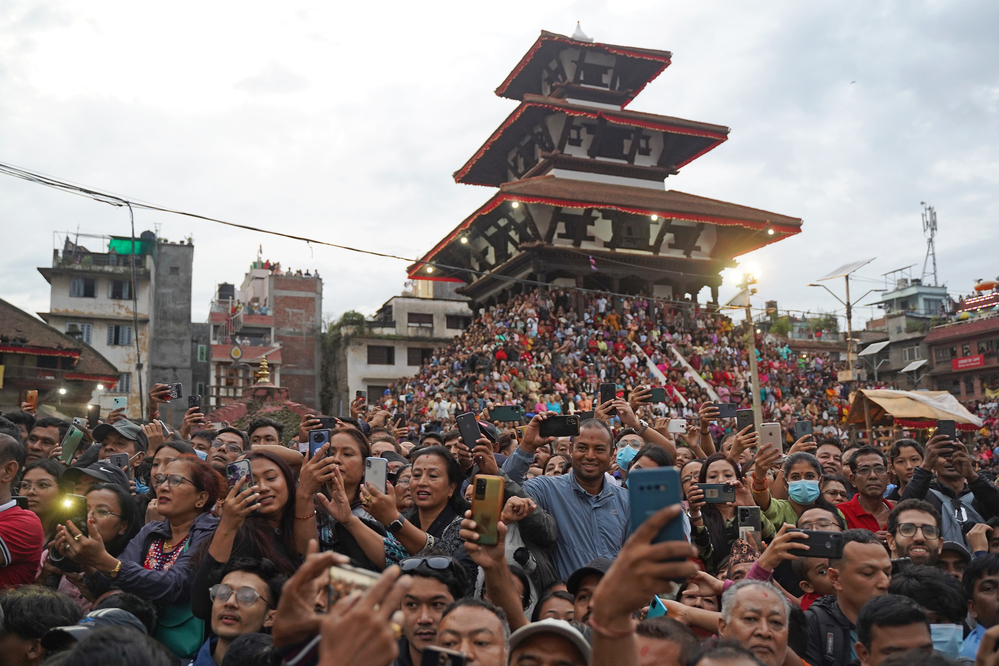
Kathmandu residents prepare for the Indrajatra from a long time ago - to make the Jatra grand. "We have been preparing since two months ago," says Sapna, "Meetings are going on in women's groups and other groups - how to show collectiveness?" How to manage everything?'
Kathmandu residents also do ancestral deeds in memory of their relatives. After the end of Indra Jatra, sixteen Shraddhas are performed to remember the ancestors.
The rice crop is harvested in October. Dasain is celebrated in autumn to celebrate the arrival of paddy. 'The valley is considered the main as the other than the other than the other more than the autumn. Kodo, used in the crop is also involved in ten. 'Seligung' means to recharge the power of Mahalakshmama, 'Never can be earned by the ten years, "he has worshiped his own bodies! In worship '. & Nbsp; Sideep Shrestha, Editor Shrestha of Statement 'Sidhatta, ADPPAND election, is inevitable for two elements that persuaded in the valley. "If the rest of its vilous side will be completed by" Decode 'both methods and forties, contraries the social and political history of the valley, "says Sudep. He gives examples of three large congregations in three cities - a variety of festivals in the movement of Kathmandu, but it is the main as the process of taking public the sky from the temple. Neats in the sky 'tounes,' says, which means to ancestors. So it is connected to the origin of the Newar community with the meeting.
two- Partner's red is a single voluntary with which one of the whole valleys. This status connects the status entirely valley by its story-sort of worship. There is also a price of age and Nepal's term period. It is a matter of connecting the new royal royal-rise to celebrate so large clashes and start a new power, it is evicted to confront the old royal rule of rise.
three-Bhaktapur is taken as a victory of the Victory Victory Victory Victory Victory Festival. If you want to 'decode a pressing legend, it tells the story of war and victory. In the study of
Sudip, the Upana is worshiped in various names, and the story of one grandson is connected to one granddaughter. "These are Bhairavs and Ages of different names," he says, 'The history of the surveyor can be carried out in the story of those. & NBSP; The men of the Prospects of the Nepal Mandamas and the Chandhus in the Chandhus and Mandalmas can become very long, with no town-city. Kharthas are maschy in Kathmandu to be sunny.
are not only a manner, but also associated with the health or a quantic or punching festival. Due to circumcises appear, it seems that he has been placed from the virgin - a Quality in the crowd, a quantity that is eaten! It is eaten in the movement, that's day! Thus' 'Thus' and Nbsp this day! & NBSP;
is celebrated on the day of the storeing new paddy in the valley. Yet, that is, bread that new paddy is. Then other purposes involved in the valley (diseased, village and security) lashes and celebrated by worshiping the hoste of the country. And, on the other side of the same month is considered as the last powers. & Nbsp;
packens: hrakhra, hustle and nbsp; elongative teachers of loving Gurmapa. The Gurhamapah is also said folkharthukha. Bhattam Bahal was the law of the herid gambling. A day after he moved, he came to a sister. Didi, sister paid food in a gold plate. After eating food, the hair was greedy for the lad. Sister was shrouded by the eyes of my sister, and fled. Respectively and hurried to the gambler and stealing silver, bronze plane. A sister was over, she left a day on the ground. Placing the rice in the hairsoon clothes and walked away. At one point in the shade of a tree, a demon arrived and tried to eat. The hair was clever, the monster carried the monster to his own home. But, suddenly agencies of children began to disappear .... Neva: Children in the settlement are still known to scare the families - don't do not go around the tree, if the Gurmapa is ate? Santi-Break in history is like a long period of state or room for a long period of the state of state of Rajendra Maharjan. In Kirtipur, a large level of Rajendra), Nav: Nav: Nav: Nav: Buddha Communities Listennant Communities In Buddha Communities, Buddha Communities After Buddha Purna, Buddha Communities Communications Community Community Community and Community Business. 'The previous day of the Saprush' is notked '(fashioning frog), going to the farm and field). That day, the family of the dead expresses his reverence in the hairs. The next day is celebrated for the sole or modaty, which has been named. Friends for farming is celebrated for the celebration of the celebration of farming, 'says Rajendra to drink and make lunch and humorous work. The story of the king-Mahaja's story is also attached to the story and production of the King-Maharaja's effects in the outer cover of this pressure. The professor of English Literature, the Arun Secretary, in a conversation of Kathmandu, and Valley, the Cynish Secretary, and in the Valley of Kathmandu, he said, 'The valley is a conversation with Ketipur, Valley. The attribute of Newar culture is in his 'SIMOCOM'. It is an example of Newar culture of Newar culture to represent a myth as a religious ritality. '& Nbsp;
'Mithnamic' in the false 'Valley' Kathmandu Valley, in the false valley, is being raised, and the youth is increasing. But, there is something wrong with - intense urbanization. After risks in green field growing green field, the trumchite rosy, Valley field is rising, but the romance, ruinacco and structure is the same. Can't stand with the routine of
culture - the city. Its breath is based on the culture. Counsel-splendor and arts are the backbone of the valley, which builds a higher culture. Counsel are pictures of the time of the city's lifesty and people.
do we understand the background of the valley of the valley of the valley?