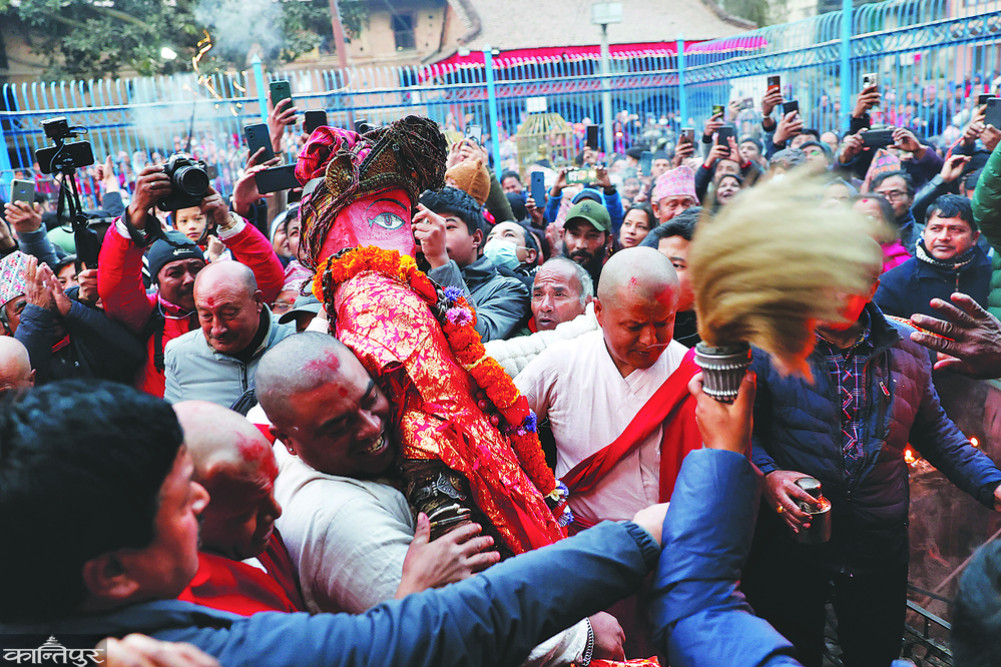
It is believed that Matsyendranath's face is red due to the fact that he is Padmapani, who is composed of the qualities of many Bodhisattvas, who has been showing friendship, compassion, humility and neglect, and who is giving knowledge to destroy ego and ignorance.
We use Google Cloud Translation Services. Google requires we provide the following disclaimer relating to use of this service:
This service may contain translations powered by Google. Google disclaims all warranties related to the translations, expressed or implied, including any warranties of accuracy, reliability, and any implied warranties of merchantability, fitness for a particular purpose, and noninfringement.
Sixty years have passed since he started making the chariot of the red Matsyendranath, who is considered to be the god of grain and age. At the tender age of 9, he learned to make chariots from Baje Chandra Bahadur Barahi. And in 2053 he became assistant Nike, after 2059 the main Nike is - 69-year-old Dilkumar Barahi from Patan. It is considered very difficult to make the chariot of Matsyendranath. As a symbol of Trayodash Bhuvan, 13 floors should be built. You can't nail it, you have to make wooden pegs. Rope cannot be tied, cane must be used.
What is more interesting is that the chariots are still made according to the same method which was made by Mahatantric Bandhudatta Achaju of Kathmandu, who played a role in bringing Matsyendranath from Kamarupa Kamakhya mountain in Assam, India to Nepal. According to Naike Dilkumar of Barahi Guthi, the chariot should be made with 32 characteristics. On the top of the chariot is placed an idol of Abhithab Buddha from Swayambhu and Vajrasattva brought from Kwabhaal (Golden Temple). An idol of Hayagriva Bhairava is placed in front of the 'Ghashma' so that there is no disturbance during the Rath Yatra. A long piece of wood placed in the middle under the chariot is 'Gahma'.
The four wheels of the chariot are considered as symbols of the four Bhairavas. Among the four Bhairavas are Harisiddhi, Hayagriva, Lupta Samhara, Nandakunda of Luvhu. So that the chariot does not fall down while pulling it, it is pulled with 'jungle' i.e. rope. The right forest is considered as Basuki Nagaraja and the left as Sheshnaga. On the top of the chariot is hoisted a flag with Lokeshwar's shadakshari mantra 'O Mani Padme Hoon' to protect all beings. The long stick 'Gahsma' placed in the center under the chariot is considered to be the symbol of Karkotaka Nagaraja.
To show the feeling that the compassionate Lokeshwar is rescuing all beings, the auspicious symbols of Srivats pundarik, dhwaja, kalash, chamar, matsya yugam, chhattra are placed on the side of the chariot. Because of its 32 symptoms, it is believed that whoever looks at the chariot of Matsyendranath, his heart will be filled with compassion.
Barahi Guthi Nike Dilkumar says, 'You have to take initiation to make a chariot. It is not possible to be arbitrary. For some reasons like this, during the Rath Yatra in 2050, the family of Gahma was broken three times and Guthi's family was continuously
He remembers that 9 Guthiyars died. In the chariot, Barahi makes wood, Jwala cane, Bosi cuts trees, Potters make utensils, Kou iron, Painters paint wheels and other chariots, Neku makes/decorates the idol of Matsyendranath from the clay brought from Swayambhu using a golden spade.
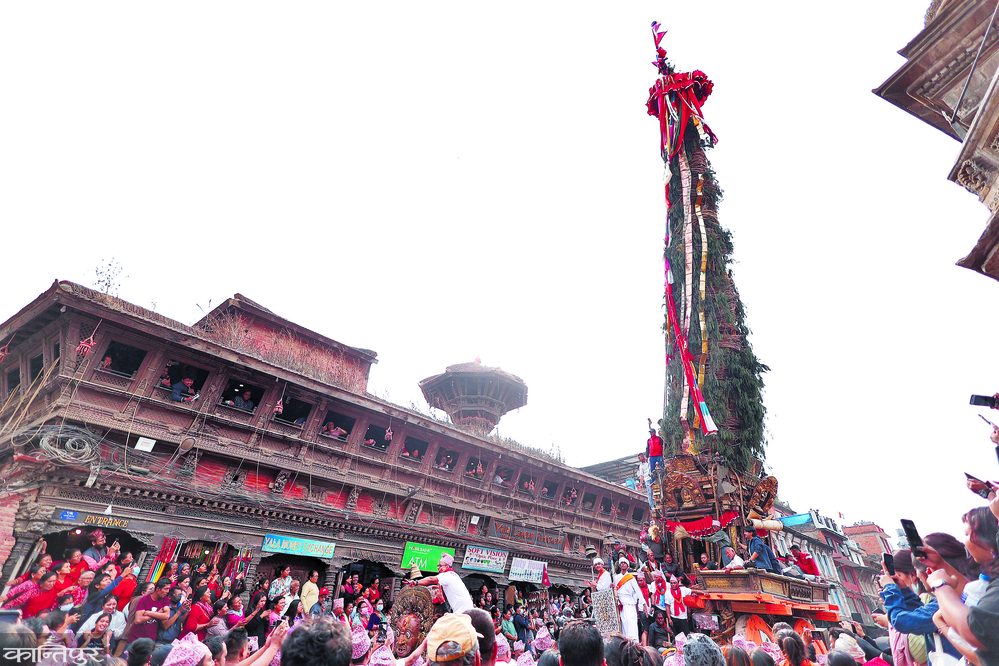
Wisat Guthi supervises. This responsibility has been given to Guthi Adda since the time of Shah Raja Girvanyuddha. Now the Guthi Institute looks at it. Lusa Guthi of Patan Mahabuddha does the task of placing the pylon on the chariot. 'Dhakku' breaks the wheel with Guthi, 'Se Se Bajya' commands when pulling the chariot and Paneju i.e. the priest performs the rituals of Matsyendranath.
There are 31 Panejus (priests) who perform the rituals of Matsyendranath. Everyone gets their turn in 15 days. Now it is the turn of 59-year-old Manikraj Shakya from Bungmati. After becoming a priest, one has to follow strict rules.
no one can touch. It is forbidden to wear other clothes except Votto and Jama. Eating other than bananas, ginger, rice, small bananas, ghee, knife, milk, oil is prohibited. 45 festivals related to Matsyendranath and 42 festivals related to Bhairavanath Guthi Bungmati should be conducted throughout the year. One should recite stotras composed by Guru Bandhudatta Acharya, Raja Narendradev, Lalit Ratchakra daily.
000
There was a famine in Nepal for 12 years, so in 458 AD King Narendradev of Bhaktapur, Tantrik Bandhudatta Achaju of Kantipur and Lalit Jaipu (Tandukar) of Lalitpur called Rathchakra brought Mastyendranath from the Kamrupkamakhya mountain in Assam, India. As mentioned in the Gopalraj genealogy, the Tantric Bandhudatta brought the baby Loknath to Nepal after putting on taran rakhi mohni and performing sadhana in an urn. It is said that the Rath Yatra, which starts from Baisakh Shukla Pratipada, was conducted by King Vardev only in 650 years. After Varadeva became the king, the form of Matsyendranath was transformed from the urn into a statue and the urn was placed in the womb of the statue. Before the Rath Jatra of Matsyendranath, there was a Rath Yatra of Lokeshwar of Patan Dhalachen tol, Narayan of Swath tol and Meenath of Tangal. Except for Meenath, the practice of pulling the cow Loknath in one chariot was established by King Vardev.
Matsyendranath's red face
Why did the face of Matsyendranath turn red as white as milk? The president of 32 Paneju Sangh, Yagyaratna Shakya, says, "Matsyendranath's face is red because night and day are the same for Matsyendranath, who is leaving his body and resuming his body." told .
Matsyendranath's face is red because he is always saving the creatures of heaven, mortal and hell with equal compassion, Shakya added, "The color of the rising sun is also red." Here the name, philosophy and work of Surya and Matsyendranath are meant to be consistent. Among the Panchabuddhas, the face of Abhithab Tathagata is also red because of the effect on his head.'
He says that the face of those who are devout and engaged in action naturally turns red. According to Shakya, after being born as a human being, one cannot be freed from the fear of disease, illness, old age and death, if born as an asura, one cannot be freed from the fear of murder, violence, fear, horror, terror. Even if born as an animal, one remains afraid of making food for the other. Even if you are born as a ghost, there is a possibility that you will remain an unsatisfied soul without food and drink.
Shakya, the president of Paneju Sangh, who is afraid of having to live a painful life if he is born in hell, cannot bear the heat and cold, said, "It is believed that Matsyendranath's face will turn white like milk only after all the creatures are sent to Nirvana to get rid of all these fears. Matsyaendranath's face is made of metal except for the mask made of clay. The credit of making the image of Matsyendranath has been given to the scholar 'Sunyashri Mishra'. During the reign of the Mishra king Varadeva, who followed Brahmacharya, he cleared the forest called Lalitaranya and built Yampi Mahavihara.
Karunamay Lokeshwar is called Bungdyo by the Newars. A depressed nose, jeweled crown on the head, hinges on the forehead, jeweled ornaments on the ears are furnished. He is adorned with a necklace of Karkotaka naga on his neck, bangles on his hands and kallis on his feet, holding a varada mudra in his right hand and a lotus flower in his left hand. Mastyendranath is worshiped as Vishnu by the Vaishnavites, Shiva by the Shaivites, Shakti by the Shaktis, Surya by the Solars, Lokeswara by the Brahmins and Karunamayya by the Buddhists, Abhithab Buddha and Padmapani Bungamalekishwara.
000
Regarding the origin of Matsyendranath, as mentioned in the genealogy written in Nepali language by Ashakaji Bajracharya, Gunakamdev's thirty-two-character daughter Gunakamdev was born in Bhaktapur during Lichchavikal. When Gunalakshmi was young, she used to cry and would not listen to anyone's teasing, and she used to keep quiet when she had to marry a fox. Gunalakshmi was young. She dreamed of marrying Narayan. Since then, a white jackal named 'Rupak' started coming to the palace to howl. When the daily jackal came to cry, Gunakamadeva told the astrologer that it was an auspicious sign. When Gunakamadeva called 'Rupak' to the palace, he told Gunakamdev that he had come for marriage because he had said that he would marry a jackal when he was young. The truthful king was embarrassed when no one agreed to marry the fox.
The princess got married after agreeing to marry the fox. The porter took the dowry and sent the daughter with the metaphorical jackal. The porter who was surprised to see the form of Narayan sitting in the golden palace inside the cave told the king everything. Arriving at his daughter's palace, Gunakamdev Narayan was overjoyed to see his daughter. Narayan asked the king to ask for a boon. The king asked for food crops for the welfare of the people. When the grain crop was planted, the rice did not grow in the paddy field. The king again asked for a boon to keep the rice. This work can only be done by Karunamay and Karunamay has already been born from the womb of Yakshani. Narayan decided to fast on Ashtami to bring Karunamay to Nepal. Gunakamadeva was blessed with a son Narendradev due to fasting on Ashtami. During the reign of Narendradev, there was a drought in Nepal for 12 years. There was no rain even after many peace talks. The Tantric Shantikaracharya saw through clairvoyance that Karunamay's disciple Gorakhnath Pashupati was meditating on the nine serpents in Mrigasthali. After Loknath came to Nepal, he advised that Gorakhnath would wake up to see the Guru and there would be rain. King Narendradeva Shantikaracharya set out for Kamarupakamakhya in 446 with his disciples Bandhudatta and Lalit Jayapu as porters. It is said that Matsyendranath was brought to Nepal after suffering many hardships for 12 years.
Rath Yatra
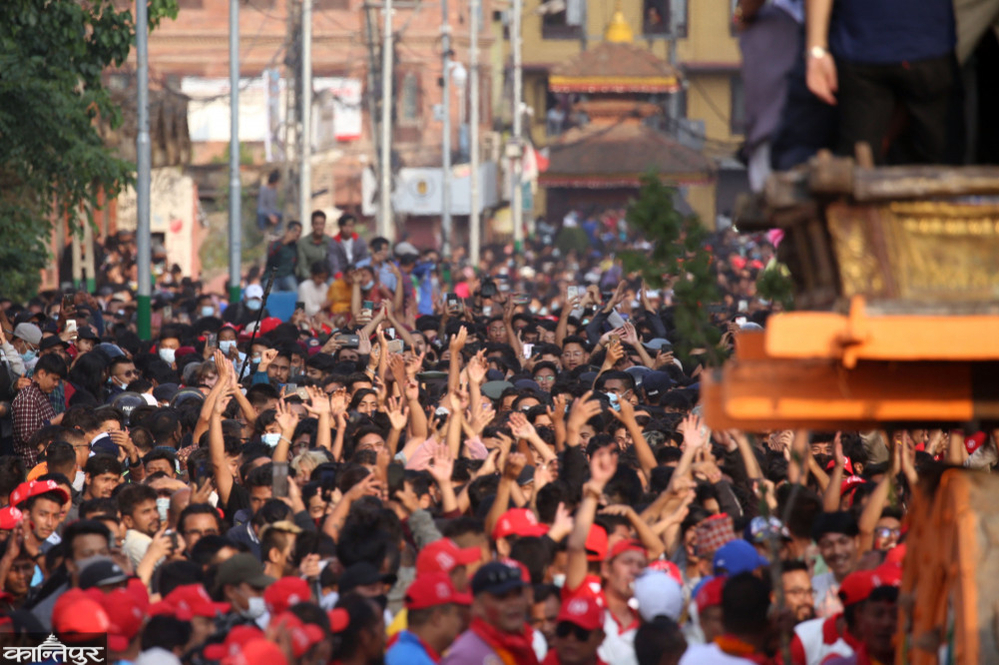
Yaha means journey/journey. When the chariot of Matsyendranath is pulled from Pulchok, it is called 'Bhujaya' Jatra after reaching Gahbahal, after reaching Sundhara, Nuga'ya' and after reaching Lagankhel, 'Bhujaya' Jatra is celebrated and after reaching Jawalakhel, 'Jya' Bhujaya' Jatra is celebrated. The main festival celebrated within the main inner city of Patan is the Bhujaya ie coconut festival. On this day, Lalitpur Metropolitan Corporation has given a public holiday. 'Bhu' means plate or land. The meaning of 'Jayah' is that which is grown on the ground. Matsyendranath's astrologer Kirtimdan Joshi says, 'Bhujaya means to offer food to Matsyendranath by placing incense, corn, wheat, flowers, etc. grown on the ground. Bhujaya: During the Jatra, Matsyendranath is worshiped and anointed from the top of the chariot with coconuts as well as Yomari and Lhonchamari (a type of bread cooked by the Newars on Dhanyapurnirma). It is believed that a person who receives a coconut that has been dropped in this way will be blessed with a son with 32 symptoms like Matsyendranath. On the day after coconut shedding, there is a tradition of ``Kak: Misaya: Bhujaya'', where only women pull chariots. Rath Yatra from Pulchok to Gahabhal is considered as a visit to heaven. He narrates the zeal of the first stage of the pilgrimage in memory of Tantrik Bandhudatta Achaju from Kathmandu, who played a role in bringing Matsyendranath to Nepal.
The journey from Gahabhal to Sundhara is believed to be made in memory of King Narendradev. This journey is considered to be equivalent to a visit to the underworld. It started to be taken from Mangalbazar to Sundhara in 1718 during the reign of King Srinivasa Malla. The journey from Sundhara to Lagankhel is considered to be equivalent to a visit to Patal Lok and is called Rathchakra in the name of Lalit Jaipu.
After reaching Lagankhel, the chariot is circumambulated three times around the temple of Dolamaju, called the mother of Matsyendranath. Mahabali Puja is performed at night on that day. On the day of Sait Jure, the chariot is pulled from Char Dobato of Thati tol and taken to Jawalakhel. Four days after that, Bhoto Jatra is held. Along with Matsyendranath's chariot, Meenath's chariot known as Jatadhari Lokeshwar is also performed in Jatra. Meenath is famous as 'Chakwa Dyo' as the bird is the deity of Bihar.
On the day before every Jatra, 'Chyala Boo' is compulsorily celebrated. According to Joshi, when Matsyendranath was brought to Nepal, Yaksha Gana also came with him. Chhyala means burnt meat and booh means plate. Chyala Boo: It is a day to put burnt meat on a plate and feed it to ghosts, pisachs, gandharvas and kinnars,” said Joshi.
Earlier during Rath Yatra, there used to be fights and death due to being crushed by wheels. Jaapu Samaj Yal has been managing the Jatra for about 25 years since the accidents did not stop. Santaman Maharjan, President of Jaapu Samaj, said that around 3-400 young people are deployed as volunteers during the Rath Yatra. The society is also playing the role of coordination between the government agencies and Guthiar when problems arise. Once in 12 years, there is a tradition of making a chariot and traveling to Bungamati. Voting is done in Jawalakhel of Bungmati and Patan.
Votto Jatra
The precious objects such as nagamani, manikya, hiramoti etc. are kept sealed in ancient voto pachimhicha (cloth bag). Guthi Sansthan Lalitpur branch office head breaks the bond and shows it in front of everyone after checking the seal. According to legend, the bhoto belongs to the Karkotaka Naga king. Nagaraja's wife's eye disease is not cured even after many treatments. Nagaraja comes looking for a physician disguised as a Brahmin to treat Nagarani. Joshi, the astrologer of Matsyendranath, says, "He met a farmer from Bhaktapur. He thinks that Jaipu is a doctor who treats eyes and requests him to treat his wife.'
'Jaipu goes to the Brahmin's request for treatment even though he is not a doctor,' he narrates. Jaipu is afraid that he is not a physician when he sees Nagaraj and Rani seated as deities in the palace. Jaipu remembers Guru Bhaishajya Tathagata. And the mud behind the right ear is rounded and mixed with water and put into the eyes of the woman. Diseases are cured without telling. And Nagraja Happiness gives Battle-wearing Ritual Bhoo.
astrologer Joshi, "Mapsulada stole the ghostly while he was working. By Jahwakhel, a demon came to go to see the process of Matanhindranath in Javlakhakhe. Dispute was arrested on Bishnokokoka and a man's dissolving demons. Nerraza, who humbly come to see a procession also sees. Eventually, Ghost, Jabri and Karcikang Nagraja is offered to the same agreement. They are the beginning of the king in Lalitpur there. & NBSP;
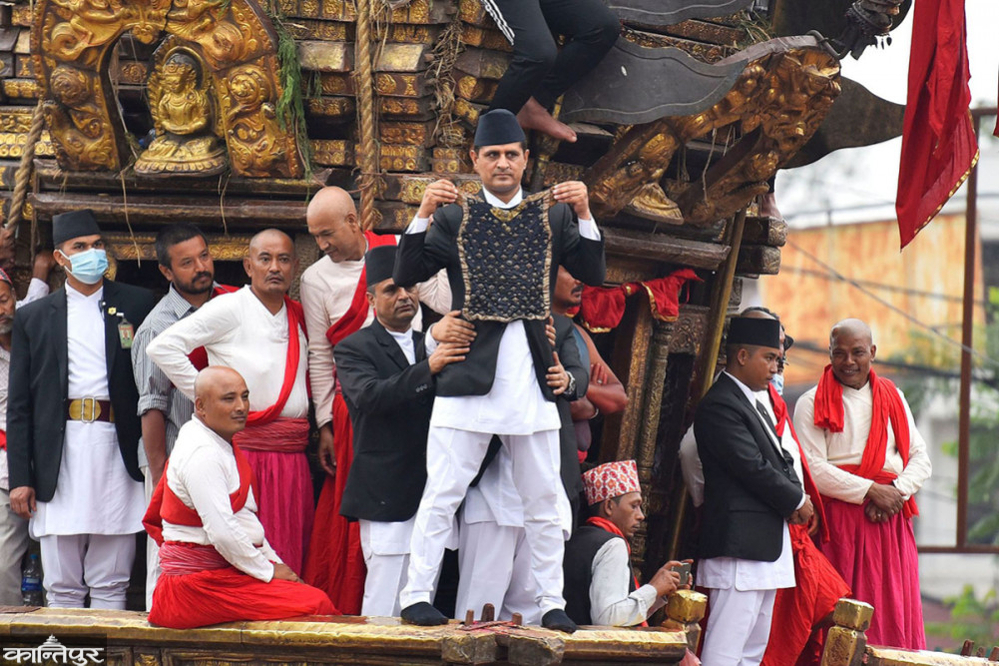
Man Rupuk Nagraja Kagraja, Bathmade, is commanded to show the king's day after the king's ride. Us that is the historic folklore that has been running every year. When showing the differences, the chariot refers three times throughout the chariot. For the first time, human and to -nolk, second time, the astronomical Jote, King Narayrav, Barhika Nagraj, Barhika Vacant, and Yachlook, the astronomical Joody says. Viewing the vision of the confined dominity believes that fire, water, is mortal such as fire, water, dies. Chairman of Penjuju Association Shaky says, 'Bhuto was stolen in the bark of King Tribhuvan. It is also said that Mahendra was king. '
-Break is the Ranwan-Break of the Ocean Seshinath, the Raman-BREAK Mati-Break Matna Mati-Mati Center is the deceased by Kathsandhanath. The statue of the MataCrendrain in the Midnight of the Evang (a type of instrument for the tail community in the Newar Community) is placed in the temple geneal in the temple. One day of the Penjuju Association of Penjuju Sangh, who is trying to release the message of Matiusndranath, is trying to die that not everyone is trying to give the message that should be forsaker, anger, anger, anger, anger, says Shakhy.
is made up to the idols of the image after the oath. According to Buddhist tradition, repatriacism, nominations, food, nicknames, nickshans, Nickwan, Big Marner, Badar, Bida, Butism, and Bell marriage. Both men and women are in male and women as the Matiyndranath is a multitament. Backward of the chariot, '(blood and blood transplantation) is established. It is also considered as a symbol of Shiva. Chairman of Penakija Shakyha says that he has participated in the same as a village as a botherarchi road. It is customary for Matiya and the parcean when the sun is sorted in the sun.