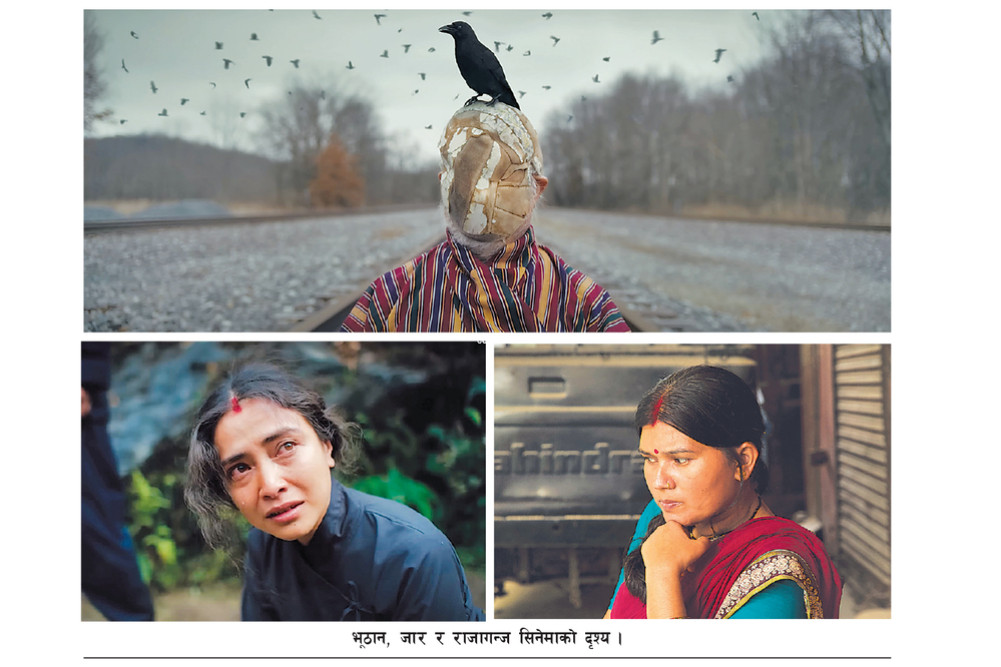
Recently, the use of meaningful scenes in Nepali films is increasing, regardless of commercial or art cinema, such use is enriching the language of cinema.
We use Google Cloud Translation Services. Google requires we provide the following disclaimer relating to use of this service:
This service may contain translations powered by Google. Google disclaims all warranties related to the translations, expressed or implied, including any warranties of accuracy, reliability, and any implied warranties of merchantability, fitness for a particular purpose, and noninfringement.
Scene 1 Harshjit gets to cut the jar. Mrs. Thuli is loved by Rudraman. He is the czar of Harshjit. On the fixed day of cutting, Rudraman gets to stand nine steps ahead of Harshajit. Harshjit gets to carry the khukuri in his hand. After the chief says cut, the jar escapes. He gets to regret it.
Rudraman runs. Harshjit starts complaining. Running - running they enter the forest.
How many people can run away continuously? How long can a nagging person keep nagging? After a while, they get bored. After all, they are men. A man who is right to fight and fight to get his rights over a woman! Because they are men, there is a rule of cutting jars.
Being a man, he got the right to be a tsar and cut. The female character has no major role in being either of those things. Nor did any woman have a role in the decision to make them flee and cut. It was also men who asked Harshjit whether he would cut the jar or what he would do.
However, the love made by Thuli was true. She loved Rudraman. Well that love was broken by social rules. Rudraman and his sister got married. It doesn't take much to have a 'twist' in the story. Indra Bahadur Rai is its 'master'.
After the wedding, the ex-boyfriend followed Thuli. That was not what Thuli wanted. Or even if there was, he didn't know. He was overwhelmed by it. That's why in one scene he says, 'None of us can have the life we want, sometimes someone spoils it. Others keep spoiling it, spoiling - spoiling eventually becomes life. Life is the same.'
If external conditions deteriorate in our society, the lives of both men and women deteriorate. However, there are many structures that spoil women's lives. Many others decide on a woman's body. However, while watching the scene where the two men ran while cutting the jar, I noticed something else. They are running because of this patriarchy.
They have become a villager's favorite. They are tired, they are fighting, all because of this patriarchy. The two young men could say no to this if they wanted to. But no, they are used to it. Thuli's husband said, for him, not being a disbeliever is life. They are not able to be disbelievers because of this patriarchy.
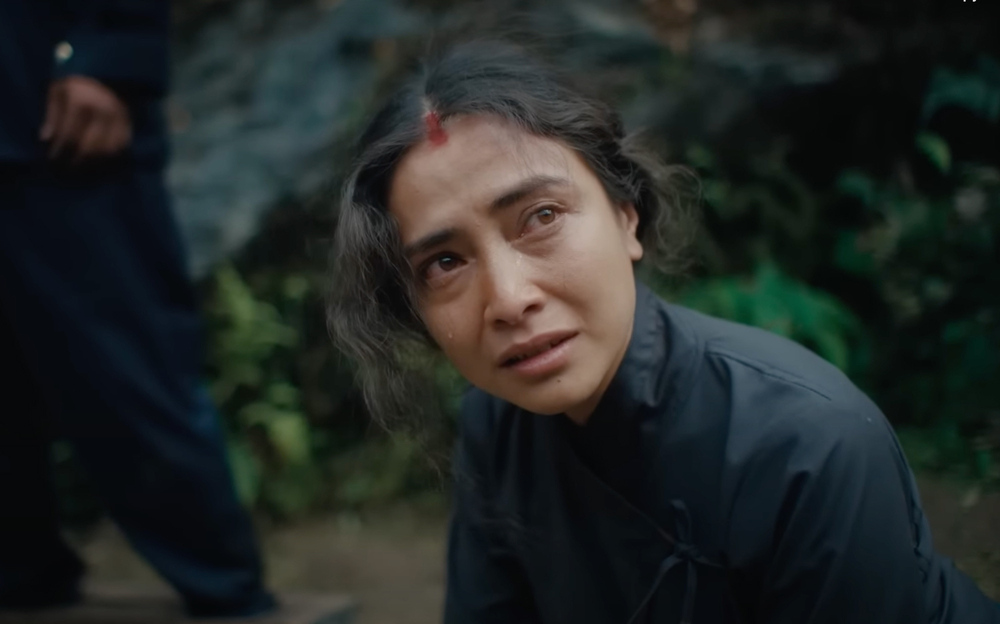
Neither did anyone ask anything special about Thuli's mind. Do you have something to say to him? Why did he first stab Rudraman, his ex-boyfriend who came to meet him? Was she happily married? They may be ready to cut each other down but not ask so many questions. Patriarchy not only oppresses women, it also oppresses men. However, the men of the society are not understanding this. Phurwa Tshiring Lama, the director of the film 'Jar', said this profound thing through the scene where they were running away.
scene 2
Bishnu Bahadur KC was a national player of Bhutan. However, he became a refugee. Being a refugee doesn't need a big reason.
It's enough to be kicked out by your country.
Vishnu's time is reversed. What he was born into, the language he spoke, was enough to drive him out of the country. However, he played football for that country by wearing the jersey of Bhutan. However, he became like a football. He was kicked by Bhutan . He became a refugee in Jhapa, Nepal. Later, rehabilitation struck again. He fell in America.
But, no matter where you go, the heart of a person searches for the place where he was born. He is in America. However, her heart stays in the post box where letters drop every time. 'Is there an answer to the letter?' is the only question he asks. A corner of his mind is always thinking of Bhutan. Became American. I want to go to Bhutan even if I have to travel. After listening to the desire, did Bhutan invite you to come? After all, how long can a state continue to be unhappy with its ex-citizen?
But, no, Bhutan, which claims to be the 'happiest country' in the world, did not hesitate to return his happiness. He also did not wake up from his dream of going to Bhutan. He did everything for it. Meet those who can meet. Tell it to those who can tell it. He wanted to be there. Tried to sing the song there. Be born again as a Christian. But no, no, they did not deserve to go to Bhutan. Somehow his illness was not cured. No disease can be cured. Because those who seek to heal do not know how deep its effect will be.
If you have to show the death of such a character who is alive and dying many times in the film, what kind of scene is needed? Will a breathless scene suffice?
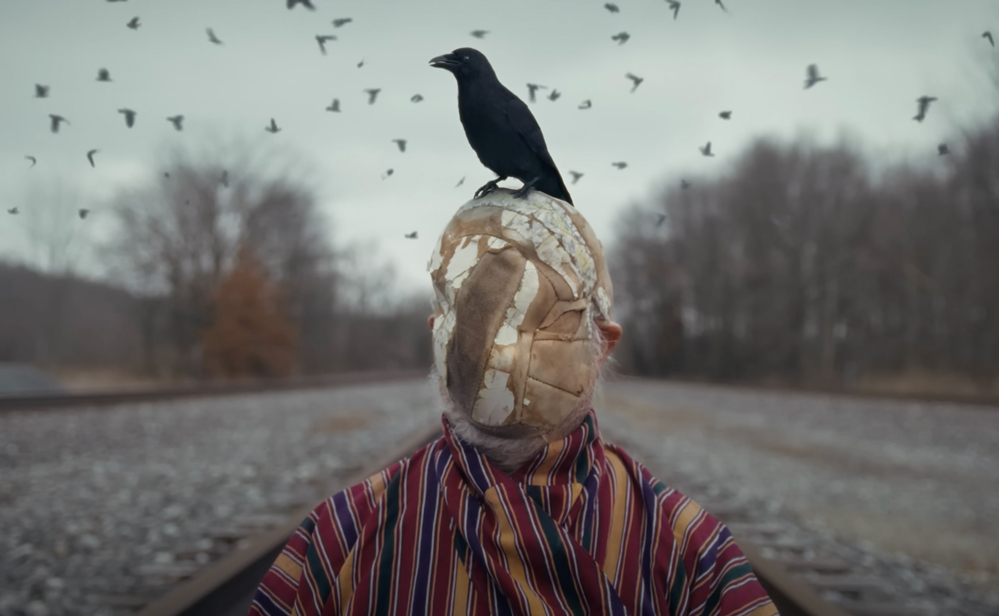
Vinod Paudel, the director of the film 'Bhuthan' and his team created a powerful visual language to say that. Even when Bishnu Bahadur came to America, he took football with him. He took it out of the box every now and then, humming. As long as there was no hope of returning to Bhutan, football was safe. But when hope was gone, he cut the football with a knife. A deflated football became his head. It became his face. His face now became a deflated football. And football also became a separate narrative.
The hope of going to Bhutan was in his body as long as he lived. It died only after death. And a crow sat on his head. Crow means bad news. A crow flew behind him in that scene outside, accompanied by a powerful background sound. He is not the only person to experience such a situation. Her story is not hers alone. One crow is not enough to tell his story.
Not to be forgotten, in that scene, Vishnu is wearing Bhutanese national dress.
scene 3
Saraswati is bathing her kidnapped child as her own child. The child in her stomach was crushed because of Savita, the mother of that child. Savita, who was the principal of the school, had power in her hands. She married a Madhesi MP. In addition to that, she also hid her mistakes. She didn't bring out the fact that she lost the child because of her, instead she bought the doctor and made it true that she had another disease.
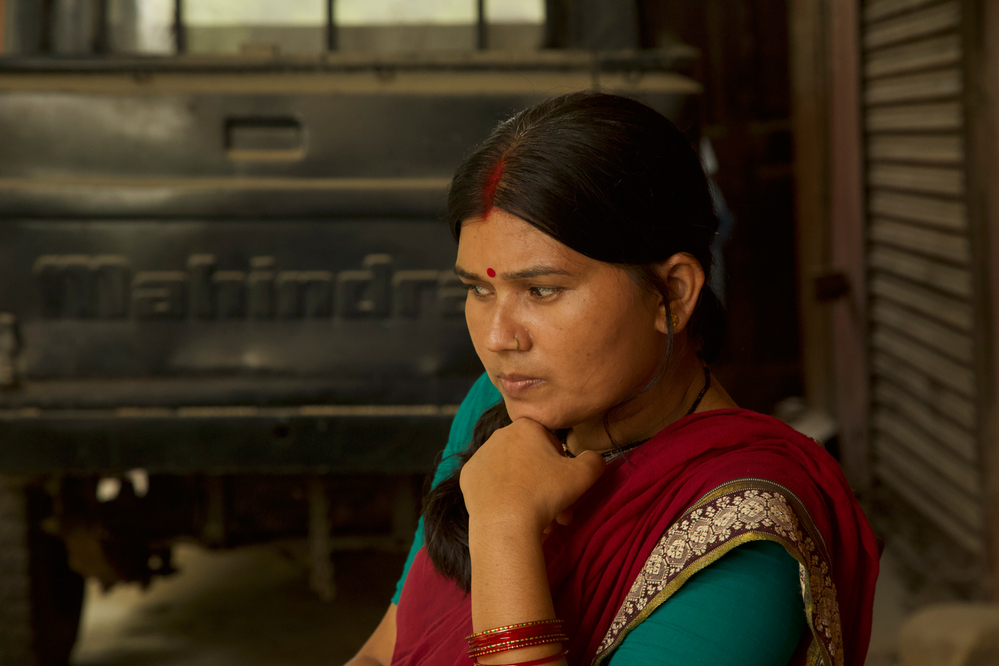
Saraswati was a small person. Just like every little person's truth, his truth became anonymous. However, Pooja Sir, a female police officer who came from Kathmandu to solve the kidnapping case, understood her pain. Every political promise is broken after coming to Kathmandu. It is also symbolic that he went to Terai from Kathmandu. Pooja managed to send the child back from Saraswati's hands not by using power but by talking. It is rare for an administration to listen to Madhesh's case without using force. Saraswati asked only one thing before sending the child, that the injustice done to him should be made public. Whatever happened to your child, should be written in Kathmandu newspaper. Don't suppress what happened.
She is therefore taking a bath to send the child back. She probably also had a dream to bathe her child in the same way, it was shattered. However, she is also lovingly bathing her crying child.
After bathing, the child returns home. Pooja sir is discussed for bringing him back. What can we say about Pooja sir, the male policemen around her are the talk of the town (or let's say they steal the talk). The next morning, Saraswati buys a newspaper. She asks if her news has been printed. However, it is not printed. Color fades from his face. Her husband, reading her face, asks her what happened. She says her story is not there. The husband says, 'When was it written?'
Through this scene, director Deepak Rauniyar has questioned a deep thought of Nepali society regarding Madhesh. This is how Madhesh has been cheated in Nepal. Just as Saraswati believed, people living in Madhesh have believed many people since history. They think their words are heard and understood. However, they have been deceived. They are standing in the lowlands as a border. However, he has endured the humiliation of being called an Indian time and time again.
Saraswati's story not being printed is a reality of Madhesh society. Or at least one thing like making Saraswati a wholesale kidnapper in the film. How the voice of anger in him came, is not to be found.
and not being acknowledged for doing so. At least Pooja has a burden on her face. Saraswati cannot see eye to eye with him in the scene after his arrest. However, on the face of the rest of the male officers, there is no guilt for betraying Saraswati.
...
Cinema is made up of many scenes and characters. He talks a lot in the movie through the above mentioned scenes. Someone is advancing the story. One says what is going on inside the character's mind. And someone tells the story of the writer or director or the purpose of telling the story.
I am touched by such scenes with depth. They show how much time or thought a creator has poured into their art. Being a writer himself, he also knows how long a scene can take to come to fruition.
Lately, the use of such meaningful scenes is increasing in Nepali films. Be it commercial or art cinema, such usage enriches our cinematic language. Gives space to think. I occasionally take them out of the scene to see how important these scenes are. If he were to be removed, how much of a gap would there be in the film? What would have happened if that scene did not happen in the movie 'Bhuthan'? What would have happened if that scene did not happen in 'Rajaganj'? A
film is also like a person. Just as one needs certain habits to understand or identify a person, such scenes are those habits. It is through those scenes that we are introduced to the film. Because after a while, only scenes like this are remembered, not everything in the film. Such scenes can be saved for later. Such scenes can be seen again and again and take on new meanings. Scenes like lines of poetry.
Even now there is no shortage of stale stories in cinema halls. The only way to show love. The only way to show struggle. Hero same. 'Hironi' is the same. Many filmmakers do not understand that what saves cinema is its novelty. As the currently ongoing film 'Unko Sweeter' shot a romantic scene from the roof of a barn. It was different from the love scenes seen many times. It touched many. Through that film, we got to see the love seen by director Naveen Chauhan.
If you stand and look at two different places, every object looks different. The tower seen from Sundhara and the tower seen from Swayambhu look different. If you try to look at Dharahara in other forms than Dharahara, what will it look like?
I want every filmmaker in Nepal to think of his story as a human being. Hear his voice. Instead of repeating something that has been said over and over again, tell them what their view is on that matter. Find yourself in that matter. Don't do as you are told, say something special.