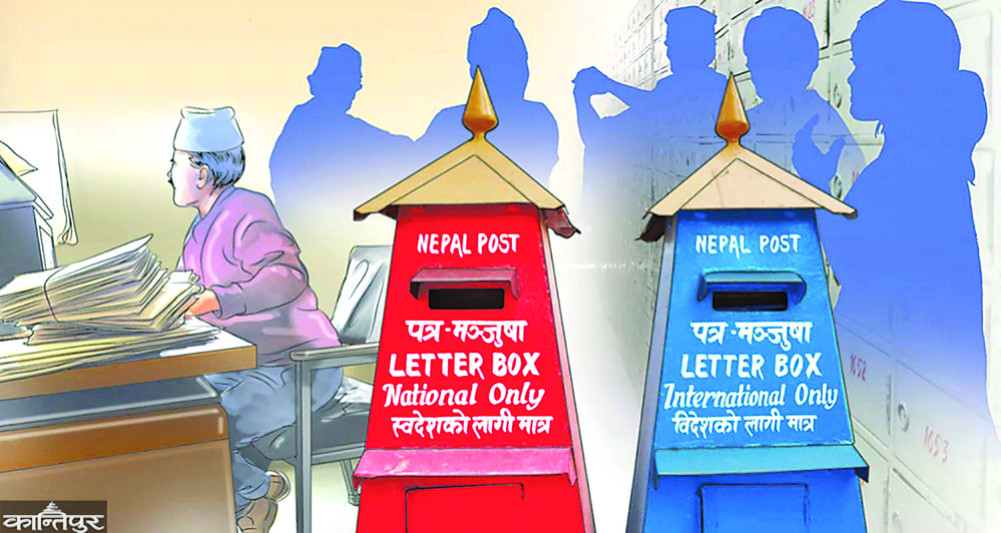
Patramitra was the most popular column after Horoscope in magazines, poet Bhavesh Bhumri's love and marriage with a girl from Darjeeling was through Patramitra, recently they brought out a collection of love letters.
We use Google Cloud Translation Services. Google requires we provide the following disclaimer relating to use of this service:
This service may contain translations powered by Google. Google disclaims all warranties related to the translations, expressed or implied, including any warranties of accuracy, reliability, and any implied warranties of merchantability, fitness for a particular purpose, and noninfringement.
The days that have passed physically do not return, but they keep coming back and forth in memory like paper tossed against the wind. I belong to that generation, which saw the call for Annapisani in technology from the thick to the cutting-edge, which in communication, from the active post to the cutting-edge electronic communication.
The era of autocopying
Naveen Chauhan's film 'Oonko Sweater' is still playing in the halls of the capital. In that, Phool Gurung asks Dharni Kafle to write something on his autocopier. Later, Phool Gurung complains that Dharani wrote a love letter on it instead of words of remembrance. That was the originality of autocopy in particular. The filler would have expressed love, friendship, compassion or warmth in some way. In this sense, this padalikha was a common medium of literature or art of expression. The "Gen-G" generation who sees the "wool sweater" will find it strange. The
auto was in vogue a long time ago. When I was young, I used to see my brothers and sisters bringing home autocopies of their friends. They kept it as secret as possible. However, where the bedroom was not different, what could remain a secret! In their absence I used to look at those autocopies. They had pictures of different people and their tender loving expressions. After reading those soulful expressions of Autocopy, the seeds of literature were planted in me. And then I used to draw my mindless Korkali literature with chalk on the paddy, wheat and pitha gyampas.
In the days of schooling, there was no address of who would reach where, who would go to another school. Also when SLC was approaching almost everyone in class 9th and 10th used to 'autofill'. I also filled it. When the female students accepted to fill the auto and he let her fill the auto, Mr. Freud would become speechless and pretend his heart would burst out of his chest to express his happiness. Last time in 2051 when I was studying BA second year in Trichandra campus, I filled the auto copy of a female friend named Asha Sharma. I wrote a lot in English to reflect the intelligence in it. I still remember one, 'Every End of Journey is the Other Beginning.' I don't know where Asha is. Today, after 31 years, I said that sentence from Vanira Giri's novel 'Karagar'. I had kept the autocopies and piles of my old literature until later. All of them were martyred in the Great Earthquake of 072.
Letter from post
Post was very popular during our school and college days. After reading Manu Brazaki's article on ghazal structure in 'Madhupark' in a certain month of 2046, I forgot the world and started writing ghazals. I had the illusion that I would write an excellent ghazal. I still remember two verses of one of them -
When I was walking, my foot slipped under the road.
The wolf grazed the green grass from the kid.
There are freckles hanging all over your cheeks,
Your husband smiled as if he didn't recognize me.
I wrote this in the imagination of meeting an ex-girlfriend after a long time. Remembering now makes you feel bad. I used to write 25-30 ghazals a day. Sometimes I used to write all night long, my head would fill up. And I used to send by post to various newspapers including 'Gorkhapatra', 'Madhupark', 'Garima', 'Samiksha', 'Drishti', 'Prakash' and other newspapers in and outside the capital. They would not have been printed, they would have gone straight to the dustbin. Editors and journalists were not familiar. In every newspaper there were disrespectful letters. The editor rarely read. I came to know this in the year 2052 when I saw it in the office of 'Drishti' weekly. Before that, how many letters were sent to request a song in Radio Nepal! My name did not appear in it either. The names of Gahwa Ansari, Qurban Ansari and others from Birgunj used to come every day.
At that time, our village brother Madhav Ghimire was employed as a news anchor in Radio Nepal. After telling him, my name was suddenly heard in the song "Formaise". My ghazal was broadcast for the first time in 2048 in the 'Yuva Sansar' run by him. For that, I got a salary of Rs. My feet weren't on the ground when I got paid for writing for the first time. Now I think it was only natural that my works sent by post were not printed. The editors and program directors did not read the letters that were written. Editor Vinodmani Dixit told me this while showing me the copy of the letter at the office of Samiksha weekly in Kalikasthan. The first literary magazine to print my work was 'Anurag', the editor of which was Lalijan Rawal. After that, there was another literary magazine that continued to be printed when it was sent by post - 'Nawakvita'. The editor was Hari Sharma.
literature in the newspaper
At that time literary newspapers were very popular. I don't know who started it. It must have started with the intention of publishing his own works and those of others like him when the big magazines did not publish his works. At that time 'Jyoti' newspaper edited by dramatist Krishna Shah 'Yatri' used to visit my address regularly. Slowly others started coming. Chhatra Kshitij used to issue another paper, Kashiram Viras another. I also decided to become a small editor due to the fact that the big magazines did not publish my work. I also became the editor of 'Darpan' newspaper in the year 2049 when I was studying BA first year in Trichandra campus. Three other people from
village remained in the editorial board. We used to refine and print the works of our friends in the village. Compositions also came from outside. Every now and then we used to sing special ghazals. I used to write an informative article about world cinema in every issue. We used to go to different villages, cinema halls and schools to take advertisements. People were eager to meet when they said it was from a magazine. After showing the air ticket, she would start laughing. However, I think that he and some people from the village helped me to raise my desire to become an editor and to build a foundation to become a journalist by giving me a little financial support. A few days after the release of
magazine, our busyness was worth watching. We had made some customers. We were busy going to deliver to him, visiting groups of people, tea shops and other shops to sell. As soon as they saw us, people would shout, 'The editors have arrived'. We used to fly. After reaching the customers to sell in the village, we would go to District Post Office Bhaktapur after reading the correspondence column of 'Yuwamanch' and people interested in literature. The post office would stamp it and keep it in the process of sending. At that time, Bhaktapur and Kathmandu District Post Offices did not have any space.
Correspondence
At that time, the practice of correspondence was also in the doldrums. It was the most popular column in magazines after horoscopes. Poet Bhavesh Bhumri's love and marriage with a girl from Darjeeling happened through correspondence. Recently, they collected the same love letters and brought out a book. After the composition was published in the newspaper, I also started receiving letters. Apart from replying to them and writing a composition with letters to please the editor, I had no idea how to become a pen pal. Yes, instead send many greeting cards by post to dear friends on Dasai, Tihar and New Year. The answer came from only a few. If the address is not complete, the letter may not reach the destination.
I learned how to send letters from a children's program run by comedian Gopalraj Mainali on Nepal Television. Thus the first letter I sent was to a classmate named Babita. I was the only one who could spell and spell 'Sapkeeper' when I was studying in Class 4 at Arani's High School in Dadhikot. Navraj sir, who taught English, picked up all those who did not come from the bench. I only pretended to be scolded for having to hold her ears and peck her cheeks. During Babita's time, her cheeks became like a mustache. Everyone laughed. Navraj sir, who was watching all this, scolded me by saying 'not like scolding, like this', so that the left cheek reaches to the right. A herd of girls sympathized with me after halftime because I was so quick. Babita was also there. He didn't say anything, but his look was like playing a fife in his heart. Well, I wrote him an emotional letter and sent it by post. I put his name, surname and village in the address. Complete address was not known. That letter must not have reached him because he never responded to me about it.
In the end,
Correspondence, autos, and letters have now become stories of Ekadesh. Yes, letters are still in practice in government affairs. So the post offices still exist, even though they have to be swatting away flies. Internet started on January 1, 1986 followed by Hotmail in 1996, Yahoo in 1997 and Gmail in 2004. Slowly the computer age began. It's been a long time since writers started writing on computers. Pradeep Nepal, Abhi Subedi and Khagendra Sangraula are known as authors who started writing on computers in Nepal. There was an era of fax before email took off. Newspaper page editors and operators used to be puzzled by the dim letters coming from the fax machine. After the email came, the fax also went away. I mailed many handwritten ghazals and poems to
newspapers. I also sent the article later. Newspapers like 'Kishore', 'Parda', 'Manokamana', 'Roshni', 'Kamana', 'Sadhana', 'Star' used to publish my articles sent by post. Later I went and met the editor myself. It became known to the editor and was not difficult to print. In the year 2060, when we started writing and using e-mail on the computer, we entered another era.