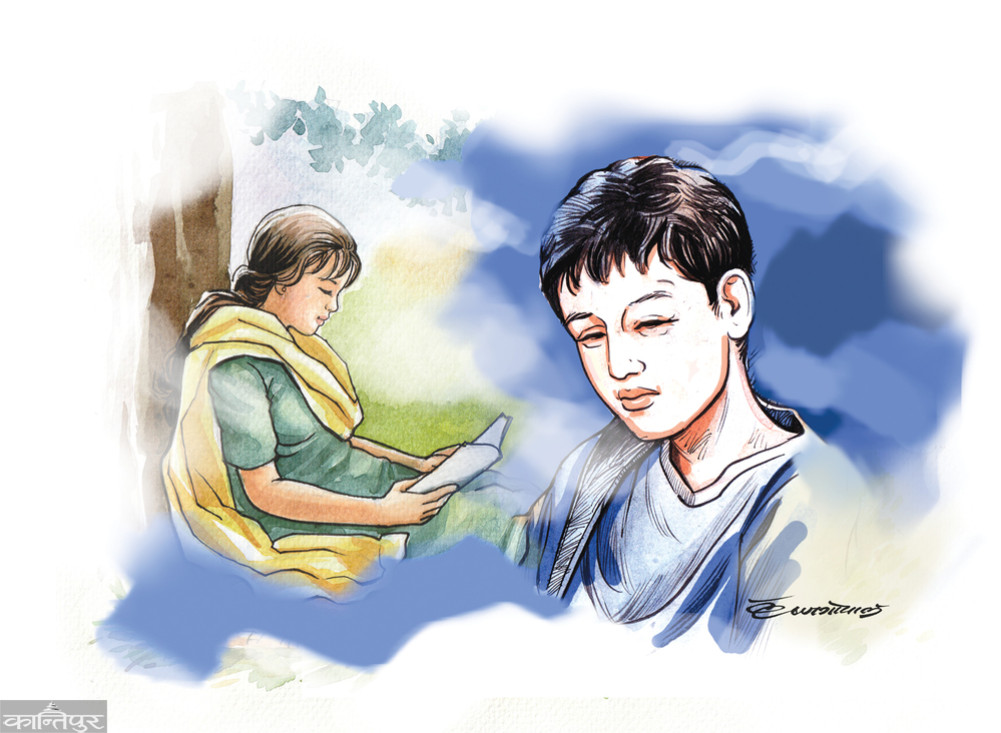
In today's digital world, sending and receiving messages is instant and easy (one click away), no need for paper, no waiting, no ritual but, in gaining convenience, we have probably lost depth.
We use Google Cloud Translation Services. Google requires we provide the following disclaimer relating to use of this service:
This service may contain translations powered by Google. Google disclaims all warranties related to the translations, expressed or implied, including any warranties of accuracy, reliability, and any implied warranties of merchantability, fitness for a particular purpose, and noninfringement.
It was a time— must still be fresh in the memory of many— when the villages had no telephone, no television and certainly no Internet. The trend of going to school had just started in the village. In those quiet corners of the country, where there was no electricity.
One had to sit and study under a peepal tree or else the roofs of the schools were usually thatched or stone. Girls rarely attended school and those who did often sat quietly at the back of the classroom, watched over by both family and tradition. Falling in love in such a situation was not only difficult—it was also dangerous. Like an unannounced ban! Open or public conversation between boys and girls was considered improper, if not outright forbidden.
Despite that lack and silence, a powerful, unexpected, nuanced and sensitive curriculum developed – the practice of love letters, which not only communicated the risky communication of love, but also gave new life to newly learned literacy. Love sought the path to literacy. Literacy gave love a strong medium.
Love in the Time of Silence
In that world, there was no shortcut to the heart. Phones had not come to the village yet in the country. Printed books were extremely rare. Some used to have religious books or textbooks in their homes, which reached the village very late. The radio hummed government news or devotional songs and the newspapers had no mention. Some pages of 'Gorkhapatra' brought by someone back to Kathmandu were sometimes found. Schools were confined to small rooms, focused on rote learning.
teaching-learning was often limited to the teacher moving texts written in illegible characters on the blackboard. What this means is that the environment needed to expand literacy was not ready. Still, somewhere in the midst of these limitations, something remarkable happened: boys began to write letters—love letters.
By the time I reached/not reached 7th grade or even earlier, some boys in my class used to experience homin in a mysterious, exciting journey of infatuation. But how can they talk to the girl they want? It was a very risky job. At least they had one newly acquired skill – literacy.
therefore dared to write. With trembling hands and hopeful hearts, these young writers began to compose the most honest, clumsy, poetic and emotionally charged texts of their lives. Sometimes, they would spend the whole night finishing a letter. Due to the intensity of their feelings, they decided not to leave Sidhyai. Parents concerned – children doing homework.
The Birth of Hidden Literacy
Writing love letters wasn't just a romantic gesture. It was a secret entry into the world of literacy. Educators such as Lev Vygotsky have emphasized that learning is intensified when engaged in meaningful social interaction. The process of
love letter writing—although unsupervised and informal—took the form of learning and social interaction. Its purpose, sentiment, audience and outcome were also clear. This informal, but effective learning environment is what educators often call the "invisible curriculum"—an informal education that takes place outside of the formal classroom. Every word was important. Every word in a love letter has meaning.
Philip Jackson, an American pedagogue and curriculum specialist, said in 1968 after a detailed and long study of classrooms - in addition to the lessons formally given by the teacher, the informal, unwritten behavior that develops in the classroom, hopes, expectations, unannounced rules, social relationships, etc. are also an integral part of learning and these things cannot be denied. In fact, it is from the classroom that children learn things like obedience, hatred, morality, social discrimination, and love. Children's attraction to each other is also a natural process in the classroom.
is actually an important means of textual production of love letter writing. In many countries, textbooks written by children are used in teaching and learning. It is nothing new for modern 'adult education' and 'reading pedagogy' students to use learner-prepared materials in teaching-learning. While the concept is popular and effective, the texts created by these young lovers are an entirely different phenomenon.
Love letter writing was an underground activity, born of personal desire and social compulsion rather than academic design. With no access to story books or literature, the love letters written by many boys became the first real 'text'. And, it was not an easy task. Finding the right words to express affection required not only emotional courage, but also a command of language. Spelling became important, grammar became important and metaphors became meaningful. Boys who struggled to pay attention in
language classes now spent hours revising a single paragraph. As paper was rare and valuable at the time, one did not have the luxury of throwing away a letter if it did not make sense. Writers had to do great mental preparation, daring to put pen to paper before carefully squeezing their thoughts onto a tiny, precious piece of paper. It was not easy to put into words the invisible feelings inside the mind. If those who have such abilities were given a formal opportunity to write about nature, rivers, rocks, mountains, deities or any other subject, there would probably be no shortage of teaching materials in schools.
love letters are sometimes not easy-to-understand text. It was especially difficult for an outsider to fully understand the text of the love letter. The language used by lovers often resembles sociologist Basil Bernstein's limited code. When speaking in such a language, one does not have to reveal much, because it is the shared experiences, memories and feelings between them that reveal the meaning. A single look, a special nickname or even an incomplete sentence can have a very deep meaning for them. Like- 'Same place, same time?', 'You do the same thing again...', 'Do you remember that night?'- these sentences may sound ordinary to others, but they are very meaningful to lovers.
However, the language of love is not just a limited code—it also has emotional depth, metaphors, self-made words, and private signals. Therefore, some linguists refer to it as an intimate code or an emotional code, which is formed by a special relationship of trust and love.
I mentioned Basil Bernstein above. Just to show the slight connection between love letter and limited code. In particular, Bernstein conceptualized two types of language codes—restricted and extended codes—by clarifying the differences in language use according to social class.
According to him, the language used by the working class is context-based, short and vague. This was called the limited code, while the language used by the middle class—the elaborate code—was clear, formal, and elaborate. Schools often value formal language, which can place working-class children at an educational disadvantage. Bernstein mentioned this after studying the British education system.
Even when studying the language used in the answer sheets of the school level and university level exams in Nepal, there are many varieties. Studying Bernstein's perception in the context of Nepal will be useful from an academic-social point of view, but what seems to me is that through love letter writing, a person's limited code is transformed into an extended code, where a simple, context-based expression evolves into a deep, emotional and sophisticated communication style. When it comes to
love letters, then writing a love letter is like doing a mini-research. Love letter writers did their own little quests. They listened intently to Nepali or Hindi songs, memorized dialogues from dramatic films, repeated poetic lines used by adults and even looked to nature for inspiration—observing how love manifests between birds and animals. These metaphors helped them describe their desires. This process helped transform them into not just writers, but students-poets of their own lives.
And, when words seemed insufficient, they turned to other sources of inspiration. Boys from affluent families, who had some old novels or film magazines in their homes—they used to look for those materials. Such novels were often highly dramatic and sentimental, but contained a wealth of heart-stealing sentences.
A boy might not understand the full meaning of a story, but he would remember a phrase that touched him—like 'heart on fire' or 'eyes like a deep river'—and use it to impress the girl he liked. Since ancient times, women have been compared to the softness of flowers and the light of the moon. These similes express the beauty, mystery and aura of woman. These boys did not fail to find and use those similes.
This wasn't just imitation—it was creative adaptation, a form of intertextual learning. Without realizing it, the boys were practicing literary techniques: borrowing language from one context, modifying it, and synthesizing it in another. These tasks reflect what literacy scholars call 'transformative literacy practices', where learners repeat and reassess texts they have not yet learned.
Literacy: The Basis of Expression
literacy is the ability to read and write, but it's not just that—it's also a way of understanding, communicating, and constructing ideas. When someone first learns literacy, their words can be simple, clumsy, but functional. Over time, literacy turns to fluency, which deepens and refines ideas. For newly literate adolescents, each word is a new discovery, each sentence a step toward mastery of communication. Their writing can be straightforward, raw, and imperfect—but it has a thrill of expression.
Literacy : the art of language
Literary writing is not just a means of conveying information—it is an attempt to find beauty, emotion, rhythm, and depth. It plays with language to create symbolism, evoke emotion, and convey truths that lie beyond the surface. Literacy is created by making literacy artistic. Interestingly, neo-literate writers create literary beauty spontaneously.
Their words can take on a poetic quality, simple and honest. A teenager might write: 'There's something about you that I can't describe. But, I try.''This is a literary moment—born of literacy. thinking, which encompasses emotion and strives for metaphor, while the writer himself is learning the structure of writing.
literacy makes literary expression possible. Expressing words at first, no matter how hesitant, is the first step toward artistry. The raw, uncertain voice of neoliterate writers conveys emotion directly, leading to powerful literary moments.
The girl who secretly reads
Of course, the recipient of the letter was the girl who sat in a group of two/four girls in a corner of the classroom. At that time, very few girls would initiate conversations with boys. Social norms would have silenced their voices. However, receiving the letter was a different matter. Reading that letter—secretly, often late at night, sometimes with a heavy heart—was a profound experience.
It was also a lesson in silent, reading. Through love letters, girls were also learning advanced and complex literacy skills with no connection to formal textbooks. These letters had to be interpreted with caution. It was not a matter of choosing to interpret the words of the
letter one by one. Is it serious or playful? Were the cheap metaphors borrowed or honest? Did he really mean what he wrote? How difficult – reading becomes layered, emotional and interpretive – comprehension and emotional intelligence the hidden curriculum.
Importantly, the girl reading or reacting to the letter was a rare opportunity in her life to think or make a decision independently. Where others told him to do, he had to do. Before she had probably done nothing of her own free will, had no right to even the extraordinary and important, where girls were rarely encouraged to speak their minds or express their desires, the love letter provided them with a mirror. The
was the first time they felt cared for, noticed, wanted, and often provided a private space for self-reflection and choice, even against significant social barriers. For many, it was the first time they had been directly addressed by another person's imagination. A subordinate also reserves his right to imagination.
girls were sometimes more emotionally expressive in their responses. Some were sharp observant, expressing their feelings using delicate metaphors and even Hindi Shayari (Doha). Some responded politely and encouraged the relationship.
Others, however, would end the conversation abruptly, using strong language that reflected the social boundaries and emotional risks they faced. But those actions were also powerful lessons in determination, choice, and interpretation. That task, too, had to be accompanied by both literacy and literariness, with either an affectionate ending to the story or a careful journey to continue.
messenger: The third corner of the triangle
was then the messenger—the third, and often forgotten, participant in this secret teaching. Usually, a sibling, nephew, niece, trusted friend or a simple boy from class was chosen with great care. He had to be loyal, discreet, and brave enough to get the letter into the girl's hands—or at least where she would find it.
Sometimes, the temptation was too strong. The messenger would open the letter, read it, and in doing so, become another beneficiary of this unintended classroom. He would brainstorm difficult words, laugh at romantic exaggerations, and even anticipate what would happen next. In this triangle—writer, reader, messenger—all three learn something. Not only about love, but also about language.
This phenomenon corresponds to Paulo Freire's concept of 'reading words and the world'. Freire, a Brazilian educator and philosopher, who argued that literacy is never neutral—it is a tool to interpret reality, to imagine new possibilities. These letters were therefore not merely sentimental documents. They were small acts of resistance against a world that discouraged emotional expression and female literacy.
experiment: validation of unseen learning
To test these theoretical insights in real-life experience, I conducted an informal 'experiment', interviewing a group of people well over 60 years old. Although it was a long time ago, but as we talked, we realized that they were in a position to tell what happened in their school life. Half of them admitted to using love letter writing in literacy activities, confirming its profound impact.
These were all men and they spoke openly about their experiences. Four out of ten admitted to writing love letters to girls, three sometimes and two never. Interestingly, one in ten had served as a messenger and described it as 'the most dangerous job in the world'. Those who practiced
love letter writing are now either teachers or working in government roles. During the interviews, they reflected on how letter writing helped them strengthen the literacy skills they had acquired.
Current educational research supports this: regular practice is essential to strengthen literacy. Writing love letters improved their handwriting, expanded their vocabulary, and mainly taught them how to express themselves, organize information, and find ways to say more with fewer words. Even the messenger—though not the author himself—benefited. By reading the letters he carried, he also got a chance to get acquainted with new words, ideas and feelings.
The science of love and language
Cognitive neuroscience has increasingly shown that emotions enhance memory and motivation. When an action is emotionally charged, the brain releases dopamine and oxytocin, chemicals associated with motivation, emotionality and attention. Practically speaking, this means that a guy who writes to someone he cares about is more likely to focus on, revise, and remember what he wrote. Thus the love letter becomes a neurological engine for literacy.
This kind of experience is what literacy researchers describe as 'emotional literacy'—meaning that emotional engagement is not just a 'side effect' of language development, but a driver. Modern classrooms often miss this important element, focusing instead on emotionless forms of writing. Through emotion, as these love letters so powerfully demonstrate, reluctant learners can be transformed into passionate writers. Genuine emotional involvement is the most effective driver of learning.
A multi-purpose text
These letters were not just expressions of affection. They were also a negotiation of identity. In an attempt to impress a girl, a boy explores different versions of himself: dreaming of becoming a poet, a gentleman, a philosopher. He could learn to revise, self-edit, and imagine another person's thoughts and feelings. This process sharpened his awareness of his audience or reader, causing him to consider how his words would be received and understood by the girl he was trying to reach.
He also learned to take risks. Every letter sent was a gamble. Will she read? Will she smile? Will you tear it? Will she tell anyone? The emotional stakes made writing so meaningful—more so than any school homework. For
and Katie, reading letters was also a way of seeing herself differently. Where the world gave him few words Letters gave him focus, meaning, and sometimes, a sense of power.
A classroom without walls
If education is to develop the whole person, these love letter exchanges were a kind of elective course. They taught young people how to communicate, how to take emotional responsibility and how to imagine another person's inner world. More importantly, they taught literacy as a lived experience.
New Literacy Studies scholars such as James Paul Gee argue that literacy is not just a skill, but a collection of social practices. A love letter written in a village without telephones is as legitimate a literacy event as a school essay. In fact, it can be more effective—because it makes more sense. The physicality of the
letter was also important. The texture of the paper, the choice of ink color, the folded corners—all these features engaged the senses. This embodied literacy, evident in every wrinkle and hasty scribbling, cannot be duplicated by digital communication.
What have we lost?
In today's digital world, sending and receiving messages is instant and easy (one click away). No paper required, no waiting, no ritual. However, we may have lost depth while gaining convenience. The love letter made us pause, reflect, be artistic. It taught us that writing is a devotional act. Today's language is 'disposable'. Typing 'I love you' takes two seconds and requires almost no thought.
Moreover, today's digital literacies often lack emotional seriousness. Emojis take the place of metaphors. Like replaces letter. Learning through emotionally invested communication is now scattered in bits and pixels, often without nuance. This is not to say that modern love lacks meaning. But, it's important to remember what was achieved in the old way—and what might be worth reclaiming. Literacy experts say that in today's digital world, it is necessary to change the definition of literacy.
Conclusion : Literacy as Love, Literacy as Salvation
In the days before phones, it wasn't just lovers who wrote and read love letters. They were accidental poets, secret learners and participants in a quiet revolution in language. Lacking formal resources—no phones, no storybooks, no permits—they built an underground school of emotion, form, and expression. The
love letter, passing through the hands of a trusted messenger, became a medium of both romance and education. It taught young people not only how to feel, but also how to express what they felt. And, on that fragile, folded piece of paper, they discovered the magic of words—and, unknowingly, the power of literacy.
As educators and societies today ponder how to best foster literacy, the stories of these letters remind us: The best learning happens when it is grounded in real life, filled with emotion, and shared among people. Even in silence, even in secret, young hearts were learning—and, through love, they were writing their way into the world .