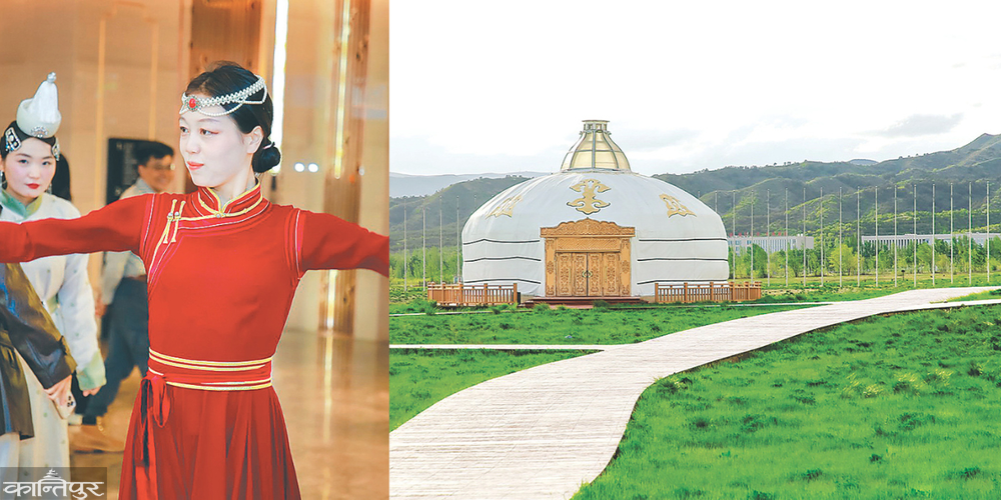
If some of you have an image in your mind of Inner Mongolia as a desolate, backward or remote city, that understanding will be just an illusion.
We use Google Cloud Translation Services. Google requires we provide the following disclaimer relating to use of this service:
This service may contain translations powered by Google. Google disclaims all warranties related to the translations, expressed or implied, including any warranties of accuracy, reliability, and any implied warranties of merchantability, fitness for a particular purpose, and noninfringement.
Have any of you visited Inner Mongolia before? If not, how do you imagine it would be?' Wu Hanglang, president of the China Diplomacy Association, asked this question in the middle of a formal speech and took a few seconds to 'pause'.
In the second week of last May, at least two dozen of us journalists from 23 countries of the world reached Hohat, the capital city of Inner Mongolia, at the invitation of China Diplomacy Association and Chinese media company Global Times. Wu Hanglang was speaking at the formal welcome event held at that time. After a long 'pause', he looked at the journalist for an answer. When there was no answer, he said, "If any of you have an image in your mind that Inner Mongolia is a desolate, backward or distant city, this visit will confirm that your impression is false."
Then Wu Hanglang smiled. And, added, "Inner Mongolia is an important part of Chinese civilization, where the grassland and agricultural civilizations mingled with each other." The sight of herds of horses, cattle and sheep in the vast grasslands is a sight to behold.''The Chinese are known for their warm hospitality. And now they are equally excited to share their achievements and success stories with outsiders. In this sense, Wu Hanglang's enthusiasm was natural. However, he was more than excited. Because, this was the hometown of this high-ranking Chinese official who lived in Beijing most of the time. He is a resident of Ulaanbaatar, Inner Mongolia. After the welcome program was over, he said, "This time I am touring my own city with my foreign media friends. That's why I'm excited and this will be a new experience for me.'
Hanglang, a resident of the same city, was getting a new experience, while for an outsider like me, the journey to the rising prosperity of Inner Mongolia was going to be a new one. The feeling of novelty was felt from the first day of the visit, when we reached the 'Yili Modern Intelligent Health Valley' in Hohat.
This is the ambitious project of Modern Intelligent Health Valley Hohat, which has taken a big leap in milk production. Among the world's leading dairy companies, Hohat's two milk dairies, Yili and Mengniu, have also emerged. According to Jian, the general manager of the National Center of Technology Innovation under the Yili Modern Intelligent Health Valley, the famous dairy Yili, which dominates the Southeast Asian market, produces more than 1,000 types of dairy products, including milk, yogurt, and cheese. What was new to me, the main attraction and highlight when I got there was that dairy products were being processed using Artificial Intelligence (AI). The use of AI robots in cattle rearing, milk production, processing and packaging was an unparalleled example of the highest use of technology in agriculture and animal husbandry.
How many cows should be reared to produce more than a thousand milk products? Filled with curiosity, I asked General Manager Jian, does this dairy company have its own cows? If so, how many? He said that an estimated one million cows are in various firms in Hohat. There was no opportunity to see cattle rearing directly in the firms. However, a video was shown during a tour of a dairy factory where thousands of cows were farmed. With the help of automatic robots, grains and water are kept in their tanks and their toilets are also cleaned.
Cow rearing, milking, collection, processing to packaging as seen in 'Yili Modern Intelligent Health Valley' where the highest technology was used, was amazing. Jian says, “This ambitious project focuses on leveraging cutting-edge digital innovations to promote full chain development within the dairy industry, empowering smart city initiatives.” He further added, “Hohat aims to establish a sustainable and integrated model through green initiatives with technological advancements. Now our journey is to become the world's most prosperous dairy company and we have grown into the concept of building a 'Dairy Silicon Valley'. According to him, this project aims to employ three and a half million people by 2035 while increasing economic and social benefits in the future.
The second day of visiting Hohat, the capital of Inner Mongolia, is a bit hectic. Because, the organizer is planning to tour at least 5 different places. Language translator Iris is ready to give information about the places. Introducing the city, she said, 'Hohat, the capital of this northern province of Inner Mongolia in China, is a combination of blue and green colors. "The open blue sky and pure green meadows have brought the beauty of this city to life," Iris said, "You can even call our Hohat the blue city." Perhaps because of its many characteristics, today it is called 'blue city'. We reached the Chilechuan grassland to get a panoramic view of the blue city. This grassland is in Yematu Village, Baoheshao Town, Hohat City. This meadow, which is closest to the city, is also called the 'garden behind the blue city'. The main feature here is the view of vast green pastures. In other times, there were many horses, sheep and other livestock. Maybe it will be less during this season,' said Iris. Only two-four horses were seen grazing in the pasture area, that day.
then reached - 'M grass'. When I heard the name, I thought it was another meadow. But, yes - an office that produces high quality grass seeds. It produces high quality grass seeds and provides innovative technical services. M Grass will work in collaboration with the National Forest and Grassland Administration and the National Engineering Technology Research Center for wind erosion and desertification control, informed the official. Similarly, it operates more than 30 national, but provincial scientific research platforms with laboratories for conservation and improvement of cultivated land fertility in agricultural phase ecotones under the Ministry of Agriculture and Rural Affairs. It has also established the National Grass Industry Innovation Center in collaboration with more than 70 research institutes, universities and enterprises.
After understanding the institutional efforts made by China to study and research new species of grass and its achievements, our next destination became the Hohat International Sculpture Park. The park embodies the essence of northern frontier culture through a harmonious combination of architecture and nature, said another Chinese official associated with the park. He said, 'These architectural designs placed in the park thoughtfully adapt to the natural terrain. The built structures create a seamless bond between the surrounding landscape.'' The buildings in the park have thatched roofs decorated as if they were lawns. From a distance, the buildings look like a natural extension of the meadow. On the second day of the tour, there was an opportunity to see examples of the best practices in technology at Yungu Exploration Port and Inner Mongolia Data Center.
Yungu Exploration Port Horinger is an attractive digital exhibition space located in the heart of Data Town within the new area. Covering a vast area of 8,000 square meters, this futuristic port highlights various sectors including aerospace and national defense through immersive experiences and digital tourism. Journalists were observing how the intersection of culture and technology is creating dynamic educational opportunities and enriching the consumer experience. Likewise, the Inner Mongolia Data Exchange Center is a government-approved data training platform. An official of the company says, “It is promoting the digital economy by providing services like data registrar, its trading and computing resource transactions. It is fueling innovation.'
Another destination after Hohat was Ulaanbaatar, also the hometown of Wu Hanglang, president of the China Diplomacy Association. It is another district connected to Hohat, the capital of Inner Mongolia. This district has been awarded the title of 'National Garden', not only clean, but also in terms of food security. Another nickname for it is the potato capital. It is also called the Capital of Dahi as it is equally famous for curd, which is famous for cheese. The Chinese style of promoting by adding the capital behind it was strange.
Let's see how the highest technology has been used in agriculture in this city. Reached for that, the Cold Tolerant Vegetable Center established in 2012. It is the first vegetable research center established in Ulaanbaatar. Its president Guan Huiming said, "We use AI control system for vegetable farming. Specifically, it uses sensors and computer chips to automate the water process. Sensors detect how much water the plants need and a computer automatically controls the valves in the pipes after receiving the signal. Rather than simple words, we call it smart water conservation, which is also a part of smart agriculture.' A few years ago, when I visited China, I saw an experiment by the Chinese to make the entire village affected by the earthquake a museum and how to adapt to adverse conditions. Here too, the same tourism-development model has been adopted in the volcanic area, where thousands of Chinese have been arriving every day. Apart from that we visited various tourist and cultural parks, high technology development areas like in Hohat.
Wherever we visited, the Chinese style of presenting things seemed exemplary. The Chinese love to glamorize their things. Whether you reach a museum or a business house! There the relevant subject is archived in depth and presented in an attractive manner. For example, a potato company that makes chips had a similar experience when it reached Saidu. There were packets of chips being made, along was the history of the potato. When and what potatoes did the Chinese introduce to China? Where in the world can potatoes be found? Who produces how much? Alu museum has been made by including etc. topics.
When I was returning with many such tableaus from my five-day visit to Inner Mongolia, I asked Wu Hanglang, who spent his childhood in Ulaanbaatar and is now a high-ranking official of the Chinese government, 'How do you see the prosperity of Inner Mongolia?' He said briefly, 'I have lived in this city for 19 years. Where my house is now, there used to be a farm and even today I am amazed at the progress this city has made. I am amazed to see the prosperity of the city in my lifetime.'