Narayan Wagle is looking for Raithane cows, but does not find the real Raithane breed. The village is home to Holstein, Jersey. Only Thimaha is found in the name of Raithane.
We use Google Cloud Translation Services. Google requires we provide the following disclaimer relating to use of this service:
This service may contain translations powered by Google. Google disclaims all warranties related to the translations, expressed or implied, including any warranties of accuracy, reliability, and any implied warranties of merchantability, fitness for a particular purpose, and noninfringement.
Our car was heading towards Kuchap Teranga Gumba. We got news that the monastery is half an hour away from Jomsom. A plan was made to go there after getting the information that the monastery is a magnificent view point with a view of Sang, Puthang, Jomsom, Dhumba Lake and the Nilgiri mountains.
When turning from Thini towards Dhumba Lake, after seeing four/five cows grazing on Fusro Danda, fellow traveler Keshav Dahal said, "Narayan Wagle's Raithane cow is here."
I was surprised. What is this? Raithane Gai sought by author Narayan Wagle?
The car enters through the iron gate. A few Teranga monasteries are under construction. The view point of Thumko is as beautiful as it sounds - the view of Sang, Puthang, Jomsom, Dhumba Lake and the Nilgiris is amazing. The villages of the Kaligandaki valley are resting and the runway of the airport seems to lie on the banks of the Kaligandaki. There is a wind blowing in the beak, a colorful thread is fluttering.
The ship is landing at Jomsom airport in fifteen minutes, taking off. Because the wind does not move the ship after 12 o'clock. While landing, the ship turns rapidly in the narrow gorge of Kaligandaki. A few seconds went down...! Syringe. On take-off, it flies from below the tip of the monastery, amazingly!
companions are – Keshav Dahal, Mumaram Khanal, Prashant Singh and Dumbar Khatiwada. Keshav Dahal is a storyteller and columnist. Mumaram Khanal Political analyst and former Maoist. Prashant Singh Former Director and Financial Analyst of WWF Nepal.
Dumbar Khatiwada political analyst and columnist. A common bridge connecting all – Citizens First Campaign. During the journey I came to know about Dherthor Nagarak Pratham campaign. Fellow hikers take photos with the Nilgiris in the background. Single, double, triple photo taking - the sequence goes on endlessly. We take a group selfie with the blurred gorge going to Kaisang Cap and the nilgiris in the background.
Hururu wind is running through the valley of Kaligand. When facing the direction of the wind, nothing is heard due to its flow, you have to turn back to listen. We return to the car, the cow is still grazing in the same place as before, eating thorny weeds. I can't stop opening up. Turning towards Dahal, I opened my mouth and said, 'Narayan was talking about Wagle's cow. I don't understand. Don't say anything stupid!'
Dahal says with a smile, "I went to Tanahun Farm from February 15th to 17th to participate in the spring festival of Narayan Wagle. There I got an opportunity to learn about the organic farming system. I got to know the knowledge technology of Raithane Biun-Bad and the importance of Rainathe breed of animals. Talk to the tree. I learned that clay breathes. However, due to modern farming systems, the soil is not able to breathe. Soil is dying due to increased use of pesticides and chemical fertilizers. Cow dung, wheat, hooves, horns are of special importance for increasing agricultural production.'
Vasant Utsav made him an activist.
Dahal is known to say, 'Vagle Raithane is looking for cows for organic farming system. Cows of real Raithane breed are not found. How to get? Jersey, Holistin is home to advanced breeds. For the promotion of dairy business, the government has given priority to cows of advanced breed. Thimaha cow is found in the name of Raithane.
Raithane seeds and animals have been displaced. There was only a small Mahabharata, the search for a cow.' While saying this, a deep sadness appeared on his face. As if he is saying - Poor Narayan Wagle! The vehicle was moving towards Jomsom through Thini and the military barracks of Puthang were moving into view.
I said, 'That is Raithane cow here - says Lulu. Found in central and western Himalayan districts including Mustang, Manang, Dolpa. Above 2800 m. Accustomed to living in the harsh climate of the mountains, the Lulu cow. Wagley had to be called Mustang. Where is Raithane looking for cows in Tanahun?'
Something like lightning flashed in my mind and I eagerly said, 'How about writing an essay with the title Narayan Wagle's Cow? A little bit of reality mixed with a little bit of imagination? This time, Khatiwada said, "Good, Roshanji." Being a writer, you are probably thinking of a title right away. The title is suitable, write it.' Khanal also turned to me and smiled, so I thought the title was unanimously approved.
Arrives at Jomsom, where the wind is blowing, at 12 o'clock. Met friend Sherjung Gurung at ECAP Information Center in Jomsom. We are familiar with each other as he is an old employee of Acap. The vehicle will be informed about the road conditions to Lubra (Lupra).
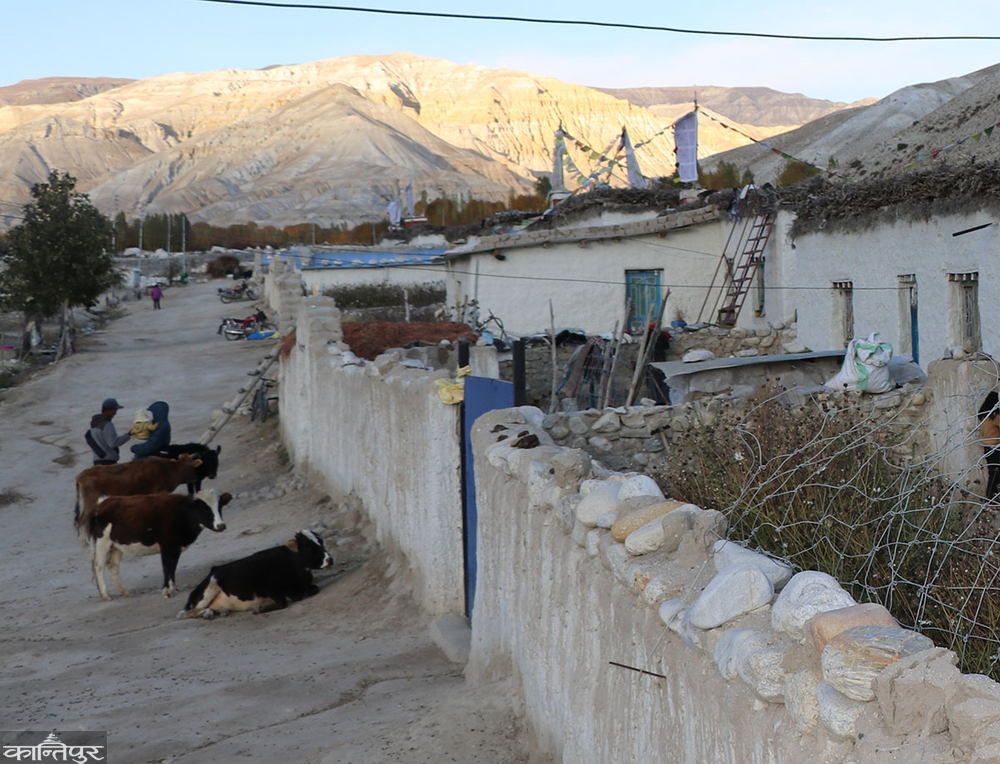 Lomanthang rural municipality-2 new Samjong settlement of Mustang, local Lulu breed cows. Photo: Ghanshyam Khadka/Kantipur
The car of Kaligandaki is running wildly on the black road. Prashant sir is driving cautiously, also listening to our conversation with persuasion. As I used to work in WWF Nepal, he is my senior, but fellow traveler on this journey. As per Dahal's plan to see the Bon Monastery in Lubra and learn about the Bon religion, the vehicle diverts from Pandakhola. We were lured by Lubra, said to be the only bone monastery in Mustang.
Bon - Pre-Buddhist is considered to be an older religion than Buddhism. After twenty, twenty-five minutes of walking along the unpaved road, Lubra arrives. A small bush settlement. Just off the beaten track. A place of wonderful spiritual feeling. Household total 14. Asking
, we went straight to the monastery. But, unfortunately, the monastery is closed. Not found for a long time. We entered a restaurant hoping to get some information from the locals. Two foreign tourists were drinking tea - from Muktinath.
That means, there is a footpath connecting Lubra from Muktinath. We ordered Tora (Dale Chuk) juice. Coke, much stronger than Fenta, with a distinct taste. Helping the local economy as well. The sister of the restaurant will not know much. All she said is that there is only one Bon monastery in Mustang district and Bonpo walks from the opposite direction to Manelai Buddhamargi. I asked, 'And being a local, why do you have so little information?' She said, 'I have not been in this village as a daughter-in-law for a long time.'
Charles Ramble, an anthropologist, is known to have studied Bon religion in this village. As an employee of Acap in the past, I had heard about Ramble. In history, there was a terrible war between Bon and Buddhists in Tibet. If the Tibetan king became a Buddhist, Bonpo would be chased, and Bonpo would be Buddhists.
Pratapi Raja was a special favorite. I heard that Tasi Gyalsen, a Tibetan lama who was driven out by a Buddhist king, came to this place via Dolpa in the twelfth century and built the I Monastery. Bon probably chose such an uncontorted place to preserve the seeds of religion. Here too saw three/four cows in the barn. A scene of writer Narayan Wagle searching for Raithane cow suddenly came to mind. I scolded myself and asked the local residents - is Lulu a cow? I got the answer, 'Yes.'
We arrived by car. The vehicle was parked on the banks of Panda River. We took photos with the car to get a view of the barren wall across the river and the ancient cave that can be seen there. Leaving the Panda River, the vehicle moved forward. Reaching Lomanthang today. Descending from place to place, enjoying the cool air, taking pictures and taking photos. In the car or tea break, you have to exchange the ideas you have met on the culture and economic social side of Mustang.
Kagbeni was seen. I was chased by Lulu the cow. Lulu cow of small saddle is made for Himalayan region only. Every time I write Lulu, my heart melts. Not having enough grass to eat, thorny weeds are found scratching leaves. There is a complete lack of pasture. Barley straw. There is also intense competition in the thorny weeds, with sheep and goats.
The red monastery of Kagbeni market is visible. The car is racing to find Kagbeni. At the same time, the imagination is running at an equally fast pace. I see in my imagination - Dahal will meet Wagle at the farm in Tanahun after returning from the trip. Wagle will elaborate on the Raithane cow found in Mustang. Dahal will say – Where are you looking for Raithane cow in Tanahun? Raithane has to go to Mustang to find cows. They will not fail to say
, 'Lulu, who is living in Mustang with a lack of pasture, will be very happy to eat plenty of grass in Tanahun. You like religion.' But, they will not say, 'How will Lulu, who is used to the harsh climate of Mustang, endure the heat of Tanahun?' Wagle's eyes will shine after hearing everything. And, in a well-known Dhodro voice, he will say to his wife, "It is very difficult to get a Raithane cow here." I will climb the Mustang tomorrow, but where is my rucksack?'

