We use Google Cloud Translation Services. Google requires we provide the following disclaimer relating to use of this service:
This service may contain translations powered by Google. Google disclaims all warranties related to the translations, expressed or implied, including any warranties of accuracy, reliability, and any implied warranties of merchantability, fitness for a particular purpose, and noninfringement.
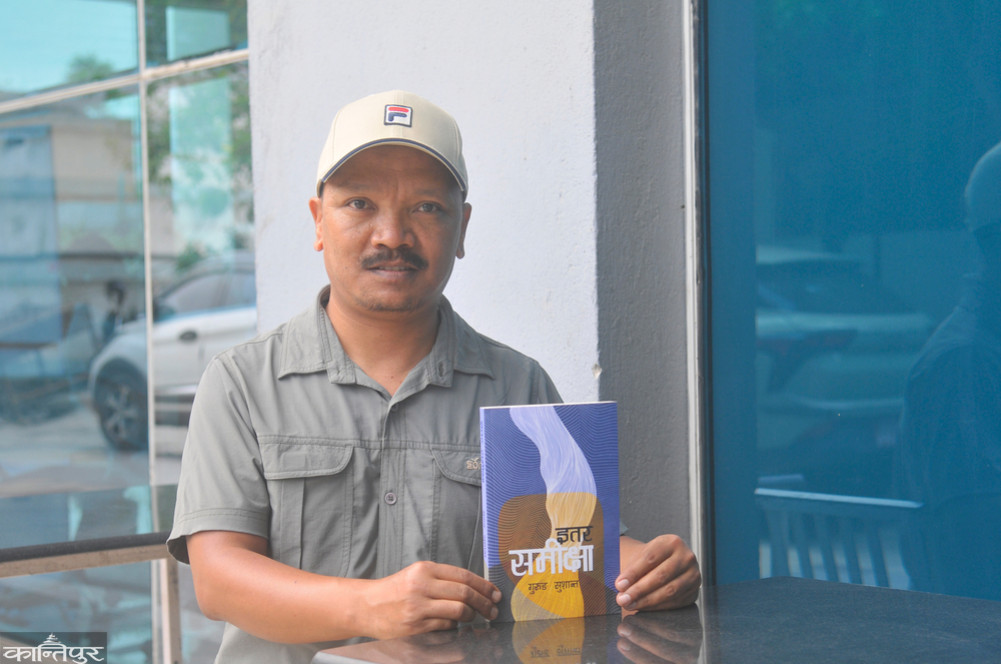
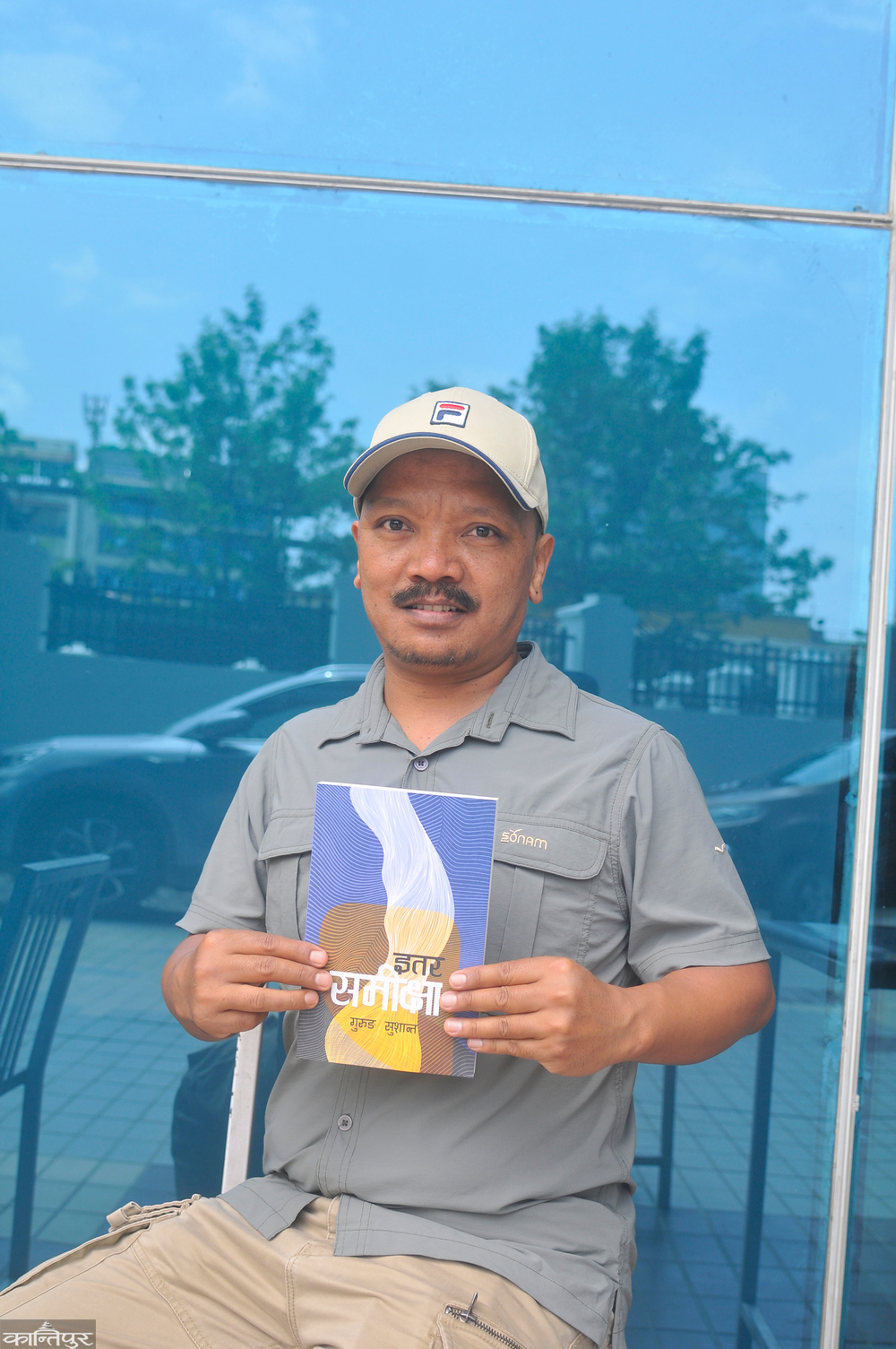
Gurung Sushant, who has been writing criticism, essays and reviews for almost two decades, is known as an identity writer. Gurung's latest book 'Other Reviews', which is preferred among readers due to its critical sense, strong worldview and tasteful language, has further established him as a strong critic.
Deepak Sapkota's review-conversation with Gurung, who presents a sharp analysis-evaluation of ideological non-narratives from to , on Serofero of 'Itar Misiksha'
:
What gift have you brought to the readers in your recently published book 'Itar Misiksha'?
The little wealth I have earned in life is the reader. I have got the opportunity to have a one-on-one discussion with the reader and show the rough journey of my review writing in 'Other Reviews'.
A type of reader-opinion says, 'Nepali review is dead, only to be saved.'
I think declaring review dead is apolitical 'politics'. Such an expression can push the creation into the realm of self-praise by giving it an idealistic air of divine genius and isolate it from criticism. Such an environment encourages the destruction of the social responsibility of creation and the desire to earn name and fame from within the egocentric confusion and transience can grow in the creator. And, in the end, literary creation becomes the romantic joy of wordplay.
Instead, commenting that the review is weak is closer to reality. Review, like poetry, is a genre that is refined through the triveni of understanding, practice and study. The reviewer should naturally be more responsible and the review more credible. It is a terrible tragedy for the entire literature that the reviews are losing credibility and are dying from the fever of misdirection.
You have said in 'other review', 'The review should have been able to guide the overall language-literature. However, critics have become like contractors and reviews are more like an 'underground business' than a genre. It makes us sad. If it's just a market, then why be sad? Is this 'market-truth'?
This is not just a market rumor, nor is it the whole truth. I see a partial truth between these two. As much as it makes me happy to have friends who write honest reviews, I am saddened when someone who uses unnecessary words to settle mysterious accounts of secret relationships under the guise of a review comes up to my nose.
If the 'ethical' ground of the reviewer is torn, then the 'creator' who longs to earn a fake name overnight, leaks his greedy investment in the dark. It seems that when greed and greed both increase, at some point there will be a landslide that sweeps away many. I sometimes feel sad because of the sense that both creators and critics should be responsible and committed to strengthen the ground of our literature.
reviews are not a very readable genre. What's more, a review has a total of two readers. The reviewer is one and the one whose book is written on is one. This is not just sarcasm. Why is the readership of reviews so small?
is not exactly like that. However, it does not seem unnatural that the readership is low. A good review is not only an evaluation of the text, but also a discussion of the issues raised by the piece. It seems that in our society, there is a majority of the people who warm the way by pouring out a speech on their whim rather than participating in the discussion and pondering over the opinions of others. Is it a reflection of that? ∕, it seems that the head of the literature that has been pushed to the margins of the review is not fully understood.
What motivates you to write a book review? The author's fame or the power of the text? Or, have you created a personal standard? Since it is not possible to read all the books when there is a flood of
books, the effect of the author's pre-published material can work very hard. Sometimes having high expectations of a famous author is equally likely to disappoint. However, when you sit down to read a book, the text is more important than the author. When writing a review, three main elements of a book motivate me: theme, worldview, and presentation. Apart from that, there are other aspects of literary quality.
What is the state of the university review, he is still absorbed in the search for progressive elements in Bhanubhakta's 'Badhu Shiksha'. Why did he not consider poet Shravan Mukarung's 'Madam Geeta' (for example) worthy of criticism?
Even though the university should teach questioning, since performing rituals in the name of 'methodology' is a practice that is considered academic, review writing also seems to fulfill the adage of 'tying up a cat and starting Shraddh'. In particular, the review should be written with great responsibility and should be led by the university. However, the aridity exhibited by our university reviews has spread a web of distaste for the genre itself. This net will not be broken until university reviews change their approach and become creative. Known as a
identity writer. The authors of the identityist movement and their writings are closely observed. Our identity is literary, how is it? How cool is the aesthetic it creates? The idea of
identity has also been effective. Regressive and status quo forces have also tried their best against identity. And, those forces are trying to corrupt the Nepali ideology by distorting the essence of identity. Even some so-called Marxists are determined to show identity politics as 'identity politics' and predict that it will fall into racism.
Running in the very classical circle of Marxism, but not understanding or digesting the history of class-building in Nepali society, this ironic attempt has thrown another thorn in the journey of our ideological construction. Another scary thing is that some identity advocates, instead of establishing rights by explaining the identity movement, spend their time and energy on insulting certain individuals or communities based on their lack of study and arrogance, confusing the issue of identity, and trying to push it to the brink of 'racism'.
Whereas, the essence of the identity movement is to make Nepali society a rainbow on the canvas of equality and coexistence according to multi-ethnic, multicultural, multi-religious and multilingual philosophy. It is sad to see that some activists of the identity movement are leaning on the edge of racist thinking.
We can see the reflection of exactly this scenario in our literature.
You may have read reviews of Marxist aesthetics. Why are they characterized by two-foot-long paragraphs, barkhe vel of jargons, stilted and monotonous language? Yes
, this is another problem. From an ideological point of view, although Marxist aesthetics is beautiful in itself, the inertia adopted in the language used by this volume review makes it dry and dull. Also, the reluctance to collaborate with tribal aesthetics and Dalit aesthetics in the context of Nepal is a major problem for Marxist aesthetics. Therefore, this kind of review writing seems like a deserted island to the reader. Do
reviews and reviewers have 'politics' or not?
Just as creation directly-indirectly or knowingly-unknowingly does 'politics', reviews also have 'politics'. I believe that it should be. Writing a review with the wish that the creator can create better next time is also 'politics'.
Your reviews often sound like good essays in themselves. This should create a review for you. However, some writers say that review is not creation. Express your point of view on this! A
review is not a creation, but the sentence itself is a creation. Because someone created this sentence on their own. However, I strongly disagree with the meaning of this sentence. A real review should be able to invite the reader to discuss with an original creative flavor. It is not possible with technical language to invite the reader into the debate of ideas and art. Why does the language, style and format of
reviews feel archaic? Isn't it too late to invent fresh and new languages, styles and patterns? I agree 100% with the opinion that
is an intensive genre of discussion and should have been innovated in ideas, language and format. If these things are left aside, it seems that the reviewer is merely brokering letters. To enrich the
review, broaden the scope of study and increase the association with new people and books. Our desire to travel should be increased. Without these, how will the horizon of our review be widened? Our review will be 'cliché' until we come in contact with different societies, cultures, historical books and serious people and do a comparative study.
is more than just a famine of gritty and fast-paced film reviews. Meanwhile, internationally acclaimed Nepali films are coming in full swing. However, reviews that judge a good film have not yet come. Why did this happen?
Recently there have been many good works in Nepali cinema. In particular, we have not had a lively debate about the beautiful and pleasant aspect of recognizing the tribal beauty and belief system through cinema, nor has the state got a move. By the looks of it, we are still not out of our old ways. The most frightening thing is that most cinematographers see cinema only as a means of entertainment and as a 'good' for the market, and another shameful thing is that cinema critics think of their success as being able to mix and match the story of the cinema.
Both of these things seem suicidal. What should have happened is that critics should have called for an ideological debate on the issues exposed by serious cinema. Because, in a country like ours where there is less tradition of written history and formal studies, cinema could be a dynamic medium of education. Even our mothers and grandmothers, who did not know the alphabet, used to get new scenes and initiation from the cinema. However, we have a lack of cinema-literacy from filmmakers to critics.
'Theatre review' and 'painting review' seem to never end. How is the poverty in this area solved?
theater and painting's 'review' need a 'reviewer' who first has a clear 'view'. There are many of us who have not only got a 'view', but not even a sheep. These genres demand a patient and studious reviewer with commitment and determination. Poverty in this area can be alleviated only by having the ability to understand and explain to the people. For this, the state has to invest with policy clarity. However, the state is busy with fake 'painting' named 'Viewtower' on top of the attractive hill and how can the review be rich?
Reading your reviews, it seems that you don't present yourself as harshly in poetry as you do in other genres. Is the poem really moving or is it a dense association of poets? Or as a prophet?
poetry itself is a genre in which meaning is sought between words or beyond words. I tried to follow the style of the poem while criticizing it. ∕, if you read the poetry-reviews I have written slowly, you will find a lot of criticism. However, it is true if it is not worded harshly. I believe that poetry is what literature lovers love. Because poetry is the measure of bravery and beauty of every language. That's why I love poetry.
I think poetry is the most written and well-written genre in Nepali literature. Only a few poems of even the best poets survive for a long time. That is why there are poems with longevity in Nepali literature. Another important thing is that if we don't pay much attention to the languages of our own country, there could be hundreds of immortal poems in the mother tongue of Nepal.
It is said that you are very fond of certain authors. Like – Kumar Nagarkoti, Narayan Dhakal, Khagendra Sangraula. What do you mean by explanation? Even if you reach the level of 'Confession'?
I keep meeting with them and I also respect them as parents. Otherwise it would have been thought that Gurung Sushant was the one who wrote 'Sankramanma Nagarkoti'. I both respect and criticize them. In particular, I've always respected good writers. Respecting and appreciating those who excel at ideas and craft can motivate new writers to work harder. Overall, it seems to benefit the entire novel.
I know, Important fascination will keep Govind Count. Starten 'Names, repeatedly, and keep recommending my friends. But, with her name, no one has said anything. Because, he was not with me. The Dal Bahadur Bista, Joseph Dalton, Higuak, Hukatha Roy and Synancelj Tiwar, openly praised the 'Text' of the Tony Harurta Ragan, Arunhata Royal and Synancelijat Tiri. However, Rarang Gurung has shown that it was said.
is compatible, my poet Bernodes KC KC KC KC, Valakala Jishing, Puckhala Joshi, Peam Gurungs. However, I also have a fact that I have not written about their original book today. I have talked about the role in my role of good news. And, this proof that the review written by criticizing the books of the friends, this proof that there was a 'difficult review'. Therefore, it may not be based on writing, this comment. & Nbsp; Tell me about the encmdy of the enmity of
reviews!
begins with the first glands without writing. 'Why not write our book? Did I feel that I am? 'Such questions. In other things, taking a weakness of taking a weakness of a weak book, not to get a weak. Some are sweetened, how much they request through my friends and how many also offer journalists. I will give up and refuse to ignore such a temptation. The book also greets the creation of the creation of the Creat of the seven seashore writings. Khanksa gets writing to a similar composition.
is not a matter of thinking, even if I do not have a sense of personal appearance. But, if no one puts me in the vigilance, but it is a richness of animosity in writing, but it is a property for me. However, I admire Cinema from the heart. I only do critical text. Another thing-review is not my job or contract. I have my own thousand lambs.