We use Google Cloud Translation Services. Google requires we provide the following disclaimer relating to use of this service:
This service may contain translations powered by Google. Google disclaims all warranties related to the translations, expressed or implied, including any warranties of accuracy, reliability, and any implied warranties of merchantability, fitness for a particular purpose, and noninfringement.
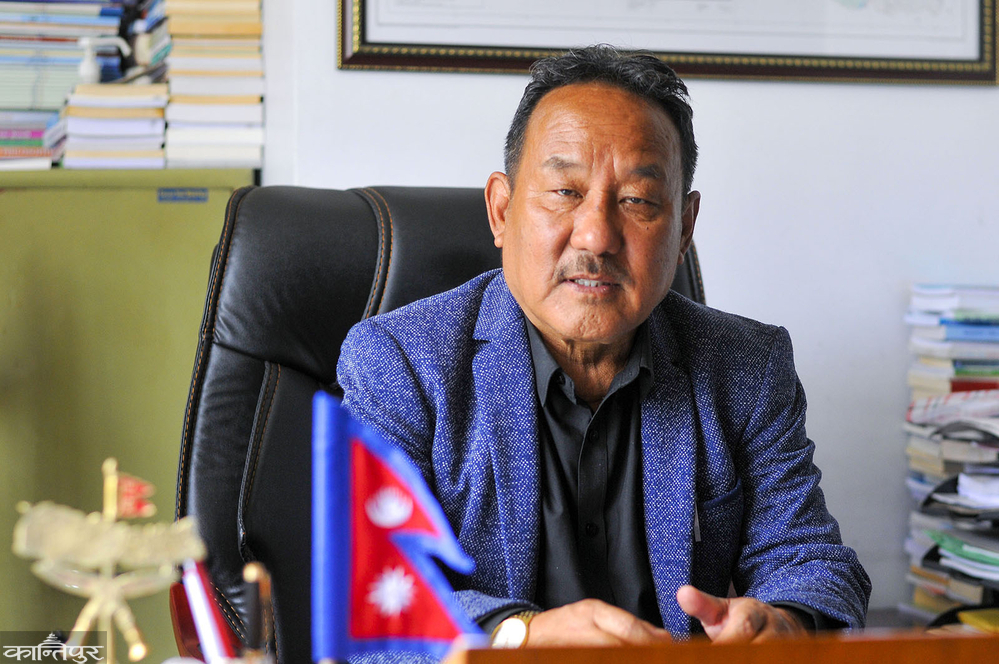
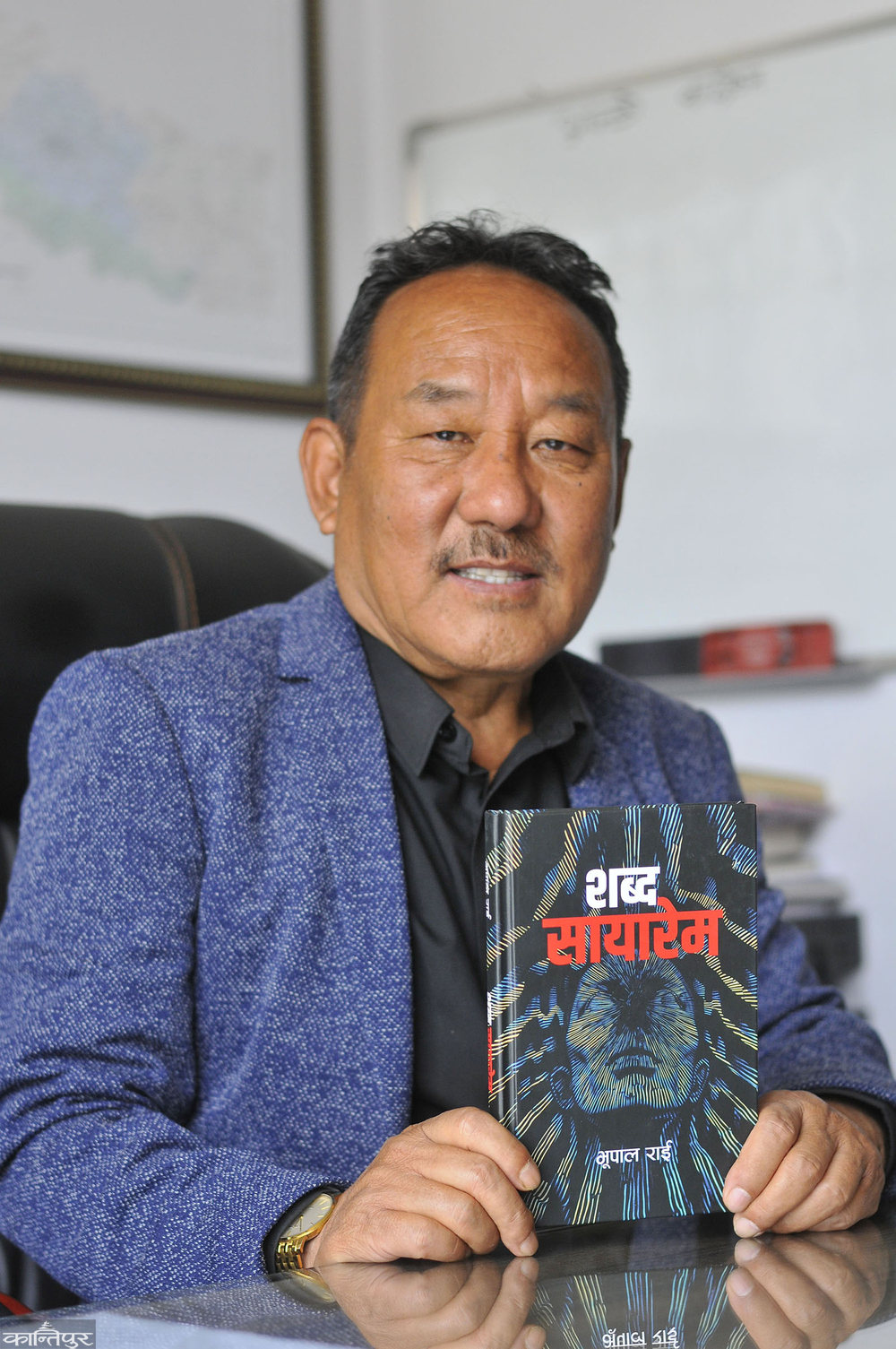
Bhupal Rai, established in poetry and song, is the Chancellor of Nepal Pragya Pratishthan. Better known as an identity writer, his latest book 'Shabd Sayarem' has established him as a powerful essayist.
His essays are delicious as they are a blend of emotions, thoughts and philosophy. Deepak Sapkota's conversation with Rai on the centrality of 'Shabd Sayarem': The word 'Sayarem' of 'Shabd Sayarem' means 'lifting the fallen head' in Kirat Rai (Chamling) language. The book has been called an 'ideological essay to raise the shadows that have fallen due to the state'. Hasn't the establishment of a federal republic based on inclusion been the sayaremma (resurrection) of the fallen heads?
'Sayarem' is not just a word, but also a ritual. In the Kirati society, if a member or a community has lost its head due to various reasons or if someone has been discriminated against due to the same reason, it is said to raise him to a respectable level in the society. It envisages a society without discrimination. Sayarem, which envisages a society based on equality, is therefore not a fagat word. Its cultural significance is greater. Since Sayarem is also a social ritual, it is also a subject of sociological study. Let's think about the socialism that we are currently debating, what is the basic diagram of socialism? We look for socialism elsewhere outside our society. We do not recognize the cultural embryos of socialism that exist within us. Sayarem or the concept of non-discrimination society is a practice followed by Kirati society for thousands of years, which has a socialist character. We must build our own original socialism by overcoming the existing socialistic cultural practices in our society.
Now we are in the Federal Democratic Republic of Nepal. This system is an armed 'people's war', repeated protests and the support of thousands of people. Federalism is the restructuring of an identity-based state with people's sense of autonomy and ownership. Democracy is a guarantee of inclusion. Republic is the most advanced system in the last few hundred years. We have accepted this arrangement with all these values. And, for this we have also fought. However, despite this, it does not mean that 'everything is fine' in Nepal. We have to look closely at whether the governance system is working according to the price system we fought for and wanted. In this way, many things are still incomplete and fragmented in Nepal. The principle of inclusion is distorted here. The dozer of hegemonic ideas has run on the very essence of federalism. We know very well that such a game on federalism has been started since the second election of the Constituent Assembly. Inclusion is a political tool to mainstream the marginalized sections of society. However, a large part of the people are still deprived, their Sayarem is yet to be done. The mistake seen in the restructuring of the state, i.e. naming the provincial states against identity, has bowed the heads of the entire communities. He also has to do Sayarem.
In the essay 'Where is your mountain house?' you have written - 'Mountain house', which was the seed of the blind nationalist fire that Mahendra once carried, was a historical conspiracy of expansion and encroachment. What kind of 'nationalist fire seed' is that? what "Conspiracy"? Where is your mountain home?
Being a 'mountain house' in Nepal indicates two meanings. One, hills are 'special' in the geography of Nepal. Two, those who have a house in the mountains must also have another house and that is in Madhesh as much as possible. And, this collection spread widely since then, when in 1955 malaria was declared to have been eradicated from Madhesh. Why was 'mountain' special in the geography of Nepal, it was associated with a specific nationalism, which was called mountain nationalism. And, its real architect was the then King Mahendra. He inherited the seeds of this nationalism from his ancestor Prithvi Narayan Shah. Initiated by the ruling power of Pahadiya high caste and the Prithvi mantra of 'Real Hindusthana', he was the architect of 'Hindus hill nationalism'. And, he wanted to spread this mantra of nationalism to Terai Madhesh. Because he did not think that his ancestors could protect the southern border of this country of Arzya from the Madhesi people. And, it was not thought that if he did not do this, the mantra of 'One Language One Disguise' given by him could materialize. For this, as many Pahadiyas as possible had to be moved to Madhesh land. Mountainous human shields should have been deployed along the east-west corridor of Madhesh. For this he conducted some campaigns. The first was the eradication of malaria. This campaign, conducted in a Tharu-dominated area, was not actually a Tharu-targeted campaign because the Tharus were already a malaria-resistant caste. In particular, this campaign was a campaign aimed at Pahadiya. It was a cave that expanded the hilly settlement in the Tharu-dominated area. As a result: when malaria was declared eradicated, a large influx of Pahadiyas began, wiping out the Tharus from their historic foothold. The second was the construction of East-West Mahendra Highway. This highway was delineated in an area of Madhesh, which neither cut through the core area of Madhesh nor touched the hilly terrain. Rather, it was delineated in such an area, where it would be easy to settle hill settlements. As a result, it deployed a huge human shield of hills along the upper corridor stretching east-west of Madhesh. And, the third was the establishment of a rehabilitation company. This campaign was also carried out with different pretexts and reasons, focusing on mountain migration. The announcement of the eradication of malaria and the construction of the East-West highway helped it a lot. In this way, the 'Mountain House', which Mahendra once walked on, was the seed of nationalist fire, which had a great impact on the land, life, culture, etc. of some Madhesi people. Incidentally my birth place is Bhojpur. However, this is also a part of the mountain. However, I do not fall into the category of those who live in the mountains because my other home is nowhere in Madhesh.
In your essays, you refer to Kavithe Kami as 'Adikavi' and Setange Jetha as 'Rashtrakavi'. So who are Bhanubhakta Acharya and Madhav Ghimire? Who can give any title?
Pratapsin Nachiring Rai is an old journalist. He claims himself as the original poet of Nachiring language. From this it can be understood that there is not only one poet in Nepal. Similarly, there are many national poets. Another thing, the society or community in which I was born and brought up does not know Bhanubhakta Acharya and Madhav Ghimire. If the ignorant society asked the same question, what would be the answer?
Raithanevasi's culture, suppression of knowledge system and list of tyranny of unitary state system are abundantly written in your essay. How do you see the relevance of Raithane-Knowledge System in the current environment?
Right now, let's look at our village home, dozers are destroying mountains everywhere. Patipauwa, Chino Chautari and forests are being destroyed. In such a situation, environmentalists are turning to the culture and knowledge systems of the indigenous peoples regarding how to save the earth. Even UNESCO has said that development is only environment- and culture-friendly development. Reports say, tribal knowledge is the knowledge that can save the earth. Raithane knowledge system is nature friendly knowledge. Cultural practices informed by nature-friendly knowledge maintain an identity with nature. Their wisdom says – save nature and save yourself. The essence of Raithane knowledge is the knowledge of identity relationship that if nature is not preserved, one's own existence will not be preserved.
Don't go elsewhere, let's talk about the context that you want to raise with your own essay! There is an essay in this collection Bhai Ko Chihan and Kadam Ko Tree', in which Kadam tree is planted in the grave dug after the death of the brother. This is reminiscent of the Kirati society's culture of mandatory planting of trees after digging graves. This work may seem normal, but the practice of planting a tree as compensation for every six feet of land dug is not small from an environmental point of view. Although this practice is gradually disappearing, but if it continues, this knowledge is no less relevant to save the future earth. Raithane's breadth of knowledge revolves around this Serofero.
The porters and the 'primitive music of Tokma' in your songs from a decade and a half ago are now only a memory. Has the pain of the (East) porters disappeared after the road reached the villages? That Dojre development has destroyed the life, culture and life of the tribals?
Four/five decades ago, the place where I found the embryo of one of my songs, was the Akkar path carved in the Bhir of Arun and Saptakoshi. It was the way to bring heavy loads of salt and oil down from the hill to Dharan. In Dhaka, porters who were taller than themselves carrying heavy loads were often seen there. Tokma's talk-talk sounded like some strange music. About a decade and a half ago, I wrote a song remembering those porters – Sunkai Bhau Cha Suntala Variki…. Later, four decades after meeting the embryo of that song, in the year 2070, when I was walking on the same road, I saw that there was no laskar of porters nor the sound of Tokma. Neither the music nor the rhythmic steps they cover in the Tokma. The roads are overgrown with weeds - deserted. Alternative roads dug in many places in the village have erased the name of that road. The tractors that were running all over the place had replaced the burden of the porters. The question arises, has the development in the village reduced the weight of porters? I think porters have not lost weight. Only the form of heavy has changed. Only the way they walk has changed. Today's porters have simply stopped walking that path. But they are bearing a different weight in the desert. Some sheep are grazing in the bay. Some are hanging from twenty-five stories high. In this way, the dojre development that has entered the village has displaced people and erased people's songs and feelings. Where there is no man, there is no story of man. Dodger deleted that story.
Are your essays trying to argue that 'Raithane knowledge and practice developed in Nepali society should be the basis for building socialism'?
writers are guided by some writing psychology while writing. While I was writing this, I always kept in my mind, how can the current path set by the society be directed towards the advanced direction! After all, the path society has to decide is one day towards socialism. But, what is the path towards socialism? What is its modality? What are its bases? Will it be brought from somewhere or will it be built by yourself? We are confused about this. We have been saying for a long time that socialism is not something to be imported from somewhere, it is our own social development. It is a flower that blooms on the foundation of our own originality, not by imitating anyone. For this reason, we are saying that there are many socialistic knowledge systems existing in our society but which we are ignoring - they should be developed and practiced. To be clear, there are many knowledge and cultural practices among the tribals of Nepal in which the characteristics of socialism are found, they are the basic conditions of our relative socialism.
Take the 'Sayarem' ritual for example. To envisage a society based on respect and equality is to be naive to socialism. Let's look at the case of collectivization discussed a little above, the character of socialism can be found in that too. It is said that the Kiratis work in groups or perform any cultural ritual which points towards socialism. A great example is the communalization of the Sakela dance, which is danced twice a year at Undhauli-Umbhauli. Hundreds of such cultural practices are also alive in other communities of Nepal, such as Badghar of Tharus, Guthi of Newars, Huri of Gurung/Magars etc. In the Kirati society, when asking for a daughter, it is customary to ask for a guarantee of three statuses from the in-laws for their daughters. 1. Family/social status 2. Financial status 3. cultural status. A girl cannot be obtained without guaranteeing these three rights. Such assurance of women's rights and position certainly points towards socialism.
You are the 'rebel' in the poem-essay. People say - by writing you are disrupting 'social harmony'. What is your acceptance of this?
'Social harmony' is a commentary created by the rulers. The irony is that there is a certain race, a certain class of rulers in this country for a long time. And, sadly, it is irreversible. They want their rule to remain unbroken, unbroken. Therefore, if a ruler raises his head, they feel that the social harmony is disturbed. They hold on and want no one to say they are hurt. Don't say that. I say Aiya in my pen, I want to raise my head. So they think that social harmony is disturbed.
I wrote in the essay 'I can't be great, Rupa!' Yes, I can never be that great.' What is the basic idea of your writing?
I've always said – thoughts are relative. When the idea is relatable, the author is also relatable. He cannot be everyone. Not only writers, not everyone has any campaign or movement. When relativized, the writer becomes an enemy. Campaigns are enemies of movement. In this process, I remember that at one time I called my poetry collection 'Agole Janmotsav Mayan' as an 'enemy poem'. The basic ideology of my writing is 'equality', not 'equality'. I am against the equality of amputating feet in the name of treating everyone the same or sharing shoes of the same size.
You think 'there is no need for criticism on literature'. Is it inappropriate to think about aesthetics over art? That this is your mistrust of Nepali art and beauty-thinkers?
At some point I said that there is no need for criticism on today's poetry. Because today's poems are more reader-oriented than critics. They are poems of the people. At one time, especially during the absolutist monarchy, it was not possible to express oneself directly in poetry. She should have been told in the shade, she should have been decorated with images. Such poems were rare and needed a critic to explain them. The critic used to interpret it according to his own understanding. However, time is open today. You can say what you want to say freely. Therefore, I mean that today's poetry is now the responsibility of the reader.
Another thing is not that aesthetic thinking is not needed on art literature, it is definitely needed. However, the tradition of Nepali beauty thought was/is monotonous.
Nepal's multi-colored beauty is yet to be properly thought about. That is why I once expressed such an intention.
You were also a singer-musician, but not now. What are the chances of 'that' happening again? How does the face of singer-composer Bhupal Rai look when looking back at the time when he was the Chancellor?
Yes, one day I was also in a recurring role as a singer-songwriter. I used to sing with full enthusiasm in my youth. Passed the voice test in Radio Nepal and also sang some songs. Made some music and recorded it.
I used to walk around the districts outside the valley with a guitar on my shoulder, looking for listeners. But now I remember that it was an undertaking to find myself. There comes a time in a person's life when he is searching for himself. He does a lot of work at that time. He puts his hands in many places and tests himself by saying where he fits. However, there is no possibility of returning to the position where I am now. Because now I have found myself.
And now, when I remember myself that day, I feel like I was the hunter of my own life, like a concentrated hunter hunting for prey in the forest.

