There was an increase in the number of people in the mountains. However, there were not enough people in Madhesh. When the people of the hills were entering Muglan without food, at the same time people in Madhesh were unable to find food and had to be brought from Muglan.
We use Google Cloud Translation Services. Google requires we provide the following disclaimer relating to use of this service:
This service may contain translations powered by Google. Google disclaims all warranties related to the translations, expressed or implied, including any warranties of accuracy, reliability, and any implied warranties of merchantability, fitness for a particular purpose, and noninfringement.
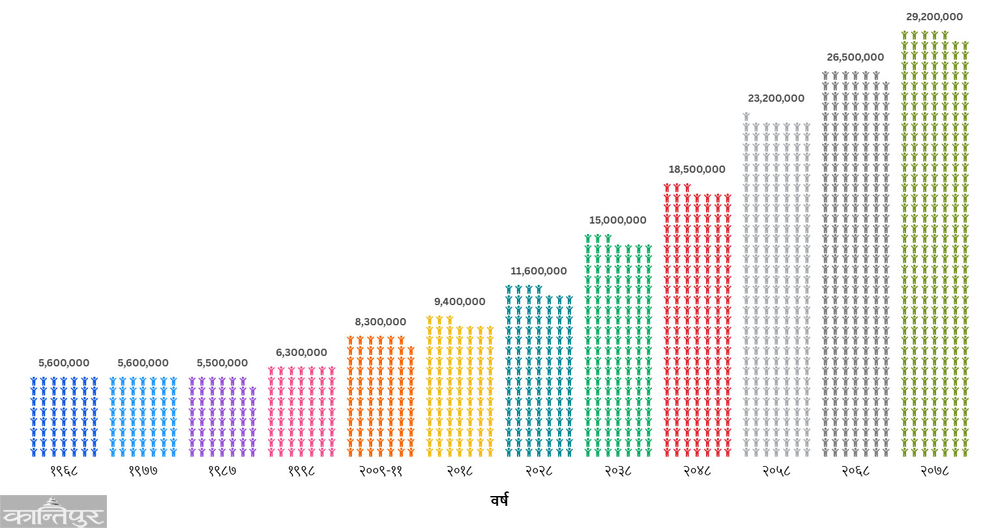
During the reign of Queen Vidyalaya Lakshmi (Rajarajeshwari) who ruled Nepal around 1859 or 60, Damodar Pandey found that 5.2 million people lived in the entire state of Nepal. According to the historian Shiromani Baburam Acharya, that's why the tradition of '52 lakh Nepalis' prevailed till 50 years later (Nepal was much bigger then than it is now).
In the meantime, it is not known whether people from all over the state of Nepal were counted, but according to Dineshraj Pant, a census was taken in the city of Kathmandu in 1896. The full details are not known. It is only known that, "In the census of Kathmandu city in the year 1896, the sum of 36246 bis lakhs of people is estimated to be 17925750 of Shanasarch Warp 1 -." In the first two figures of this description named
census, it can be assumed that '20 lakh' means people and 36,246 means households. However, if we look at the calculation of food expenses for a year, it should be said that it is not ``twenty lakhs'' but two lakhs, because if we consider 20 lakhs, one person should have less than nine rupees to eat for a year, which is not possible even at the market rate at that time. Considering a population of two lakhs and 36,246 households, there are five and a half people in a family, which is natural.
I had the opportunity to read some forms of that 'census'. His legacy is as follows:
Swasti Sri Samvat year 1896 year date Chaitra Shudi 9 day 7
Manasin's house 1 k 8 people
Gunananda's house 1 k 5 people
Bhajuman's house 1 k 7
Similarly the details of pode toll, tawtol and kotav toll are also given. There is also Behora in these four villages with 442 houses and 2,373 people living in them. In this way, about five and a half people used to live in a house. Even if 20 lakhs is considered as 2 lakhs, it seems that so many people live in one house. In other words, two hundred thousand people lived in Kathmandu city (or Kathmandu Valley) at that time.
After 182 years, the entire Kathmandu district became a city and the population increased tenfold. Historian Dr. According to Jagdishchandra Regmi, after this in 1910 during the reign of Jung Bahadur, a census was taken in some parts of Nepal. However, data for Kathmandu is not available. In Patan, as many as 5 people used to live in a family.
108 years after Nepal's population was counted for the first time, i.e. by 1968, the population of Nepal increased by only 400,000. Only then did the opportunity to say '56 lakh Nepalis' arise.
However, at that time, the population in Nepal was growing rapidly. According to John Claude White, an English engineer and photographer who lived in Nepal for more than a year, Nepalis had to find a new place to migrate due to the increase in population. The practice of going to the Hocha Hills of Bhutan and Assam continued at the same time. In 1977, after observing the migration from Nepal, he predicted that the Nepalese could soon become a dominant race in Bhutan just by virtue of their numbers.
In the year he made this assumption, a census was held again in Nepal. In this, the Nepalese came to fall. Apart from the trend of people moving out in search of a new place to make a living, it is believed to have happened because many Nepalis were 'wasted' in the First World War and the epidemic spread throughout the country in 1975.
After that, Nepali population grew slowly and reached about 8.5 million in 2009-2011. At that time, Nepali planners, foreign donors and domestic and foreign 'experts' considered the Nepali population, which was growing at a rate of 1.5 percent per year, as a big problem. It was written in the book of the first plan: Production has to be increased to maintain the current standard of living.
Nepal's population is estimated to double in 15 years. Even then in some districts there was not enough food and malnutrition was rampant. Planners fear the problem will worsen. Planners also had another fear – that land-hungry farmers had increased in recent decades. The main reason for this is the increase in population (village, especially mountain population at a rate of more than one lakh per year). According to
scientist and author Eric P. Ekholm, around 2011, a consultant sent by the United Nations presented a highly exaggerated, alarming picture of Nepal, saying that deforestation in Nepal's mountains was "getting worse and landslides were causing financial loss." Matching 'yes' to his 'yes', the Nepali planner said - if the population of the people in the mountains cannot be reduced, the floods that bring misery and destruction to the plains of Madhesh cannot be stopped.
At that time, about 65 percent of Nepali people lived in the mountains (70 years later, only 46.4 percent of Nepali people live in the mountains). Shortly after this, in 2018, the population of Nepal increased further to 9.4 million. And Mahesh Palpali made a song:
Hey mother Nepal will make you the beauty of the world
A crore of people will join together to sing
These almost one crore (crore) of Nepali singers were singing the song of Mother Nepal only in their eyes. In the eyes of planners, development experts and local and foreign scholars, these were monsters who were hiding Mother Nepal. Some facts were mixed to make him a 'monster' and this story was woven:
The mountains of Nepal are a place of old settlements. So there was already cultivation in the arable land. Nowadays, as the population increases, the land for cultivation is not enough, and the farmers have cleared the steep hills that are not suitable for cultivation. After the forest near his house was cut down, he cut down the forests far away to get firewood. The surrounding mountains became bare. Landslides took place everywhere on the mountain after the tree that held the soil on Kamalo Hill was uprooted.
After such destruction in the mountains, the productivity of Madhesh also suffered a great loss. Flooding in Madhesh increased. Conservation officers observed that river levels in Madhesh were rising 6 inches to a foot annually (if this had happened, the river level would have risen 20 to 40 feet in 40 years of writing!!!). Due to this, even if there is little rain, the flood will enter the village. The river changed course and damaged the farm.
Scholar Eric P. Ekholm wrote that the Nepal government did not implement the largely controversial reports prepared by western consultants - in the fifties and sixties (from 2007 to 2027), one after another the reports submitted by western forest protection directors in Kathmandu were read with interest. In fact, they became only the mournful cries of a deserted place.
Another consultant said in 1967 - It is a strange thing that people do not pay attention to the fact that a handful of precious soil, which is not used for grass and shelter in Nepal, was carried away by the muddy river during the drought.
By the year 2022, USAID advisors and staff also felt that a permanent balance should be maintained between Nepal's people and resources. Therefore, they showed an interest in supporting family planning programs so that Nepalese people, who are increasing in number compared to resources, are not born at the same rate as before.
Family planning program was started in Nepal in 2023. A little later, other donors also helped in this work. In 1968, 1.8 percent of the total health budget was allocated for family planning, which was increased to 13.3 percent in 1974.
The third five-year plan, which started in 2022, considered that it would be difficult to raise the standard of living of the common people no matter how much development is done without reducing the rate of human growth. The plan was to do two things to reduce the population density in the mountains: resettle 6,000 families in the mountains to Madhesh and advance family planning.
The fourth plan launched in the year 2027 focused on some aspects related to the growing Nepalese. They were: The ratio of cultivable land to population in Nepal is not satisfactory. The population density is very high. Population growth makes it increasingly difficult to meet the growing educational needs. It is difficult to make the manpower in agriculture fully useful. It has also become difficult to fulfill the residence needs of Nepalis. Due to the pressure of people in the mountains, the natural balance has reached a critical state. 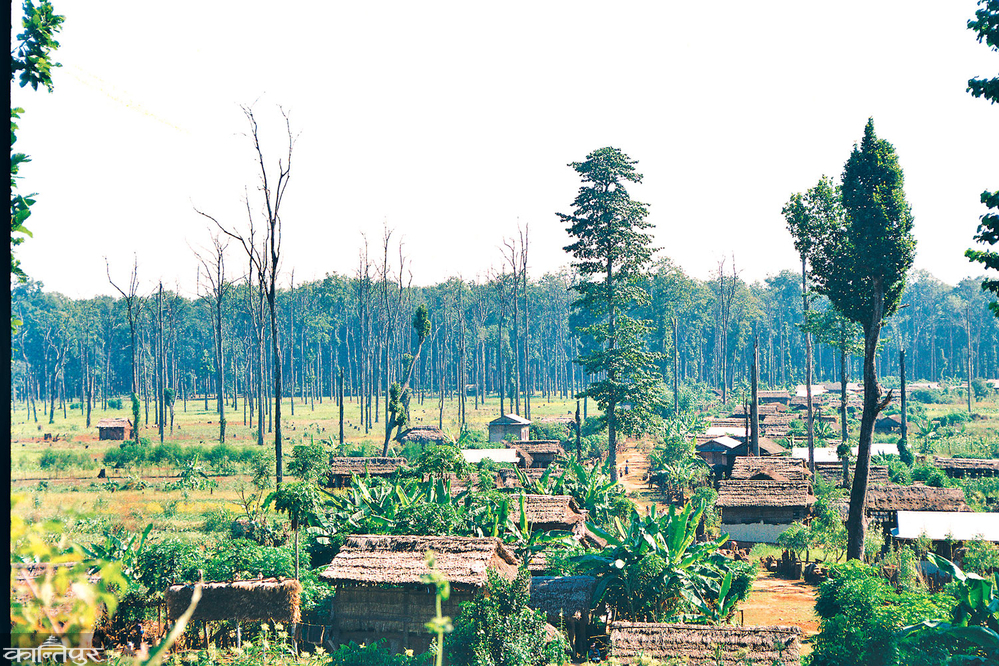
Foreign scholars wrote books and made video documentaries about the disruption of natural balance. A documentary titled 'Kamalo Himal' (The Fragile Mountain) made in 1982 said that 'half of the blame for erosion in the mountains is nature and half is human'. It says that all the forests in the hills of Nepal will be destroyed in the next 10 years. The mountains are to blame for the damage caused by the flood in Madhesh, the mountains are to blame for having too many people.
The study conducted by the Indian government in the watershed area of the Koshi river also said that although there are natural causes for the landslides, the cultivation and grazing on the steep hills is significantly responsible for it. That is, there is a fault of the people there.
Nepal had already experienced the irony related to human resources - the pressure of people in the mountains was too much to support the resources there. However, there were not enough people in Madhesh. Because of this, whenever people from the mountains were entering Muglan without food, at the same time people in Madhesh were unable to find food and had to be brought from Muglan.
Around the year 1861, the farmers who were cultivating on the government land were lured by the owners of Birta, Jagir and Kalabanjar lands to cultivate on their lands.
Due to this, the land for which Malpot is to be paid is lying idle and the Malpot will not be raised. In order to prevent this from happening, in 1862, the king instructed Jagirdars, Birtawals and Amalidars from Parsa to Saptari that they should not allow the raitis who are earning land for raising property to earn the land of others (Jagirdars, Birtawals and Amalidars), only give it to the raitis brought from Mughlan. He also warned that those who do not follow this instruction will be punished. The king instructed his staff from Narayani to Koshi to send the name of the landlord who was tricking the raitis of Mal Jagga to cultivate Birta, Jagir and Kalabanjar lands.
This problem seems to be most acute in Morang. Because Dashrath Khatri left the Raiti who was earning land to earn that land and put him to work digging up his Kalabanjar land, only in Morang Rs. 6,000 worth of goods, the Chaudharys, Kanugoys, Maldars and others are in trouble. The king sent a court to investigate this. The culprits would be punished.
According to E. A. Smitheis, who was a forest advisor to the Nepal government during the time of Juddhashamsher, 60 to 70 percent of the territory of Banke, Bardia, Kailali and Kanchanpur, which is called the new country, was covered by primeval forest until 1997 because there were not many people. Somewhere in the middle of such forest there were only settlements.
There were less people in Chitwan even in 2013. According to the second plan of Nepal, there were only as many people as there were bigha of land cultivated here at that time. That is, one person had to do the work of earning one bigha of land.
Nepalese planners panicked by predicting that in 30 years the number of Nepalese would double in 2028 (their guess turned out to be correct). Earlier, the per capita national product was not able to increase even if the population grew at a lower rate than this. After some time, they found out that Nepal's national product grew only at the rate of 2.2 percent per year, but the per capita income decreased as the population grew at the rate of 2.3 percent.
Another thing they thought was that the Himalayan and hilly parts of Nepal are suffering more from human pressure. The density of cultivated land in Nepal was 1174 per square kilometer in the Himalayan region, 1002 in the hilly region and 336 in the Terai region. Therefore, if people are allowed to grow randomly, the speed of economic and social development will slow down, people will become poor, Nepal will have to import food, and the facilities of education, health, drinking water and housing will become more inadequate. Due to the pressure of people, the clearing of paddy fields, cultivation in steep places, forest encroachment increased. As a result, one centimeter of soil formed over 100 to 400 years could be washed away in one rain.
Even when there were fewer people than now, the economy of the hills was running at a loss. Let's look at the situation in the eastern hills for example. According to a survey in 2029, from East Hills Rs. Goods worth 1 crore 3 lakh rupees were exported and about Rs. 5 crore was imported. To make up this loss, people went to the British or Indian army or went to work in India, Sikkim (till then Sikkim was a separate country), Bhutan.
In the five years from 2032 to 2037, when it was considered essential to prevent many people from giving birth, the government provided family planning services to more than 800,000 couples, but the government estimated that only 38,000 people were able to prevent births.
Due to the tireless efforts of the government and foreign donors, people's awareness, more doors to go abroad and expensive education etc., the growth rate of Nepali has decreased over time. When it came to 2068, a new feature was seen that in 27 districts of hilly areas, which were worried about the population increase, not only the rate of population addition decreased, but the population decreased. When this trend increased further in 2078, people decreased in 34 hill districts.
At this time, the cries made by the governments and scholars of the country and abroad that there were too many people in the mountains were forgotten. The opposite kind of crying started - that people have decreased! When I see the crying of the current Nepali people, I like to remember these lines in the short poem 'Gauri' written by Madhav Ghimire after the pain of separation from his wife in 2004:
thinks these cries also hurt even if they remembered, these laughing the
that he remembered:
National National Going on the census of 2078 BS. He cannot write a song that is not happiness even when people grow and lose it. So we are singing such a parole song from the President: The
is also sorry that the stories of which they have been killed is not even absorbed.
are now saying that the people of the mountains are raised, how many people occur? What happened to people there? Since the census, 2028, we cannot find answers to the above questions by comparing with the population of a previous fifty years ago.
Let's compare the results of the group of mass and 2078 BS, 2078 BS. After the border of the districts after 2028 BS, we cannot see with the population of those districts. It is reliable measure for this - compiling population density in those districts. This shows that the population density of 31 districts except Khuharathum and Manang, the population of the population, the Tehrathum and Manang is more than 2028 BS. In the middle of 2068 BS, 2068 and 2078 BS in
Ramechhap districts, but still a square man lived by 2028 kilometers. & nbsp; Statement of District Khotang in the past 50 years of work is worried for work. There were many people when they were less popular in 2028 BS, they have blamed a valuable soil that they have been taken away and have been flooded by the mountains and went to the hill ends in Madhes to build a mountain end.
has been a lot of so many soil, but if there was a lot of people, then so will not be able to make so many clay! When he saw the brings a brim, he said, 'He was taken away by snoring the soil. Now after not a mountain in the mountains, there will be the County Rish, so, that it would be crying. Even when the mountain were too rained, we said that the river surface of the river rose half from a river surface taller in Madhes, the river Sagbiel was flooded in the village and farm. Now the surface of the river, no more! The river and the serpent flows on each other by engagement by engaged by one another! & NBSP;
Koshi Redire was driven to the land of the world, and for that, it was the most people most people, the most people were considered responsible. People have come to all the places of Koshi's okay in Nepal. So Koshi must not bring any trouble. It is not a happy thing and! & Nbsp;
first people were stretched out the tree in thinning the soil in the sepend in the middle of the wall that was worth more. Why, why weep itself so that they are now binding so much even when it grows soil, and they are low now? & NBSP;
had increased in a rate than that the people had increased in income to more than that grew more. Why worry that doesn't mean? & NBSP; How many people are the story-braak to stay in any place? How much people worry about how many people increase in in which district of the hill? How to worry about how many people have reached? It is very important to see the answer. For example, how much resources are there? How many and how has his use? How has the property of the property shared? Etc.
began to make things from the milk that had earlier than 32,000 tourists in Russia, and there was no problem with more than ever in that place. Earlier, land was in the hands of a few people in Nepal. The man who made the land earner had to explain a large share of income. Its & Nbsp; when people were few, they had a problem.
is now a little better than ever before. In many places, work has been open other than farming and Nbsp; hydropower and Nbsp. The road has reached a lot of place. Still, there are no employment opportunities to get too much. I do not know. & Nbsp the production of the product right now.
so it is useless to worry that a man has declined in the mountain. Instead, it is important to pay attention to other problems that come to the future than people who are growing in other people in others.

