It is necessary to love what you have to make your self-image beautiful
We use Google Cloud Translation Services. Google requires we provide the following disclaimer relating to use of this service:
This service may contain translations powered by Google. Google disclaims all warranties related to the translations, expressed or implied, including any warranties of accuracy, reliability, and any implied warranties of merchantability, fitness for a particular purpose, and noninfringement.
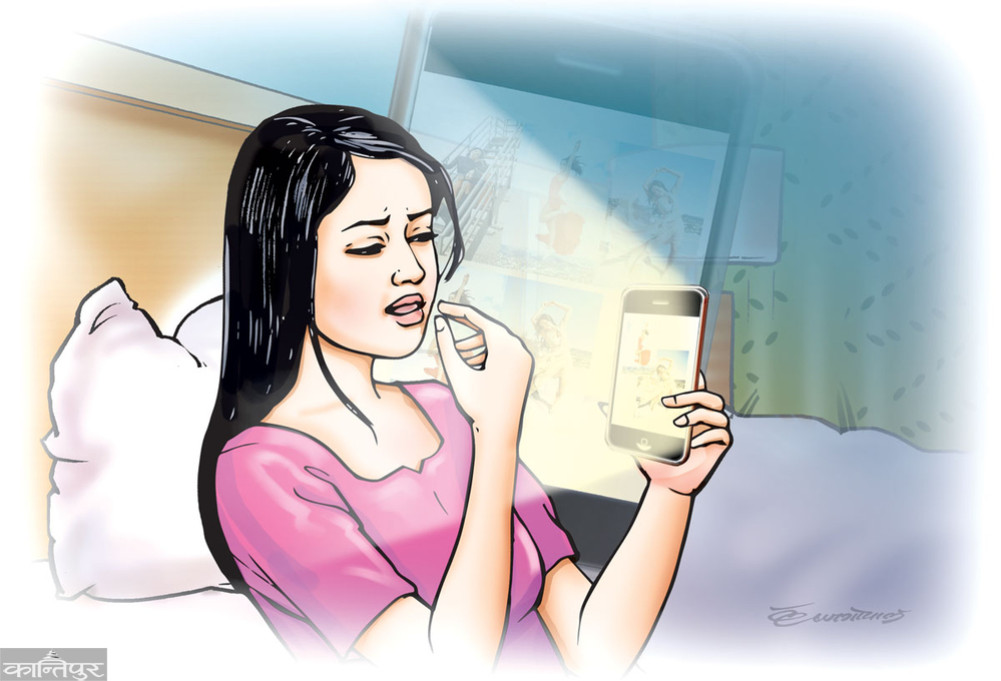
Let's say you are lying in bed and scrolling through your mobile phone. After scrolling, the feed is full of stories, posts, reels about friends going to concerts. And, the caption reads - 'Favorite Song', 'Best Night Ever', 'Once in a Lifetime Experience'.
Seeing that, you are regretting that 'why didn't I go or couldn't I go?' You are thinking - it would have happened if you had bought an expensive ticket or if you had arranged the time....
Have you ever felt like this? However, I have heard similar experiences from friends. On a recent Saturday there was a concert by Sushant KC at Bhaktapur Sallaghari. A friend felt the same way because he didn't go to the concert. I posted a video of the concert on Instagram. She immediately texted and asked 'what happened, how did it happen ?', asked for all the details.
If you don't feel so enamored with the concert, let me remind you of another incident. You are too lazy to work in the office. Opened the phone to get an update on what is happening in the country. In the beginning, the photo of your friends trekking on your phone came up on Instagram. As you may remember, I have not traveled anywhere this year. Now the whole mind 'where have other friends gone?' You suddenly regret not owning that photo with the caption 'The mountain air is different'. Suddenly you start thinking about your life decisions, 'Hey, why should I be the only one responsible? Having to sit in the office and work.' And it's not just about going on a trek. You think everyone is having fun, I'm the only one missing out.
has it felt like this or not?
Let's say you don't use the phone in the office, so you don't even realize it. But, you definitely use some kind of gadget.
The discussion of the new phone in the market is going on - what a total feature, how good the camera is! Meanwhile, your friend shows you that he has bought a phone with the same total features. After this you will start to feel your phone is old. It starts to feel like the oldest version and the worst photo comes only from your own phone.
Now let's talk about me, a little while ago the 'Panchayat' series was released on Prime Video. It was being discussed everywhere from social media. Wherever the song was played, there was gossip among friends, memes came from him. After all, I watched all the episodes of the series in one night, not being able to join the gossip of my friends. Sleep is disturbed, morning college is also missed.
Did you know what I was talking about when I gave so many examples? Today we are going to talk about a fear. Fear of missing out, FOMO.
FOMO is the thought and feeling that 'other people are having more fun, living a better life or having a better experience' than you. This creates deep feelings of jealousy and can seriously affect your self-esteem.
Apart from the above examples, there may be many incidents in which you regret not having done something because of what others have done or seen others do. This is called FOMO.
The fear that you're missing out on a fun moment (fomo) isn't unique to our generation. This concept is very old. However, it was not scientifically studied long ago. In 1996, marketing expert Dr. Dan Herman first coined the term 'fear of missing out'. Only then did investigations begin on this matter.
With the development of social networks, FOMO has started to increase. There are different ways that social media spreads FOMO. First, social media gives you a glimpse into the lives of others. You compare your normal routine with the attractive and fun moments of others. This may cause you to find your life less interesting than others.
Second, social media is becoming a place for 'show-offs'. Here people show only their best moments. You don't get to see other people's sad moments, which can make you feel like everyone else isn't struggling as much as you are. It can make you feel like something is missing in life.
Cornell University's SC Johnson College of Business has conducted a study on why FOMO will increase in 2024. According to the study, Fomo mainly
stems from the fear of missing out on important friends, not because of missing an event. Especially people with social anxiety have been found to have more FOMO.
More than 5,000 participants participated in the study, which included seven different types of studies. He looked at how people react to real, remembered and imagined events. Studies have shown that if someone doesn't get to go to an event that their friends are attending, they are more likely to experience FOMO. However, FOMO is felt less if there are no friends at an event or fewer opportunities to make social connections. What's even more interesting is that traumatic events, such as not being able to support someone in a difficult time, can also trigger the experience of FOMO. According to
studies, FOMO can affect people's satisfaction with life. Those who fear missing out feel that their needs are not being met. In this way, overall satisfaction with life is seen to decrease.
According to several studies, FOMO is also deeply linked to greater use of social media. People with FOMO tend to feel the need to be more active on social media and use it more. Thus, a negative cycle can form between FOMO and social media addiction, which can have long-term effects on a person's mental health.
Psychologist Hasana Shrestha says that FOMO is a normal human psychological condition. He says many of us experience this. Similarly, there are two main reasons for FOMO, says Gestalt therapist and psychologist Ashish Kafle – firstly social relationships and secondly social comparisons.
According to him, people like to stay in social relationships. It is a kind of longing, which is accompanied by a fear that the relationship will end. Says, 'The fear that my social relationships are going away from me, that I am moving away from the group is a kind of 'Fear of Missing Out'. Fomo is something that comes automatically if there is a social relationship.'
Similarly, Kafle argues that social comparison increases FOMO. FOMO occurs when we think that others are doing something different than us and are doing better than us, which may not be true. Such a comparison makes us feel that we are less than others, that I can't do anything,'' says Kafle. It increases foam. That's why it also causes anxiety.'
Shrestha has the same argument. The core of Fomo is the need for collective belonging. Affiliation is sought with peer groups, society or family members. It is a strong emotional desire. It motivates someone to be a part of a group, which he finds admirable or beneficial,' says Shrestha, 'This is more common in teenagers. At this stage of development they have a greater need for belonging and recognition. If they lack it, social deprivation, isolation, and resentment towards themselves and others can occur. It increases foam.' Effects of
Phomo
Phomo is a natural psychological tendency. However, experts say that how often it is repeated, what is the intensity of fear, determines how much it affects our mental health.
If someone experiences this type of thing in every aspect of life, it can have a serious impact emotionally, on self-image, on personal and social relationships.
Shrestha says that when a person constantly focuses on the issue of 'missing something', he actually begins to miss what he has. She says, 'This happens more in teenagers. When they try to copy others, they do not appreciate what they have or what they have done. This affects their identity, causing them to feel confused about themselves. They cannot understand whether their wants, needs, and aspirations are their own or just what others do. It can also have a deep impact on their relationships.'
Similarly, Kafle also says that this kind of feeling that happens occasionally is normal. He says that if this feeling lasts for a long time, anxiety or other problems will occur.
Telling the experience of the clients who come to him, Kafle says, 'I have seen many such experiences in clients who come to me when their self-esteem is low. The feeling of feeling like oh I can't do anything, I'm behind in life is so much FOMO. No matter how well you have done or progressed, it seems like that.'
The effect of 'fear of missing out' is to follow others. Seeing that others are good and trying to follow them He says that
will increase the possibility of losing its originality, ability, beauty and identity. Ultimately, 'following' others will have a long-term effect on you and will affect your decisions in the long-term. How to reduce
foam?
Every person's ability, experience of life, environment is different. Psychologists say that if a person can sympathize with himself, such fear will be reduced. Kafle says that if you use comparison with other people to improve your personality, this comparison becomes healthy, but if you only think of yourself as weak by comparison, it is unhealthy, says Kafle. He says, 'We should be able to manage information. When is a digital detox necessary? The most important thing is to be able to accept your ground.
Likewise, Shrestha says, 'We need to improve our self-image, to increase our confidence and to consider what we have as important. I should be able to accept myself as I am.'