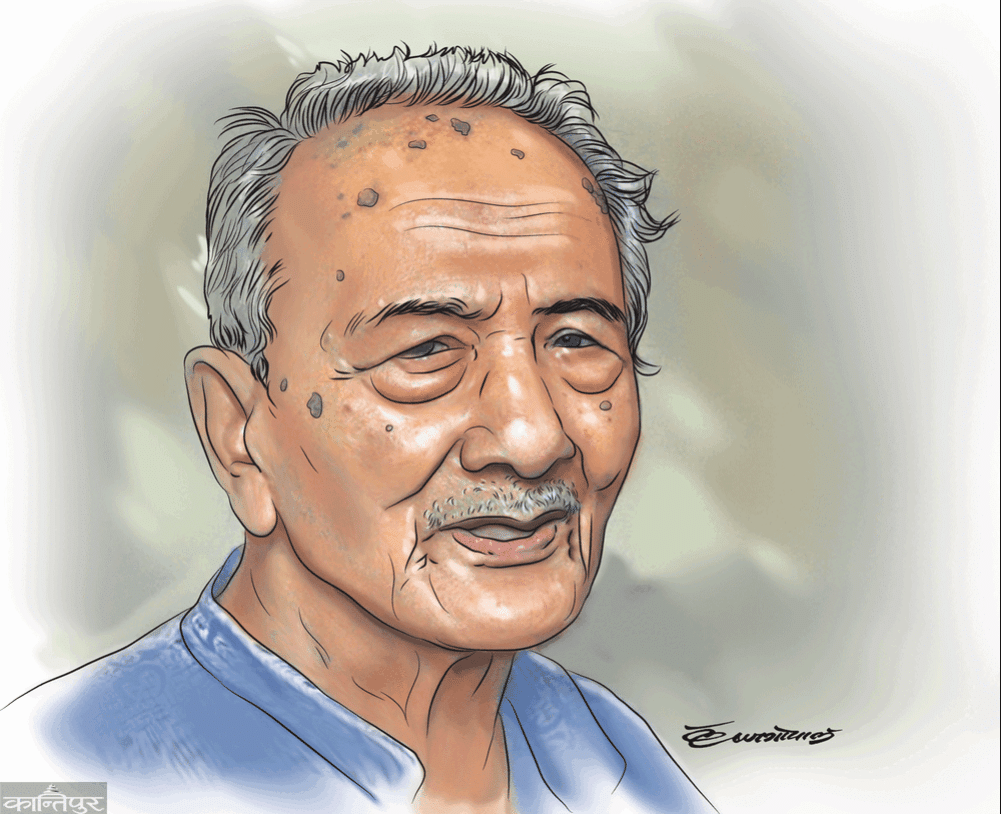
The portrayal of Assamese Nepalese society and life by Leel Bahadur Sir in 'Basai' inspired me to write 'Refugee'. After taking approval from Sir, I introduced him as 'Kshetri Sir' character in 'Sharanarthi'. If Leal Bahadur had not been found, perhaps 'refugee' would not have been written.
We use Google Cloud Translation Services. Google requires we provide the following disclaimer relating to use of this service:
This service may contain translations powered by Google. Google disclaims all warranties related to the translations, expressed or implied, including any warranties of accuracy, reliability, and any implied warranties of merchantability, fitness for a particular purpose, and noninfringement.
Naka's eyes fell on Tulsa's forehead at the edge of the courtyard. After going inside, she came out with water in a jug and poured water on Tulsa's mouth and murmured - 'From tomorrow, you too may be dying of dryness! Who will come and offer you water! When will you be able to offer water to your feet again?
Maina entered again. Inside, he began to grope around in the dark, searching for clay. Matia went near the pigeon's nest with a fistful of kanika. Putting the fodder in his nest, saying - 'Who will feed you from tomorrow!'...Maina remembered the bull. She went to Katera. Seeing him, the bulls looked at him and started panting.
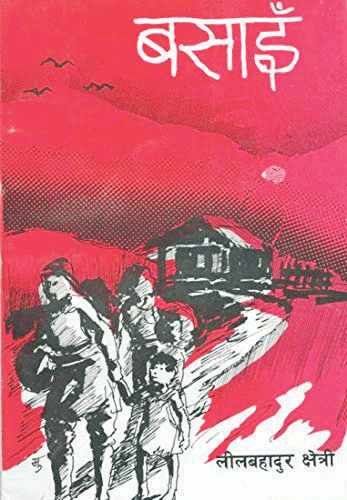
by putting a straw nearby, Maina started stroking both of them. ...say, 'Your new boss will come from today. They give you sweet grass, hoe. Don't hit anyone. Work straight. Nabha kutai khaneho.' Tears were falling from his eyes (from the novel 'Basaiin').
This is where I cry every time I read the novel Basain. There are countless places to cry in the book, but after coming to this page, the teardrops stuck in the eyeballs will fall down on the pages of the book. Many times I thought, 'Why did I cry after I came here?' When I started writing the story of my own life in the book 'Adhabato', it was written at the beginning that we 'stayed'
The description of the walking moment is as follows-
'Two porters were searched for as far as Ilam and they were also given corn for wages. 50 rupees worth of black lentils were sold for food expenses. The rest of the grain was left in the barn. A buffalo pen in the barn, milking cows, bulls, goats and goats were all taken out and taken to the field. All the windows and doors of the house were opened. We moved on the 9th of January 2024 with fifty rupees in cash, utensils that could be carried by two porters in Dhaka, clothes, and enough food for the journey (from the book 'Adhabato').
I think today - the style of every traveler was like this. Why do people migrate? There are different types of interpretations and analyzes about it, but the migrants say the same thing, "There is no land for farming, even if there is enough food crops, the wealth of the moneylenders cannot be consumed."
All the social, economic, political and family psychology has been disrupted in the North, but what have been done to prevent the continuation of this tradition of migration? If we start looking in this way, our gaze will again be like the stone of Deurali. Whatever happens in the house of those who don't have it, the pain of leaving it as it is and walking away with just a little can't be removed by a penman who has the skill of writing like a poem or a work. What kind of story would be written by the seer on the unfinished journey of where this family has gone and where to lay the heavy head of this family?
I read the novel 'Basaiin' published three years before I was born (in 2014) when I was a student of class eight and my parents also heard it for the first time while reciting it. Even after listening to this entire book, my father said nothing but my mother made me read it several times and every time she cried on the last page above. These are the same pages my mother wept over every sojourn, the slow motion of her shaking hands and the tears that flowed from her eyes as she bid farewell to the walkers.
This song was very popular at that time -
The aunt of the migrant makes the heart of the resident cry
This country is desolate for millions,
There is heaven for a handful
Even today, the queue of migrants is just as long. Why is it long? We will discuss it at the end.
While I am writing this article today, I am remembering the 'Brihat Katha Symposium' organized by Nepal Pragya Pratishtan and Sasank Pratishtan Dhulabari in the year 2053, in which hundreds of writers from within and outside the country were present. There, for the second time, I was able to welcome Leel Bahadur Chhetri, the author of my favorite book 'Basai', as the host.
His presence in that program became the center of special attraction. I could see him as a man of simple nature, dressed in Nepalese style, fond of talking, mixing Assamese words in his speech and respected by all. The crowd around Leel Bahadur Chhetri seemed more special than Indra Bahadur Rai, the bone of intelligence.
I met him for the first time in the year 2052 during a literary trip to Northeast India under the leadership of the then Vice-Chancellor of Nepal Prajna Pratishthan, Madanmani Dixit, at the Nepali temple in Guwahati city, where hundreds of Nepalis were present to welcome us. He was the chairman of that nomination committee. He introduced us all in detail. We were on the trip – Madanmani Dixit, Rita Dixit, Jagat Bahadur Shrestha, Avinash Shrestha, Bhagirathi Shrestha, Rama Sharma too. At the last moment, Krishnabhushan could not go to the ball. After the formal program of the first day, he gave a very warm welcome to his home.
I was the youngest in age on that trip. That was the longest and farthest trip I had ever taken. After meeting with Leel Bahadur sir, I had many queries and questions with him. As many questions as I had, they were all related to the life of Assamese Nepalese and he explained each of them very carefully. Maybe those questions of mine drew his attention to me in a special way and he kept telling me more things than I asked. The way he portrayed the Assamese Nepalese society and life that he saw and experienced inspired me to write my first novel 'Sharanarthi'.
After returning from there, I started the journey of novel writing. During the five-year journey of writing 'Refugee', I kept meeting with Leel Bahadur Sir. During those encounters, I became more curious. With his approval, I presented him as a 'Kshetri Sir' character in the novel. If I had not been able to participate in that trip and meet Leel Bahadur Sir, my novel writing journey would probably not have started and even if it had, it would have been very late, 'Sharanarthi' would not have been written. So I consider that meeting with him as an important turning point in my literary writing journey.
Leel Bahadur Chhetri was a writer who wrote complex ideas in simple language. To understand the level of psychology in his writings, one should read the novel 'Atrapta'. The author's second novel, which can bring the ancient thinking, lack, poverty and exploited psychology buried in the society from the outside into the human mind, is able to bring out the search for dissatisfaction and unattainability buried in the human mind. I don't think all the readers of 'Basaiin' have read the novel 'Atrapta'. However, many must have read 'Next to Brahmaputra'. 'Basaiin' and 'Brahmaputra Ko Chheuchhau' seem like complementary novels. Readers who are curious about what kind of struggle the family that moved from Nepal would have faced after reaching Assam will quench their thirst with 'Brahmaputra's side', but it seems that the author does not want to give continuity to the character of 'Basaiin' in that novel.
The fourth novel 'Echoes of Oblivion' is his biographical novel, in which the author narrates his family and Assam's social, educational, caste history from his father.
A young man distraught by the pain of the mountains was taken to Ankantar village in Assam, forced to be recruited in Paltan, and forced to work as a slave for years without pay. This novel is also a myth of success and failure in the life of those who struggle with determination.
He sent me the manuscript of the novel in a sealed envelope to write the role. Inside that envelope was a letter, signed by Chhetri Sir, tucked inside the manuscript of the new novel 'Pritdhwanaru- Vismrutika'. Those letters stood out saying - 'The manuscript merged together Let's say the proof copy was written as 'Echoes - Bismritika' novel. It is based on the biography of my father. ...is a novel after all.'
Before receiving that letter, he had said on the phone - After reading your half way, I have also written a novel based on my father's life. I want you to write its role. What could have been a bigger reward for me than to have my name added to Leel Bahadur Chhetri's book? And within the time he wanted, I wrote and sent an article titled 'Like History, Like a Novel', which he published in the front of the same book.
After reading the novel 'Sharanarthi', he accepted that he was a character and wrote, 'The characters of various novels and stories in Sharanarthi stand together and move forward, even losing the 'next to Brahmaputra' is not left behind. He advances one day to meet his guardian Kakati Babu near the Kamakhya temple on Nilachal mountain. From there he goes to B. Baruwa Road towards his author's house. The lost writer asks the question, why was Basnet forced to migrate? As to why he was not made to fight within the country.' They only say in their hearts - 'Look! In reality, even today, where has this tradition of migration ended? Today, the country's best doctors, technicians, lawyers, academics and those who rely on intelligence are rushing to America and Britain, while those who can make ends meet are swimming in the oil wells of Arab countries, even if they sell their bread. Some are also buried in Kheleriahat coal mine in Meghalaya. If the labor force and intellectual resources of the country are going out like this, who will fight for the development of the country?' As soon as a new book was published, it would come to me from someone coming to Jhapa and on my way back, I would also send a package of good books from there. Whenever possible, his presence in the special programs held there would become energy for us. Even when he came to Nepal on his own work, he would get a phone call after arriving in Kakadvitta and we friends would get together urgently.
'BP Koirala India-Nepal Foundation' has also given great support in meeting Leel Bahadur sir and me time and time again. From the first conference held in Siliguri, India in 2055, the conferences held every 2 years in Dhangadhi, Banaras and Kathmandu respectively, we continued to meet .
In the year 2061, I was in charge of bringing the writers from India who would participate in the ceremony in Kathmandu from Jhapa. At that time, Leal Bahadur sir was not going to come. I was the one who called after doing a lot of work. I heard that in a video posted by Leela Anmol in a dialogue with the literary teams that reached Guwahati a few months ago. The most pleasing thing about listening to that video was that even at the age of 93, his memory was still fresh.
The person he believed in the most was Indra Bahadur Rai. He was very impressed by Rai's Leela Chintan.
Although he did not use the Leela style in his writing, he liked to explain philosophy. In the year 2059, his presence was special in the 25th anniversary celebration of Lilalekhna organized by us in Jhapa. When we had to stay in Jhapa, we were very happy to have him in our house sometimes.
I suddenly heard the news that on March 13, 2025, at the age of 93, he cremated his decrepit body. I felt uneasy but after a while I accepted the natural truth.
Leel Bahadur sir is not with us anymore but he has left such books to Nepali language, literature and caste, due to which we cannot forget him even if we want to. In Nepali literature, there are two immortal works, very small in size and very long in subject, which will continue to be read as long as the unemployment and migration situation of the Nepalese race is alive. They are - 'Munamadan' and 'Basaiin'.
In the end, I would like to say this - Leel Bahadur Sir became the most fortunate writer among the Indian writers of Nepali language, who was able to receive not only the Indian Academy Award, but also the highest honor 'Padma Shri' given by the Government of India. I think Assam politics helped him a lot to get that respect.
As much as there was a movement in Darjeeling to recognize the Nepali language, there was not so much in Assam. After the language movement of Darjeeling eventually reached the demand of Gorkhaland, Delhi's view of Darjeeling became different. In the same view, not only Darjeeling, but also in India and in Nepal, the highly respected writer and thinker Indra Bahadur Rai was the first writer to receive the Indian Academy Award, but after some time, when Indian Prime Minister Morarji Desai said that 'Nepali language is a foreign language in India', Rai returned the Sahitya Akademi Award with the money. That's why I think that Rai should have been excluded from other honors given by the Indian government.
The ethnic pain suffered by the Assamese Nepalis is of a different kind, which I have written in the novel 'Sharanarthi'. I cannot say 100 percent what I have said above while evaluating the literary journey of Leal Bahadur Sir, united in that pain, together, for the Nepali race and language. The story of the sufferings of the Nepali race inside the country and abroad, which he wrote, are the immortal works that will make him immortal. With the wish of immortality, my literary association with him for about thirty years has been completed after coming here.