Nepali films could not cover Madhesh. Where will the Madhesi see themselves in the character that makes the audience laugh by wearing black on the face, selling hot drinks or making a mouthful? However, the Madhesi have met themselves in ”Rajaganj”.
We use Google Cloud Translation Services. Google requires we provide the following disclaimer relating to use of this service:
This service may contain translations powered by Google. Google disclaims all warranties related to the translations, expressed or implied, including any warranties of accuracy, reliability, and any implied warranties of merchantability, fitness for a particular purpose, and noninfringement.
Buttedar carpet is laid from the main door of the Girija Hall to the inner entrance. There is a Dhawa in the courtyard of the hall, here is made the taruwa of Banta, Chatpatte. A thermos of tea at the end, nearby are cutting tea glasses. The tea connoisseur cares about summer, they are drinking tea mast. A crowd is slowly gathering in Girija's courtyard. SP of Janakpur, rights activists, activists, filmmakers and local journalists arrived at the courtyard walking the red carpet.
Before, the Girija was neither decorated like this, nor had this kind of grand gathering. Today, Girija is decorated with twinkling lights. The only reason for this decoration is that for the first time in 25 years of the establishment of the hall, a Nepali film is being premiered here - 'Rajaganj'. Hindi, Bhojpuri and Maithili movies only increase the buzz of this courtyard today because of 'Rajaganj'.
Hall businessman Narottam Shah says that the premiere of 'Rajaganj' changed the atmosphere of this hall established in the year 2000. "No Nepali film premiered in Girija before this. So we were excited about the premiere," said Narottam, "For the first time in 25 years, my mind was blown." At the time of 'Pushpa' there was no place to set foot in the courtyard of this hall. The audience used to enter the hall in a row. Hindi films like 'KGF' to 'Jawan' have been making this hall running. A Maithili film called 'Ganga Jaison Mai Hajar' became a hit many years ago. The Bhojpuri film 'Sat Saheli' was also a hit. Be it Girija or other halls of Janakpur, Madhesh movement is the reason why only South Indian films are shown, Narottam says, "After the movement, people of Pahadar origin separated from Janakpur." "When there were hills, Nepali films were fun. Films like Darpan Chhaya first used this hall. When there was a movement, the mountains separated, and gradually the audience also separated," said Narottam, looking towards Girija Hall. However, Nepali films are not shown here. There is a crowd of spectators in Kathmandu to watch Hostel 3. People don't even come here.'
For these viewers who have been watching the action of South Indian films, Narottam's experience was that even language could not attract them to Nepali films. Another bitter reality is that Nepali films have not even been able to cover Madhesh. The Madhesi character is not depicted realistically in the film. Where do Madhesi see themselves in the character of wearing black clothes, sometimes selling briskly and sometimes making the audience laugh? How to watch films with characters that are shown in a humiliated manner? Viraj Bhatt's '12 Villages' will run for a week. Meanwhile, the famous Bhojpuri song "Jhinjhiya" was included in "Ek Bhagwat Aar Ek Gita", so the audience had reached the hall. Whether it is the character of Madhesh or the sentiments of Madhesh, Narottam tells that Janakpur wants to watch any film with Madhesh. The premiere of 'Rajaganj', made in the background of the Madhesh movement
(2072), forced even the audience who had not seen a film for 15-20 years to visit Girija's courtyard. In that sense, the power of art was displayed at the premiere of the Nepali film in 25 years. Starting with Aamir Khan's 'Mela', this hall showed the story of 'Poojas', in which a female character is seen in the lead role.
Before the premiere of the film, the 'Rajaganj' actress was afraid - how will the police look at Rajaganj? Asha, who is seen in the role of an inspector, is shocked by the response she got from the police.
Pooja is not a Madhesi, but a hillbilly. Madhesh descends from Kathmandu to rescue two kidnapped children in 'Rajaganj' (fictional city). However, this Pahadeh character gradually sees Madhesh, Madheshi women and the movement. That's where she sees oppression and discrimination in the movement, abuse of power and power. And she fights for justice. After watching the
movie, most of the women in Janakpur were saying, 'There are women like Pooja in the society, who really fight for justice.' After watching the premiere, women praised the steps taken by the police for justice in this film shot in Janakpur and said, 'Salute to a character like Pooja. Pooja's character has played an example of how the police agency should work.'
In this film, it is also shown how women from different communities have to endure discrimination. In the film, Saraswati's (Aarti Mandal) character kidnaps the headmaster's son. Why would a Madhesi woman kidnap another Pahad mother's child? At what level does an ordinary woman who tutors children take such a decision? Can't ordinary Madhesi women who can't speak confidently fight for justice? The story of the film gradually turns towards the hills and Madhesi mothers. And slowly it shows Madhesi women who can raise their voices for justice. While giving an interaction after the premiere of
, Jamuna Bhujel gave the opinion that this film portrays the reality of Madhesi women. One woman will not back down even to abduct a child, while another woman will go ahead for the rights of all three women. We Madhesi women are still unable to speak about whose house is where. However, this film has inspired us Madhesi women to be like Pooja Sir,' she said. Tears came to Pooja's eyes when Pooja sir felt that I was the guilty one. Bhujel is also a human rights activist. After 16 years, Bhujel rushed to the Nepali film hall to see the Madhesh issue.
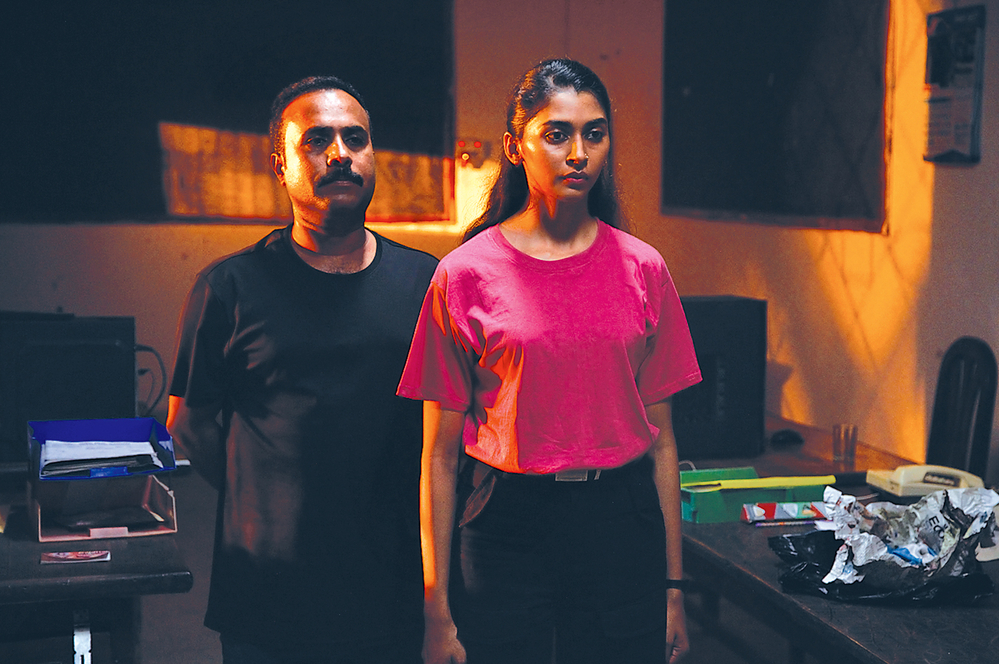
In this film, Pooja of Pahade origin is a gay woman. The film also shows the silent battle he has been fighting with his sexual identity. Bhujel said that this subtle issue related to sexuality is presented in an interesting way in the film. How far will a woman go for justice? It means women are not less. Pooja sir is also of hill origin and works honestly. He himself is a minority. There is another problem at home,' she said.
Dr. Ramji Ram lost 'Rajaganj' because of the Madhesh issue. So for the second time in his life he took the court of 'Girija'. Earlier, he had seen 'Girl Missing Notice' directed by Dipendra Gauchan and has come to watch the Janakpur premiere of 'Rajaganj'. After watching the film, he was heartened by the female leadership shown through Pooja sir. Women are the heroes of the society, but Nepali films do not show that kind of portrayal of women. The way the female lead is shown is good. It was shown that women are also heroes," said Ramji, who was met in the hall. "The film does not show the subject of Madhesh in a trivial way. Why would a Madhesi woman kidnap a child?'
Remember Burma first came to know about 'Rajaganj' through social media. When the news of the Janakpur premiere reached her, she couldn't say no. The acting of a Madhesi actor in a Madhesi character made him feel proud to be a Madhesi. Reminiscence also watched the film after about 7 years. Pradeep says that the film covers the discrimination faced by the sexual and minority community and is raising the voice of justice for this community. Characters representing sexual and minority women are shown in the film. It has also been shown how such women endure discrimination. The story of discrimination shown in this film is a real incident,” Pradeep said after watching the film.
Deepika Karki, who joined the Madhesh movement of 2072, also got a chance to watch the film at the premiere. Deepika doesn't remember, which Nepali movie did she watch last time? He was also led to the hall by the theme of the film. Deepika, who is a relative of Ghanshyam Mishra, who acted in the film, watched the film as a family member. Deepika was touched by the movement. "Nepali films don't do well, that's why they didn't go to the theaters. We ourselves also participated in the Madhesh movement. In that sense, another side of the movement could also be shown in this film. At that time, Pahade also took part in the movement," she said, "At that time, it doesn't seem like Pahade and Madhesi were separated as shown in the film."
Most of the female viewers found in Girija Prangan were not used to watching movies. Most of them watched Nepali films after 15 years. "Nepali films are not made like before, that's why we don't watch Nepali films. This film was shot here, the subject is Madhesh, so I came to see the film," said a woman. Indu Karan also watched a Nepali film after 15 years. How was the Madhesh movement shown? I have come to see how the Madhesh issue has been shown," said Indu.
Most of the audience present there was brought together by the issue of Madhesh. Watching these women's films shows that Madhesh has not yet been touched by mainstream films. If they were able to include Madhesh in Nepali films, the Madheshi audience would watch the film. And the filmmakers should not have cried saying 'Nepali films do not work in Madhesh'. That woman is an example that Nepali films could not cover the large population there.
Before leaving the country for the film premiere, Asha Magrati was afraid, how will the police look at Rajaganj? What will be the reaction? Asha, who played the role of a police inspector, was shocked by the response she got from the police. "When trying to get justice, like Inspector Pooja, we have to fight within our own body, they responded like what is shown in the film," said Asha after the Janakpur premiere, "They understood that Pooja won the case because she was a woman. They didn't see the Saraswati character as a villain.'
A large number of policemen in Birtamode watched the film and praised Pooja. Asha was also happy when the Madhesh audience responded to the film's subtle aspect. Asha said, "Rather than when the film flopped at the box office, this kind of love and response from the audience made me happy."

