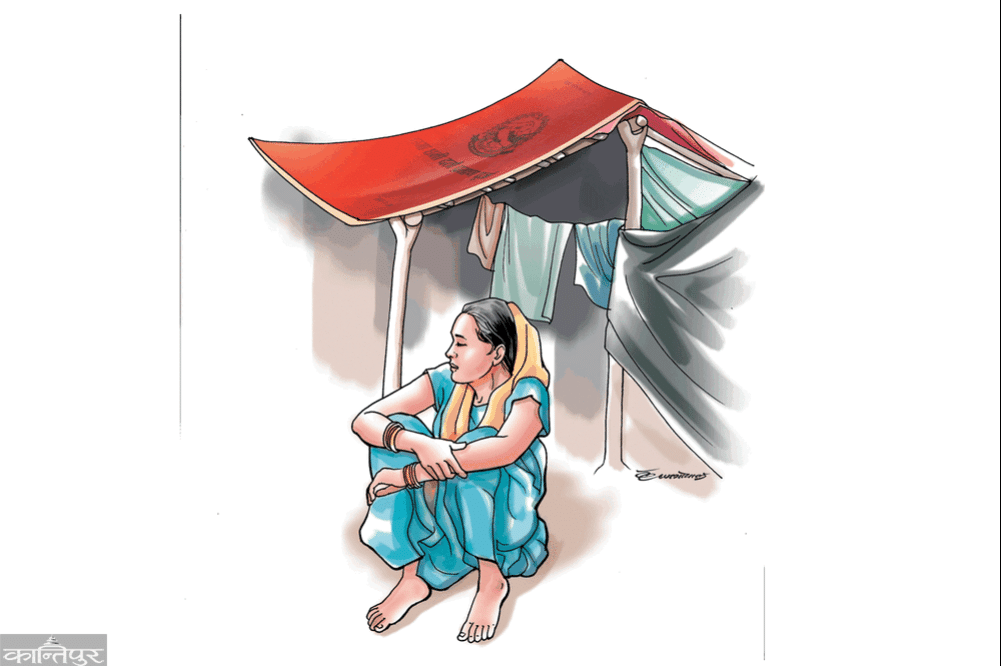
Women who sweat in the soil all their lives are deprived of land ownership
We use Google Cloud Translation Services. Google requires we provide the following disclaimer relating to use of this service:
This service may contain translations powered by Google. Google disclaims all warranties related to the translations, expressed or implied, including any warranties of accuracy, reliability, and any implied warranties of merchantability, fitness for a particular purpose, and noninfringement.
Read the entire life-journey of Nandakala Kami and you will know that it is no less painful than the journey of a star and man is the most powerful creature in the world, who cannot bear anything. I worked hard all my life, but I didn't know happiness.
Couldn't sleep with joy and feel safe. Why did you have to suffer such a fate? I thought a lot, this happened because I didn't have land,' this is the grief of Nandkala Kami of Birendranagar Surkhet.
When Nandkala was 12 years old, her mother passed away, her elder sister was already married. Father did not fulfill his responsibilities. Nandkala worked in other people's houses and raised 4 siblings. They had no land. They are born landless. He was envious of people who were farmers, 'If we had land, we could have farmed and eaten, otherwise we would have suffered.'
She got married when she was 17 years old. Relationships are also intertwined according to their status and situation. The relationship of the sad was connected with the sad. Husband is also landless. They lived on someone else's land near the remote village of Dailekh and later came down to Surkhet in search of work. The husband and wife were earning their living by doing wage labour. He used to earn 10 rupees in the evening carrying heavy loads all day. There was a small bush in the hollow not far from the city. A son was born, who conceived another child when he was 18 months old. Her husband, who went there in search of work, disappeared somewhere.
Nandkala felt as if she was being pressed by a mountain. She cried, screamed, wandered around looking for her husband but could not find him. A child in the arms, another child in the womb. No address. She fell into a great calamity. There was no physical condition to carry heavy loads. Another daughter was born. The days of childbirth were spent with difficulty, many days were starved. Nandakala became physically and mentally exhausted. The sight of his son picking up food thrown into the drain and feeding it to his sister when he is unable to work still shoots an arrow in his heart.
After much searching, she found a job washing dishes and cleaning at another's house. Since it was difficult to eat and live, there was no way to teach the child. At the age of 7, his son also disappeared, he was not found when he searched, Nandkala lost her mind. After 6 months, a fat envelope arrived in Nandkala's hands.
The son sent 18 thousand with a letter. He has gone to India. Got a job washing dishes in a hotel, 3 thousand per month. And, after receiving the salary, he sends it to his mother. After 4 years, the son came back and then started to visit. Mother and son saved a little by suffering.
He built a house with bricks in Kharkholi in Birendranagar with the money he had saved, but he was always afraid of eviction because he did not have land. At the time when the rumors of Corona started, they were told to leave the land they were living in because it was 'government', where to go now? Didn't know.
After the government intervened, the neighbors demolished their houses and moved elsewhere. Nandkala and 4 other families did not go anywhere. Is there a place to go? The government used a dozer to demolish the concrete house. It was difficult for her to handle when her son destroyed the house built by the money of washing the dishes and the hard work of Nandkala.
Even after demolishing the house, abuse continued to rain on him while he was staying there. She is still living in the same house after repairing it. If he has the most beloved thing in the world, it is the house and the land with the house! With the drops of his blood and sweat, it became a hollow settlement like Masanghat.
says, 'someone was born in a big palace. We were born in the womb of the poor and landless. If there was land, it would not have been neglected like this. No one could come to destroy the house where he lived. I have submitted an application to the commission to see if I can still get the red portion of this land. I have heard that even the day ends here. No matter where I am, I will be the richest man in the world the day I have land in my name.'
74-year-old Kumari Vick of Nawalpur Setapani, who was born in a landless family and lived with the nickname 'landless' all her life, got a red portion from the Land Commission only in 2080. She was very happy to have a safe house with Lalpurja. Now he would have his own control over farming. She is hoping to get rid of that insulting nickname, which everyone gave her as 'man of the forest' when she lived near the forest because she was landless.
These stories are representative. About 1.5 million landless families across the country have many stories and sorrows. There are great hopes and dreams of secure housing and farmland. Land is life, livelihood, self-esteem and identity.
Women's ownership and access to land ownership marks the beginning of liberation and freedom from centuries of slavery and second-class citizenship. The issue of women's land rights is also a campaign to build their identity and power. Therefore, for the past 20 years, women have also been fighting and fighting for land ownership in an organized manner for land rights, housing security and ease of livelihood.
It is the women farmers who have toiled in the soil all their lives and are deprived of land ownership. It is extremely unfair that those who have an inextricable connection with the soil and its produce, who are contributing the most to agricultural work, who are totally dependent on agriculture, are today excluded from land ownership.
The social, cultural, educational, economic and political conditions of women are not improving significantly due to lack of ownership, access and decisive rights to land. Increasing land ownership is indispensable for the protection of the human rights of women, who constitute more than half of the population, and for the implementation of the constitutional system. It also helps in guaranteeing women's overall development, self-esteem, self-esteem and independence, developing equality in society and reducing family and gender violence and discrimination.
Despite the challenges, women's ownership of land has been increasing in recent years. If we look at the statistics, Census 2078 has published data that 23.8 percent of all households in Nepal have at least one female member owning land. While in 2058, 11.7 percent and 19.71 percent of women owned land in 2068.
Recently, with the trend of men and young people going abroad, the responsibility and role of women is increasing. Women are taking care of family, society, agriculture, children. They are saving the land from becoming barren as much as possible. Having assets in women's names gives them the courage to venture.
reduces dependence on fathers, brothers and husbands for financial resources and increases women's empowerment. It helps to reduce poverty and helps to bring qualitative improvement in children's education and family health. Importantly, it also controls the indiscriminate sale and fragmentation of land.
The issue of landless women farmers who have no land all their lives is complicated. Generation after generation of them had to die without seeing the red part of the land. More than 1.5 million families are landless due to discriminatory government policies. The existing laws of the country say that all citizens are equal, but here the gap between the haves and the have-nots is huge. To bridge this gap, to do justice to landless laboring women farmers, to increase their self-esteem, women's access to land must be increased.