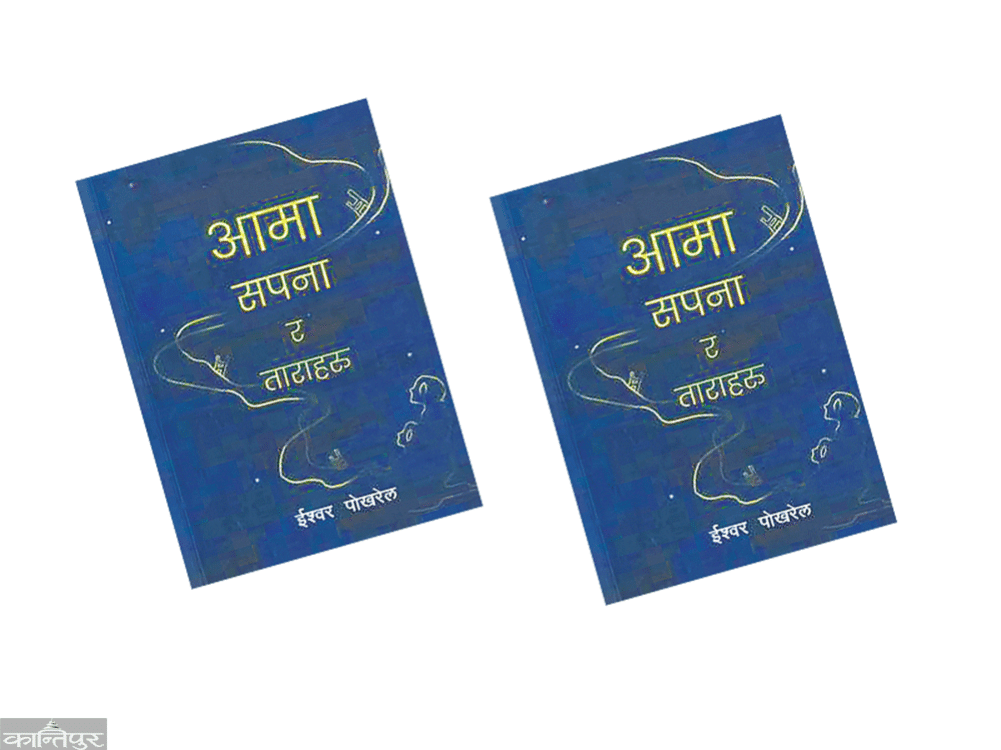
The society experienced by Ishwar Pokharel is a representative Nepali society, where poverty, suffering and pain were shared, it is not over yet. The writer is always haunted by the memories of his mother's sad days.
We use Google Cloud Translation Services. Google requires we provide the following disclaimer relating to use of this service:
This service may contain translations powered by Google. Google disclaims all warranties related to the translations, expressed or implied, including any warranties of accuracy, reliability, and any implied warranties of merchantability, fitness for a particular purpose, and noninfringement.
The word 'mother' makes some people emotional. Also, when the memories of the late mother are recalled, the person becomes 'nostalgic' and wallows in the memory of the past. About his mother who left the world 25 years ago, Ishwar Pokharel has refreshed those old days through 'Aama, Sapna aur Taraharu'.
One can't help but become emotional while reading the place and feelings of a mother in the heart of a politician who fought against the autocratic Panchayat state system and went to change it by neglecting issues such as family, education and writing, and his personal future.
The system changed, over time Ishwar Pokharel became a political advisor to the Prime Minister, MP, Minister, Deputy Prime Minister and now he is in the top leadership as the second leader of CPN (UML). How did the inside of his personality, which dominates the political aspect even in daily life, from the outside? From what ground of struggle have they risen? That statement is made inappropriately in this book.
There are no big things in 'Ama, Sapna og Tararu', there are small practical issues, through which many of you - we live. The effects of Baidhavya suffered by mother Ram Kumari after her father passed away at a young age, leaving behind four daughters and four sons, are still fresh in the writer's mind. The writer especially remembers the days when he used to live alone with his mother after his brothers left for easy livelihood and future from Rupnalu Pakho of Okhaldhunga Mamkha village and after his sisters got married.
The author, who lost his father at the age of 8 years, has spent almost 10 years with his mother until the age of 46. The author has mentioned the state of mind and condition of the mother during the tragic days of the separation of her husband and children. In the
book, the events and topics of that time have come around the mother. No memory or event is absolute and its specificity cannot be established without reference to the surrounding environment. That is why the author has placed the mother at the center of the environment from Okhaldhunga to Janakpur, Jhapa and Kathmandu.
Born in the Neupane family of Bhojpur Gogane and married to Pokharel from Mamkha of Okhaldhunga before the age of 11 and gave birth to 12 children, the main themes of this book are the stories of sorrow, pain and struggle of a mother. Naturally, along with that, the travel patterns of the author can be read from time to time.
The society experienced by Ishwar Pokharel is a representative Nepali society, where poverty, suffering and suffering were common and still not over. The memories of those sad days seem to haunt the writer. The author has described his family situation, "It must be around 2019, father passed away. We were starving. There was no money, the harvest at home was about to end. Mother sent me to Rumjatar to find Besaha along with a village elder. We reached Ratna Sahu of Rumzatar and stayed' (page 37).
When describing Rumjatar, which cannot be seen directly from the house and has to be seen from the hill, he has discussed the relevant historical characters there. The author has shown the importance of Rumjatar by giving a place to Prithvi Narayan Shah's Nepal unification campaign companions Trilochan Padhya Pokharel, Harinandan Padhya, Yadunandan Padhya, Jhagal Gurung, saint Gnandil Das, singer Melwadevi.
Mother's expectation was not otherwise that her son, who returned to Janakpur after completing his BEd from Kathmandu, now got a job and returned to his happy days. However, it was different - the author returned with his friend Ratnakumar Bantwa after giving up the scholarship he had received in Switzerland with the determination to devote his life not to personal 'career' but to change.
Ishwar Pokharel, who is unable to answer his mother's question, 'What happened to you, where are you going?', remembers the painful moment when Ishwar Pokharel had to leave his brother's house with his mother, saying, 'I did not have the courage to answer that mother's request or inquiry correctly. I didn't even look at my mother, I didn't want to go anywhere, I was going to go because my friend from school called me, I said I'll come.
I had to shake my mother's hands that were holding my hands. I quickly got out and reached the road to the house. I couldn't even look back at home' (page 65). In this way, the author has carefully collected the emotional moments of meeting his mother, searching for harmony in the midst of adversity after going underground. Ishwar Pokharel is presented as a son in the memories of his mother covered under the title
25. He also shows regret for not being able to fulfill his responsibilities towards his mother. After the death of the father, the younger son, whom he raised with love, did something he did not think about and even brought a daughter-in-law who did not wear a fulli (Newar), which shows her immense love for her son.
When informing about the inter-caste marriage, the mother says, 'I am glad to hear your story, father. I was afraid that your life would be stuck. I am happy to see that you are marrying with love' (page 105). During the underground period, the writer met his mother three times. Even though she hadn't seen him in years, even though she didn't know what he was doing, she was happy that her son was safe. The story of the daughter-in-law also tells how much faith a mother has towards her son who has spent her life in prayer, chanting etc. The language in the
book is polished, simple and elegant. When reading the events, one feels as if one is there, as if one walks along and feels one's own suffering. Ishwar Pokharel has actually expressed himself openly when he descended from the harsh field of politics to the sweet field of literature.
We celebrate the Memorial Day of the departed. We remember not only the natives, but also the foreigners. In Hindu rituals, there is a custom to perform Shraddha of one's parents. That is actually the practice of remembering, paying homage and bowing down to one's birth-giver. Ishwar Pokharel, who has dedicated his life to communist politics, has shown true respect by collecting his boundless feelings and memories towards his mother in a 140-page long book, even though he did not perform rituals. Even describing the mother as a Shesnag with a thousand zebras is not enough. That is why the author has placed the mother along with dreams and stars –
As I sat on my mother's lap
I saw the stars –
Stars twinkling in the sky.
After falling from my mother's lap and starting to walk
I learned to count countless stars.
not tired
My campaign to count the stars
is still going on In memory of my mother...