Inside the armored vehicle I was pressed down with a 10 kg bullet proof jacket. I thought, the car is a prison.
We use Google Cloud Translation Services. Google requires we provide the following disclaimer relating to use of this service:
This service may contain translations powered by Google. Google disclaims all warranties related to the translations, expressed or implied, including any warranties of accuracy, reliability, and any implied warranties of merchantability, fitness for a particular purpose, and noninfringement.
Mosquitoes abound in South Sudan, so there is a risk of malaria. And, before going to Sudan, we got vaccinated against aloe fiber and hepatitis-B. And on the same day of vaccination, we also took cholera medicine and three tablets of malaria medicine after a week.
Entry into South Sudan is prohibited without a yellow card containing vaccinations. So when we flew to Juba, the capital of South Sudan, we had a yellow card in one hand and a passport in the other.
Before flying to Sudan, the Nepali Army's peace operations directorate made it clear to us - what is that country like? What do you do there? He said - do not take photos or videos without permission, mobile phones and cameras will be taken into custody if they are found secretly taking pictures. In particular, this is an old problem, like mobile phones of army soldiers have been taken away. Why does this happen? Chief soldier Ramprasad Lamichhane, who has worked as a peacekeeper in South Sudan, says, "When taking photos and videos, the community there feels oppressed and they don't like it."
New Delhi, India, Addis Ababa Boll International Airport in Ethiopia, we arrived at Juba Airport by Ethiopian Airlines. Disembarking was greeted by a warm rap. It felt like we were standing on a hot plate. It was sunny – sweaty, temperature above 34 degrees Celsius.
Waiting for us at the airport was a vehicle with UN written on it. On the trip were General Hari Bahadur Bishwakarma of Public Relations and Information Directorate of Nepal Army, Chief of Army Staff of Peace Operations Directorate Ram Prasad Lamichhane, Deputy Minister of Foreign Affairs Subba Tank Bahadur Rai, Deputy Minister of Defense Subba Ram Prasad Nepal, Journalist Chhaya Chandra Bhandari, Army Technical Subedar Anil Adhikari, Jamdar Ramesh Kumar Basnet. Later, through Congo, technical soldier (Major) Kishore Dulal joined the team that reached Juba.
...
What kind of country is South Sudan? It was important to understand that before moving. It is an African landlocked country, five times larger than Nepal in terms of area. The time difference between Juba and Nepal is 3 hours 45 minutes, where there are 10 states. And, there is a majority of Christianity. Religion was the main reason why Sudan became South Sudan in 2011. Because Muslims predominate in Sudan and Christianity predominates in South Sudan.
It is dominated by the Dinka ethnic group, which accounts for 35 percent of its presence. The Nuer caste is 15 and other various castes are 50 percent and the estimated population is 12 million. Per capita income is 340 US dollars. Sudan gained independence from the British Empire in 1955. After that, Sudan and South Sudan got into internal conflict and in 2011, South Sudan gained independence and became a separate country.
Not only the internal political turmoil, the armed activities of ethnic groups, but also the grip of the state apparatus in South Sudan is weak. With the declaration of a new country, the United Nations (UN) has been trying to maintain peace and stability here since July 8, 2011, and bring the turbulent situation under control.
The conflict between the Dinka and the Nuer, the ethnic groups supported by President Salva Kiir and Vice President Riek Machar, respectively, has left the country in dire straits. Controlling the armed activities of the two ethnic groups is the main challenge here. The state apparatus is also divided by the clash between the President and the Vice President. The United Nations Mission in South Sudan (UNMISS) was established under the UN peacekeeping mission to bring the turbulent situation under control and maintain peace and stability in the country. The United Nations is active for peacekeeping under UNMISS.
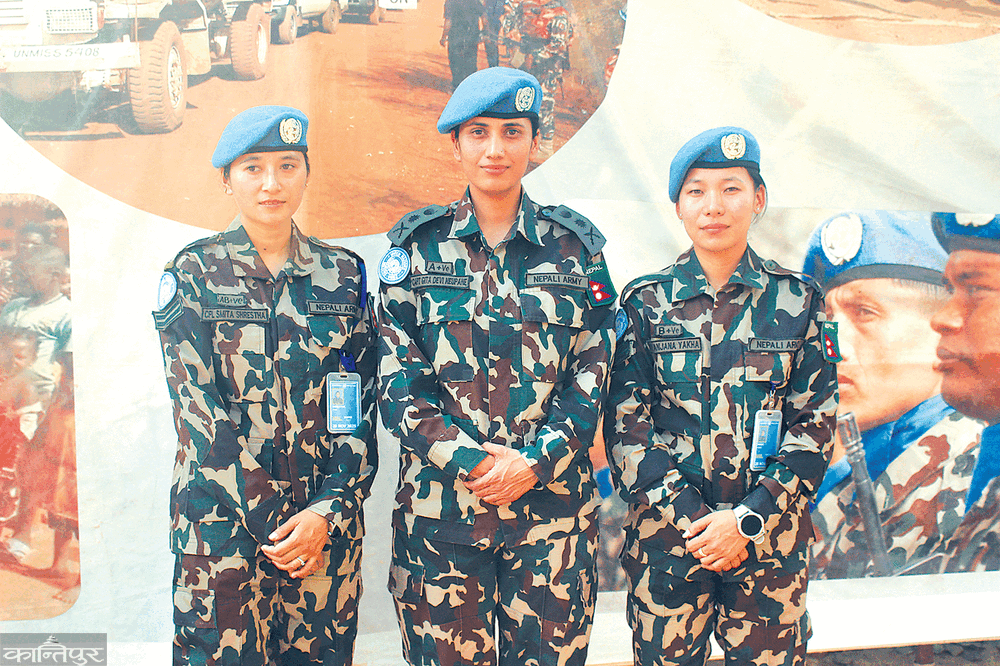
The main responsibilities of those who come here as Nepalese peacekeepers are to protect the locals, create a harmonious environment, protect international laws and human rights, and implement the detailed peace agreement.
Currently, 18 thousand 134 soldiers, policemen and non-military personnel from more than 20 countries are working in Unmiss Mission, in which Nepal ranks third among the countries that send security personnel to peacekeeping forces. Number one is Rwanda and second is India. Currently, 1,966 people are working in Unmiss, including Nepal Army, Armed Forces and Nepal Police. Three units of the Nepali Army are stationed in Anmis, two in Juba and one in Rumbek. The UN House is always powered by a generator. UN vehicles cannot be driven on the road from 8 pm to 6 am.
...
We headed to the UN House, just beyond the airport. After leaving the airport and entering the inner city, you will find a dirt road, where the movement of vehicles creates a lot of dust. The speed of the vehicle cannot be increased while moving on the local roads. If the dust blows, the locals can also take control of the vehicle.
In the Juba area, there are some concrete houses and some wooden houses. From the looks of it, it looks like a poor settlement in Nepal. As you enter the inner settlement, you can see more houses on the left and right side of the road. It is common to see common people riding motorcycles without helmets on the road. Up to three people ride on a motorcycle. Only tall men and women are seen in South Sudan. Seeing these and similar scenes, our car reached the gate of the UN House.
The weather was very hot. Mahasenani Hari Bahadur Biswakarma, who went along saying that 'air and water do not mix', was suggesting everyone to drink plenty of water. UNMIS Force Commander Lieutenant General Mohan Subramanian openly praised the work done by the Nepalese peacekeepers in the mission. Representing from China, Bangladesh, high-level army officers who are holding the command of different areas were also openly praising the Nepalese peacekeepers.
However, we did not get to walk on an uninterrupted road. Even the army cannot go out on foot without uniforms, vehicles and weapons. People from other communities were nowhere to be seen walking outside the UN House. Traffic police of South Sudan were found in various places. The feet of traffic policemen dressed in costume were usually sandals.
When the army vehicle of that country appears on the road, the vehicles of the security personnel of other countries leave the side. However, traffic rules were not observed. Private vehicles were plying on the road. In Juba area, a thick crowd of locals was seen. After staying in Juba for a few days, our journey moved to Rumbek, a distance of 350 km. You had to take a ship to get there.
The road transport here was not as easy as in Nepal. Then we boarded a 15-person UN boat and reached Rumbek in an hour. Looking from the ship, a flat land was visible below. Only one long road seemed to be dug up. Houses were visible in uncontorted places, but no roads were visible.
No crops, vegetables, fruits were seen on the ground. They grow crops and they bear good fruit, but they do not pay attention to them for fear of being robbed. Charter ships occasionally arrive at Rumbek Airport, where the Kachi airport used to be. The temperature there had risen to 38 degrees Celsius.
Nepali army was also present in Rumbek along with the army of other countries, where red soil was visible. When I entered Srinath Gana, I felt as if I had reached a part of Nepal. After entering through the gate, the greenery of the bride and groom was seen. That Jor Var-Peepal was planted in 2014 by Ransingh Dal Gana from Nepal. Cashews were growing on one side and mangoes were growing on the other side. An officer of Srinath Gana showed a cashew plant and said, "Sudanese eat cashews when they feel they are infected."
Sarifa was about to ripen in the other corner. 'Sir, what is planted here?', a military officer was showing the vegetable plants planted in the camp and said, 'There is nothing that does not grow in the sewage water, the Sudanese are afraid to plant food crops for fear of theft, we have grown vegetables, chickpeas, green corn and tomatoes in the camp.'
A peace soldier was saying, 'Many people say that they returned to Nepal after coming to peace mission and earned so many lakhs, but no one asks how we worked, what is the state of the country, how difficult it is to work.'
It was four o'clock in the afternoon, the heat of the sun had not decreased. Some soldiers were preparing to go on a peace patrol. Meanwhile, there was talk of going out on patrol with the peace soldiers wearing helmets and bullet-proof jackets in armored vehicles. Bullet proof jacket weighs around 10 kg. Wearing the same jacket, we entered the armored vehicle. How can you avoid a double collision while sitting in a car? The peacekeepers proceeded with a 'briefing' patrol.
The body was completely wet with sweat. A bullet proof jacket was covering the body. The car felt like a small prison. From inside to outside, we could see children playing football and people gathering in the square and gossiping. When the armored car went out on patrol, the locals would occasionally glance at us. After about an hour of funko at Rumbek Bazaar, we entered Ganamai. There is no paved road in this place. Even concrete houses were not visible. When I got out of the armored car, I thought - it is really difficult to leave the country and come so far to work as a peace soldier.
...
Again our journey was thought to be towards Juba. A seven-day trip to South Sudan - time was running out. After returning to Juba, a military officer told us some interesting things about South Sudan. As here, those who have many cows are called rich. The price of one cow will be more than 100 US dollars. Used for beef and milk. Therefore, there are many herds of cows in South Sudan.
It is customary for boys to give cows to girls as dowry in marriages, said a military officer who was on a mission for a year, "Those who have many cows are marrying up to three times for prestige." Incidents of cow theft are also decreasing. "Cow theft is a major problem," said the soldier, "Cow thieves do not hesitate to kill people, so the presence of peacekeepers on mission is mandatory."
From time to time food is distributed to local people in various places under the World Food Program (WFP). However, there is also the risk of being attacked by unknown groups while carrying food. Sensing that danger, Nepalese peacekeepers deliver vehicles carrying food to the respective places. In many places peacekeepers are being attacked by unknown armed men.
Ramprasad Upadhyay, who is living in South Sudan for business, organized a gathering of Nepali people the day before his return to Nepal. Then we reached the Nile, the longest river in the world, where a cruise ship could be seen half-submerged in the middle of the river. For the first time, we reached the river bank outside the army camp and took pictures, there was a lot of foreigners. Relaxing under the mango tree that summer was a blissful feeling.
Now the time has come to return to the country. After flying from Juba, we stopped for 6 hours at Addis Ababa Bol International Airport in Ethiopia. A military officer who was returning to Nepal after successfully completing a 14-month peace mission was saying - 'This was my second mission, but our country is heaven when we look at other countries. How good is our country, whether it is for touristic places, or for the climate. The taste of food is also delicious in our country.'

