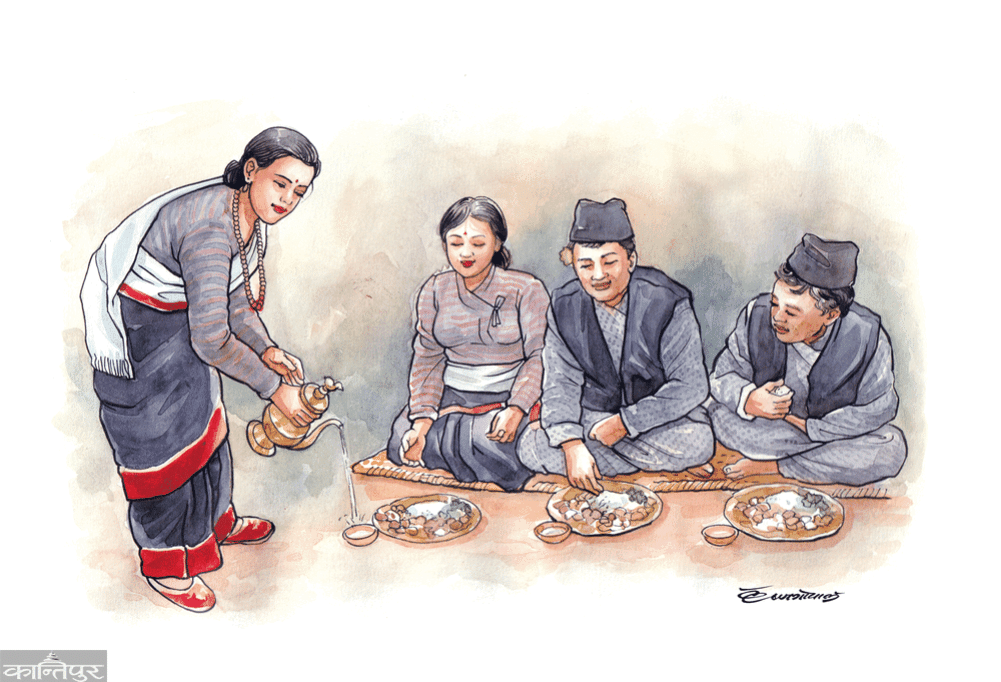
Bhoj is in Neva's blood. However, the status, environment and conditions to hold a feast are disappearing. At present, the Bhoj held by the Neva has only 'Bhoj' and no 'Neva'.
We use Google Cloud Translation Services. Google requires we provide the following disclaimer relating to use of this service:
This service may contain translations powered by Google. Google disclaims all warranties related to the translations, expressed or implied, including any warranties of accuracy, reliability, and any implied warranties of merchantability, fitness for a particular purpose, and noninfringement.
This February is also the month of feasting. On top of that, there is Vain Vya in February for the Newar community who are constantly drenched in feasts for twelve months. Newa is also famous for food. Moreover, Bhoj is an event where only eating is done. That is why non-Nevas who know about the Newa meal say that if the meal is a Newa dish, then one should not die. When it comes to serving food, the Newa community also gives their lives.
As soon as we say feast, we often think of wedding or fasting feast. However, the Newa: community does not feast only on weddings and fasts. Bhoj Khan Newa: Community has hundreds of excuses. A feast is associated with a person's rites of passage, with seasonal festivals, with the worship of a deity, with an ethnic group or with music, and with any other creative activity.
Let's talk about the rituals - the child is not born, from the time of conception, the feast starts in the name of the child. For example: During pregnancy, feeding Dhaubaji (yogurt), feeding Sichupalu, sending Sinh: (vaccination), feeding Ghya:baji (Gheeu Chiura) is done. After the birth of the child, a feast is served by completing the rituals of Machabu Byanke Ku Chhwayegu, Machabu Swa: Wanegu, Pyuchan Nhyak: Wanegu, Aunchabia: Wayegu, La Nak: Wanegu etc.
Then a feast is held in the name of various rites such as Navaran, Annaprasana, Vratabandha or Pravrajyasamvara, Ihi, Bahra:, Marriage, Janko, Death and even after death (Fanindraratna Vajracharya, Neva: Nasa Nakh:, 1113). These ritual feasts are not just for one day. For example: When the daughter is here, the feast lasts for two days. And, at the time of marriage, the feast starts from the sending of betel nuts - as in pahan lya: (counting the number of guests) feast, feast when going to see Ranga, main feast, then room feast, before Anmaa, Thaybhaju feast to the bride, after Hwanke (Swayambar) sabjambva feast for both bride and groom, after the wedding, feast to bring in the groom, Vanjala feast on behalf of the groom, and finally help in the feast. Bhimbeli feast for those who do.
When a person dies, a feast is made in four days, a feast is made in seven days, a feast is made in 12 days, a feast is made in 13 days, then a feast is made in 45 days, 6 months, one year, two years. Even on the same occasion there is feasting for many days. And, strangely enough, the custom of organizing these feasts can vary from year to year. That is, Maharjan, Tuladhar, Shakya, Manandhar, Khadgi etc. have different types of feasts. In some cases, even if the last name is the same, if the place is different, the feast of the same last name is different. The feast served by Maharjan of Kirtipur and Maharjan of Bhaktapur is different.
The feast dishes eaten on these different occasions are also different. In some feasts, only four dishes are served, while in others, there are five, six, eight, 12, 24, and up to 84 dishes. There is also a separate law on how many dishes to have in which feast. How many dishes in a happy feast, how many dishes in a sad feast? The type and number of dishes eaten at a feast indicates what kind of feast it is. In the
feast, there is a variety of food, and alcohol and wine are also used as drinks. Just as different dishes are used in different types of feasts, different types of food are also kept. Newa: At least 12 types of soil are used by the community. Such as: Hayanthwan (Thwan means Jand), Bhauthwan, Mootithwan, Katathwan, Byoyathwan, Ajithwan, Tyapathwan, Jutithwan, Pya:thwan, Vyavarathwan, B:tathwan, Bhutikwayan Thwan (Jyapu Panch, Bhabo, N. No. 1121).
Newa: The society uses different types of bread (Mari) in their feasts, pujas and various rituals. We usually know some names like Yomari, Chatammari, Gwaramari etc. Author Jyapu Panch has collected the names of 41 types of birds used by the Newa. Some of the spices that are not used now are: Kasaramari (Rati given in Panchadan), Satfali Mari (used in janko), Bhasanmari (bara-like pepper), Panchapakwanmari (used in Yajna), Afungmari (used in Satyanarayan Vrat) etc.
This is what it looks like: The community is extremely wealthy. However, some have the opinion that the Newa: community is rich in feasting, but the feast itself has made the Newa: community poor. After watching Newa's Bhoj, they also remember the saying that 'Newar got spoiled by Bhoj'.
But, Neva: Community feasting is not just about the dishes. These feasts also have religious-cultural significance, and it is also the identity of the Newa civilization. There is also a custom to consider the dishes served in the feast as symbols of various gods and goddesses. Like: Chiura is Earth, Chatammari with Cumin is considered Moon, Ginger is Mahakali, Rakti is Shwetkali, Amilo is Kaumari, Lansu (radish chana) is Ganesha, Khursani is Prachanda Bhairav, Choyla is (skeleton) etc. (Dr. Rajan Lal Joshi, Newa: Bhoj).
Not only that, Lapte (sal leaf) along with the feast is also considered as a symbol of Ashta Matrika if eight are tied together, and if sixteen are tied together, it is considered a symbol of Bhairava. There is also a separate way of cooking dishes, which is called Suwa: (Suwal). There is also a custom to start the work by ritually worshiping the hand of the cow when starting to cook the feast. The worship done to Suwal's hands is called 'Hapuja'.
Newa: If we look at the history of feasts eaten by the community, there are many such legends and folktales in Newa: society, where feasts are discussed. Like: the story of the gods and goddesses feasting on the flesh of a dead man in Masan, the story of the eight mothers being invited to a feast by Bachlamai, the story of the Ajimas going to the sisters for a feast, etc.
Apart from this, if we look at the written history, there is a discussion of Bhoja in the record of Licchavi king Narendradeva of Lalitpur Gaihridhara (Savat 83) and in the record of Anantalingeshwar (Dhanavajra Vajracharya). Similarly, it seems that the records of the Licchavi kings Dhruvadeva and Jishnugupta also contain episodes related to feasting. During the Malla period, the practice of feasting is found to be further developed. Records have been found that the then Malla kings Jayasthiti Malla, Bhupatindra Malla, Jayaprakash Malla fed the people on various occasions.
On the contrary, it seems that the dishes eaten at that time and now have changed a lot in history. For example: Dishes called Rangako Panla, Goat Panla, Bhangera Panla, Karan Panla, Sohni Naga Panla, etc., which were served during the Malla period, are not even heard of now. Until 50 years ago, it was customary to include dishes such as gorma (an edible bag made with sesame seeds), khichabhyat: (a type of grass), bhuyumva:kva: (a bag made with sesame seeds), himva:kva: (a bag made with blood). Nowadays, people who know how to make these dishes are not even found.
Newa: Some of the dishes used in feasts have now disappeared. Like: Kimla, Tupala, Talatula, Marsyala, Hulla, Kalakhuna La, Khunala, Dulapila, Khwapula, Sansala, Sapu Panla, Cha:Gulila, Kachula, Chilla, Galapala Neva: The meat used in the feast is raw. The names of 70 parts of the entire body of a snake are written in Nepali language. At one time, all those organs were used to make dishes. Now that the medical science has termed the meat of Ranga as 'Red Meat', the Newars have started to fear Ranga.
First-first eating had its own rule. Newa: The feast is usually eaten by squeezing plenty of rice. Senior citizens are placed at the top of the Sukul. The feast is eaten in sal leaves (lapte). After placing the initial dishes of the lapte meal, the senior citizens are the first to start eating. Only then should others start eating. In this feast, dishes are brought to the table repeating three stages and sometimes four stages. There is also a regulation of what to put in the first step, what to put in the second, third, and fourth step when preparing the dish. Fruit and curd are placed at the end of the
. After the meal, a tooth brush is also given. After taking the khauka, the feast is over. However, you can't get up quickly saying 'done'. Only after the senior citizens of the first line wake up will others wake up. Now this custom has disappeared. In the feast of Janko (Old Pasni), it was also a custom to put chatammari, talatula, ta:khala and some dishes in pa:mak: (a clay pot) and send them home to the guests. Later the custom of keeping Dayeka La (Kavaf of meat) was introduced and later this custom disappeared (Jyapu Pancha, Bha:Bw, Ne. No. 1121).
Newa: When organizing a feast, all the work of cooking, serving dishes (catering service), cleaning is done by Guthiars of Guthi. No need to spend money on it. According to the author Premhira Tuladhar, it was customary for the Tuladhar community to 'serve' the dishes by placing the dishes on the feast. It was customary for the men to have a feast and feed the women as soon as the guests arrived and the men would eat only after the women had eaten. Now it has become like a story.
Why do the Newars eat so much food? It also has a long anthropological history. As history has confirmed, Kathmandu Valley was once a large lake filled with water. Science says that due to the big earthquakes that occurred in different periods, the mountain cracked and the water started to flow out and the lake dried up. Due to being submerged in water for millions of years, the soil here was very clayey and hence its fertile power was unmatched. Because of the huge production, the food could not be consumed.
So the local Newa: residents started drying and storing the grains so that they could be eaten throughout the year. Like: Grind the rice and make it into chips. Leftover rice was used to make drinks such as jand and liquor. All the vegetables can be dried and stored. In fact, what is eaten at the feast is the stored food. Planning a feast is all about making good use of these foods. Newa: The community was rich in food during that time. So go to make many types of dishes. And, they could organize large feasts. Therefore, the feast celebrated by the Newa community can be considered as a symbol of the prosperity of the Newa at that time.
Bhoj and kinship
Newa: In society, the meaning of eating and feeding is changing, and not eating and not feeding also has meaning. Bhoj also determines whether to keep or break ties with a relative. If a member of the family who must be invited to a feast is not invited to a feast that he organizes, then the relationship with him is severed.
If you are having a falling out with a relative, the 'easy' way to officially break up with them is to not invite them to the party. No matter how distant the family relationship, it remains until it is invited to the feast. That relationship is considered to be broken when the banquet is stopped. Even if someone does not go to eat the feast called by him, it is considered that the relationship with him has been broken. Even after being invited to a meal, not going to eat means to postpone the relationship with him. If you want to officially break up with someone, the 'easy' way is to not attend the party he invited.
Because the relationship is connected by the feast and the relationship is broken by the feast, it is called by the Newas in their language 'Bhojan bya: Bhojan swa: (Bhoja breaks, Bhoj connects)'. It is a social relationship associated with feasting.
Is the dinner broken?
As mentioned above, when talking about Bhoj, the saying 'Newar spoiled by Bhoj' also comes together. Because not only in Nepal, there is hardly any caste in this world that organizes a feast like the Newars. So it must have become a proverb that the Newars are spoiled by eating only Bhoj. But the question is, is the Newar community really ruined because of feasting? To determine its essence, it is not a feast, but the political-economic history of Nepal.
is only a part of the proverb 'Newar spoiled by feast'. Its complete proverb is - 'Rana is ruined by Mozle, Newar is ruined by Bhoj'. Some people also say that 'Bahun Bagrio Mojle'. It is not appropriate to add the word 'Bahun' to it. Because in Nepal, the Bahoon caste has not been destroyed, nor has the Bahoon been able to count. Although Bahoon has managed to gain some power recently, it does not seem to be able to gain social power yet. It is the ruling queens who measured it. Therefore, it is clear that this proverb was made after the beginning of the Rana rule in Nepal, and it fell or was on the verge of falling.
Now, looking at the course of history, it is known that when the Rana regime reached the stage of collapse, the Newars must have deteriorated. However, the reason for that is not the feast. The reason is, the Shah-Rana rulers of the Valley Raithane Neva: Unauthorized occupation of the community's land. After the rise of Prithvi Narayan Shah, he seized the land of the Newa tribe of the valley and gave employment to his soldiers. He gave bigha land in Kathmandu to all the Gorkhali military officers who migrated from Gorkha to Kathmandu. That land belonged to the Newas.
After the rise of the Rana rule, they too seized the land of the Newa: community and built for themselves the Alisan palace and many other structures related to the palace. As a result, the Newas gradually became landless. Without land, there was no production. Since there was no production, it became difficult to hold a banquet. Guthi and Sanskars to hold a banquet are still there, but the land for the banquet is getting less and less.
As mentioned above, the Neva's feast is not just about eating. It is also associated with religious, cultural and social dignity. Maybe some may have sold a small piece of land that remained with him to maintain that dignity. Some may have been fallen by leaving such dignity. Why did the News of the Neigh Lean feast on Shah-Rana Dakaria come to Shah-Ranaaka and not running to the banquet? After the paid, land related to Gunti was also in government control. Means that followed by the Guthile also gradually started getting lost. Neva: This is the one who has been written with the community and politics.
Bastus Nav: It's in the blood of the community. However, the status of the environment and situation is going on. In such cases, NaW: The type of banquet, it has started to ruin the banquet. Nowaday Nava: Only a 'Banquet' at the community is' Bankes' Neva: 'No. Neither there is no na: Vegetables, neither na: the laws of the feast. Now the Neva: The Neva: The tissue is vested such as stubborn, chowom, fish, fish, chicken, chicken, chicken, chicken, chickens. The party spends more in the grandmother's grandmother than food. December expenses has increased due to the family, Catricing, Foreign drinks etc. This is a sign that the party is deteriorating.
now the party organized by Neva / shat is not like before. That has gone to the whole modern pillar. Nevertheless, chief feasts such as marriage, wedding, Nepali: Signium: The customs kept in the facetime says that the operators of the party palace in Kathmandu in Kathmandu, Maharjan. He says that her party is now increasing the scene of the vice. But, thereaa: Even if there is a banquet, it has been changing right now.
was first done by Guthi involving the party's project, now the party Palace is started to do. Feding first to keep it in secret, now is the provision of a mesh-table. Because people are now known to eat. Section of section (fiber) has been the plague. Because of the same way, the same cost of the same is the ten rupee, and the section start will be rented at cheaper than that. The feasuring it says: 'If so, there is no change, Na: The party cannot be organized. Again, the party is also cheap. '
, according to the Buffether Top, Nava, reduces the cost of 40 percent. He also wants to add slowly to feed the Neva: However, the other wishes in the party are not found now. & Nbsp;
Left: The witnesses came to see if the vigals came, but not as 'thererentinal'; tasting, it is difficult to find now. Still now, J & NBSP; Neva: The party has entered our plate, the tongue is the option of the tongue. Now the Neva: The food-starts must say, "Guli: & NBSP; Navi: How Mood New Test!