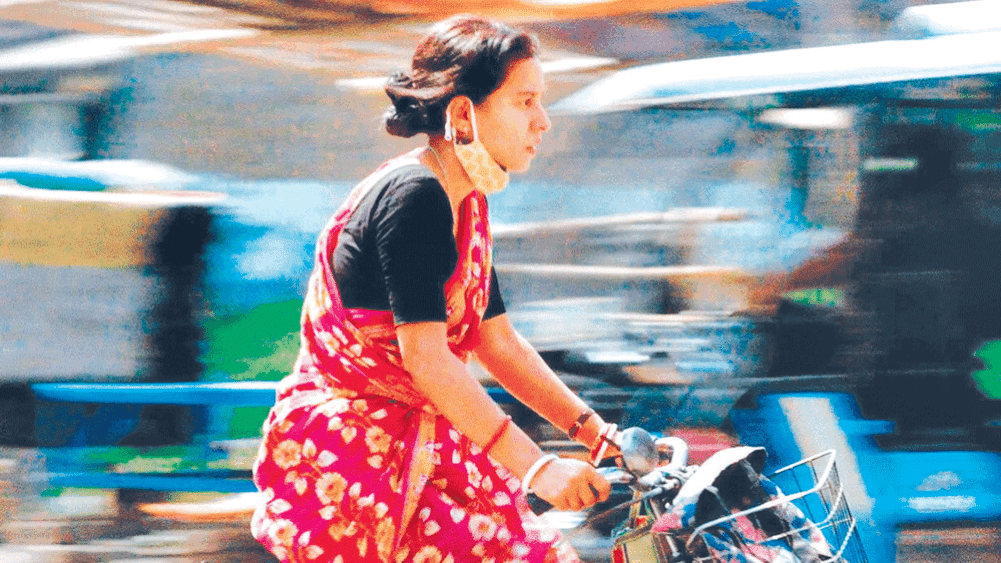
Tilottama Shome has presented the lives of mothers, sisters, aunts and maids of our society through the character Maya of the film 'Bakso Bondi', which was world premiered in the 'Perspectives' category of the 75th Berlin International Film Festival.
We use Google Cloud Translation Services. Google requires we provide the following disclaimer relating to use of this service:
This service may contain translations powered by Google. Google disclaims all warranties related to the translations, expressed or implied, including any warranties of accuracy, reliability, and any implied warranties of merchantability, fitness for a particular purpose, and noninfringement.
Maya delivers women's clothes to other people's homes early in the morning. It has become a daily routine to go to someone else's yard to deliver clothes after doing the housework. Then during the day she has to go to someone else's house to help, and she also works at the chicken farm. Back home at night again the same kitchen and clothes iron!
Her husband Sundar (Ex-Army) suffers from PTSD (Post-Traumatic Stress Disorder), convulses on hearing loud noises, is monotonous. Maya has no other option to spend her life like this in the morning and in the evening. Neither she is ready to take the help of Maiti, nor does her self-respect allow her to depend on her brother who is running the shop.
In the midst of this struggle, she has to find a job for her husband and raise her son well. He has no place to rest his weariness, nor a shoulder to cry aloud in sorrow. He doesn't have big dreams, he wants to live a happy life with his family. That's why she laughs night and day, she is leading her life with sadness like a bicycle pedal.
Maya is the character of the film 'Bakso Bondi', which was world premiered in the 'Perspectives' category of the 75th Berlin International Film Festival. Actress Tilottama Shome played the role of Maya. The life she lives with love, the pain she endures and the courage within her has been well portrayed by Tilottama.
Actress Shome, who succeeded in garnering praise for her performance from the audience with 'Is Love Enough Sir', has presented the lives of mothers, sisters, aunts and maids of our society through this character. Tilottama's character has brought to life the theme of how the women of our society have made friends with suffering, how they have assimilated the struggle and how they are peddling bravely with hope for the future. This is the strong point of 'Bakso Bondi'.
Women are not glorified in this 91-minute film. The fact that women don't get angry, they don't cry is not related to their strength. It is shown through this character that women are also human, they also suffer. It is this aspect of characterization that makes Tilottama a Maya.
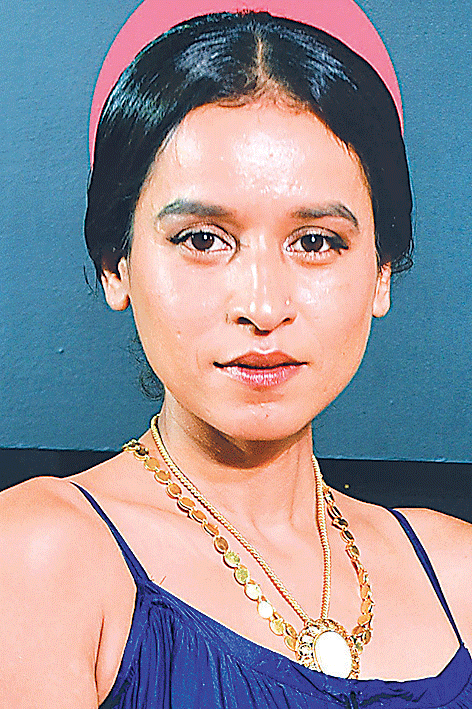
It is wrong to make a comment that mothers don't cry, they don't make mistakes. Yes, a mother can love immensely, but they also suffer," said Tilottama, who met in Berlin, with Kantipur. "Love makes some decisions based on the difficult circumstances of choosing a husband and family. Sometimes loving someone is a difficult task.'
Maya is not the type of character shown in Bollywood, who is kept in the film just to dance around the hero. Maya is such a poor character of the society, whose life revolves around the struggle of avoiding morning and evening, whose daily life is involved in such poor work inside the house. The different women of the community, who are searching for their existence in this society, those women who are at the back, who are still not seen by Bollywood. Tilottama has been presenting such characters through independent films for 20 years. This is the identity of Tilottama.
Tilottama himself is drawn to such characters, who are ordinary, whose struggles, sufferings and endurance are always ignored by the society. Those women whose work is not given importance, women who are ignored. The aspect of showing women who are not seen through character encourages them to create such characters,' she said, 'You don't see what women do from morning to night. It is the best thing to tell the stories of such women.'
In this film, the perspective of the society and the family is also shown. Sundar's character shows how the society accepts only the able and capable. The film satirizes the society/world that is becoming rigid. We humans fight at some point, then we have to stand up and support each other. I can be the one who fights, you can be yourself. This film covers people in such situations, said Tilottama.
It took about 7 years for Tilottam to become the love of 'Bakso Bondi'. Although Tilottama spends about 4 years in most of the films, independent films do not have box office pressure. They spend their time making films. About 7 years ago, a friend gave him a film script and told him to read and respond. She accepted her friend's request.
One day the same friend asked him to present his feedback on the script to the director. He felt embarrassed, maybe they didn't like the reaction he gave? However, the production team said that her reaction was necessary for them and said that Tilottama, the character of Maya, should do it. Thus Tilottama was involved in the film right from the writing of the film, she started building the character from the very beginning. According to him, the production team immediately collected pictures of Maya's character, gave him a watch, a kapi to keep track of, and a saree worn by the character.
When you wear a dress that many women have already worn. It helps you get closer to the character," she says. "The director of this film gave me freedom to explore the character. If you invest a long time in a character, that character will gradually grow within you. This is also the style that Tilottama is following in character creation, she gives time to each character to grow within her. Why is he so rash that he has to go to the shooting within a few days of receiving the script?
As a seed sown on the ground grows slowly. She stays within the script and gradually nurtures the character within her. "The seeds of character grow inside you slowly," she says. Tilottama argues that it is because of the women of Ubela that today's women have reached the point where they can tell stories.
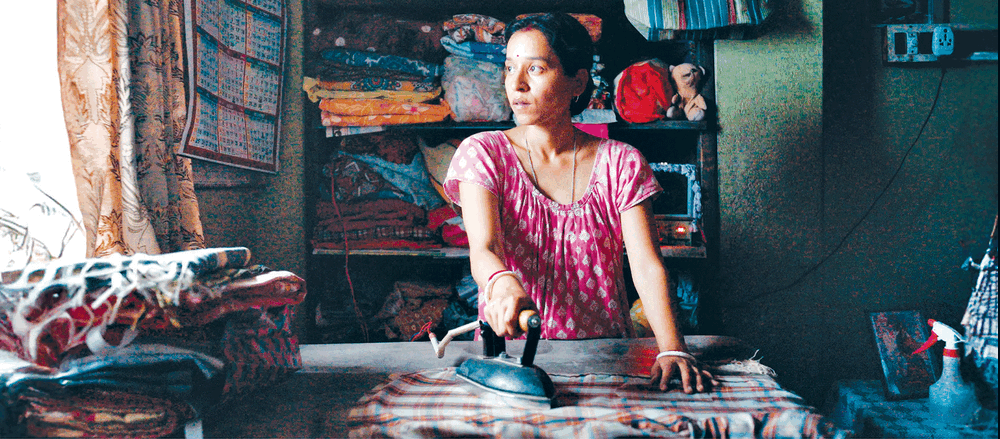
'Our mothers, aunts drank the insults in such a way, they didn't get a chance to get it out. That's why today we have come to this place where we can now tell their story," she said. Fought with society, fought with family. It is because of them that today we can be angry, we can seek change. We can speak for our acceptance through the film.'
This actress, who has been working for a long time in character creation, is known by most of the audience in India only from 'Is Love Enough Sir'. Tilottama, who made her acting debut with Meera Nair's 'Wedding Monsoon' in 2001, made her mark in acting through Anup Singh's Kissa.
However, she has been doing independent films for nearly two decades and was not known by many in her own country. After covid, more viewers started to recognize him. 'Kissa' became a school for learning how a film is made through Meera's film. Especially due to Covid, the independent style 'Is Love Enough Sir' could not be performed in the hall. After coming to Netflix, the search for Tilottama increased within Bollywood.
Most of my films have not been seen in their own country. Only my family and those who come to the film festival have seen my film," she says. After 20 years of filming, my film reached a large audience.'
Actually, actresses like Tilottama are being saved not by the film industry, but by film festivals. "Festivals like Berlin are keeping us alive. But, it took time to accept my work in my own country,' she said.
Meanwhile, Tilottama worked in popular Netflix series 'Lost Stories-2', 'Delhi Crime-2', 'Paatal Lok-2'. At a glance, such digital platforms seem to provide a different character for artists like him. However, she admits that there are still not enough characters written for female actors even on the 'OTT' platform. Yes, we are getting a good role. However, we have to work hard to reach the same level of equality as men are getting,' she says. To break the story, he does not believe in 'method acting', although most people know him as a 'method actor'. She reads the script over and over again. And she creates a character between the script and her life. After a woman does something, her first quest in character building is to find out what is directing that character.
Now Tilottama is finally getting an age-appropriate character. However, in her 20's and 30's, the beauty standards of the film industry forced her to act as an aging character even at a young age. "Perhaps I didn't fall into the prevailing beauty vision of India, and therefore I had to portray an older woman. Now, at the age of 40, I am finally getting the character of my age,” she said.
Nepali film industry has been following this practice of neighboring country India for years. The field still carries the comment that only women who fit a certain standard are 'heroines', with chiseled waists, chiseled faces. Tilottama, who has been breaking this comment through independent films, advises Nepali filmmakers to take up new subjects without beauty standards.
I'm not saying that I broke the beauty standards. But, let's say I made my place even among such comments. The beauty of telling different and new stories is different. The more you start telling stories that are new, closer to you, then many beautiful characters are created," she said. "We live in a world where we are afraid to be different. But, when you tell a story that you don't want to tell, then your character crosses different boundaries and communicates with the audience from the other corner of the world.'