Poet/narrator Ramesh Kshitij says – Poetry is a mantra. However, reciting the mantra is not so easy to understand. Therefore, before reading Kshitij's story, it is important to make yourself a competent and conscious reader.
We use Google Cloud Translation Services. Google requires we provide the following disclaimer relating to use of this service:
This service may contain translations powered by Google. Google disclaims all warranties related to the translations, expressed or implied, including any warranties of accuracy, reliability, and any implied warranties of merchantability, fitness for a particular purpose, and noninfringement.
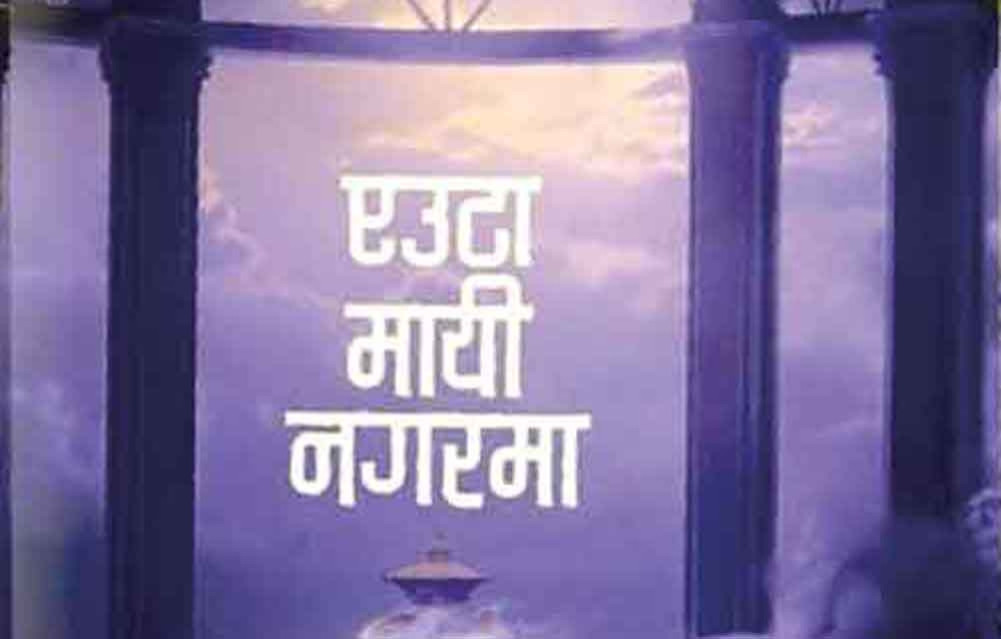
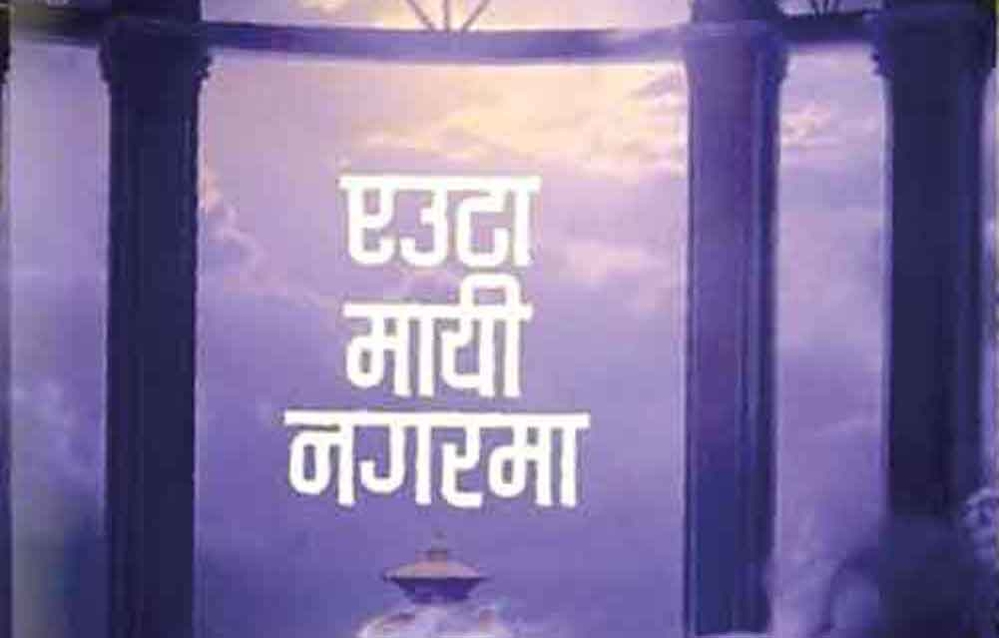
A lovely combination of purple, dark, light shade, black and white! Purple sky, soft-white cloud pieces! A palace window with a dark purple stripe, from where you can see a different world - the roof of the temple covered with wind, a mysterious kalvar with a white feather on the ground! This is the cover image of poet/storyteller Ramesh Kshitij's new story-book 'Euta Myi Nagarma'. That picture continues to fascinate a reader like me.
It is a city that stands with 17 mysterious, beautiful stories in itself - 'in a lovely city'. Mayi Nagar feels like a planned city while reading the stories. Each story begins with a full-page picture that reflects the mood of the story. On the other side of the picture-page, two lines reflecting the story-theme are printed. Those poetic lines are like a beautiful invitation to the reader to enter the story. He also tells stories. Each story in the
collection reflects the current times and Nepali society. William Shakespeare said - Literature is the mirror of society. As Shakespeare has already said, most of the stories in this collection seem like a mirror showing the existing political-social distortions-inconsistency of Nepalese society.
is reflected in that mirror – the bad trends of Nepali society and the stories of people. In the stories of the collection, 'Machha Bazar', 'Ustei Chu Ma', 'Swachh Chabi Jindawad', 'Mukhundo Avatar', 'Chair Factory', 'Shri Krishna Gobind Hare Murari' and 'Face Lost Face', it is seen in the stories - the existing disorder in the society, extreme corruption, the faces of people who are trying to hollow out our society-nation, employees, traders, smugglers, politicians, etc.
In these stories presented with the above-mentioned man as the main character, how does a person from a simple economic background gradually turn into a corrupt person due to profit, ambition and restrictions? Explains it in detail. In the plot, it is shown that these characters receive some form of punishment. As, how many are punished by law, many are punished by conscience. He has lost the joy and peace of his life, walking helplessly on the path of life with a broken heart.
Aristotle comes/goes to mind when watching the end of this story. He said that bad people should be punished. This point gives immense satisfaction to the reader. The experience of the characters in the story is pathetic. Judging from his mental stress and guilt, he seems to be shouting from the alphabet - wealth is not a source of happiness. And, the stories also say that wrongly earned success, fame, wealth, achievement, nothing can give a person lasting happiness, rather it takes away happiness and joy from life itself.
These stories of a new style written in soft language have created a wide horizon, in which the reader is thrilled to the height of joy. As he wanders through the world constructed by the story, he himself feels that he is a victim of the vicissitudes of time and life. And, the story of the struggle of the characters is his story. As the reader is thinking - Shaivlini and Aryakirti of 'Swapna Baghainchama Ukcha Chhaya' is himself, I am the character of 'Itramko Kotha', Haribol of 'Charitra itel Nishik Na Haribol', Dublo-Maranchyanse 'I' of 'Usthei Chu Ma' is the same.
While reading 'Munamadan of the year 2081', it seems that we are eyewitnesses to the suffering and struggle of Madan and Muna. While reading 'Maitidevi Muskaan', the sweet illusion of Vainshalu Thito leaves a smile on our lips involuntarily. When you stumble upon 'Namaste Lumbini', you will meet people who are full of humanity and people who are deprived of humanity. That meeting brings a terrible upheaval in the reader's heart. After reading that story, the words spoken by the Nepalese character, "After being born as a human being, one should have feelings, what is the purpose of a person who does not melt and lives only for himself?" echoes in the mind for a long time. The
collection has a variety of story topics and presentations. Most of the love stories in the book describe unrequited love. It seems, through this story, the narrator wants to create a different definition of love for the reader. In 'Arya, Wait Arya', the past character defines love like this, he says, 'Sometimes I wonder what is love? Friendship? Marriage? Close relationship? Or is it ever possible to have such a love, which is different from the name established by the society, or different from the name established by the society, or is there any love in the world that is different from the society's definition? After reading the story, one feels that the author is a supporter of 'Platonic Love' i.e. ideal love. Through the story, he leaves the scent of ideal love. How is that fragrance? That lust like Aryakirti's, Anurag's, Sylvia's, Prarthana Shah's - immovable, selfless and deep love - felt.
author Laurence Sterne took the narrative writing to a unique height by using the innovative use of intertextuality in the novel 'Tystorm Sandy' in 1819. In that novel, he not only included essays and other literary genres, but also dialogued with the reader. Even in Nepali literature, narratives using completely new/new/innovative style got a very warm welcome. Whether it was the storyteller Dhruvachandra Gautam's 'Alikhit' or Upendra Subba's 'Lato Pahad', the narratives were received with great enthusiasm by Nepali readers. Mikhail Vakhtin considers narrative to be the best genre of literature because of the possibility of mixing different genres in
novel/story. According to him, the novel/story incorporates the structure and style of other literary genres, hence it is multifaceted and can create a high level of narrative. Incorporating this quality, Kshitij has presented diverse voices and perspectives in his stories.
The storyteller has used a new style in the stories 'Bisman 2081 Ko Munamdan' and 'Malai Nabirse Manjari'. Munamdan of the year 2081 is a new version of Mahakavi Lakshmi Prasad Devkota's short poem Munamdan. That story tells the story of foreign employment that has taken on a more sinister form in the twenty-first century. However, the 'Munamadan' of 2081 did not have to suffer a tragic end. The journey is certainly sad and painful, but Muna and Madan are reunited. In
'Malai Nabirse Manjari' the characters join the procession, they take out the procession. Through this story, the author has turned his face blue by satirizing the sad stories and tears in the Nepali literary world. In the story, the characters of the books of various famous authors of Nepali literature have expressed dissatisfaction with the role given to them, which is very interesting and shocking. Indra Bahadur Rai has used this kind of
in 'Kathaputli ko man' and Krishna Dharavasi has also used it in his stories. According to the English writer TS Eliot, the new writer needs to continue but not blind to the old traditions. In his essay 'Individual and Tradition', Eliot says, 'No writer can separate himself from literary tradition. A new writer should establish a deep connection with the old works and reinterpret those traditions in a new creative way.'
When we read the stories of 'Euta Mayi Nagar', we definitely get a glimpse of the old creators. What we feel is that storyteller Ramesh Kshitij has spread the light in the entire city of Mayi by turning the sparks taken from the old creators into the light of his artistry and creativity.
The storyteller has not only spread awareness of the environment by making the tree the main character and humanizing it in the story 'Batuwa tree', he has also presented a unique example of humanity. The compassion shown by the tree towards the girl by breaking its own branch to save the girl's life shows the affection of the parents. The characteristic of this collection is to present the anthropocentric dimension of different narratives in the same story. The fable style used in 'Batuwa Rukh' makes the reader nostalgic. After reading the story, we feel the warmth of our grandmother's arms.
The stories 'Itramko Kotha', 'Fish Bazar', 'Malai Nabirse Manjari', 'Namaste Lumbini' take the reader into the wonderful world of self-imagination. The poems included in 'A shadow in the dream garden', 'Itram's room' bring waves to the brain.
In 'Arya, Park Arya', the entire story of Past and Prarthana Shah is presented through email. When reading the story of Arya and the past, one feels that one is reading a play rather than a story. These two characters are introduced only in dialogue. In the story, the narrator himself has not given a lecture to Lama-Lama. In the stories, the philosophy of life is presented very neatly, in a rhythmic and soft style like poetry. However, the stories lack linguistic and cultural diversity.
In most of the stories, the main characters seem to be of the same age group and from the same community. Most of the stories have carried the city on their shoulders. Reading some stories feels like reading a narrative-essay, like reading the essays of Richard Stilley and Joseph Edison. The storyline of 'Mukhundo Avatar', 'Shrikrishna Govinda Hare Murari', 'Anuhar Abhihi Gusak' seems to be the same, it feels like a repetition of the stories.
The poet/storyteller says the horizon – poetry is a mantra. Reciting the mantra is definitely not easy for common people to understand. Therefore, before reading Kshitij's story, it is indispensable for the reader to make himself a capable-conscious reader. Only the reader who is well acquainted with Nepali literature and also familiar with the current events of the country can enjoy this collection. My journey to the beautiful city of 'Euta Mayi Nagar' was a wonderful-joyful one for me, the cherished memories of which will always remain in my mind. C U Mayanagari .