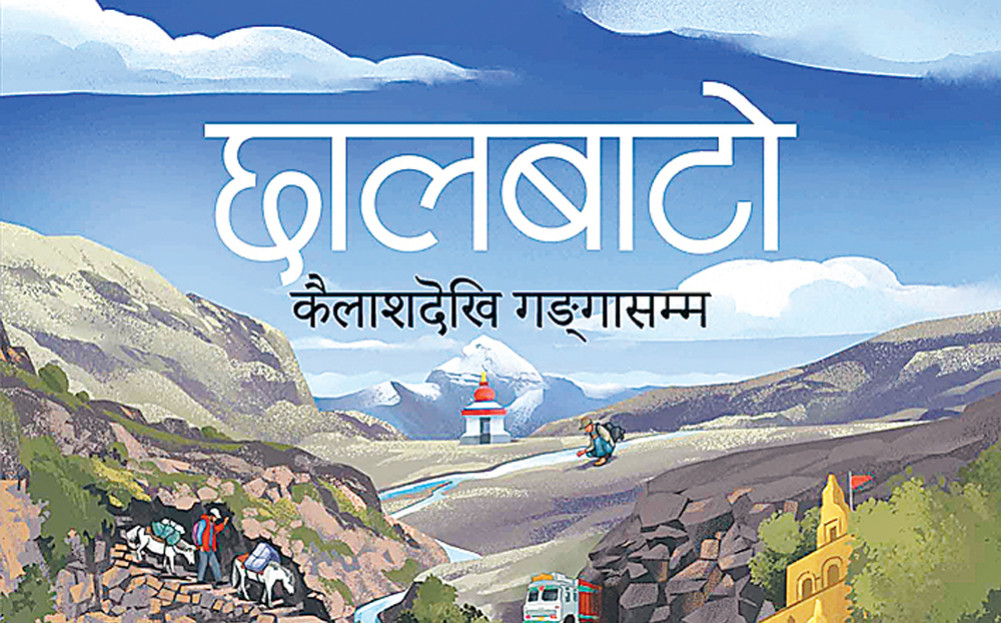
This book is not a sentimental travel memoir, but an on-the-ground study of issues like climate change plaguing the world
We use Google Cloud Translation Services. Google requires we provide the following disclaimer relating to use of this service:
This service may contain translations powered by Google. Google disclaims all warranties related to the translations, expressed or implied, including any warranties of accuracy, reliability, and any implied warranties of merchantability, fitness for a particular purpose, and noninfringement.
The Nepal government opened an immigration office on the road from Rasuwa to Kerung. The Chinese who come to take its service went to the toilet there. An employee was angry that a man coming to his office after work got dirty after going to the toilet. They locked the toilet.
Then the people coming to that office for work started going to the toilet of the hotel which was run by the housekeeper and was on the ground floor of that office. The householder got angry.
Journalist Ramesh Bhusal's book 'Chalbato: Kailash to Ganga' mentions this incident at the beginning.
An office worker who opens the office to ask for service and is angry that those who come to take service have gone to the toilet! A house owner who rents an office for people to visit and is angry because they went to the toilet!
If the right to urinate is fundamental, people have not even thought that it should be mentioned somewhere. If it comes to a situation where a person can use only a few rights, the right to urinate should be number one, because if this right is not used, a person cannot live as an animal. As a human being, let's leave it at that. A person can survive for a few days without eating but cannot survive without defecation. To be civilized, people should not defecate randomly. But defecating in a civilized manner angers the government and householders. This shows how rude our society and government are.
In 'Chalbato: Kailash to Ganga', the author has described what he saw in the places around Kathmandu, Rasuwa and Karnali river as a journalist in a car, boat and on foot. Although this book is a travel memoir, it shows how ugly our society is.
Let's look at another episode. While strolling along the Karnali River, Ramesh saw a pile of sand pressed with some stones. A woman's body was buried there with a weed repellent. While alive, she was accused of being a witch by the society. After death, it was just like burying other people's corpses.
The writer's mind was shaken when he saw that our society has a bad culture that makes people capable of this level of inhumane behavior. Our mind shakes when we read the incidents of such rituals that do not allow the society to move forward even in today's age.
In another context, the author has mentioned about the Upper Karnali hydroelectric project. According to him, this project was discussed in the 1960s, that is, 60 years ago. Then around 2045 this project started again. A study funded by the World Bank estimated that 240 to 4180 MW of electricity can be extracted from there. Six of the most suitable schemes that could be built on that river were selected. The Karnali hydropower project was considered to be a 'diamond in Sripech'.
Enron and other companies came to Nepal showing their greed to benefit the country by building a power project on the Karnali river. The leaders of Nepal allowed foreign companies to extract electricity from there, even though the rules were mixed. However, hydropower projects have not been built there yet. It is not expected to be done soon.
What happened to this?
A session was held for discussion at the 'Nepalgunj Conclave' held on November 20th and 21st in Nepalgunj, a city that is moving towards progress, located in the neighborhood of the place where these projects will be built. Its title was - The country exports electricity, Nepalgunj faces an energy crisis.
Pradeep Chhajed, General Manager of KL Dugad Group, told about the electricity problems faced by the industries of Nepalgunj - As the summer progresses, the voltage decreases and the electricity is cut off. Due to this, the industry cannot run properly. One of the industrialists there wanted to sell a Chinese machine. Company people came to Nepalgunj. Seeing that the power went out, they said that their machines would not work in places where there was such power. While answering Pradeep's question, Executive Director of Nepal Electricity Authority Kulman Ghising said, "This happened because there is no project to add electricity to the power line between Butwal and Attaria." In other words, if there was electricity in Karnali, there would not have been such a problem around Nepalgunj.' There are strange beliefs about the
river. Brahmaputra river became male, Ganges, Jamuna, Narayani, Kali etc. rivers became female. And Koshi River is unmarried. There is also a tradition that all flowing water is holy, Ganga. There are many religious places on the banks of rivers east of Karnali. Even west of Karnali, there are such places on the banks of the river, but it is said that there are not many monasteries and religious places on the banks of the Karnali river. It is also said that the Karnali river is not considered sacred like other rivers because it originates from the Rakshasa lake.
The author of this book thought that the Karnali river really originates from Rakshasa lake. He reached Rakshas Lake Karnali did not come out of there. He found out which river is the source of Karnali. Since the author studied environmental science, his words have to be believed. Moreover, his team also had a river expert. This makes what he wrote more authoritative.
The author and his friends who entered Tibet from Rasuwa traveled around Tibet for several days. During that time they had to suffer the harsh Chinese rule. He had to bear the pain given by the guide who was greedy for even the smallest things. After that, when he entered Nepal from Humla, he felt happy. He has written, "Now to talk with my people, to hear the chirping of my birds... I was full of happiness." Look at the sky, talk to the people, take a dip in the Karnali, drink a cup of tea and take a deep sleep...the sky is my own, the river is my own, the land is my own, the people are my own.'
From where Ramesh entered Nepal, there is not much difference in the sky, river, land and people across the border. But he found the difference between heaven and earth. Country borders are artificial. However, what kind of impression it has made on the mind of people can be seen in this book.
The author saw the severity of Humla while descending along the Karnali on foot and sometimes by boat. Saw the miserable life there. He also saw the suffering of walking the road. He also saw the lack of grain. And children suffering from malnutrition were also found. He has described all these subjects in an interesting manner.
The people the author met on this trip said that the snow has started to decrease in the past few years. No snow means drought for winter crops. The root of irrigation for dry crops is drying. Snow data has also shown that their experience is correct. According to the data compiled by ISIMOD, the snowfall in the Ganga river basin has decreased by up to 17 percent. In the winter of 2075, the least amount of snow fell compared to the previous 20/21 years. The next least snow fell in winter.
While traveling 2000 kilometers across the Himalayas, across the Himalayas and across the Ganga plains, taking forty-five days, the various and useful topics that a curious journalist can find are included in this book. In order to provide information to the reader, he has worked hard to extract various information written in Chinese and translate it later. He made this trip specifically for the purpose of making a video documentary.
. So this journey was also recorded on video. One of the advantages of this is that the author does not have to rely solely on his memory when writing a book. You can watch the scene when you are confused.
This book is not a sentimental travel memoir, but an on-the-ground study of issues plaguing the world like climate change. The author has increased the importance of the book by placing such topics among other interesting information.
It is said that there will be no development if the water is allowed to go straight to the sea without using it for human benefit. According to this belief, in some places it is used for irrigation, and in some places it is used for generating electricity. In this way, the author has presented the issue of how much the desire of people to use water spoils the river through the example of the Karnali river in India.
There the river is dammed and its water is sent east and west through canals. Only a small amount of water is allowed to flow into the river. Due to this, water has reached the farmers' fields during the dry season, but it has created another problem. The level of the river has risen and the village has become higher. When it rains in the rainy season, floods have started to cause more suffering to people than before.
'Chalbato' tells us not only about the problems that Nepal is facing, but also about the Kashi civilization that surrounds us from three sides and the Lhasa civilization that surrounds us from the north. It also tells about the strict rule of the Chinese in the north and the conflicts in the name of using the river in the south and the effects it had on the people.
The river tries to carry its water to the sea. However, there is an example in the book that when a person eats in the middle, he takes revenge. In this way, this book is also a guide on how to develop and how not to do it. It has given a message - even a regime that does not breathe like China is not suitable for people and the way of South to exploit natural resources beyond limits is not right. Nepal's tradition of only talking about using such resources is not useful.
Ramesh was not alone in this journey. Experts in various subjects were also with him. So he has been able to write authoritatively on various subjects. Sometimes he tells the temperature of the water, sometimes the amount of oxygen in that water. Based on these symptoms and the aquatic animals found there, he says - the Karnali river is healthy, its health is good because it has not been affected by humans.
In many places he walked on the waves by riding a boat. It was adventure tourism with huge potential in Nepal. Megh Ale was with him, who was showing that it is possible to get economic benefits from the river by playing with the waves of the river, fighting, protecting them from them, and giving them an exciting trip through this type of tourism. However, such tourism is not possible in many rivers of Nepal. Therefore, there is a voice in this book that some rivers like Karnali should be allocated for this purpose. Since it is a
travel memoir, the presentation of serious themes has also been done in an interesting manner. The reader gets serious information without being burdened with reading serious stuff. Ramesh's long but interesting article was read by us readers in the newspaper. From this book, he has also become the author of a collection of information collected in the course of journalism, but which could not be included in the genre of journalism. His first book 'Chalbato : From Kailash to Ganga', it seems that his future is bright in this work too.