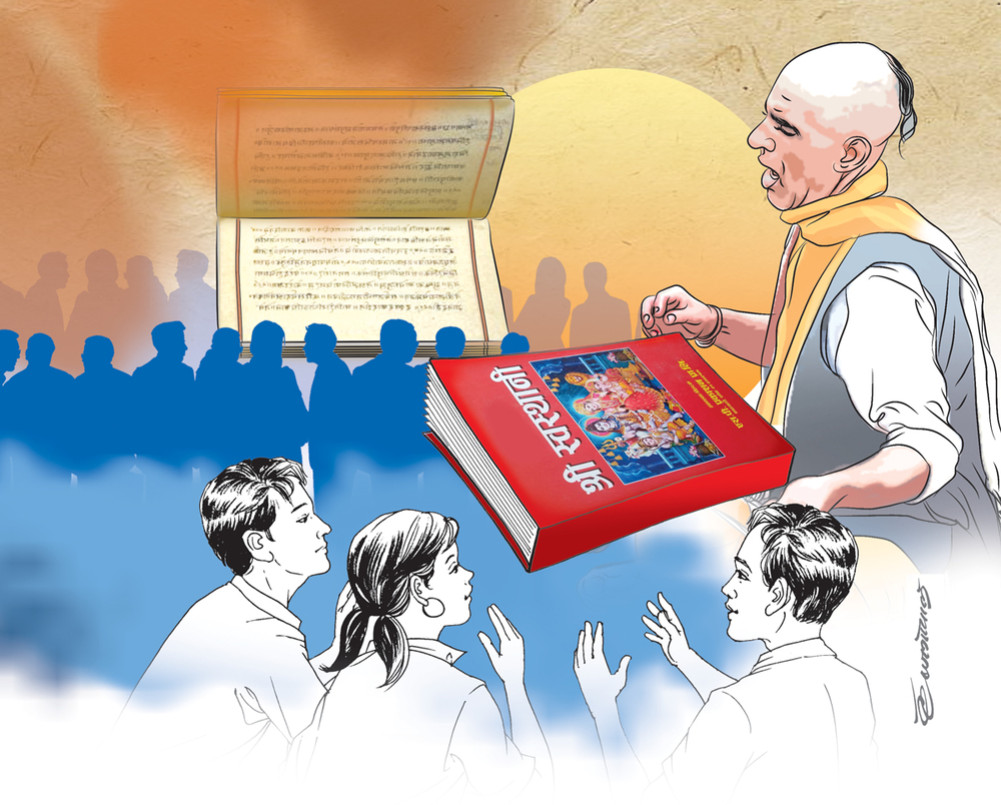
Genji and our childhoods have been different, the language is also becoming different. Genji is not a child of health stories. Gone are the days of listening to stories in Magh saajs with pushpanjali in hand. Now, parents read alone, listen to themselves. Does Genji need to listen to health?
We use Google Cloud Translation Services. Google requires we provide the following disclaimer relating to use of this service:
This service may contain translations powered by Google. Google disclaims all warranties related to the translations, expressed or implied, including any warranties of accuracy, reliability, and any implied warranties of merchantability, fitness for a particular purpose, and noninfringement.
I haven't been able to talk to my best friend in Australia for months. Abroad he is busy with his own life, at home I am in my own tanabana. However, when we spoke on the phone a few days ago, he quickly narrated his routine.
Dropped daughters to school, went to office, picked up daughters from school, cooked food. And nowadays? Nowadays, health should also be read and recited. I interrupted and asked - and do the daughters understand the story of Swasthani?
Australian-born 12- and 10-year-olds clearly do not understand health stories. He said, 'Words are complicated! However, they listen attentively. They are still curious and ask what.'
Sneha, the younger daughter, asked, 'Shivaji's wife Mata Sati Devi is also not God? Does God also die?' According to the Swasthani story, when Sati Devi's father Daksha Prajapati organizes a great sacrifice, he does not invite his own son-in-law Shivaji, he insults Shivaji. Unable to bear the humiliation of her husband, Sati Devi jumps into the Yajna Kund and commits self-immolation. The loss of Sati Devi causes unbearable pain in Shivaji and he wanders across the universe carrying Sati Devi's dead body. The places where Sati Devi's limbs fell while wandering the earth are in Nepal and India. That place is known as Shaktipeeth. Astrologer scholars say - the energy of that place is very holy, powerful.
Mother Parvati and Shiva get married after thousands of years of rigorous penance as Sati Devi's next birth. Shivaji and Parvati's relationship is that of 'twin flames', who are incomplete without each other and omnipotent when together. They accompany each period of time in one form or another.
• • •
How to address Sneha's question? His mother, my friend, was confused at first, but the children's curiosity and questions had to be answered. He asked, 'After being born as a human being, why not become God? They also have to suffer various hardships, sorrows and pains. After we are born on earth we have to be prepared for any situation. Suffering, suffering, struggle, suffering, are endless. The death of a relative causes grief. Different situations come.' Hearing this, both daughters became silent, maybe they too were confused by many questions like me.
• • •
Srisvasthani Vratkatha is recited by Kumar, the eldest son of Lord Shiva and Goddess Parvati. Kumar told a sage named Agastya Muni about the events that happened in different periods of time. This myth mainly revolves around the glory of Lord Shiva, his various periods, the characters he created, their suffering, grief, religion and sin.
After a conversation with a friend, one of Swasthani's stories began to circulate in my mind. Kamala Day of childhood started dancing in flashbacks. As a child, in the dark nights, wearing a mandi (or not) wearing a mandi (or not wearing it), sometimes crying and sometimes afraid, I recited the stories of Swasthani, but with time, the stories mentioned in Swasthani started to become a problem for me. Those problems are clearly written, which have raised a lot of anger, pain, curiosity and many questions along with fear in the young mind. They are read like stories - without any explanation, without any example. There is gross gender inequality in those stories - the abuse, oppression and injustice against women is justified. The language used to define women in that story is Papini. For example: a woman who stares at her husband becomes a bitch, if she confronts or quarrels with her husband, she becomes a bitch, if she eats before her husband, she becomes a bitch, and so on.
Another myth mentions that one has to cross Vaitarani River to reach heaven or Vaikuntha Loka after death. However, it is not possible to pass the tax. For that, the son has to perform Pitradan etc. It is written that one must give birth to a son to reach heaven and only a son can reach heaven after doing various charities. What is more interesting is that if a couple has sinned in a previous birth, they cannot have a son in this birth.
After the story of Swasthani was spinning like a reel in my mind, I called my friend again and asked, 'And will I tell all those stories to the children in the same way or mix them up?' He laughed, 'I will mix them up. I have not emphasized on inequality, tyranny and sinful things, Pir Nagar.' He knows that I am not satisfied with the story of women's tyranny.
• • •
I was about 8 years old. I have cried while reading the three stories of Swasthani. I have been offended many times by characterizing that story. When Lord Shiva wandered the whole universe carrying Sati Devi's dead body on his shoulders, I felt immense love for Shivaji. I used to think - Lord Shiva should be able to make him alive, why didn't he? However, I was very angry with the same Shivaji, when he cursed a character named Goma to marry a 70-year-old man at the age of 7. The most terrifying and heartwarming story after hearing/reading it is that of Chandravati. These three stories still haunt me. Even for a long time, they were afraid of getting leprosy if they did not eat the Prasad of the Swasthani. People who came to the house to beg for alms used to fear thinking that they would get married to an old man like Goma and suffer greatly. Even when I was 12 years old, I was afraid of the Jogi sadhus who came to beg for alms. As soon as the sadhus were swinging in the courtyard of the house, the heart was pounding. And in the house where there is as much rice, Akshata, what! I used to bring everything that I could carry and give it to Jogi Baba. They were very happy there, I was safe.
houses from the Silent Generation to the new generation Genji. Our childhood and Genji's childhood were different. Nowadays, even the language has started to differ. My brothers and sisters do not know the story of Swasthani. They were never even interested. The tradition of all the family members sitting and listening to the story and eating prasad while reciting Swasthani-katha in the evenings of Magh with Pushpanjali in their hand also disappeared. Now my mother sits alone and reads in peace, listens to herself.
• • •
Vrinda has a story – in Swasthani. Vrinda is the wife of the demon Jalandhar. She was Pativrata. That is, her devotion to her husband was so strong that she was his protective shield. Jalandhar is wreaking havoc on the earth and in the heavens - causing grief to the gods and sages. There is a story in Swasthani that Lord Vishnu took the form of Jalandhar and destroyed the Pativrata Dharma of Vrinda after no solution was found. On the other hand, Vishnu destroys Vrinda's religion by becoming Jalandhar. On the other hand, Shivaji completes the work of Jalandhar. After realizing that she has been deceived, Vrinda cries and curses Vishnu, 'Vishnu! May you live on earth as grass, stone, tree, and weed forever.'
• • •
There is another story in Swasthani - about Goma and her parents. Goma's parents have no children. They worship Lord Ganesha for procreation. Ganesha appears and gives a boon, 'Go to a cow in the morning before sunrise, bring cow dung and put it on the skull of the house. A beautiful girl will be born from the same cow dung. Goma is described in a very interesting way - a girl with a look like a deer, a waist like a tiger, long arms, bright like the sun! When Goma is 7 years old, Shivaji comes disguised as a 70 year old man and proposes to Goma's parents to marry Goma. The story of Goma's marriage, subsequent sorrows, his healthy fasting, the story of his son Navraj Lavanya becoming the king of the country is no longer new.
•
• • The most painful story is that of Princess Chandravati. She is the daughter-in-law of Goma and the wife of Navaraj Raja. Most of the Swasthani stories refer to him as 'Papini'. Because when Navraj goes away from home to do some work, earn wealth and find out about his father Shiv Sharma Brahmin, Chandravati stays with his wife. And, after becoming king, Navaraj sends doles to fetch Chandravati. That Srisvasthani fast is going on. It is said in the story - Apsaras have come to the banks of Salinadi and worshiped Swasthani Mata.
On the way back to Lavanya country, the Doles take a rest on the banks of Salinadi. At that time the Apsaras are seen worshiping I Swasthani Mata. They go to Apsaracheu and sit down to listen to Swasthani's story. After some time Chandravati returns to the place with prasad. At that time, Chandravati's anger is described - while giving Prasad, she spits with a stick, asks with her red eyes, "Who is the healthy mother?" Doles are disappointed and tears fall from their eyes. On the way back, there is a sudden flood in Salinadi. The flood washes away the doles and the doles also die by drowning in the Salini river. By eating Swasthani's prasad and listening to the story, they are liberated, but Chandravati survives. His condition has been described as a wooden block. She thrashes about on the beach, fainting and regaining consciousness. Everyone calls him 'Papini-Papini'. After that Chandravati lay helpless, helpless, diseased, amputated, leprous, emaciated on the banks of Salinadi for months. After suffering for a long time, she fasts for sanctity, is freed from her sins and finally meets her husband King Navaraj. This story is not new either.
•
• • Society is developing rapidly. Introducing your religion, culture and tradition to the new generation who are now used to mobile, internet, social media, AI is a beautiful aspect. They should also be introduced to their ancient language, culture and religion. However, he should also get answers to many questions raised in his mind. Here everyone has interpretations and stories according to their own mood. Why did this happen? Why? Perhaps no one has this knowledge. All express according to their compatibility. It does not address the questions of the new generation's bright minds, nor does it play an important role in preserving religion and culture.
If we look at the lives of the female characters mentioned in the stories of Swasthani, there is only an explanation of the respect, dedication, and sacrifice that women have to give to their husbands. The main female character is often portrayed only through her relationship with the male character and her devotion to duty.
It is written that women should fast for the well-being of their husbands and families in the month-long Swasthani Vrat. Feminists have argued that such a narrative increases gender inequality by placing the burden of family welfare on all women. However, some scholars have given an alternative interpretation to this – such as: the main goddess Swasthani herself is a woman, who represents the divine feminine power. Some have interpreted it as an empowerment of women's power and potential. Sociologists say – Swasthani Katha has given women a place to gather and share experiences. However, the stories mainly depict women as having to be subservient to tradition, otherwise they will incur sin and suffer. It is trying to impose the idea that the woman's sacrifice, unconditionally sacrificing for her family is her responsibility, the main religion.
How does Genji take the healthy story? Scholars say that in this age of modern education and cultural preservation, it has become very important for children to tell stories about healthy fasts. But, has its interpretation and practice evolved under contemporary values of gender equality?
It is also argued that these stories promote the cognitive development, language skills and moral understanding of Genji and the children, but have the stories been modified to address the fear, emotional emotion they evoke? The question arises - how to modify the myth? A myth is a myth. It is a fairy tale. Swasthani Vrat stories are profound, yet challenging for children to understand. But, shouldn't they get satisfactory answers to the questions raised in the minds of children? I think that every child's curiosity should be clarified and addressed. Society is developing rapidly. However, in the context of Nepal, traditional religious texts have not yet been viewed from a modern perspective. If the new generation understands the stories of Swasthani only superficially and follows them in the same way, the society is sure to return more and more to the stone age.
•
• • I read the news about the incident at the ongoing Mahakumbh Mela in Prayagraj, India. On Wednesday alone, 30 people lost their lives and hundreds were injured after a rush to bathe in nectar on the day of Mouni Amavasya. "To reach Mahakumbha and die is to get salvation, how many religions have you practiced!" Some said this. Some said, 'Why do people have to go in such a crowd?'
says - This Mahakumbh Mela has come after 144 years. Maha Kumbh comes only after the completion of 12 full Kumbhs that happen every 12 years. Videos of Naga Babas, Sadhus, Aghoris who came to bathe in the fair are seen on social media. Many questions arise in the mind while watching the videos. Where were they until now, where do they live at other times? How did so many fathers get here? Are these fathers included in India's population of 144 million or not?
I will not be on this earth in the next Mahakumbh Mela, but the questions are that the next generation will continue to do so - will the stories of Swasthani be told in the same way then?