We use Google Cloud Translation Services. Google requires we provide the following disclaimer relating to use of this service:
This service may contain translations powered by Google. Google disclaims all warranties related to the translations, expressed or implied, including any warranties of accuracy, reliability, and any implied warranties of merchantability, fitness for a particular purpose, and noninfringement.
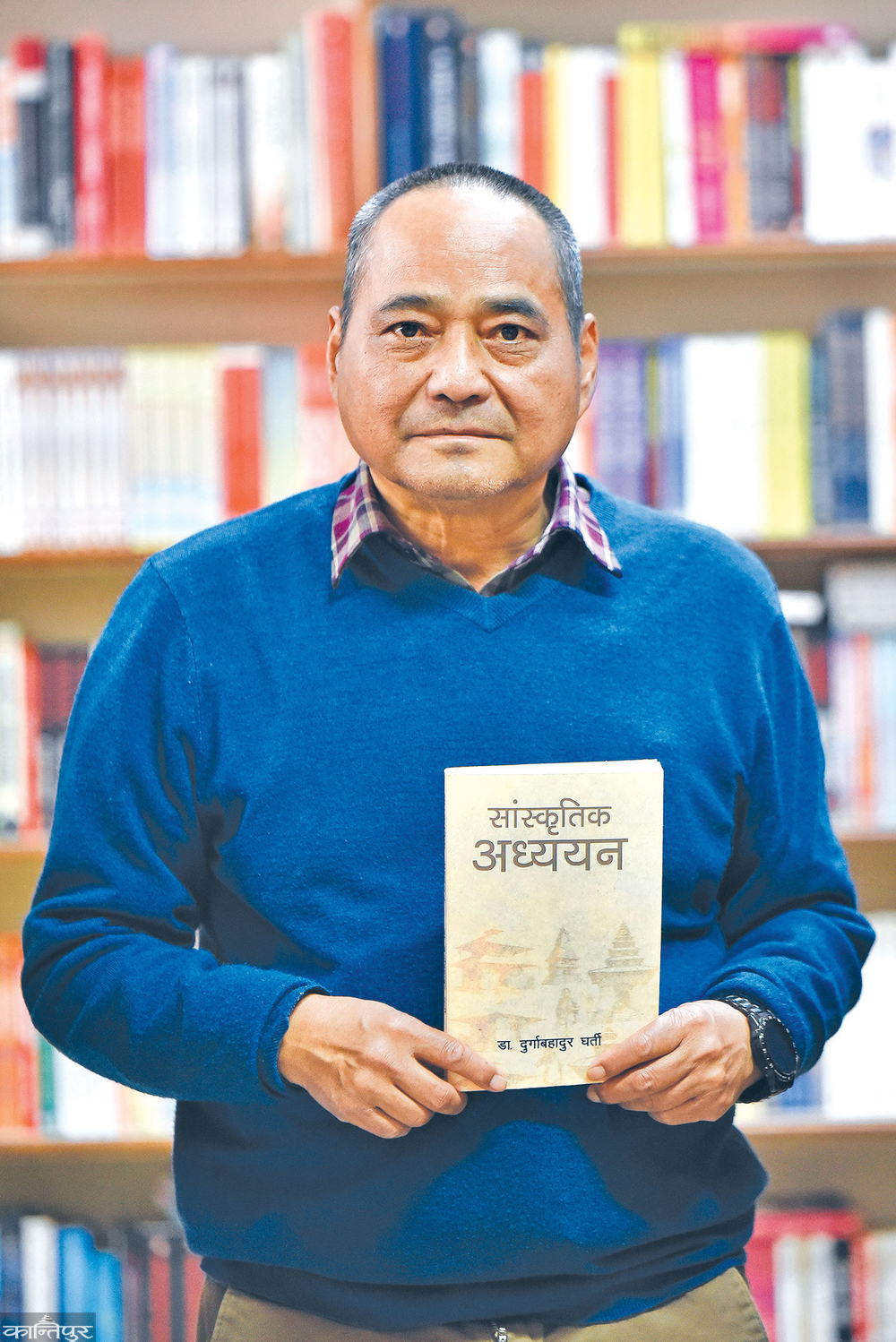
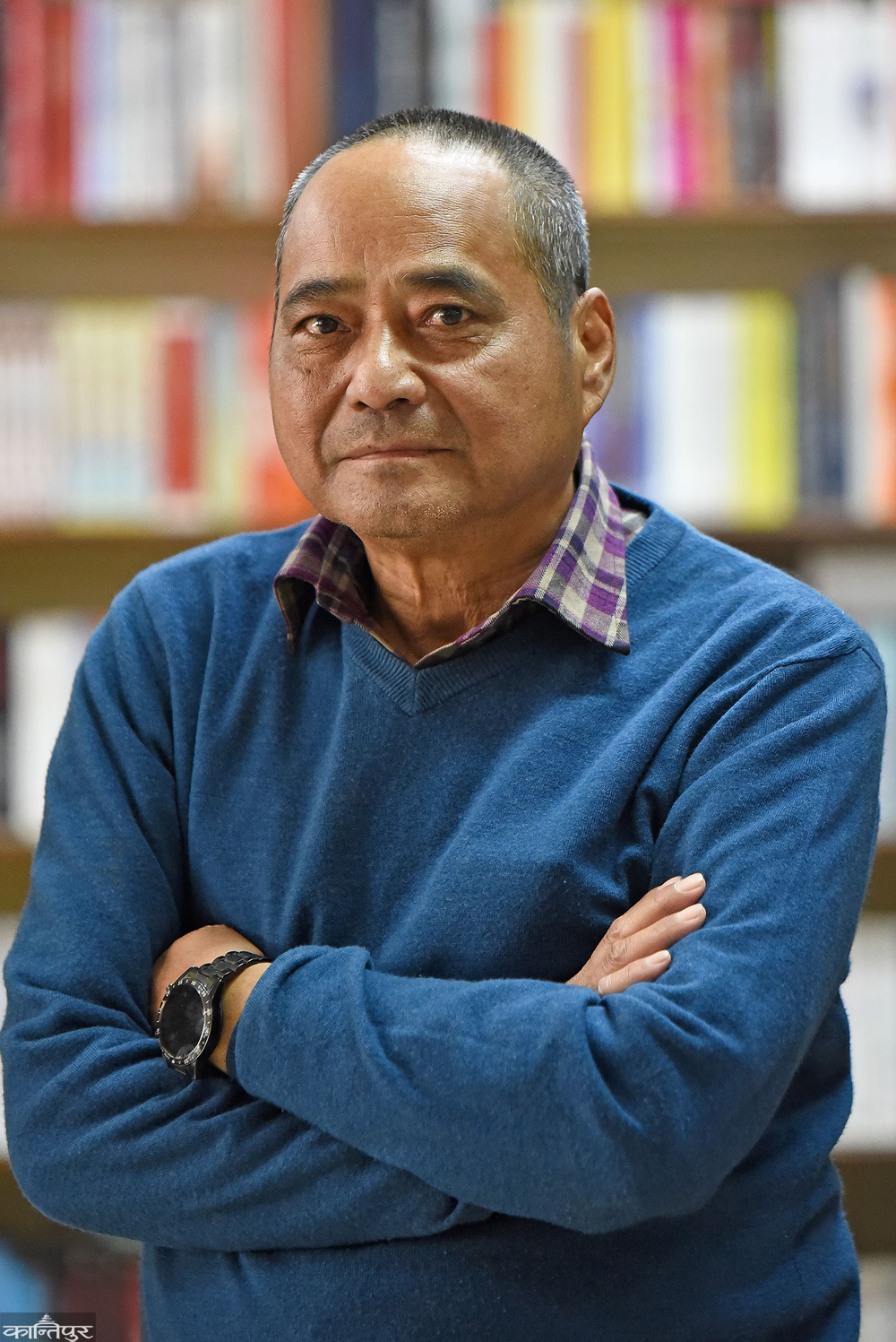
Durga Bahadur Gharti, engaged in continuous research and literary criticism, has been teaching at Tribhuvan University for a long time. Gharti, an established critic of the psychoanalytic stream of criticism, has completed his study and analysis in a concise manner from half a dozen critical books.
His latest book 'Cultural Studies' focuses on various aspects of criticism and literary critic Durga Bahadur Gharti talks with Deepak Sapkota : has been writing critiques of the psychoanalytical stream for a long time. Are there additional reasons to lean toward cultural studies? Because
is an integral part of human life, culture is connected to the overall aspect of human life. Culture is a mixture of folk beliefs, custom and folk behavior that people adopt in common in the society. Language, festivals, pilgrimages, rituals, rituals, costumes, food, education, entertainment, lifestyle etc. are the culture, so we cannot stay outside of it. Psychoanalysis also deals with culture. The society has made certain rules for collective welfare and unity and it has been applied in the society as a custom.
Although a person always wants freedom, society wants to keep him bound by law. In such a situation, there may be a negative impact on the mentality of the person. We call it mental illness. Psychoanalysis was born from the study of mental illness. Culture is also related to social psychology. As for my attraction to cultural studies, it is both my interest and my need.
Growing up in a mixed folk culture, Arya culture and Magar culture flowed in parallel from birth. Nowadays, there is interest in the impact of various cultures entering Nepali society in the name of religion, festivals, rituals, fashion, etc. The effect of this is that literary creation and criticism are also focused towards cultural studies. Universities have also incorporated cultural studies into higher education. Those are the reasons that attracted me to cultural studies.
Recently, it seems that 'civilization' and 'culture' are getting more priority than 'class' in the field of study and research. What do you think is the reason for this attraction?
Culture is a traditional thing, while cultural studies is a modern and postmodern way of thinking about culture. It has the influence of Marxism. However, rather than the classical theory of Marx and Engels, cultural studies began under the influence of Antonio Gramsci, Louis Althusser, the critical theory of the Frankfurt School, etc., which was called Neo-Marxism. Marx-Engels emphasized class and class-struggle while neo-Marxists emphasized groups. Neomarxists do not accept economic determinism. Raymond Williams says that society changes not because of economic reasons but because of cultural reasons.
While British cultural studies began to refer to groups rather than classes, American cultural studies emphasized the terms culture and civilization, and it spread everywhere through Anglo-American globalization and digital media. It seems that the attraction of scholars has recently increased towards civilization and culture because they consider culture as a determinant rather than economic matters, consider culture as the whole of life, and the issue of locality, group, tribe, and minorities rather than class.
How to view cultural studies? From an ideological point of view, what part of this study method do you see?
Cultural studies is the academic work of studying how cultural practices relate to patterns of power and how they shape society. It studies the power relations existing in society. There is a power relationship between the dominant class and the subordinate class in a society or state. The dominant class tries to maintain power based on ideology, the subordinate class can either accept it or resist it.
Cultural studies opposes high culture, and postmodernist cultural studies does not accept the distinction between high and low culture. Cultural studies critically studies sports, art, literature, music, drama, dance, media, politics, ideology, gender, group, tribe, race, nationality, etc. In short, cultural studies can be said to be close to Marxism and postmodernism.
What are the strengths and limitations of cultural studies in a multicultural country like Nepal?
Here each caste has its own culture and there is also a situation of cultural mixing. The transition to new cultures is also increasing. Thanks to the media and modern technology, one culture can easily penetrate another culture. The policy of globalization is also spreading western culture in Nepalese society. Such cultural mixing is increasing the problem of identity. Cultural Studies studies such influences, cultural activities and outcomes. That is its power.
Even within the same culture there are complex relationships between elements. Relationships between different cultures are more complex. In that case it is difficult to determine which is the best culture. Therefore, the reality may be missed, because only what is happening is studied, and there may be a lack of sufficient study. The limitations of cultural studies such as the diversity of methods and content, the contradiction of traditional culture, lack of demarcation.
What is the relationship between political science, economics and aesthetics with cultural studies?
Cultural studies is basically the study of politics. Politics is about power relations. Power is not only with those in power but also with knowledge. Foucault believes that knowledge is power. Those who have power rule. Representation, identity and resistance are key topics in cultural studies. As it is a subaltern, pro-working class study, it emphasizes working class resistance and that history must be written from the bottom up. The power relationship is between two parties and its basis is economic. Cultural studies, however, do not accept economic determinism.
There is also an economic reason for the relationship between the dominant class and the subordinate class. Beauty is considered secondary by Marxists and primary by Romantics. Marx considers the economic as the base i.e. the primary and other things as the superstructure i.e. the secondary which are built on the economic basis. According to them, like ideology, beauty is determined by economic reasons. For the Romantics, beauty is the sense of pleasure and is an essential element of art. Psychology also says that it is individual and not class. Although beauty can be discussed on the basis of social psychology, cultural studies do not pay much attention to it.
Commentators like Vasudev Tripathi, Indra Bahadur Rai, Krishna Chandrasingh Pradhan, Mohanraj Sharma, Ishwar Baral, Govind Bhatt, Dayaram Shrestha, Krishna Gautam did great academic work in Nepali criticism. Looking at today's commentary, these names do not seem like the story of Ekadesh? Do you expect the glorious history of yesterday to repeat itself from your own generation?
In cultural studies, the rewriting of history is more important than the repetition of history. The scholars mentioned here are the charioteers of their era, the new generation should be able to lead the new era. For the new generation there are new situations, new problems and new needs. Their feelings, desires and thoughts are separate. Criticism leads to creation, great literature can be great criticism. That is why there is a belief in the sociology of literature that great works should be selected for criticism.
is not just about creating a strong critique. Currently, literary works are being written on different topics, different problems and different styles, and their criticism is also being done in the same way. It is not time to compare the critics of the new generation with the great critics mentioned above.
How do you find the current state of review in your study?
Nepali review is moving in a very dynamic manner. New possibilities are also being explored. Certainly, as of yesterday, impressionistic criticism is diminishing and objective criticism is increasing. Objective criticism is a fact-based discussion of the epistemological and analytical material selected for criticism. There is no room for too much praise or too much condemnation. We are accustomed to impressionistic and qualitative criticism.
Whatever Charvak said in Paurastya philosophy, others did not like it. Matthew Arnold does not consider the mere interpretation of a text to be criticism. He believes that criticism can be creative only if the text can be interpreted in an independent manner. WH Hudson says in criticism that judgment is not mandatory. Today's criticism tends to interpret and analyze rather than measure the text. It is not the critic's fault if those looking for appreciation of the text do not find criticism there.
A 'cold war' seems to be going on between university criticism and newspaper reviews. It's like being at the opposite pole. Why? There is no such thing as
university criticism or professorial criticism and newspaper criticism. It may be said that use is more than standard. Rather, critical articles are for journals and independent. Each journal has established some rules to make all articles consistent and to make it easier to reach certain conclusions. Similar rules have been arranged in the university to facilitate the research students. That does not mean that there can be no criticism until the parts of the article, the use of symbols, and the theoretical basis are found. In the beginning, there was no rule or method for writing criticism, its only purpose was to find the truth.
They interpret the material in their own way and draw conclusions. Now various foundations of epistemology, philosophy and value have been built. There are various computer software for that. Rather than whether it was published in a critical journal or a newspaper, the book introduction, interpretation of the text, interpretation of the text, and how the text has been evaluated are the main topics. I think it is not appropriate to distinguish between university criticism and newspaper review. Newspapers may also publish cursory reviews and journal articles may not delve into the depth of the facts. The quality of criticism depends on its content. It seems that critics and critics who should play a role in the growth of
literature are running away. Are the creators of literature still doing honest practice?
criticism says that creation should work like mother and father. Of course, the creation or birth of your art is loved and good by everyone. However, the society has its own kind of value, recognition, aesthetic mentality. Based on that, the art or the person is evaluated, commented and evaluated. A reviewer or critic is a reader of literature. Criticism should be able to say what kind of emotion the
literature has been able to convey, what kind of work it has been in terms of moral consciousness or in what form it has appeared from the ideological point of view. The value of a literary work cannot be raised merely by the praise of a critic, it must rise on its own. Criticism can open up horizons of possibility. Honesty is something that both creators and critics need.
What should be done to bring the recent ideological debate into literary criticism in a more meaningful way? As someone who objectively looks at things in the
text based on a certain epistemology, I cannot make any such suggestion. However, when the question comes up, something must be said. As the creator of literature is a member of the society, he is not only the political but also the beneficiary of the economic, cultural, psychological, historical etc. of the society.
He expresses what he has experienced, seen and felt and sometimes what he wants in literature. Cultural studies can address the debates in society and politics. Literary criticism can offer a new conceptual vision by unraveling the complex relationship of state mechanisms, state ideology, power relations between power and people, gender, caste, class, group power relations, representation, identity and resistance. It cannot be possible from criticism written in a way that favors, neutral and enlightened critical work is expected.