Poetry doesn't need schooling, it's useless. It is not necessary for a poet to follow anyone's school. No one has schooling here.
We use Google Cloud Translation Services. Google requires we provide the following disclaimer relating to use of this service:
This service may contain translations powered by Google. Google disclaims all warranties related to the translations, expressed or implied, including any warranties of accuracy, reliability, and any implied warranties of merchantability, fitness for a particular purpose, and noninfringement.
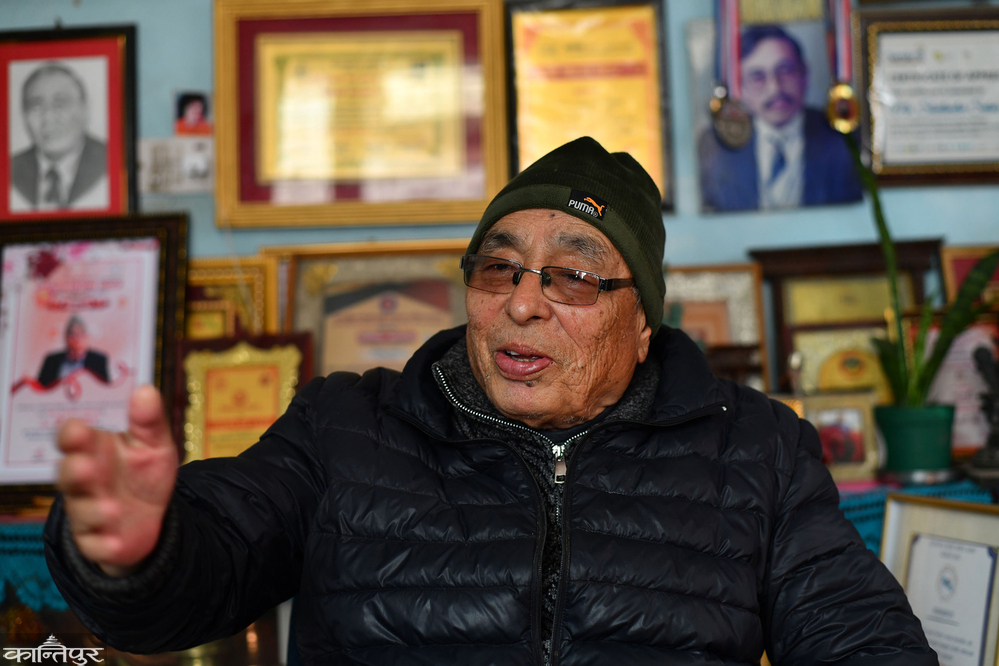
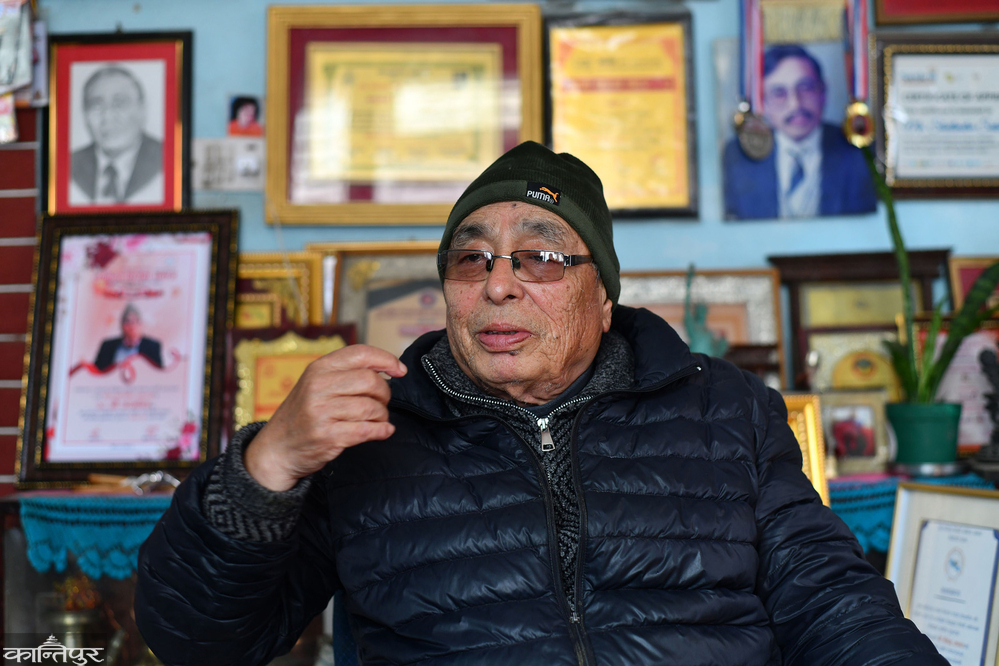
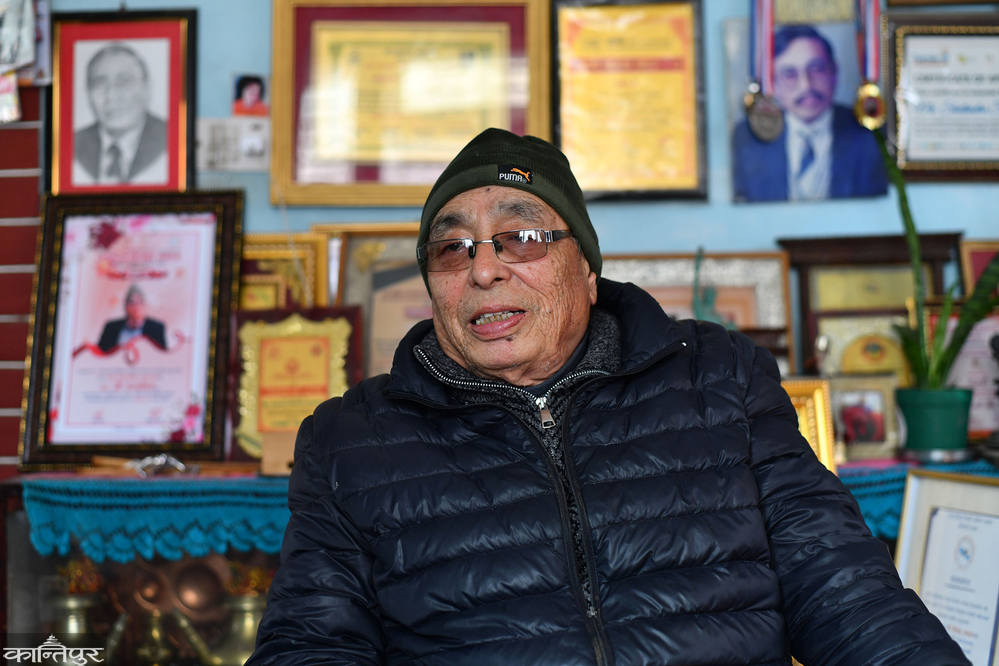
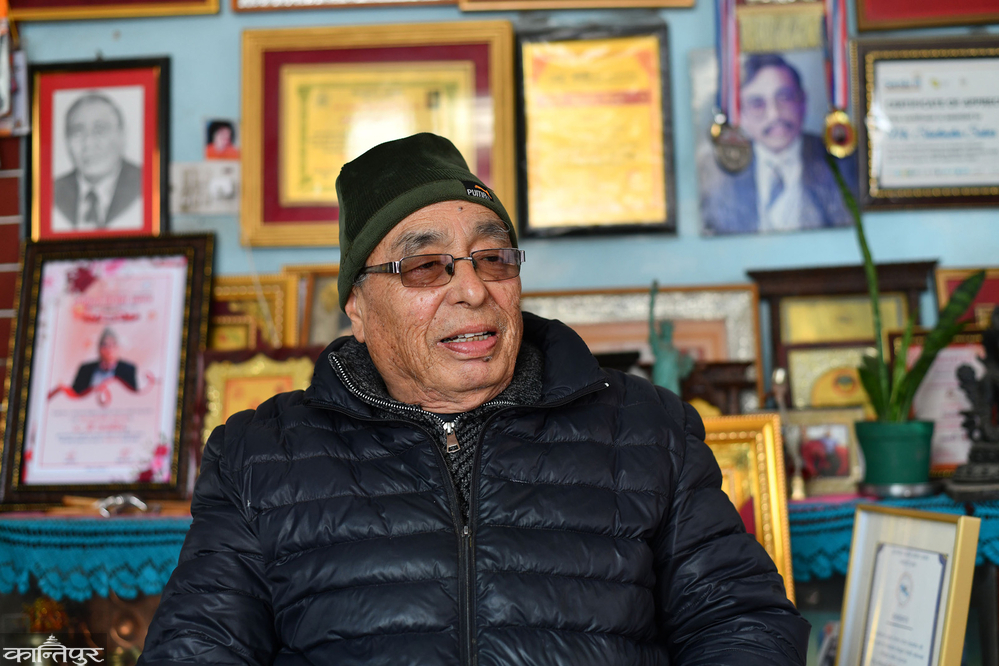
Poet Shailendra Sakar was reading the book 'Knife: Meditations after an Attempted Murder' when he reached his residence at Big Kharibot in Naya Baneshwar on Wednesday afternoon.
Saying that Salman Rushdie gave an interesting description of the attack on him, Sakar recited some lines from the book, "Poetry cannot stop a bullet, a novel cannot dispose of a bomb," he said, I am enjoying it. If the person who shoots is affected by poetry, he may not shoot.'
Since the twenties, the introduction of Sakar, who has been active in poetry writing, has many dimensions. He writes stories, novels, essays and memoirs. He is not only a witness of many movements born by Nepali literature, but also a leader of such movements. Edited 'Kathama Nari Sangham', co-wrote the novel 'Akash Biwid Che' and 'Avatar Diwali', his poetry collection 'Sailendra Sakarka Kavita', 'Sarpahuru Geet Sunahnei', 'Nango Tar', 'America in Poems', 'Aru Saat Samudra'. , 'Collage', 'Kalpatra and other stories', 'Ramayana and other stories' anthologies are published.
Recently, his memoir 'Manko Kouni Kuna' and dialogue with Uday Adhikari 'Sakar Samya' have been published. Poet Shailendra Sakar Conversation with by Fanindra Sangam :
You yourself have joined the Rejected Jamaat, through the Butpalis movement to the street poetry revolution. Was the rejected Jamaat, which started around 2026, planned or was it random?
Poets in Calcutta started the 'Hungry Generation' in the 1960s. Among them were Malayarai Chaudhary, Subimal Basak, Anil Karanjai, Karunanidhan Mukhopadhyay. When they came to Nepal, they met Vashu Shashi, after he called his residence Devpatan, I, Kavitaram Shrestha, Prakash Premi, Ramesh Shrestha reached there. Among them are hippies and
is a beatnik influence. We were also excited by their words. Later, we started the literary movement 'Rejected Jamaat' with the same zeal.
If you want to write anything, why write literature, even if you do business. The idea that literature is an exploration of truth was developed. Kavitaram and I used to talk a lot about this matter. Our movement mainly advanced three concepts. Until now, as much literature has been written, it was only written by kings, goddesses, wealthy people. The poor, the sad, the Dalits have been oppressed, now write only to such rejected Jamaat. Another, writing in favor of the liberal sex. We believed that sex workers should also be respected because sex is natural. And write the truth of life like zinc. Later we published a manifesto about the rejected Jamaat in the magazine Sanjeevani. Later, Kanakdeep, Saketvihari Thakur, Jagat Ranjan and others supported us.
At that time, your group came out with the idea that writing poetry is useless, that you should burn yourself in the fire pit. Why is there such hatred towards poetry?
In the poems written at that time, we only found mountains, mountains, rivers, waves, and glorifying the country. In the name of poetry, the truth was covered up and falsehood was written. Most of the poetry was not touched, we disagreed with the traditional poetry itself. They were written in the same frame, they were encouraged and they were discussed. In that situation we tried to give novelty.
Five years after that, why did the situation have to be 'bootpolished'?
During the Panchayat era, newspapers were banned. It could be taken out only after the approval of the District Magistrate's office, but the approval was not given at all. We lived in Dillibazar, the concept of Butpalis was born there. There was no money to publish the newspaper. Kishore Nepal came up with a strange proposal - 'Can you sit in New Road and do Butpalis?', while we were already government officers at that time. It was decided that if financial support is available to publish books in Josaijos, why not?
That morning, I, Kavitaram Shrestha, Dhruv Sapkota and Mohan Ghimire reached New Road and told Kalche Sarki. He taught me to polish. We hung up the banner of 'Yuva Akhtar's Book Prakasanartha Artha Sangam Abhiyan'. After 12 o'clock people started to crowd. Narayan Dhakal, Kashinath Tamot, Bhaupanthi, Santosh Bhattarai, Vishwanath Neupane were added, later around 30 poets gathered. Suddenly Balakrishna also arrived. He gave me shoes saying 'Lu polish me too'. I remember he came back with 5 new notes each. Even though
did not come there, Nripendra Purush Yadi, Bhavani Ghimire, Manu Brazaki, Kumud Devkota and others spread the word that poets are doing bootpalis for their contribution to literature. In the evening, some people from the administration in plain clothes came and arrested us.
In the year 2036, after King Birendra announced the referendum, poets started a street poetry revolution. Along with the poet-writer, you also joined the party. How did the movement proceed?
was a tea shop in New Road where writers used to gather. The affluent Bhupi Sherchan, Upendra, Dwarika, Krishna Bhakta Shrestha used to climb stairs to go to Indira restaurant. Sometimes Mohan Koirala was also with them. One day, Bhawani Dai said - 'Let's sit on the street and hold a movement in favor of the majority party.' Dinesh Adhikari, Saurabh, Santosh Bhattarai, Bishnu Vibhu Ghimire, Ashesh Malla were also there. We went to meet Mohan Koirala to inform him about the movement. He said let's not call street poetry revolution, let's just say poetry on the street. Vasu Sashi did not come.
On the street, Haribhakta Katuwal started reciting poetry in a loud voice. Kedarman Vyathit has been saying that he will give him membership in the academy, but he is displeased after he is placed in the press job. In this way, the poetry revolution that started from Peopleboat went on to places like Biratnagar, Pokhara and other places outside the valley via Patan, Bhaktapur.
Why is Mohan Koirala's disagreement with the word revolution? It may be that the
is more of an administration than a revolution. It may be that either the administration is more repressive or jails. Being a well-known poet and also from the Koirala family, he had an inner fear! Later we went to meet BP Koirala to inform about the movement. Kishore Nepal, Homanath Dahal, Purushottam Basnet were also there. While talking about the poetry revolution, BP said - 'Poets are anarchists, but every poor person and the country's concern should be taken by the leader, not by the poet. You did it right, but you don't touch the poets.'
You were an employee of Krishi Bikas Bank at that time. Wasn't the job in jeopardy when he took the government's salary and took the side of the multi-party against the government?
I had done double MAA. The big leader came and said to me - 'We have not studied, you have studied, seventh level officer, why did you join the revolution? You are about to be fired from your job, it will be difficult to take care of it.' Later I heard that she is being transferred. From Inaruwa, he was sent as the manager of West Haringara. He said in an insulting manner that he did not go around shouting that he will build a country-society, now go to the village and build a country. Later it was shifted from Haringara to Biratnagar. After reaching there, I came in contact with Krishnabhushan Bal, Indira Prasai, Mahesh Prasai, Pramod Pradhan, and started active in literary activities.
The Ralpha movement had already started in 2023/24 before you started the Rejected Jamaat. You must have got along well with Ramesh, Rayan, Manjul. How much of an ideological debate was there with Ralphie?
I used to listen to other people's gossip a bit more at that time. Shankar Lamichhane, Madan Regmi, sometimes Bhupi Sherchan used to come. After a while, Parijat turned to politics. He was more influenced by Nirmal Lama. They may have thought of me as different ideologically, I was not like that at the time. However, I preferred to mingle with writers than politicians.
How was the relationship with Parijat?
I first approached him through Manjul. She was drinking and smoking a cigarette. She asked, ``Eat the fruit?'', they thought it was fun after I ate it too. After that our relationship went well. In my editing came out 'Nari signature in the story'. I included his story 'My Unborn Son'.
You have also started a new genre of 'Kathya Kayakalp'!
I was reading Kafka's Metamorphosis. A new thought came to me after reading that Gregor Samsa was transformed into a worm. So none of the content is new, just a restoration. I tried a place - 'Dead people are a bit more sexy and emotional.' Like: people look at the dead Mona Lisa from their own point of view. In particular, the transformation from the larval stage of thought to the pupa of thought into a colorful butterfly is 'content morphosis'. I used it because writing requires innovation.
You call writing poetry 'like holding a bare wire' don't you?
To hold the bare wire does not mean to lead to death, but to give a jolt, to awaken. If you don't write something that can be grasped and touched, then what should you write? Time has its own face, he who knows it, understands it and writes it, holds the bare string. There were hundreds of other poets in Moti Ram's time, he alone is still alive. Lakshmiprasad Devkota, Balakrishna Sam, Siddhicharan Shrestha, Parijat, Mohan Koirala are still studying.
Time establishes some poets, leaves some and moves on. What keeps poets alive?
When asked who was the greatest poet while living in America, he said - Walt Whitman, then Robert Frost. They have been gone for years, but they live on in poetry. Here too, most people say Devkota, that is because of the impact of his poetry on the society. It is said that the critic evaluates the poet, but the reader also evaluates. The poet's approach to life and the use of imagery are important in the poem. For example, Bhupi used images like a spinning mech, a carom board ball.
You also used 'snakes don't listen to songs' did you? is a
. That's why many people preferred this collection over other collections. The reader understood that the ruler does not listen to the voice of the people.
At that time you wrote that the Panchayati rulers did not listen, did the 'serpents' of the republican period start listening?
A snake never listens. Serpents who are rulers never listen. There are also those who talk about schooling in
poetry, like: Bhupi Schooling, Mohan Koirala Schooling, Vairagi Kaila Schooling. Do you have anything to say about it? Schooling is not necessary in
poetry, it is useless. A poet does not need to follow anyone's school. No one has schooling here. Not schooling but influence. I was also influenced by Mohan Koirala and Bhupi. I feel like I write poetry in the middle of the two.

