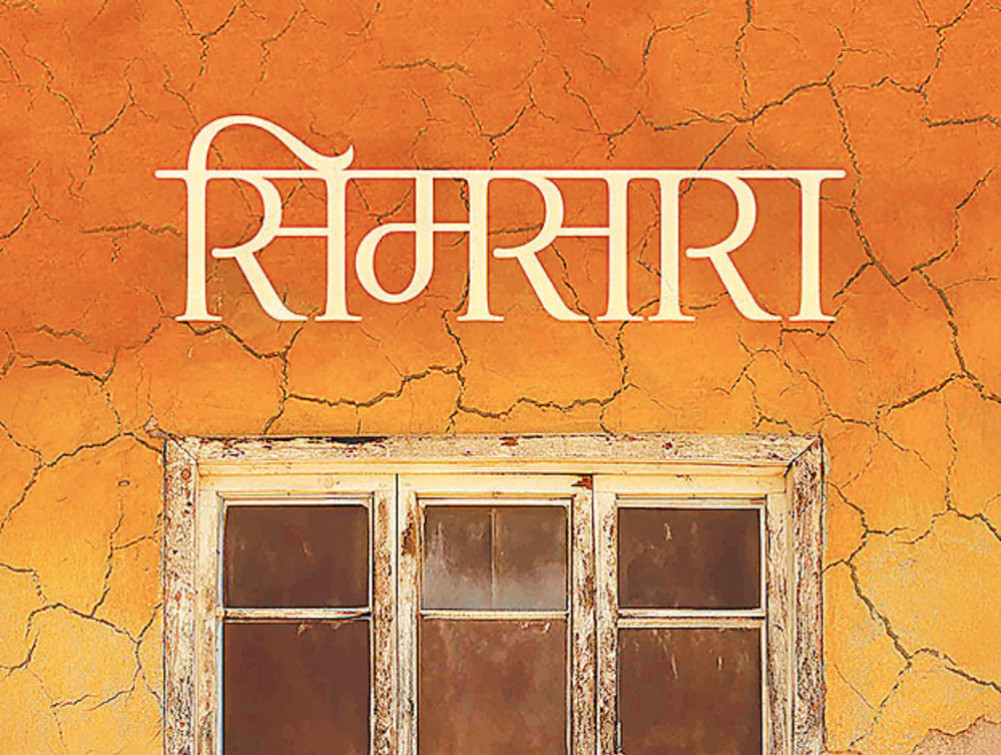
Simsara is a story seen through the middle-aged eyes of a teenager. This is not just 'young adult literature'. It shows the dimensions of family relationships
We use Google Cloud Translation Services. Google requires we provide the following disclaimer relating to use of this service:
This service may contain translations powered by Google. Google disclaims all warranties related to the translations, expressed or implied, including any warranties of accuracy, reliability, and any implied warranties of merchantability, fitness for a particular purpose, and noninfringement.
The news portal 'Local Message' headlined 'Dhanja Phateko Simsara' broke my stubbornness not to read new books. At the very beginning of the news, it was written that the pain of the fictional Bhavbhoomi was being ignored when the novel "Simsara" and the novelist Basant Basnet were becoming famous.
In Petboli, the family displaced by the Asojko Bhel landslide of Phakphokthum Rural Municipality-6 (Savik Chamaita 9) in Ilam's marginal village.
is now over, Simsara is not a fictional village. The story is not someone else's, but the shadow of the author's life. At the 'Simsara' launch event, the novelist said that he had written his own story from his heart, which he had seen in his childhood. It is better for the writer to write related content than unrelated. However, if all writers write only their own stories, who will write the stories of those who do not know how to write?
Without playing a silly role, that anonymous news brought me to 'Simsara'. The same literary dialect of the capital turned 'Simsara'. Instead of writing a systematic review, I wrote something like a review. After reading the novel, I also made a lot of notes. An unseasonal landslide recently occurred in Chamaita, seasonal and unseasonal landslides have already occurred in the writer's life. At the beginning of the
, I made a list of the characters of 'Simsara'. Added three additional characters to it – Paiyun, Chibe Charo and Gogan. Pai is a mysterious character who keeps coming back chapter after chapter. That winter queen flower is standing alone on the dill in the yard next to the house. However, in the novel, it is forgotten to bloom in a light pink-white zhuppa. No storm has been able to shake Paiyu, which looks completely dry.
It has the echo of Mandakranta, the tobacco-eating mother character of the novel, or rather, the novelist's soul is also in it. That character is reflecting the emotions of life without saying anything or going anywhere. It is telling its story in the mute language of nature by blooming, falling, withering.
The seeds of oil fall from tall plants leaving a small impact in the air before falling on the ground. Who can hear its voice?' In fact, only the writers have the ability to hear that dhikr-dhikr. They can catch the sound of a sensation. It seems that if Sanjeev had been an upreti, he would have had a heart-to-heart conversation after listening to his voice. He was given more roles. In this case, Basant Basnet was considered a staunch social realist.
I also found Chibe Charo as a character. The image of the bird chasing the bird of prey flying away the chicks is powerful. According to Iswi Karki, a character in the novel, the fast-flying mountain bird nests in two places. In the language of
novels, one nest in the meadow, another in the wetland. One on the branch of the foot, the other on the stem? Even that bird doesn't have to build a nest, others happily let it live. That Chibe Charo Babu character is similar to Dhanrup. While living with Mandakranta, he has a double marriage with Chhayadevi of 'Simsara'.
I have also considered Gogan as an additional character of 'Simsara'. There is also a sign of life in the large leafed grass Gogan. They are like gogan and pai that bloom in the same season but in different climates, Ghusghuse Dhanrup and Bola's Mandakranta.
Even if they are married under pressure or under influence, they are not compatible. If a number is added to the character list, the spear is also considered as a character. Mandakranta's most reliable friend or protector in Eklas's house near the graveyard is that weapon. His place is near the bed of Mandakranta. After reading the
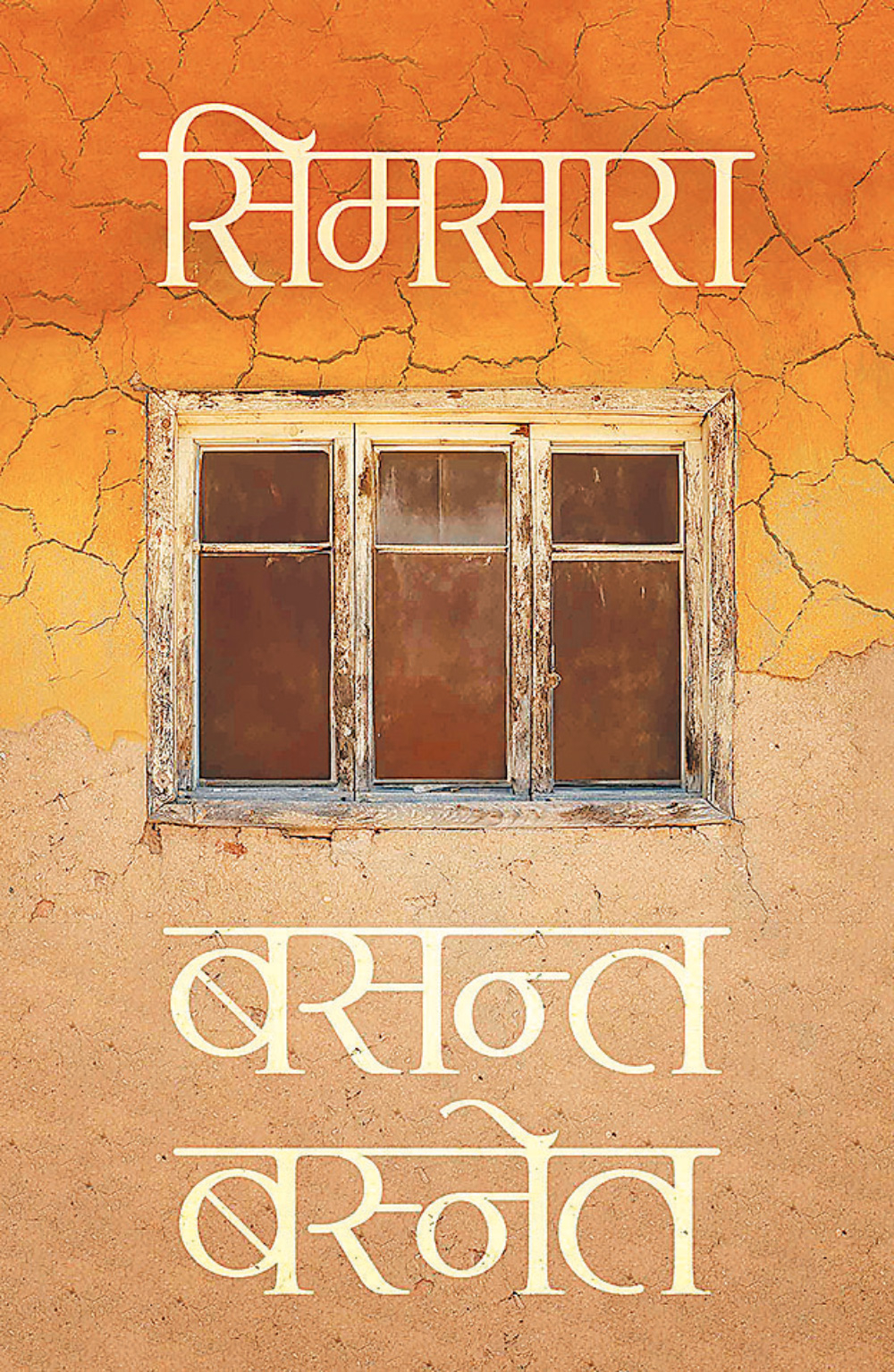
novel, I looked at the cover once. There are no non-human characters on the cover, which is notorious for having a bookish font that is taller than the book itself. I felt sorry for myself for opening the cover without reading the novel properly. That is all the reader can do. Cracked mud walls and shuttered windows reveal a gloomy world. While in the last page, Mandakranta has opened the window and welcomed the changing weather.
There is a story of a mother, father and son's family being separated. The vibration of polygamy has loosened the ties. A relationship that collapses in a small storm, what relationship? A collapsed house. After the collapse, the ruins. The narrator of the novel, a dreamy teenager Samvat Chhetri, is in emotional upheaval in his life.
is sometimes funny, sometimes cute, sometimes shocking. However, he has maintained a neutral attitude in the case of separation of mother and father. He's mostly tame, except for once in the wetlands. He did not see any villainy in the father who ripped the little one. Neither is disaffected with the youngest. There was nothing to complain about with the mother. In the
novel, Samvat does not like the excessive love of his parents, he does not consider it healthy to be separated from Ekarka. Between the distance between mother and father, he has built a fantasy home with Iswi. His house thought is, 'When the mind dies, love dies. A house where love is dead is cold. Cold is like a graveyard. A grave is not like a house, a house is not like a grave. ...Home is where people put their hearts, not their lives.'
Last year SLC passed in the second division. But his moderate proposal that mothers, fathers and children should not live together has completely failed. AD has been left in the lotus swamp of Simsara. Keeping the parents under the same house, their dream of having a daughter was not fulfilled, nor could their love with Iswi be consummated.
As soon as Iswi Sanima falls in the new sign, he has demolished Pirti's dream palace on one side. Was it not love, but raw lust or temporary attraction? The position that love dies slowly, always dies is probably a blessing of the novelist. In some places, it seems that Samvat novelist is only a mouthpiece.
Babu Patra Dhanrup has not been able to prove himself as the pillar of the house. Mulakhambo should include all rooms, roofs, attics, floors, windows and doors. However, in the village where the postman's rich job has been transferred, he is entangled in the embrace of a girl twice his age.
He has no affection for his older wife and teenage son. The newly married Kanchi also has no such attachment. Deprived of his mother's love in childhood, he is not sure about any relationship.
Then the human mind is not a puppet of the law. The freedom of the individual cannot remain unfettered in the institution of marriage. Patke agreement only adds to its agreement. However, due to arbitrary use of freedom for personal happiness due to wealth, the right of samvat has not been protected.
Dhanrup's psychological condition is very critical. Like a potted plant that wilts after two days of water. He has sent a letter in his own name, "I don't think the house built in the lake has given me happiness in life." What can be found by making a house? Even in such a dead lake.' Perhaps this is his disagreement with the institution of marriage and the concept of home.
looks like a pillar of a house or a pillar with elephant legs. Sometimes she is broken, then she is restored. Vastu is looking for a formula to keep the cold house warm through Bijuwa, Jogi and Astrology. She made her own decision by understanding the justice of the court and people's court. Perhaps that is the context of Pai.
He has shown great emotion in giving 3000 expenses to the Dojia woman who came as a stepmother even before the alleged people's government's bribery action. That is also a very emotional moment of the novel. She has proved herself to be bold by rejecting a once-in-a-lifetime dispute, a permanent truce rather than being involved in a quarrel, and her husband returning her. That decision has become unacceptable for the village, society and people's government. She has not directly fought against the ruthlessness of Pittrisatta, but has shown its ugliness.
What George Moore says is that the novel is contemporary history, a reconstruction of the social environment. However, this novel has explained what happened. The author has not come as a judge to dispense justice by the court/people's court. Every reader has a judgmental mind. It won't happen now, it will be enough if I don't do it.
Also, in the novel, there is an ideal that nothing should happen to the house, the family should live together. However, most of the characters are defeated by fate. They are forced to believe that victory-defeat, acceptance-rejection, coincidence-disjunction is life. It also has the message that life is not just about guts, courage and courage, balance is very important in life. Family breakdown, however harsh it may be, is a bitter social reality.
Simsara is such a swamp, where both father and son are trapped. Samvat makes a pact with destiny by leaving Iswi, who appears as a dramatic child. This is the climax of the novel, i.e. 'Simsara Agreement'.
Chayadevi aka Kanchhema has been defamed as a fake, smarmchada, byfale by living with a man who has children with his wife. She has found the one she loves. But the one you love is not only her. If you marry, your house will be destroyed, if you don't marry, your own life.
is a story seen through the eyes of a teenager, 'Simsara'. Adolescent psychology abounds in it. However, this is not only 'young adult literature'. It tries to show the dimensions of family relationships. But who caused the beautiful house to fall into ruin? In the novel, no one has been accused of wrongdoing. The readers are sure about this. This novel was prepared due to someone's mistake.
Whose fault, how much fault? One person is guilty when seen through one eye, and another is guilty when seen through another eye. It is not the author's job to blame the character. Even in a character created by oneself, it is very bad to take someone's side and stand against someone.
These days, such blaming is the work of politics. Opposition or support is not the work of the author, but of the activist or devotee. However, the so-called progressive literature is flawed and will always remain. I like this novelization of Basant Basnet. In
pages 52 and 53, he has done an audacity that no progressive could have done by writing the sex life of his parents. The nocturnal commotion of the Tand is quite aphrodisiac. Non-visual noise and vibration measurements have been carried out by Kishor. The
novelist seems to have worked hard on the characters. An illiterate woman is named Mandakranta. Mandakranta is a satrakshari verse. However, it is not happening in his life. It's just rough. She did not live happily ever after. Samvat met with AD. However, before their love blossomed, Iswi and Samvat were separated. Is the novelist Vikram Samvat Paksha?
A good novelist can do wonders by writing about places both experienced and unfamiliar. Be it 'Mahabhara' or 'Simsara', Basant has made Elam-Panchthar into an epic dashagaja. His characters never leave that geography. Local people are speaking in accent. His characters cannot even be free of the Maoist 'hangover'. The political 'romanticism' of Limbuan elements also became a permanent part of his novels. One day, it will be a surprise if the thick Comrade Atom with guns, Comrade Atomic Maoist guerillas with leaves, and commissars do not stand in the 'Ashrudhara'.
The regional colors of Phattanglung, Makalu Talkeko, Maibeni Baghe Charkhola in the eastern hills are painted with fun in the novel. Khongi, kholma, milke gadi, four-pronged shoe, dharke short, pate bulaki, phuppe, etc., have distinct elegance in the vocabulary.
Written in the memoir style, the plot of this novel is simple, but the extraordinary craft is mesmerizing. Moreover, it is not uncommon to be able to convert a 22-carat subject to a 24-carat one. Exciting and witty dialogues abound. It has increased the dignity, value, beauty and quality of the novel.
Basant Basnet reports on Hasyangfasyang's profession. In the middle of Dhapedi, he has given two shouty novels with a velvety drunkenness of style. Tapke's poetic heart in 'Simsara' is truly commendable.
In the latest Chhimal novelists, Basant's description style is difficult after Buddhisagar. He has the rare ability to sing Chabrung dance and Palam through words. If there are two or four writers like this, there is a possibility that Nepali novels will become weak. A few peg cheers for good storytelling!