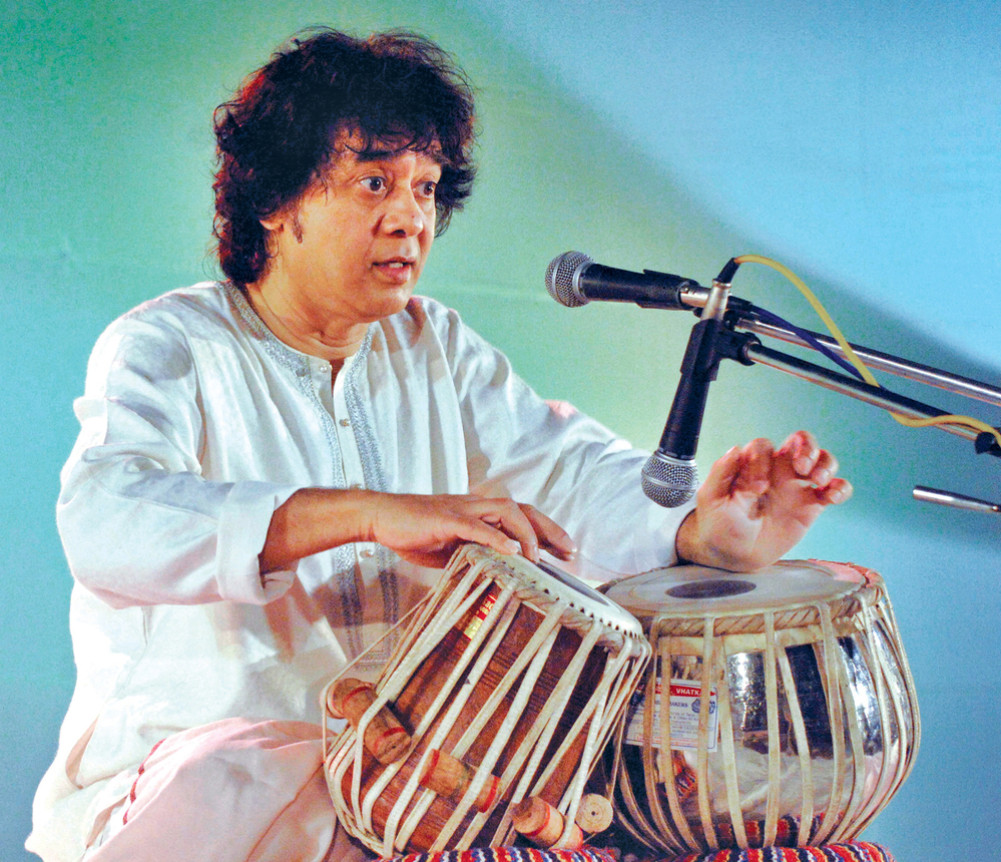
Even though Zakir's physical body is no more, the divine rhythm of his magical fingers will always reverberate
We use Google Cloud Translation Services. Google requires we provide the following disclaimer relating to use of this service:
This service may contain translations powered by Google. Google disclaims all warranties related to the translations, expressed or implied, including any warranties of accuracy, reliability, and any implied warranties of merchantability, fitness for a particular purpose, and noninfringement.
Last Sunday evening I was at Valakusari with some close friends. Politics and sports were discussed in Gafaigaf. At that moment, I forgot about the literary festivals and speakers in Nepal. The talk of Jaipur literature festival also came out.
I told the story of writers-artists being very polite to readers, sources or audience at international literary festivals. I have fresh experience of three editions of Jaipur Literature Festival. Mashur tabla player Ustad Zakir Hussain looked equally humble in the 2018 edition.
Jaipur Literature Festival conducts various sessions at 7/8 places simultaneously. After Zakir had a session, I didn't care about the other sessions. When he came home in the evening and scrolled through his mobile phone, he saw the news of Zakir's death. Born in Bombay in 1951, Zakir died in San Francisco, USA. Searched for his book and tried to remember his presentation at the Jaipur Literature Festival.
Zakir had a session in Jaipur, 'A Life in Music'. The session was moderated by festival director Sanjay K Roy, speaker Unai Zakir and Nasreen Munni Kabir. Nasreen Munni Kabir spent a long time talking to Zakir and gave the book. The book is 'Zakir Hussain: A Life in Music'. At the Sahitya Mahotsav, Zakir not only shared his experience of association and collaboration with many veteran musicians, but also his dedication and love for the instrument. He said, 'As soon as you touch an instrument, its soul stays with you.'
After about 1 hour of conversation, Zakir and Nasreen came to a stall. I had already bought the book. So I got to stand at the front of the autograph line. I witnessed the signatures of both Zakir and Nasreen. At the same time, Zakir himself asked, 'Where are you, brother?' When I said Nepal, he was surprised that he had come from such a far distance to the Jaipur Literature Festival. At the end of the same year, the Indian embassy brought Zakir to Kathmandu. Zakir rocked music lovers at the Indian Embassy premises.
Zakir Hussain was born in a musical family. His father was the famous Tabla player Ustad Alla Rakkha, Punjab Gharana. He considers his father as his first teacher in music. His father had an indelible influence on Zakir. The conversation with Nasreen shows how sensitive Allah Rakkha was towards Zakir. Zakir has beaten his father only once in his life. That too when I broke my finger while playing cricket. His father slapped him for breaking his tabla playing finger. But seeing the tears in Zakir's heart, Allah Rakkha's heart melted. He immediately hugged his son. Took to a nearby chaat shop and served Dahipuri.
Zakir's father always told him, "Don't try to be a maestro, try to be a good musician." Mera to ho gaya Ustad Allah Rakkha, Abhi second Ustad Allah Rakkha to kya hoga. शैदी kya hai ?' He always wanted his son to do something better, new and different than him. Also, Zakir never thought of becoming a carbon copy of his father and never did. Both knew: to be a carbon copy is to be 'thrown in the dustbin'.
Since there was no one in the family who had read much, Zakir studied in an English-medium school with his mother's insistence. But my father used to say, 'Hey, why are you sending him to school? He will play the tabla, let Riaz do it. School mein zakar kya karega?'
He started playing since he was in school. As a teenager, he became famous. So much so that he used to carry a reading light during train journeys to prevent his studies from getting worse. During his school life, he had performed concerts in cities including Patna, Hyderabad, Aurangabad and Ahmedabad.
Zakir is also very educated. Isaac Asimov, Dylan Thomas, Keats and Wordsworth are his favorite authors. Similarly, his favorite film was 'Citizen Kane' directed by Orson Welles.
For a long time tabla players were relegated to the shadows. Zakir recalls the old days, “Earlier, tabla players were asked to come by train for shows outside Bombay, while the lead actors went by ship.”
During the time of Zakir's father, Ustad Alla Rakkha, tabla players were treated equally. All the actors started to go on board. The contribution of Ustad Alla Rakkha, Pandit Samata Prasad and Pandit Kishan Maharaj in increasing the respect of tabla and tablaism is significant. Ustad Alla Rakkha prefers to talk less about tabla in press conferences, instead he used to say, 'I don't feel like talking much, what my hands say.'
At first, money was a problem. Allah Rakkha did not earn much money by playing tabla. Tabla players were not paid as much as other artists. Despite the fame, there was no money. Zakir reminisces about his childhood, "You see big houses and cars only in films." However, in the 1960s, when Alla Rakkha was paid 500 or 1,000 rupees, the main actor got 15,000.
Zakir, who did not play at the wedding
Recently, famous actors of the world participated in the wedding of Anant Ambani and Radhika Merchant. Artists from Backstreet Boys to Rihanna, Katy Perry to Justin Bieber performed at the wedding. But Zakir stopped playing at such weddings and private functions almost 30 years ago.
s were small gatherings of close relatives and friends or performances of artists on their annual dates. He used to say, 'I don't play at private functions, professional events and weddings. People come to these events to mingle, chat and eat and drink. I don't think this is the way to listen to music.
Zakir's family suffered a terrible fate on February 2, 2000 when they lost their father and sister on the same day. Zakir and his brother Fazal walked to Calicut for a concert. On reaching the Bombay airport, sister Razia said, 'My cataract operation is going on.'
Zakir said, 'Didi, I will be back in a day or two and then the operation will be done.' Razia did not eat anything because anesthesia was administered. But Razia felt uncomfortable while starting the operation process. It was said that the operation will not be done immediately.
Then she ate something. Anesthesia was given to him after he was told to do the operation again. Unfortunately! The food reached his trachea. The doctors at the clinic knew what had happened but they could not save him.
Bhai Tawfiq, who was at home in Bombay, contacted Zakir. Their concert was over. Tawfiq said, "Razia did not stay with us anymore." Zakir said, "We will come, we will take care of everyone."
They wanted to return that day but it was not possible because the airport was closed. The next day they arrived by car from Calicut to Kochi. They called home after reaching Kochi airport. Another sad news was told from there, 'Abba also passed away.'
Allah was very close to Rakkha Razia. When he heard the news of Razia's death, he was speechless. He did not speak with anyone. Once entered Zakir's room. He didn't see it, and went into the bathroom, having a heart attack on his way out. It was too late when the doctor came. When Fazal and Zakir came home, the dead bodies of their father and sister were in the house. How can this happen in a house? This cannot happen,' Zakir said. (A Life in Music, pp.54-55)
music: a dialogue
maestro Zakir Hussain takes music as a dialogue. Whether it is jugalbandi or the audience is the source, musicians are in dialogue. "Music is such a research because it has a dialogue," he used to say. Be it a jazz band performing with other Indian artists, he would spend hours listening to their music.
The emotions of the actors in Jugalbandi captivate the audience. Also, they communicate through rhythm and melody. Ustad Vilayat Khan and Bismillah Khan used to enjoy small gatherings. They used to ask each other, 'Hey Mian, Yeh Dada Ustad ki Cheez Hai. This is what I am hearing, listen. Look at it, yeh sur kaise lag raha hai?'
Not only with father Ustad Allah Rakkha, Zakir Hussain also played tabla with Bade Ghulam Ali, Aamir Khan, Omkarnath Thakur. He accompanied Pandit Ravi Shankar and Ali Akbar Khan at the age of 16-17 and has performed with Hariprasad Chaurasia, Shiv Kumar as well as new generation musicians like Shahid Parvez, Rahul Sharma, Rakesh Chaurasia. He has also worked internationally with John McLoughlin, Pharoah Sanders, Dave Holland, Mickey Hart, Edgar Mayer, Pat Martino, Chris Potter and Bella
has also collaborated with artists like Fleck. Pandit Ravi Shankar worked hard to develop Indian music as an entertaining art form. After that artists like Zakir Hussain, AR Rahman and others made Indian music famous on the world stage.
The San Francisco Jazz Center gave Zakir a 'Lifetime Achievement Award'. On their website, it is written about Zakir, “There is no one who does not want to play with Zakir. He is amazing. He has the ability to cross cultures and borders.'
Many artists emphasize that there should be a 'heart to heart connection' with the instrumentalist and the instrument. Once someone wished Pandit Kishan Maharaj before a performance. Pandit's answer was, 'Dekhenge bhaiya, aaj tabla kya kahta hai?' It used to be an exciting moment to watch and hear Savinaya tabla playing with rhythmic performances. Zakir, who received the Padma Shri at the age of 37, has also been honored with the Padma Bhushan and the Padma Vibhushan. He has also been honored with the Grammy Award, which is considered the most prestigious in the international music field. He has won 4 Grammys, 3 this year and 1 in 2009.
Zakir's tabla beat also made Taj Mahal tea famous with the name 'Wah Taj'. The ad shot in front of the Taj Mahal brought not only Taj Mahal Tea, but also Zakir into the household. Having lived in the musical world for more than 5 decades, Zakir's tabla beat has such a balance of thump and bang that it has the ability to mesmerize the audience.
Although Zakir's physical body is gone, the divine rhythm of his magical fingers will always resonate. Zakir Hussain will always remind us that the beat of the tabla is actually the beat of the soul.