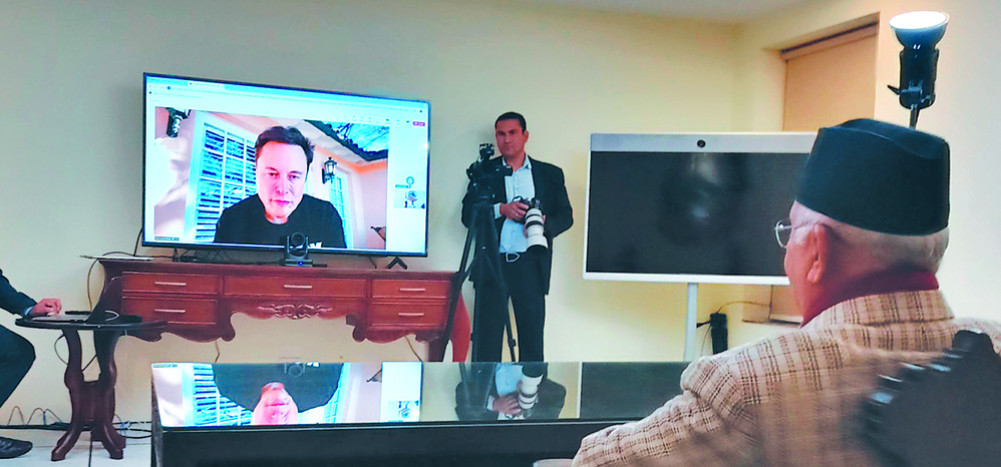
The Musk-Oli dialogue was not limited to the formality of asking for updates or jokes. Musk said he would like to see Starlink's 'high-speed' internet running on Mount Everest, the world's highest peak. Why does Starlink, which has reached 113 countries in the world, want to come to Nepal? What is the benefit to him from here?
We use Google Cloud Translation Services. Google requires we provide the following disclaimer relating to use of this service:
This service may contain translations powered by Google. Google disclaims all warranties related to the translations, expressed or implied, including any warranties of accuracy, reliability, and any implied warranties of merchantability, fitness for a particular purpose, and noninfringement.
Prime Minister KP Sharma Oli posted an interesting picture on social media last Friday amidst the discussion that the world famous credit rating organization 'Fitch Ratings' has given Nepal a sovereign rating of 'Double-B Minus' i.e. just a little lower than India.
In the photo, which became a subject of curiosity, laughter and interest some time after it was posted, Oli is seen having a video conference with Elon Musk, the world's richest billionaire.
Oli's post saying 'I am talking to Elon Musk now' has more than 7 thousand reactions on Facebook alone. Since then, there have been many analyzes and inquiries about what kind of 'interest' Musk might have in Nepal, what might be the meaning of the importance he has given to Nepal, and what will be the benefits and losses for Nepal. Due to Musk's recent closeness with US President-elect Donald Trump, his business has also been interpreted from a geopolitical angle.
While the American company Starlink, which is providing internet facilities through satellite, is taking active initiatives to expand its services in Nepal, Musk, the founder of the company, and Prime Minister Oli had a virtual conversation for about 14 minutes. In a conversation through the Microsoft team, the tech billionaire Musk said that he had a great desire to see Starlink's "high-speed" internet running on the world's highest peak, Mount Everest.
Oli's information technology expert Asghar Ali informed that Musk has made a special request to remove the political and practical obstacles in Nepal for Starlink. It was Ali who made arrangements for the Oli-Musk dialogue through Rebecca Slick Hunter, Global Licensing Head of Starlink.
Rebecca, who came to Kathmandu some time ago, met the Minister of Communications and Information Technology Prithvi Subba Gurung and Prime Minister Oli with the help of the American Embassy here and presented a 'demo' of how Starlink works. Earlier, she had given a similar 'brief' to the Prime Minister of Bhutan, Chiring Tobge. Among the South Asian countries, only Bhutan and Nepal have yet to decide whether or not Starlink will come.
When Musk talked about Starlink service expansion, Prime Minister Oli responded that he would welcome it with a red carpet, but a decision would be taken after an internal study at the first stage, informed Ali, who was present during the conversation.
Our Prime Minister said that the government of Nepal is positive about introducing new technology and that we want to welcome a leading person in the field of technology like Musk with a red carpet. Musk said that he wants to see Starlink running on Mount Everest.'
Communications Minister Gurung, who is also the spokesperson of the government, has said that Starlink should follow the laws of Nepal to expand its services in Nepal. He said in the latest episode of Kantipur Television's 'Fireside' program that any investor should come according to the law/law and the government will decide whether to approve/not give approval even if they do so.
There is a legal provision that maximum foreign investment in telecommunication and internet services should be 80 percent and the remaining 20 percent should be local partners. Minister Gurung says that there is no possibility of Starlink coming to Nepal with 100% foreign investment. However, the government has decided to proceed by forming a study committee on this matter.
Urge to invest in large data center
During the dialogue with Oli, Musk also said that he wanted to do something through the 'intervention' of technology in Nepal's health and education sector. Oli said that since Nepal is a place like "Natural AC" with a naturally balanced climate and relatively low heat, it would be suitable to build a structure like a "data center" with a large capacity here. Ali said that in response to Prime Minister Oli's statement that it would be easy to operate such structures due to the good availability of electrical energy in Nepal, Musk eagerly questioned. During the
dialogue, Oli congratulated Musk on the success of his efforts to win over the newly elected US President Trump in a humorous manner. In response Musk gave a long laugh but did not answer. On the invitation to visit Nepal, he responded that he would think about it.
Musk's conversation with Oli, who is about to spread his business empire around the world, was not limited to formalities or jokes. It is understood that his special emphasis is on starting Starlink service in Nepal and he wants to come to Nepal for sale of necessary hardware kit including antenna, router, cable. But why does Starlink, which has reached 113 countries in the world, want to come to Nepal? What is the benefit to him from here?
Economist Vishwa Poudel, who is also the former vice-chairman of the National Planning Commission, believes that Nepal is not a place where Musk can benefit financially in terms of market size, but this initiative can be a strategy to show the brand's international presence.
"Companies like Starlink want to show that 'we are present in so many countries of the world'," he said. Musk should also have the same zeal. According to Paudel, even if a project like Starlink does not cause a loss to Nepal, it will not be a special benefit. However, if Tesla, the electric vehicle manufacturing company of Elan, comes to Nepal, it will give us a big advantage.
"There is Coca-Cola in 200 countries, we are one of them, but it is not a big value, but if we can bring in foreign investment in a special project like Tesla, it sends a positive message about Nepal's market globally," said economist Poudel, "Warren Buffett, Morgan
Investors like Stanley to Adani, Ambani or Chinese businessmen or those who target a specific sector to expand business, build job creating companies, bringing them to Nepal will have a long lasting impact. The signal value of a project like Starlink that goes all over the country is relatively low. However, when it comes, we will not lose.
Although Musk's decision to expand Starlink services in Nepal has limited impact, Poudel pointed out that it can be taken as the beginning of an opportunity to attract more big investors in Nepal. He says now is the right time to attract foreign investors due to favorable conditions like good foreign exchange reserves.
In the 40s and 50s, we were able to bring in big companies like British multinational bank Standard Chartered, Eastman Kodak Company of America, India's Dabur and Unilever, he said, "now our courts, ministries, authorities, government and opposition are moving at the same pace. Couldn't run. As one competes to prevent the other, the tendency to uplift the masses prevails. Basically, the expected foreign investment has not come because we have not come out of the image of fighting with each other.'
Poudel suggests that the government should pay attention to infrastructure development and create an environment that allows big investors like Musk to come and take profits very easily and liberally as soon as they show their desire. He also commented that entrepreneurs from neighboring countries are not able to come to Nepal due to the tendency to withdraw before foreign investment, and to demonize the problems faced by investors in their own country.
Entrepreneur Sanjay Golcha, who is known in the field of communication and information technology, also says that even though there is a lot of discussion about bringing in foreign direct investment in Nepal, there is a tendency to harass foreign investors. Golchha pointed out that while it is good to have 'disruptive technology' in Starlink, it should be introduced in the right way and keeping competition in mind. ``We have already invested billions and thousands of
is a telecommunication and internet service provider company that is employing, this should also be taken into consideration when introducing new technology,' he said, 'However, satellite internet can be a good option in our rural areas where it is difficult to reach fiber network and microwave due to geographical and economic complexity. The government should take the right decision by considering both of these issues. Not limiting Musk to Starlink, Nepal's information He pointed out that by encouraging investment in the
technology sector, Nepal's international branding will also be helped.
Dilip Agarwal, managing director of Worldlink, the country's largest internet service provider, says that he is lobbying to bring Musk's Starlink into Nepal. In a program held on Thursday in connection with the agreement to bring in 10 million Euro foreign investment from the Finnish company Finfund, Agarwal held the opinion that the service of Starlink is indispensable in complex geographical areas like Folksundo in Nepal.
"Where we cannot put a tower, Starlink can provide good and reliable service," he said, "We are not afraid of Starlink, but we want to welcome it." New technology can't be ignored. At present, the Starlink Internet fee is about 15,000 rupees per month, but he says that there is an option that is suitable when using 'broadband'.
Business expansion ambitions
Although Musk's businesses appear to be US-centric, his business presence and ambitions are global. He has been expanding his business mainly in electric vehicles through companies like Tesla, satellite and space business through SpaceX, Internet through Starlink and now renewable and solar energy.
Musk's company employs about 120,000 people, most of whom are outside the US. His company, which has a direct and formal commercial presence in more than 50 countries, has Tesla production centers called 'Gigafactories' in countries such as China and Germany. Along with Tesla, Musk's company is expanding its business in the fields of renewable and solar energy in Australia, Britain, and Norway.
Musk has strong business ties with Nepal's northern and southern neighbors. He earns about 22 percent of his company's revenue from China. He has Tesla's Gigafactory in Shanghai, China, where 1 million vehicles are produced annually. Has
ing potential. He frequently visits China to increase trade with China. It is clear that he attaches special importance to trade relations with China.
Musk has also made a meeting with Indian Prime Minister Narendra Modi. Even when Modi visits the US, Musk often misses his meetings. Musk has also advanced the work of Tesla's production center to be built in Gujarat. For this, the Gujarat government has proposed to provide 1,000 hectares of land, reported The Indian Express.
Musk, who has expanded cooperation and commercial relations in various technologies of SpaceX with China and India, now seems to be especially eager to bring Starlink to this area.
Musk, who has become politically influential in recent days, is also interested in increasing his presence in developing countries. Through 'Elon Musk Foundation' and 'Giving Pledge', he has announced to work in the field of energy and technical support. He has already made a commitment to give 5 Kenyan startups about 30 million US dollars to work on 'artificial intelligence' and internet technology. Along with Indonesia and South Africa, they have started preparing to invest in various technology-related startups in Germany.
Musk, who is considered very self-centered and moody, has started trying to expand his business to small and underdeveloped countries, which can be understood as a step to increase market potential, influence on the supply chain, and increase global influence. Despite being the richest in the world, its market is highly developed and limited to urban areas, but it is trying to become global through education and health technology.
His health technology company 'Neuralink' has been claiming to solve serious health problems through the use of chips in the human brain. At Musk's initiative, Starlink has built health centers in several locations in Indonesia. Last May 19, Indonesian Health Minister Budi Gunadi Sadikin and Musk announced the launch of Starlink service in the city of Denpasar to promote health services and education in rural areas. Likewise, he has initiated technology education in 150 villages in Tanzania through his 'Global Learning Experience'.
has said that he wanted to work in Nepal's health and education technology, which may be similar to that of his company in the last days. School in the poor country of resources, but the economist Poudel, not to "promoter 'for investment. 'We need not the donation we need, is the investment,' he said. & Nbsp; The use of the Starlink of Story, Australia, Germany, is also increasing in the country and Brazilia, Brazilia, Brazilia, is higher in the Indonesia. Starries in South Asia, South Asia, South Asia, Staralinks are still trying to increase the motive in South Asia without being able to hold the internet. is
. Starlight in registration in India's Staranink Bangladesh has prepared to start services in Sri Lanka and Pakistan. Experts estimate that the mask and the US government will be able to find Nepal and Bhuntan mixing Nepal and Bhuntan. & Nbsp; Statilion of
Nepal's own sorta sorta satellite can also be another pace of interest to mask. Spacex had earned about 4 billion in 2023, working in 2023, like Nepal. Even as possible, the US Embassy has been trying to make the US company continuously not to put a mask. When printing goods in the space of the spacecon Falcon Rockets may be more than 3,000 dollars in space, and can also be another concern for Mask for the Satritalite part Devit, Technology and its influence. He repeatedly keeps the announcement to the Mars through the moon. He may expect his Spacex Empire to continue strengthening our Spacex Empire, such as large and developing countries, such as the larger countries and Nepal, such as large and developing countries like America and Nepal. & Nbsp.
is now strainaging to us, even though the Mask's style is strange, even though they are constantly working on grant, grant, and cooperation. Last year alone, his companies have mentioned more than 100 allegations of 17 American federal bodies of 17 US federal bodies, the US agenne Fighs, in the Incl Mask '. The contract of the Spalat of Spacexa, only two decades of space agency agency, has received only two decaded space agency. & NBSP; Mask, including
Germany, with a Space, Britain, Turkmanistan, has also taken work forward with the Government of India. He has also begun professional cooperation with Brazil, Nigeria, Kenya, with Kenya. The topic of the time he has done a sudden efforts with the company of
Mask can not be denyed by his last political success. As the newly elected President, the body of the US government and other countries have become more important for his interests. & Nbsp; Supporting the article in
Mask's company, may be estimated to be easier for Mask to be facilitated in the Telecom Commission of the United States. Without Trissla and Spaces in the major program of Trump, it would be helping Mask to make their business truly universal, and Nbsp ;.