We use Google Cloud Translation Services. Google requires we provide the following disclaimer relating to use of this service:
This service may contain translations powered by Google. Google disclaims all warranties related to the translations, expressed or implied, including any warranties of accuracy, reliability, and any implied warranties of merchantability, fitness for a particular purpose, and noninfringement.
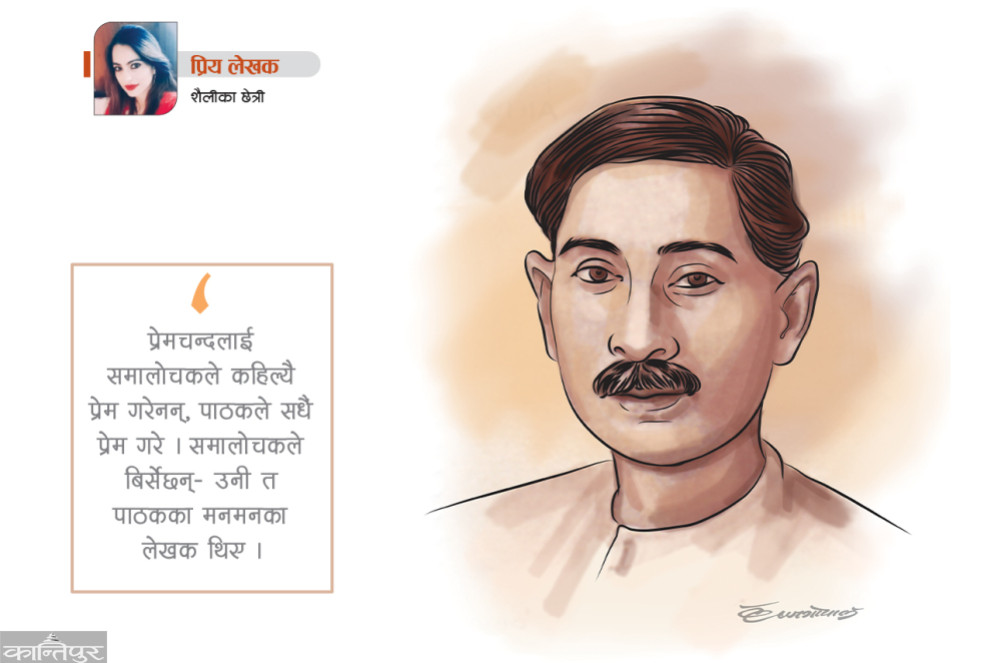
Premchand (1880–1936) was a bold voice in modern Indian literature and a well-known storyteller. Reminiscences of Premchand on his birthday (July 31):
Sridhar had tattooed Dakhni Nagari on his neck. That was Premchand's face, which looked very attractive. I was very angry with his habit of forgetting about Premchand's novel even in the rush of work. So I used to drop her off at the office all the time.
Sridhar was naive like Premchand. Lukhurlukhur used to come quietly and leave Premchand who was reading on my table. I was also the daughter of a literature lover, I couldn't sit without reading the book he kept, I used to read that book. Yes, I have been reading Premchand directly and indirectly. This time, Premchand became my 'official tour' friend. Premchand has written one place, "In my opinion, that literature is the best, in which high thinking, sense of independence, the essence of beauty, the spirit of creation flows." That was my destination. A crowd of hurriedly traveling people was running in unison, bumping, grinding, grinding. Let's say that crowd is the crowd of Premchand's film 'Mazdoor', in which the audience is having a hard time identifying the hero Premchand. The crowd looked very restless. But, even in my impatience, my eyes were fixed on the picture of Premchand, smiling in the pattern, stuck to the dirty wall on the other side.
That's it, the wall of an old book shop in Sealdah, on the floor of which Premchand's famous novel 'Godan' was also decorated next to 'Hazar Churashir Ma' by Mahasweta Devi, a famous writer of Bangla literature. Be it my stupidity or my fondness for literature or my growing love for Premchand, I forgot my destination and wandered towards an old shop in Sealdah to get a copy of Premchand's novel 'Godan'. At that moment I thought, even after 143 years of Premchand's birth, seeing his best work in a literature-loving city like Bengal is a true tribute to Munsi Premchand, the father of modern Hindi literature. And, yes, the authenticity of his permanent status.
• • •
Munsi Premchand was indeed a lively composer. The characters in each of his stories and novels seem alive. Reading his tragic novel like 'Godan', I was equally disturbed. I felt that I am not a part of the story revolving around his characters Hori, Dhaniya, Gobar, Rupa, Sona, Bhola, Jhunia, Heera, Dattadan, Mattadaan, Celia, Rai Shaib, Malti Devi, Saraj, Mr. Mehta, Mr. Khanna and Govindi. Premchand was a bold and fearless voice of modern Indian literature. He was a seer who could make a clear distinction between traditional living values and the hindering mortal element. A supporter of popular values of modernity and also a harsh critic of capitalist modernity.
In Premchand's own language, his definition of life is as follows, "My life is a flat, level field, with thousands of pits in the background, but there is no place for mountains, thick forests, deep trenches." So the gentleman who likes to roam the mountains, he is disappointed here.''There is no place to connect Premchand from a romantic angle. His story is the story of every common man. Lamhi is a small village on the road from Banaras to Sarnath. There, on 31st July, 1880, a son was born to Dak Munsi Ajaib Lal, who is known to the world as 'Premchand'. The father named the son - Dhanpat Rai and the uncle Nawab Rai. However, fate did not allow that boy to become a rich man or a Nawab. His mother died at the age of seven. After his mother's death, his father remarried at the age of 50. Premchand's opinion did not agree with that little mother. A bitter feeling of rejection towards the new mother rose in her heart. Therefore, when reading the story 'Dudh Ka Daam' and 'Gharjamai', the reader finds the emptiness of the mother in Premchand's life expressed in poignant words, where the main character speaks after losing his mother, 'Losing a mother in a child's life is a very unfortunate pain.' He grew up with the game of Danda'. The reader gets to know that attachment while reading the story 'Gili Danda'.
Premchand's father ordered him to get married at the age of 15. However, Premchand found the first woman in his life quarrelsome and could not accept the new woman as his wife. After that, Premchand became disillusioned with marriage. Reading his novel 'Premashray', the reader gets to know that marriage-feeling. Not only that, Bhunia and Gobar's marriage in 'Godan' is also a glimpse of Premchand's mismatched marriage. Several years after that failed marriage, Premchand remarried a familiar woman, the child widow Shivarani Devi. That marriage event was a revolutionary step taken by Premchand against the background of the shrinking India at that time. Even before that marriage, Premchand had already written the novel 'Prema' in strong support of widow-marriage. Premchand suffered a lot of unemployment in his life. He was fatherless when he was 15 years old. After that, the weight of wife, mother-in-law and mother-in-law's children also fell on his weak shoulders. The convulsions of unemployment cause severe pain, the pain of which the reader is experiencing as he reads the story of 'Algyoksha'. What did Premchand not do to support his family? He taught tuition, sold books, passed the 'entrance' exam and became a school teacher. During that run of government jobs, he stayed in several villages in UP, but his special camp became Gorakhpur.
India burned in the non-cooperation movement of 1921. As a result, after Gandhi's call, Premchand quit his 21-year government job and became an active writer in India's independence movement. Then? What happened next? Poverty overwhelmed him. For eight to nine years, he wandered in small jobs in Banaras, Kanpur and Lucknow. And, finally, in 1930, he reached Benares and settled there, where he started his press and publishing business. In 1934, he went to Bombay on the invitation of a film company. Maybe he did not get success, he returned to Benares again. Premchand's body had become weak due to all the hard struggles. Perhaps due to severe stress, he was afflicted with a serious stomach ailment and on 8 October 1936, he left the physical body.
• • •
Since 1901, Premchand has shown the magic of pen in literature. First he wrote in Urdu, later in Hindi. At the very beginning of his writing career, Premchand was accused of 'treason' after the publication of 'Soje Watan', a collection of five stories in 1908, which was burnt by an 'English collector'. He said to the novelist Premchand, 'Your stories are completely seditious. Consider yourself lucky that this is the British government. Had it been Mughal rule, both your hands would have been cut off.'
After that incident, Nawab Rai disappeared forever and 'Premchand' was born. During his thirty-five years of writing, Premchand published about three hundred stories, fifteen novels, three plays, more than two hundred articles and a dozen translations. That was an unparalleled story of constant struggle and tireless work.
Hindi novel Samrat Premchand had three children. Two sons Shripatraya and Amritraya and daughter Kamala Devi. Premchand's son Amrita Raya is counted among the progressive literary figures of India. Amrita Rai wrote 'Kalamka Sipahi', which was awarded the Sahitya Akademi Award in 1963, a biographical story of Premchand. Premchand started a Hindi monthly literary magazine called Hans, which was edited by his son Amritray after his death. It was Amrita Roy, who also completed Premchand's last novel 'Mangalsutra'.
Premchand's simplicity
Premchand's personality was simple and plain. Receptionists at an event in Patna could not spot Premchand at the railway station. The receptionist had Premchand's photo in his hand, but it didn't work. They showed Premchand's photo and questioned him, but did not ask Jhutre Premchand who was sitting next to him. So Premchand waited at that station all night. In the morning, when all the crowds at the station were empty, the young man who was looking for Premchand asked the ordinary-looking passenger - 'Sir, have you come from Lucknow?'
Only then did he recognize Premchand. Premchand's face showed a little anger, a little satisfaction and a line of happiness at the same time. On the way, the young man asked, "Didn't you have trouble?" Premchand said, "Trouble?" All night long I was torn between the two words 'return' or 'stay'. There was a return train to Lucknow on the platform, but I could not board it. I thought, if I come back, you will be sad.' Such was Premchand - an unpretentious person with no literary ego. Modesty was his specialty. Harishankar Parsai has written a satirical essay titled 'Premchand Ke Phate Zote', praising him for his plainness. There is a photo of Premchand, in which he is seen smiling, but a closer look at the photo also shows his torn shoes, through which his innocent toes are sticking out. Parsai's gaze falls on Premchand's torn shoes. After that photo was published, many people talked about Premchand's mustache, how much they criticized Premchand's smile.
Premchand and criticism
Premchand was never loved by critics. Throughout his life, the walls of his house were not decorated with any honors or awards, he suffered blows throughout his life. After Premchand wrote 'Premasraya', Professor Madhav Upadhyay (who studied mathematics in Paris) in an article compared the novel to Tolstoy's 'Rejection'. And contracted the stolen goods to 'Premashram'. After the publication of Godan, Srinath Singh called Premchand a "hate preacher" in an article. NCERT's His novel 'Nirmala' was removed from the
syllabus as 'not suitable for teaching in schools'. There was a rumor about 'Rangbhumi', 'Premchand's use of the word 'Chamar' is unconstitutional.' Arrogant critics who thought of themselves as omniscient scholars were busy dismissing Premchand. But, he has forgotten, Premchand had already settled in the heart of the reader.
Commentator Mirza said, 'Premchand always rode on a white horse, save the black king.' Commentator Mir enters the battlefield against Mirza with a pen in one hand and a sword in the other. Both clash. Both are seriously injured. Thus 'great' critics are willing to sacrifice their lives for a writer. The same thing keeps repeating itself. Premchand remains neglected as long as he lives.
We have become characters in one or the other story of Premchand. How? As the self-respecting writer Praveen in the story 'Lekhak' or as Roopkumari or Ramdulari in the story 'Two Sisters'. Madari Lal as Subodchandra from the story 'Prayashchit' or Subhadra as Keshava from the story 'Sohag Ka Shav', Devi or Munnu from the story 'Lanchchan'. Similarly, in many stories of Premchand, the reader finds 'self' and 'swa' somewhere.
Premchand was a feminist. His co-religionist Shivarani Devi was jailed several times during the Indian independence movement, which was a matter of pride for Premchand. Shivrani wrote the short story 'Kaumudi'. His characters stand apart from Premchand's characters as independent, independent and gender empowered. But when Shivrani wrote 'Premchand Ghar Mein', she was accused of smelling Premchand's pen in that book. Premchand never spoke against the thousands of accusations made against him in literature, but when Shivrani's Swachhand Kalam was accused, he said, 'Shivrani is a warrior, her stories or writings are filled with that feeling, so she should not be affected by aggressive literary conspiracy. A society in which women lose their self-empowerment, that society is ruined.
Premchand and Dalit literature
Premchand revealed the nature of Dalit life in literature. He wrote his first and last works about Dalits, but he himself was not a 'Dalit writer'. In India, Premchand is given the status of writer 'Maxim Gorky'. In India, at the inaugural meeting of the All India Progressive Writers' Association in Lucknow in April 1936, Premchand's appeal was that Indian writers should wake up from their romantic slumber, stop thinking of themselves as entertainers and become socially responsible.
Premchand's stories and novels tell vivid stories of common people, farmers, the poor, Dalits, women and orphans living in villages. So Premchand's writing is always relevant . Premchand does not need any wave of criticism to come to light.
Perhaps, if I had not read Premchand, my heart would not have enjoyed the poems of Agneya, Nirala, Baba Nagarjuna. Neither I used to read Kamleshwar's novel 'Kitne Pakistan' or Geethashree's 'Hasinabad'.
Premchand – On his birthday, I wanted to ask – have you read Dear Premchand?