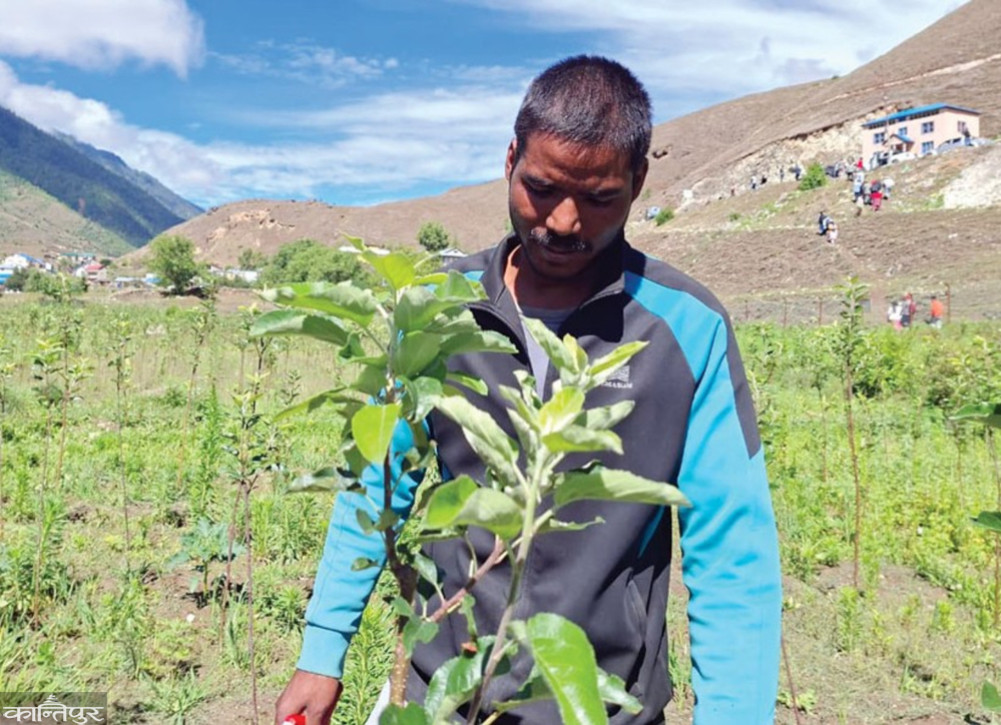
Paran Bahadur from Jumla, whose agricultural journey began with vegetable farming, has now expanded to an orchard of 14,000 apple saplings. A year ago, he invested 8 million rupees to cultivate apples on 32,000 square meters of land; his orchard is among the largest private apple orchards in the district.
We use Google Cloud Translation Services. Google requires we provide the following disclaimer relating to use of this service:
This service may contain translations powered by Google. Google disclaims all warranties related to the translations, expressed or implied, including any warranties of accuracy, reliability, and any implied warranties of merchantability, fitness for a particular purpose, and noninfringement.
Paran Bahadur Dharala of Ranka village, Tatopani Rural Municipality–1, Jumla, is now fully dedicated to apple farming, seeking his future in this field.
In the first year, he leased 32,000 square meters of land in Aireni, Tatopani Rural Municipality–5, and planted 14,000 apple saplings. This orchard is considered one of the largest private apple orchards in Jumla.
Fifteen years ago, Paran began his agricultural journey by investing 700,000 rupees in vegetable farming on 15 ropani of land. He produced seasonal and off-season vegetables such as tomatoes, bitter gourd, cucumber, local chili, and Akabare chili. His vegetables met the demand from the village to the city.
His business, which provided daily employment to four people, has now grown significantly. His four-member family was sustained by vegetable farming alone. With the savings, he expanded his business and has now ventured into apple farming as well. Recently, he has also started an apple nursery alongside vegetable farming.
“While working in others’ orchards, I understood the potential of apple farming up close,” Paran said. “The experience from producing saplings to managing orchards gave me the confidence to establish a commercial orchard.”
Seeing that farmers in Jumla had started to get good returns from commercial apple farming, he dared to take a significant financial risk. He invested about 8 million rupees to plant 14,000 saplings of the ‘Crab’ variety of apples. Now, this orchard, spread along the Jumla–Surkhet Karnali Highway, has become a symbol of new possibilities in the district.
“I realized that youths like us should create opportunities in the village rather than leave in search of them,” Paran says. “Even by taking loans, I have planted good quality saplings. I believe this orchard will yield the fruits of my hard work in three years.”
The annual rent for the land Paran has leased alone is nearly 1 million rupees. In addition, there are significant expenses for purchasing saplings, digging pits, fertilizers, irrigation, fencing, labor, and regular care. A large amount has already been invested even before fruit production has begun.
The locals have been greatly impressed by a young man who, starting with vegetable farming, has managed to establish a large apple orchard. “At first, no one believed it,” Paran said. “Now everyone is amazed.” Now, some locals have followed his example, establishing their own apple orchards and expanding their vegetable fields.
Due to the strong attraction to apple farming, the District Agriculture Development Office has started providing about 950,000 rupees in grants under the Apple–Walnut Program. Farmers say this amount has helped with sapling purchases, pit construction, installation of irrigation motors, and orchard fencing.
According to Ram Bhakta Adhikari, head of the District Agriculture Development Office, the number of youths interested in commercial agriculture is still limited. “It is a positive sign that youths like Paran have taken risks to start agricultural enterprises,” Adhikari says. “Encouraging such farmers is the objective of government programs.”
According to Adhikari, 20 new apple orchards have been established in Jumla just in the current fiscal year. The area under apple cultivation in the district is expanding every year. The cold climate, altitude, and soil quality of Jumla are said to give apples produced here a special taste and quality.
Currently, thousands of farmers in the district are involved in apple farming. With modern orchard management, improved saplings, and expanded road access, the scope of commercial farming is also widening. However, there are as many challenges as there are opportunities.
Climate change, hailstorms, pest and disease outbreaks, lack of storage, transportation costs, and market uncertainty are common problems for farmers. Even as production increases, if price and market management are not effective, it is difficult for farmers to gain the expected benefits. Therefore, investment is equally needed in processing, cold storage, branding, and marketing alongside production.
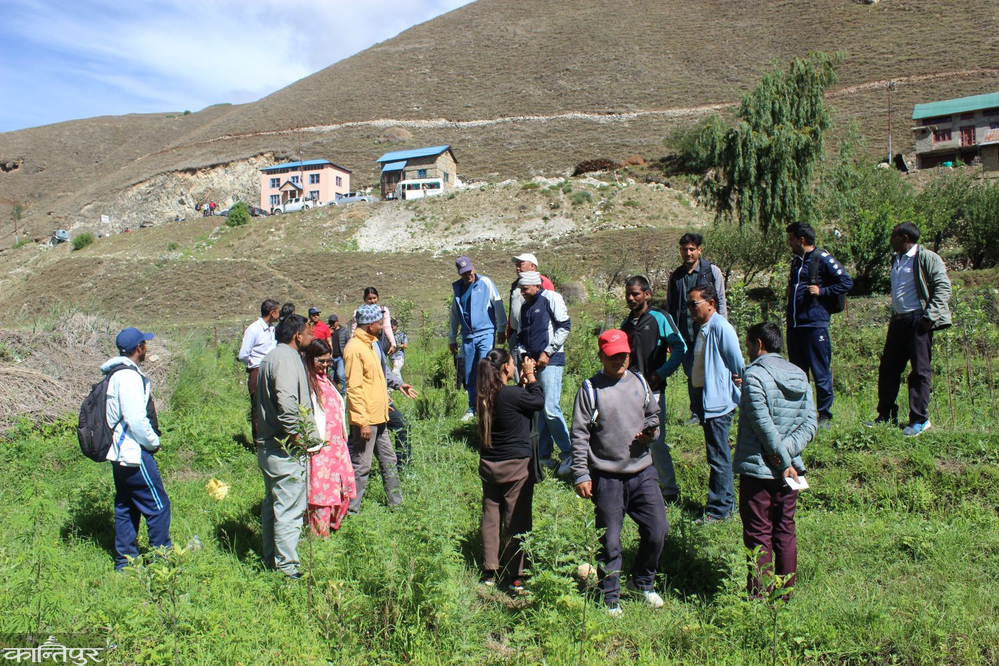
Previously, only Guthichaur Rural Municipality had private apple orchards of this scale. Now, with the addition of another large orchard in Aireni, a team including Gaurinanda Acharya, head of the District Coordination Committee; Ram Bhakta Adhikari, head of the District Agriculture Development Office; and Khemraj Shahi, head of the National Agricultural Modernization Program Jumla, has visited the orchard. Stakeholders have expressed confidence that such commercial orchards will add new energy to the district’s agricultural economy.
For Paran Dharala, apple saplings are not just crops, but the foundation of his future. In a few years, those trees will be laden with fruit, and along with them will hang the stories of years of hard work, courage, and self-confidence.
According to statistics from the Agriculture Development Office Jumla, apple farming is being carried out on 4,500 hectares in Jumla. As the number of apple orchards increases every year, farmers have started to make apple farming their main source of income. However, farmers demand that the state should help with transporting the apples to market and controlling disease outbreaks.