Increasing use of slate stone instead of tile, marble, employing nearly 100 locally
We use Google Cloud Translation Services. Google requires we provide the following disclaimer relating to use of this service:
This service may contain translations powered by Google. Google disclaims all warranties related to the translations, expressed or implied, including any warranties of accuracy, reliability, and any implied warranties of merchantability, fitness for a particular purpose, and noninfringement.
71-year-old Dhansingh of Rukum Paschim Chowrjahari Municipality-8 Goiri reaches the stone quarry near his house before 6 in the morning. His daily routine of taking out stones from the mine and shaping them into different shapes has been going on for 56 years. His father Bhojsingh also worked in this mine for almost 40 years.
Although Dhansingh did not earn much by extracting stones, he did not have to go abroad for employment. "I am raising money for my family, house expenses, and higher education of my children with this work," he said, "customers come to the mine with their cars, their livelihood is going well, and they are also satisfied". It has been nearly 50 years since he started working in the quarry. His father Shadananda also worked in the mines for a long time . "Following my father, I have been working in this mine since I was 10 years old. I made my 2 sons government employees with this income," he said. He said that he is still earning 1,000 to 1,500 rupees a day by extracting stones from the mine.
The stone they extracted from the mine is mostly going to Kathmandu and Pokhara, while the demand for it is also increasing in Nepalgunj, Butwal, Surkhet, Baglung, Dang and other places. In the beginning, most of the stones here have been going to the city since 5 years ago, they were being consumed locally. Kavindra Budha, a local, said that the stones of Goiri are being used for roofing, kitchen tiles and making decorative materials.
According to him, some people are using Goiri stones instead of marble and tiles inside the house. "When the stone quarries in other places are disappearing, we have been getting jobs for generations. At least one person from every family in the village has a good income," he said -break According to the local Kamal Vik, the stones are sold before they can be taken out of the mine. He said that since 3/4 months, the traders have been sending pesky amount for stones . He says that the slate stones extracted by them are being used in big hotels, various parks and tourist spots recently. "Nowadays, instead of tiles and marble, stones from here are being used in the city, traders come with cars to buy stones," he said, "Production is low, demand is high, it has become difficult to meet the demand."
He says that the number of people joining the mines is also increasing after the stone is sold in the city. Currently, around 100 people are employed in the mine and surrounding areas. Their income ranges from Rs 1,000 to Rs 5,000 per day. Their wages are determined based on the number of stones extracted from the mine. 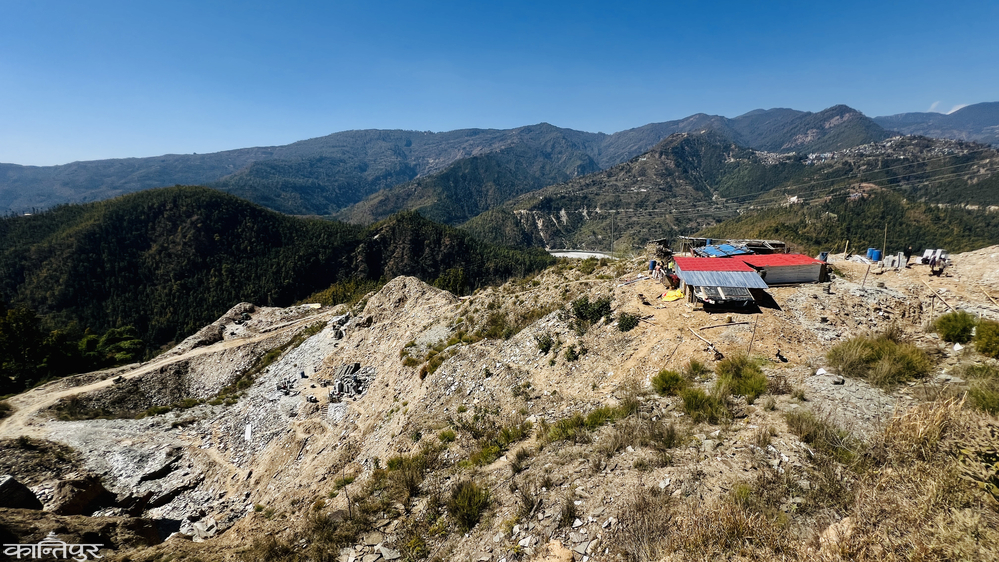
Dhan Bahadur Chand, another worker, said that a stone cutting machine was brought to the mining area as the demand for stone increased. "After bringing the machine, we don't have to shape the stone by hand," he said, "the work has started to become faster and easier, and the sale has also increased rapidly since the machine started making stones according to the order." He is the third generation of his family to work in the stone quarry. He said that his grandfather also worked in this mine for a long time.
'This is a mine since the time of our ancestors, we extract stones from the mine in the old way, bring them out and mold them into different shapes using machines,' he said, 'Initially, the stones here were only used for building houses at the local level, after some time, the demand for stones decreased after they started to cover houses with zinc leaves. According to him, the price is determined by looking at the size of the stone in the mine. A stone is usually sold for between 40 to 70 rupees. Land owners, miners, laborers and municipalities collect taxes from this price. The municipality charges up to 5 rupees depending on the size of the stone.
Dilli Hamal, another worker, said that with the increase in demand, the income is also increasing. "We have raised a family with this, we are paying for our children's education," he said, "We are earning at least 3,000 a day as the demand increases." He said that now he is busy mining from early morning to late night. The municipality has built a road near the mine. City chief Pushpa Vadi said that after the construction of the road from Madhyapahari Lokmarg to the mine, the traders used to bring stones to the mine with vehicles.
'The third generation is working in this mine now, the village has become self-sufficient through traditional business,' he said, 'young people from the surrounding villages have gone abroad, while in Goiri, quarrying is stopping the exodus, most of them have bought real estate in the city market with the income from quarrying. He says that because the stones found in Goiri are of a special type, the demand for them is increasing up to the federal capital. "Mining has not only given income to the local people, but the identity of Chaurjahari has also spread to different places," he said.
62-year-old Tula Bahadur Gharti said that he did not have to go to Kalapahad (India) after earning well in mining. "He spent his whole life in the stone quarry, building a concrete house in the Chaurjahari market, adding land, and educating his children is the main source of income," he said, "This mine is the main source of livelihood for the villagers of Goiri." It was said that it was sold for 10 rupees. He says that slate stone, which was once used to cover traditional houses, is now being used to decorate modern houses.
"Slate stones are being used in houses in Pokhara and Kathmandu to stick on the walls and print on the floor," he said, "The demand for Goiri stones is also increasing in footpaths, parking lots and gardens". Demand for slate is increasing as it looks attractive and is more durable than marble.'
Misarkumar Malla, the owner of Dhungakhani, said that now about 75 skilled masons and 23 workers are working in the mine. According to him, masons and others are working at the rate of at least 5 people in 15 mines that are extracting stones this season. He says that every year from November to May, there is work in the quarry. In other months, due to the rains, landslides and accidents occur, so the work is stopped . He informed that the price of the stones ready for sale will be determined by looking at their size. According to him, stones are being sold at the rate of 70 rupees per pound.
Goiri's stone quarry is on private land . This year, the operator Malla said that stone is being extracted from 15 mines in the land of 5 people. Apart from that, in other mines, some of them are filled with stones and some are buried with soil . He said that work is being done to extract about 250,000 stones from the mine this year. Chaurajahari Nagar Chief Plaintiff said that the stone quarry in Goiri and Gadimalika is the main place of employment for the locals. He said that nearly 150 people are getting daily employment in both mines.
Not only those who take out stones from the mine have got employment, but those who carry stones are also earning income . Stone carriers from Goiri to Chaurjahari market get a wage of Rs 10 per stone . ``Carrying 100 stones a day earns 1000 rupees,'' said Rakesh Gharti, a local. He says that tractors and cargo vehicles are also getting work while transporting stones. "After taking it to the main road, the stone is loaded on the truck and taken to different places," he said, "The stone here has become a brand for the surrounding districts." This stone quarry is spread over about 3,000 square meters.

