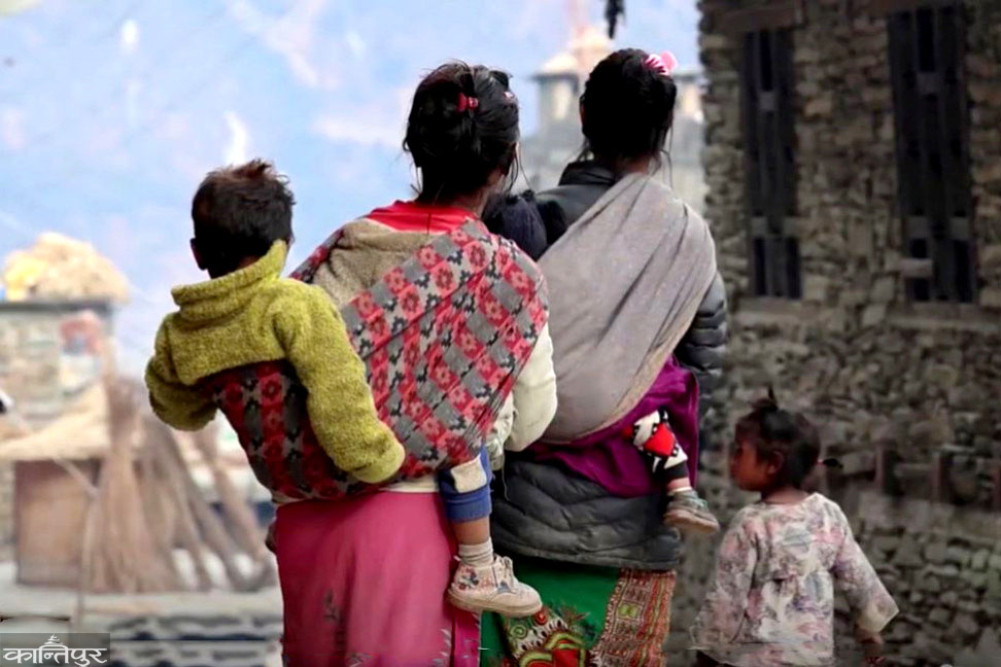
After failing to find any donors willing to invest in Bagmati and Gandaki, the federal government has written to provincial and local governments to increase investment.
We use Google Cloud Translation Services. Google requires we provide the following disclaimer relating to use of this service:
This service may contain translations powered by Google. Google disclaims all warranties related to the translations, expressed or implied, including any warranties of accuracy, reliability, and any implied warranties of merchantability, fitness for a particular purpose, and noninfringement.
While a national study has shown that more than 200,000 children under the age of five are affected by acute malnutrition, the government's efforts to find new donors for the nutrition programs in Bagmati and Gandaki provinces have failed.
Leela Bikram Thapa, head of the Nutrition Branch of the Family Welfare Division under the Department of Health Services, said that no external donor has been found willing to invest in Bagmati and Gandaki. At the request of the Ministry of Health and the direction of the National Planning Commission, the Ministry of Federal Affairs and General Administration has also written to the provincial and local governments of those provinces to increase investment in the nutrition sector.
According to the results of a recent nutrition assessment, more than 200,000 children under the age of five were found to be malnourished. This means that infants and toddlers are suffering from acute malnutrition. The national nutrition assessment conducted across the country last April showed that 9 percent of children aged 6 to 59 months were affected by malnutrition. This is higher than the 2022 Nepal Demographic and Health Survey. The study showed that 8 percent of children were suffering from acute malnutrition.
Acute malnutrition indicates a serious health problem. Doctors consider it an emergency and recommend immediate treatment. According to experts, children with acute malnutrition are 10 times more likely to die than healthy children. If the rate of acute malnutrition exceeds 10 percent, child mortality can increase significantly.
The study included more than 1 million 60,000 children under the age of five. The study also showed that 26 percent of children overall were also affected by stunting, compared to only 25 percent in 2021.
Stunting is the disruption of physical growth and development due to prolonged lack of nutritious food or infections due to various causes. In such a situation, the height for age of children is significantly reduced.
According to health officials, the government had requested assistance from various international aid agencies and development partners to solve the worsening nutrition crisis. Among them are the United Nations Children's Fund (UNICEF), FHI 360, Helen Keller International Nepal, World Vision, Care Nepal and other organizations.
'The World Food Program (WFP) has agreed to support the nutrition program in Koshi Province, while organizations working in other provinces have said that they will increase investment within their scope,' said Leela Bikram Thapa, head of the nutrition section, 'Representatives of donor agencies have not shown interest in investing in Bagmati and Gandaki provinces. That is why we have requested the provincial and local governments to increase investment from their own resources.'
According to officials from the Ministry of Health, there have been repeated discussions with the Ministry of Finance, the National Planning Commission and other stakeholders about the risk that the situation may worsen if the nutrition crisis is not addressed in a timely manner.
According to doctors, malnutrition and stunting are common when children do not get enough nutritious food and are frequently exposed to infections. They say that even if children eat enough food, they may lack protein and other essential nutrients.
Meanwhile, nutrition experts have said that the problem will not be solved by relying solely on donor support. 'The government should take this issue seriously and address the problem immediately. Adequate investment should be ensured in health, education, drinking water and agriculture,' said nutritionist Dr. Atul Upadhyay, 'Being reactive will not solve the problem in the long term.'
Nepal has committed to improving the nutritional status of children under the Sustainable Development Goals (SDGs) of ending poverty, hunger and inequality by 2030. To achieve the Sustainable Development Goals, Nepal will need to reduce the current 26 percent stunting rate to 15 percent, the 9 percent malnutrition rate to 4 percent, the 19 percent underweight rate to 10 percent, and the anemia rate to 10 percent from more than 43 percent.