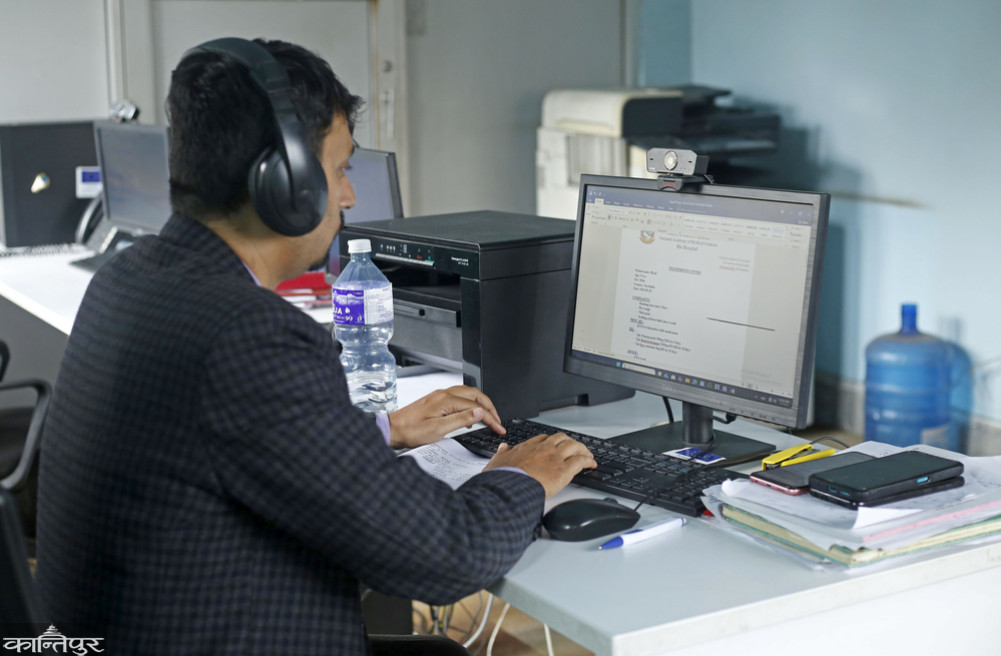
Bir Hospital's telemedicine service, which used to be available 24 hours a day, is now only available from Monday to Friday from 10 am to 5 pm.
We use Google Cloud Translation Services. Google requires we provide the following disclaimer relating to use of this service:
This service may contain translations powered by Google. Google disclaims all warranties related to the translations, expressed or implied, including any warranties of accuracy, reliability, and any implied warranties of merchantability, fitness for a particular purpose, and noninfringement.
On the last Sunday of Jestha, a 29-year-old woman from Abu Dhabi, the capital of the United Arab Emirates (UAE), repeatedly called the hotline of the telemedicine service operated by Bir Hospital. The woman from Kailali, who has been working as a domestic worker in Abu Dhabi for a year, has been suffering from a cervical infection for some time. Due to which she is suffering from problems such as abnormal vaginal discharge and unbearable stomach pain.
She tried to contact the doctor on Saturday as well, but was unsuccessful. A health worker at Bir Hospital said on condition of anonymity, 'After the government implemented a two-day holiday from Baisakh, the telemedicine service operated for migrant workers was also closed for two days a week. Although the service is said to be available 24 hours a day, seven days a week, it is only available from 10 am to 5 pm, and that too only on days other than holidays.'
Thousands of people like this woman in the UAE are facing such problems. Due to the government's decision to grant 2 days off a week, telemedicine services have been closed, leaving them deprived of health services.
Especially, Nepali migrant workers who are facing difficulties in accessing health services abroad due to language problems, lack of easy access to health institutions, lack of health insurance, expensive treatment costs, etc., resort to telemedicine services. It is estimated that more than 3 million Nepali youth are living abroad. West Asian countries including Qatar, Saudi Arabia and the UAE are the main destinations for Nepali workers.
More than 35 migrant workers have been receiving health consultations daily through the telemedicine service launched by the government about 3 years ago in collaboration with the Foreign Employment Board Secretariat and Bir Hospital.
'Like other health services, the telemedicine service has also started closing on Saturdays and Sundays after the government implemented a two-day holiday,' said Dr. Prakash Budhathoki, spokesperson of Bir Hospital. 'The agreement with the Foreign Employment Board Secretariat states that the service will be provided only during office hours.'
Nepali migrant workers in more than 46 countries depend on Bir Hospital's telemedicine service for health consultations. In order to resolve the fuel crisis caused by the ongoing conflict in West Asia, the government had decided to close government offices for two days a week instead of one day (Saturday) and operate the remaining days from 9 am to 5 pm. Thousands of service recipients and patients seeking treatment at government health institutions have been affected due to the decision.
Many patients have complained that they have to wait for many days to get services in the capital and district headquarters, surgeries have been postponed, and they are forced to pay expensive fees for treatment at private clinics.
According to the hospital doctor, the woman managed to contact the hospital doctor only on Monday, and when the hospital phone rang, she cried and cried.
'You don't even pick up the phone, I was dying of lower abdominal pain,' a doctor said, quoting the woman, 'I called all day hoping that you would pick up the phone and recommend some medicine to relieve the pain.'
According to the doctors, the woman left her young children for foreign employment not out of desire but because of the deteriorating financial situation of her family.
Bhim Bahadur Saru Magar of Sankhuwasabha, who works as a security guard in Malaysia, complained that the telemedicine service, which is available only during office hours, is not of much benefit to those employed abroad.
'There is never a day off in security guard work,' he told the health worker, who has been suffering from insomnia and loss of appetite for a long time. 'By the time he returns from work, Nepal's office hours are over, and the telemedicine service does not answer the phone.'
He has also sent a long written complaint to the health worker. In it, he mentioned that he did not receive health insurance, that the company he works for did not care about the health problems of the workers, and that those who complain against the company were beaten and even threatened with deportation.
Many Nepali youth work abroad on tourist visas without work permits, and are therefore deprived of health insurance. Such workers are at risk of exploitation and are also deprived of their right to health services. Some do not seek treatment at all due to the high cost of treatment.
According to doctors working in the telemedicine unit of Bir Hospital, many migrant workers have problems with insomnia, anxiety, laziness and excessive alcohol consumption. Some are suffering from loneliness and homesickness. Some have even had thoughts of suicide. Some report feeling extremely scared for no apparent reason, which requires immediate medical treatment.
According to doctors, migrant workers call the hospital's hotline continuously even on weekends and holidays, but the phone does not pick up.
'If the health problems of migrant workers are to be addressed, the service should be available 24/7,' said spokesperson Budhathoki, 'but for that, the hospital should be given the necessary financial and manpower.'
Earlier, health workers working in the telemedicine service used to answer the calls of workers even on public holidays, but they stopped answering the calls after the government did not pay them extra for it.
Officials at the Ministry of Health and Food Security have said they were unaware of the closure of telemedicine services on weekends and public holidays.
'This service should be available 24 hours a day, seven days a week,' said Dr. Sameer Kumar Adhikari, the ministry's joint spokesperson. 'I was not aware that this was the case. I will understand why this happened with the relevant officials.'
Public health experts say that by closing telemedicine services after public holidays and office hours, the government is ignoring its commitment to ensuring health services for all and the health and welfare of migrant workers.
'The government is neglecting the health of millions of youth,' said public health expert Dr. Baburam Marasini. 'Such a decision can have a long-term impact on the health of migrant workers, their families and their overall health.'
According to experts, the health problems of millions of Nepali workers working abroad can be addressed with modest investment and it is the responsibility of every government to do so.