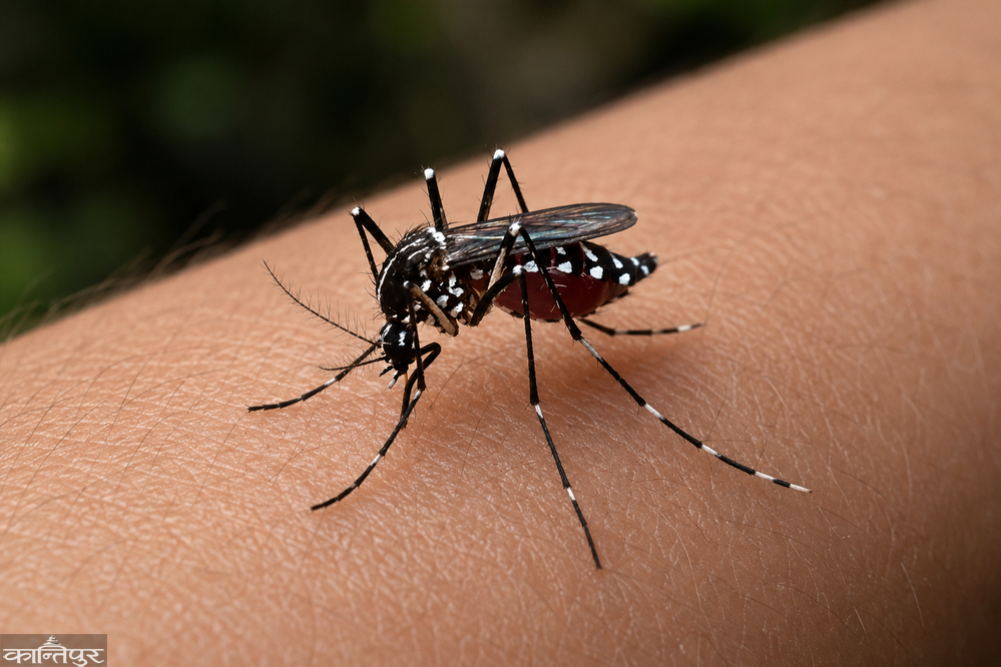
The Ministry of Health has sent letters to all 753 local governments, requesting them to conduct public awareness and ”search and destroy” campaigns for three months, citing the risk of a dengue epidemic.
We use Google Cloud Translation Services. Google requires we provide the following disclaimer relating to use of this service:
This service may contain translations powered by Google. Google disclaims all warranties related to the translations, expressed or implied, including any warranties of accuracy, reliability, and any implied warranties of merchantability, fitness for a particular purpose, and noninfringement.
It has been confirmed that two people have died from dengue virus infection this year. Since January alone, more than 1,200 people have gone to hospitals for treatment after being infected.
According to the Ministry of Health and Food Safety, one of the deceased was a 78-year-old man and the other a 39-year-old man. Officials say both had other health problems as well. "The 78-year-old patient had been admitted to the hospital for pneumonia treatment. During testing, dengue virus infection was also confirmed," said an official from the Ministry of Health. "The other, a 39-year-old patient, also had a kala-azar infection. However, doctors considered dengue infection to be the main cause of death."
Dengue is a viral disease transmitted by female Aedes aegypti and Aedes albopictus mosquitoes. According to the World Health Organization (WHO), these mosquitoes also transmit chikungunya, yellow fever, and Zika virus.
Last year, six people died from dengue infection and about 9,000 were infected. According to entomologists, the number of confirmed cases may only represent a small fraction of the actual number of infections. This is because about 90 percent of those infected show no symptoms. Most cases of infection and death in Nepal are not recorded at all.
Generally, only those who go to major hospitals after their health deteriorates following infection, and those who die in hospitals, are recorded.
In 2025, dengue infection was confirmed in all Himalayan districts except Humla. This year as well, infections have already been confirmed in many Himalayan districts. Health officials say that with the onset of the monsoon, the risk of dengue and other mosquito-borne diseases has increased. According to them, the monsoon season is also considered the epidemic season. This is because thousands of people across the country become infected with communicable and vector-borne diseases.
"We have sent formal letters to all local levels to conduct public awareness programs and dengue 'search and destroy' campaigns in their areas for the next three months," said Dr. Gokarna Dahal, head of the Vector Control Section under the Epidemiology and Disease Control Division. "We have also alerted local levels where dengue infection has been confirmed about the risks."
According to officials, federal agencies can only raise awareness, provide technical advice, and assist in preparing procedures. The main responsibility for implementing preventive measures lies with provincial and local governments. The Ministry of Health and Food Safety has stated that it has also provided budgets to all local levels across the country to run prevention programs.
Meanwhile, the Health Department of Kathmandu Metropolitan City has announced that it completed a three-day dengue 'search and destroy' campaign in all 32 of its wards on Wednesday. "For the search and destroy campaign, we mobilized about 1,400 volunteers, including female community health volunteers and health workers," said department head Deepak Kumar KC. "Health workers destroyed mosquito larvae and stagnant water in private homes and offices where dengue-transmitting mosquitoes breed."
According to officials, this year too, there are plans to conduct dengue 'search and destroy' campaigns in government offices, including Singha Durbar. Last year, health workers found Aedes mosquito larvae in stagnant water in discarded tires, plastic cups, bottles, and unused items in most offices in Singha Durbar.
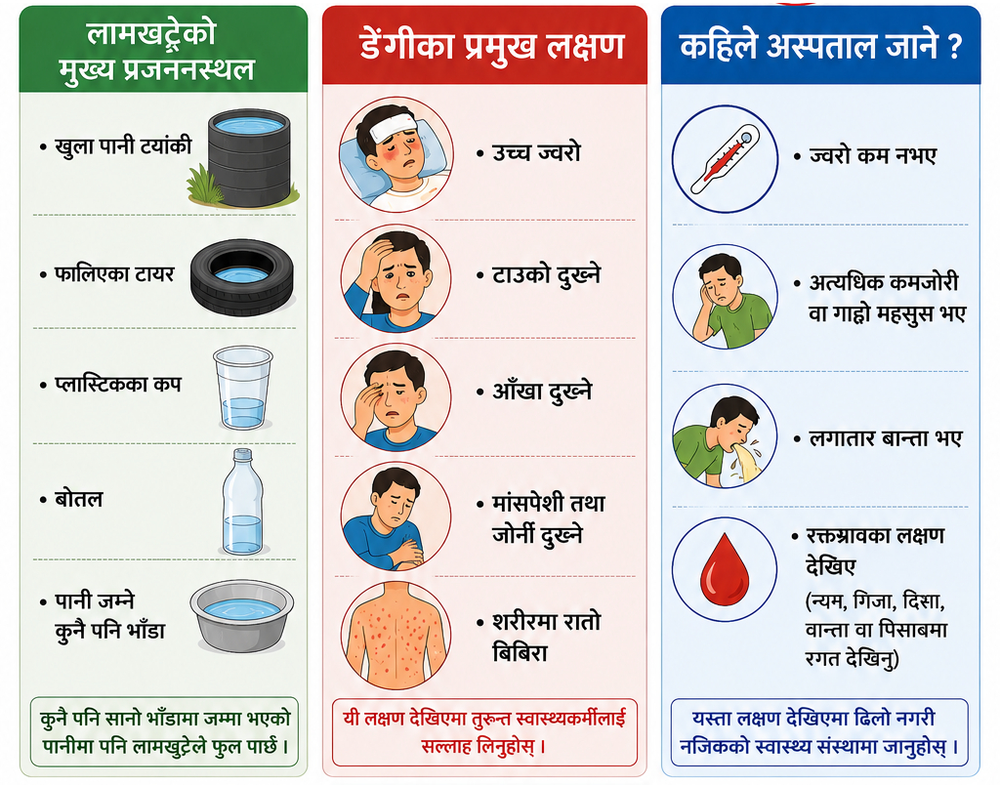
According to doctors, dengue-transmitting mosquitoes breed in clean, stagnant water and bite during the day. Open water tanks, discarded plastic cups, bottles, and tires are the main breeding sites for mosquitoes. Dengue infection causes symptoms ranging from mild to high fever, severe muscle pain, red rashes on the body, intense headache, and eye pain. Most infected people show only mild symptoms, which do not require special treatment and can recover at home by taking paracetamol. However, if the fever does not subside and the patient feels very unwell, doctors advise going to the hospital immediately.
Although there is no specific medicine for dengue, timely identification of infection and proper treatment can significantly reduce the risk of death.
Dengue infection was first confirmed in Nepal in 2004 in a foreign national in Chitwan. Since then, the number of dengue cases has continued to rise, with large outbreaks occurring from time to time. In 2022, at least 88 people died from dengue and more than 54,000 were infected. Hospitals in the Kathmandu Valley were filled with dengue patients, and there was even a shortage of paracetamol and other medicines.
In 2023, at least 20 people died from dengue and more than 52,000 were infected. That year, the infection spread to all 77 districts.