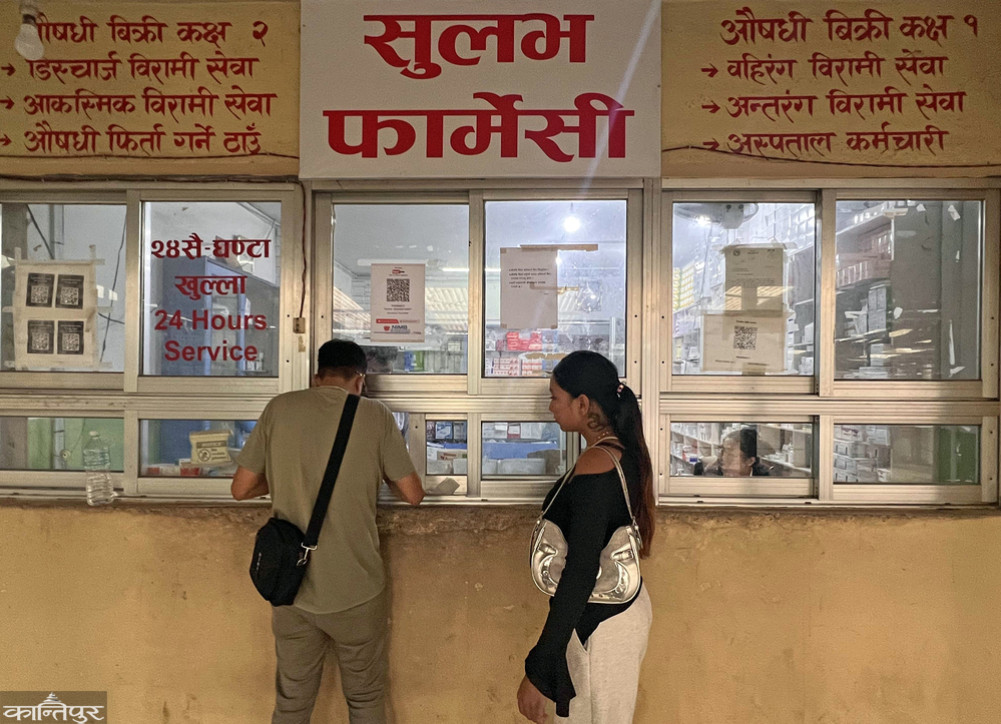
A new 'Affordable Pharmacy' signboard was hung at the old subsidized hospital pharmacy, according to hospitals that have been operating the system of selling medicines at subsidized prices for years.
We use Google Cloud Translation Services. Google requires we provide the following disclaimer relating to use of this service:
This service may contain translations powered by Google. Google disclaims all warranties related to the translations, expressed or implied, including any warranties of accuracy, reliability, and any implied warranties of merchantability, fitness for a particular purpose, and noninfringement.
The Paropkar Maternity and Gynecology Hospital in Thapathali has been operating a subsidized pharmacy (drug store) for years, from where the hospital administration has been selling medicines at prices lower than the maximum retail price (MRP). Where patients and other service recipients who come to the hospital for treatment get an average discount of about 40 percent when buying medicines.
Like Thapathali Hospital, many government hospitals including Bir Hospital, National Trauma Center, Kanti Children's Hospital, Manmohan Cardiothoracic Vascular and Transplant Center, Shahid Gangalal National Heart Center and others have been selling medicines at subsidized prices through such drug stores for years.
We are still selling medicines at the same price we were selling them at a year ago. The signboard of Sulabh Pharmacy was put up just a day ago. However, while making public the achievements of the first 100 days of her tenure, Minister for Health and Food Security Nisha Mehta has claimed that a new 'accessible pharmacy' has been opened for the same subsidized drug stores that were already operating. The day before Minister Mehta made the 100-day achievement public, she had asked all hospitals to put up signboards of ‘Sulabh Pharmacy’ on their already operating drug stores.
‘Neither new medicines have been purchased, nor has the price of any medicine been reduced,’ said a pharmacist at the National Trauma Center on condition of anonymity. ‘We are still selling medicines at the same price we were selling them at a year ago. The signboard of Sulabh Pharmacy was put up just a day ago.’ Pharmacists and health workers at Bir Hospital and Thapathali Hospital declined to comment as they were instructed not to talk to the media.
Since thousands of patients come from all over the country for treatment every day, government hospitals in the Valley require large quantities of medicines. According to officials, the price of medicines is determined based on the purchase cost. Suppliers, manufacturers and distributors compete for contracts by offering prices lower than the MRP as the medicines are supplied in large quantities.
‘The hospital asks for quotations for the medicines required for the coming fiscal year and there is competition among suppliers to win the contract,’ said an official of Bir Hospital, ‘The medicines being sold now were purchased at the beginning of the current fiscal year. The prices may remain the same, decrease or increase according to the new contract in the coming fiscal year.’
Former director of Thapathali Hospital Dr. Jageshwor Gautam said that the hospital had started operating a subsidized pharmacy eight years ago as per the government’s directive.
We do not know why a new signboard was placed in the old pharmacy. But our pharmacy has been selling medicines at a price lower than the MRP for years. According to a pharmacist at Thapathali Hospital, 1 gram of paracetamol injection, whose maximum retail price (MRP) is Rs 713, is being sold for Rs 394. Ceftriaxone injection of 500 milligrams with an MRP of Rs 90 is available for Rs 39. Similarly, calcium carbonate and vitamin D-3 tablet strips with an MRP of Rs 90 are available for Rs 24. Sinus nasal drops with an MRP of Rs 75 are available for Rs 30. Iron-calcium strips with an MRP of Rs 140 are being sold for Rs 33. Calcium carbonate and vitamin D-3 tablet strips from an Indian company with an MRP of Rs 94.50 are available for Rs 97. Tranexamic acid, which is used to control bleeding, is being sold for Rs 40 in hospital pharmacies despite its MRP of Rs 110. Meropenem injection with an MRP of Rs 550 is available for only Rs 316.
‘We don’t know why the new signboard was put up in the old pharmacy,’ said a hospital official, ‘but our pharmacy has been selling medicines at a price lower than the MRP for years.’
After the Supreme Court in 2074 BS directed the government to establish a subsidized pharmacy in every government hospital and ban the operation of private pharmacies within the hospital premises, most government hospitals have been operating their own pharmacies. Earlier, government hospitals had been renting out hospital pharmacies at high prices. The hospital also charged the patients for the expensive rent of the pharmacy. The Supreme Court’s decision was taken to check fraud by charging expensive medicines to patients who come from far and wide to government hospitals seeking concessions.
Meanwhile, officials from the Health Ministry say that the ‘Sulabh Pharmacy’ signboard is put up to inform patients that medicines are available at hospital pharmacies at prices lower than the MRP. ‘Many patients are not aware that medicines are available at hospital pharmacies at subsidized prices,’ said Dr. Sameer Kumar Adhikari, joint spokesperson of the ministry. ‘The purpose of the signboard is to inform patients that medicines can be purchased at prices lower than the MRP.’ When asked why Health Minister Mehta included this issue in her 100-day achievement, Adhikari refused to comment.