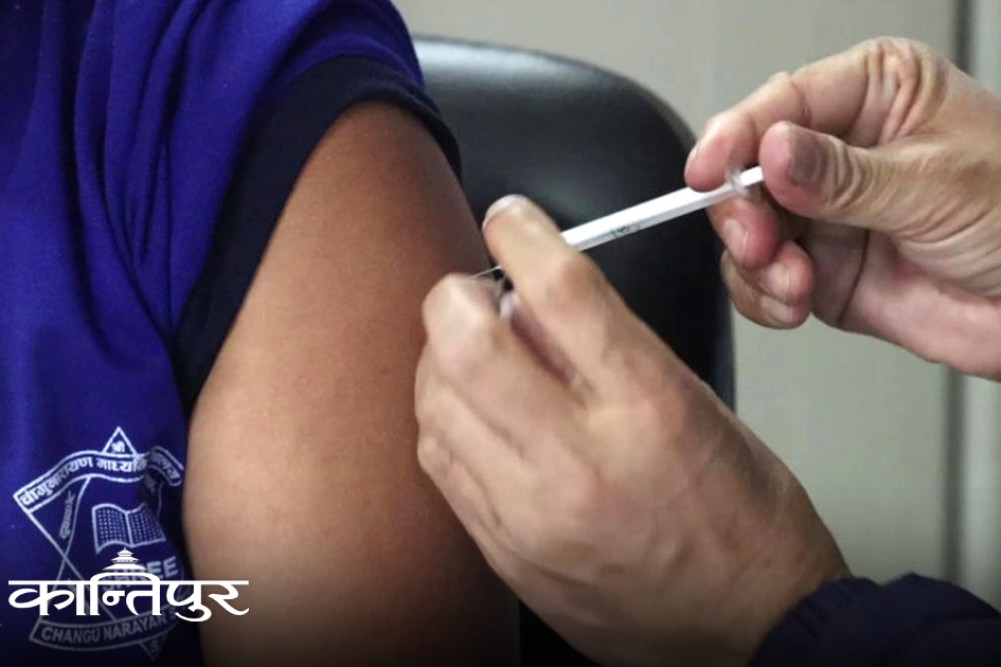
According to last year's data prepared by the Ministry of Health and Food Security, the average rate of children receiving full vaccination in metropolitan cities in the last fiscal year was only 64 percent, while in rural municipalities the rate was 95 percent.
We use Google Cloud Translation Services. Google requires we provide the following disclaimer relating to use of this service:
This service may contain translations powered by Google. Google disclaims all warranties related to the translations, expressed or implied, including any warranties of accuracy, reliability, and any implied warranties of merchantability, fitness for a particular purpose, and noninfringement.
Last month, Health workers deployed from the Dolpa Public Health Office walked for four days to reach Chharka Bhot in Upper Dolpa.
Chharka Bhot is considered one of the highest permanent human settlements in the world, located at an altitude of 4,350 meters above sea level.
The health workers walked for about 14 hours a day from 6 am to 8 pm to reach the place carrying the vaccine to vaccinate against cervical cancer.
'Our health workers reached Chharka Bhot by clearing the thick snow on the roads, crossing the Bhola Parchhung, which is over 5,100 meters high, and the Choila Bhanjyang, which is over 5,000 meters high, to complete the campaign,' said Dr. Abhiyan Gautam, head of the Vaccination Branch of the Family Welfare Division under the Department of Health Services. 'We had no option but to walk. The road was difficult and despite the adverse weather, we vaccinated everyone.'
Residents of remote villages welcomed the vaccination team warmly. They said that due to their support, it has been possible to vaccinate all girls aged 10 or studying in grade 6 with HPV.
In rural areas like the remote Chharka Bhot in Upper Dolpa, the acceptance of the government's free vaccination program under the regular vaccination program is very good. But in big cities, especially metropolitan cities, the interest in government vaccination is much lower than in remote villages.
According to last year's data prepared by the Ministry of Health and Food Security, the average rate of children receiving full vaccination in metropolitan cities in the last fiscal year was only 64 percent, while in rural municipalities, the rate was 95 percent.
'Children living in urban and metropolitan areas are found to be much less likely to receive all the vaccines recommended by the government compared to children in rural municipalities,' the report said.
According to the report, the nationwide full vaccination rate was 96 percent in fiscal year 2080/81, but it had dropped to 92 percent in fiscal year 20810/82.
'Children living in cities or metropolitan areas not getting all the doses of routine vaccinations does not mean that they have not received any vaccinations,' Dr. Gautam said, 'but access to routine vaccinations is much better in rural areas than in big cities and metropolitan areas.'
As child health is a priority program of the government, the government has been providing 14 types of vaccines free of charge against various diseases, including measles-rubella, pneumonia, tuberculosis, diphtheria, whooping cough, tetanus, hepatitis B, rotavirus, Japanese encephalitis, typhoid and cervical cancer, under the routine vaccination program.
'The data collected by the Ministry of Health is based only on official population data for urban areas,' said Dr. Shyamraj Upreti, former Director General of the Department of Health Services and vaccination expert. He said the actual number of children who missed out on routine vaccinations could be much higher than shown in the government report. He said that more people live in cities than the government's data.
According to experts, the temporary resident population, internal and external migration, urban poor, scattered slums, high density of working class and lack of awareness have created major challenges in conducting regular vaccination and other health programs.
They have pointed out the need to prepare microplans by prioritizing high-risk groups when formulating new health programs.
'If access to vaccines continues to be low, the risk of outbreaks of vaccine-preventable diseases in big cities and urban areas increases,' Upreti said, 'The concerned bodies must make microplans to increase access to regular vaccination.'
The regular vaccination program is one of the most successful programs in Nepal. The program is considered to have made a significant contribution to reducing the mortality rate of children under five years of age.
However, the large gap in the rate of receiving full vaccination between urban and rural areas has created challenges in efforts to control vaccine-preventable diseases, say vaccination experts.
Last year, the government declared that the entire country had achieved full vaccination coverage. But government data shows that the number of children who have not received all the doses of the vaccine provided under the routine immunization program is still high.
Since early 2026, measles outbreaks have been observed in various districts of the country, infecting hundreds of children. The main reason for these outbreaks is considered to be poor access to vaccines. According to health officials, most of the infected are from marginalized communities and people who have not been vaccinated in the past.