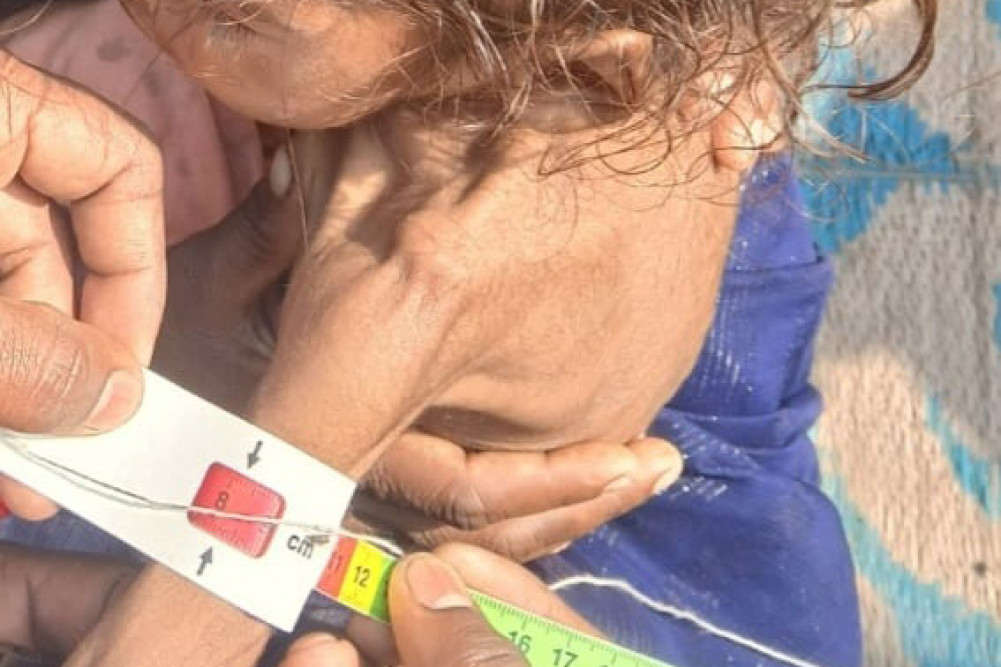
Experts say that persistent price increases, falling incomes, and limited employment opportunities have had a direct impact on household budgets. This may be the reason for the increase in malnutrition.
We use Google Cloud Translation Services. Google requires we provide the following disclaimer relating to use of this service:
This service may contain translations powered by Google. Google disclaims all warranties related to the translations, expressed or implied, including any warranties of accuracy, reliability, and any implied warranties of merchantability, fitness for a particular purpose, and noninfringement.
Narayani Tharu, a 39-month-old son of Narayani Tharu, living in Kusumkhola, Ribdikot Rural Municipality-5, Palpa, weighs 7.8 kg. Narayani took her son to the health post in Kusumkhola for treatment because his weight and height were not appropriate for his age. The health post suspected severe acute malnutrition and referred him to the Nutrition Service Center in Khasyauli. Although the Nutrition Service Center in Khasyauli referred him to the Provincial Hospital in Lumbini, she could not take him. Malati BK, focal person of the Outpatient Nutrition Treatment Center (OTC) of Khasyauli Primary Health Center, said that even though she was referred to the Lumbini Provincial Hospital for treatment under special care, she refused to go citing financial and domestic constraints. An employee of the local health post said that she had come from Bardiya and was waiting for someone else's house in Kusumkhola and could not go to the provincial hospital for her son's treatment due to constraints.
Shivam's story is not unique. A study conducted by the Ministry of Health and Food Security in Jestha on more than 1 million 68 thousand children under the age of 5 from all 77 districts has shown that more than 200,000 children under the age of 5 in Nepal are suffering from severe malnutrition like Shivam.
According to the preliminary report of the National Nutrition Assessment, 9 percent of children aged 6 months to 59 months are stunted. According to the Nepal Demographic and Health Survey (NDHS) 2022 report, 8 percent of children had such a problem in 2021. The study also showed that 26 percent of children were short. Earlier, the NDHS report of 2022 had shown that 25 percent of children under the age of 5 across the country were short for their age.
Lilabikram Thapa, head of the nutrition branch of the Family Welfare Division, said, 'When evaluating all 773 local levels, the nutritional situation is worse than the NDHS report of 2022.' Underweight is considered a complex nutritional condition. Emergency health treatment may be necessary for this. Experts say that the risk of death of children suffering from severe malnutrition is 10 percent higher than that of healthy children. They have warned that the child mortality rate may increase sharply when the problem of underweight is seen in more than 10 percent.
Malnutrition occurs when children do not get enough nutritious food and are susceptible to infections. Even those who do get food lack the necessary protein and nutrition. According to nutritionist Dr. Atul Upadhyay, the presence of underweight in more than 200,000 children is a very dangerous situation. Such children can also die from common diseases like diarrhea.
The rate of underweight among children under 5 years of age is highest in Madhesh Pradesh (13.2 percent). Similarly, it is 10.4 percent in Sudurpaschim. While it was only 5.1 percent here in 2021. Similarly, it is 7.3 percent in Koshi, 7.2 percent in Karnali, 9 percent in Lumbini, 4.8 percent in Gandaki and 4.4 percent in Bagmati.
According to the data, the situation at some local levels looks dire. The highest number of 36.5 percent of children under 5 years of age in Koshi Rural Municipality of Sunsari suffer from underweight. Similarly, 27.1 percent in Haripur Municipality of Sarlahi, 21.8 percent in Rajpur of Rautahat and 21.2 percent in Chakraghatta Rural Municipality of Sarlahi have been found to be underweight. In other affected areas, this problem has been seen in 21 percent of children in Ramgopalpur Municipality of Mahottari, 20.9 percent in Devtal Rural Municipality of Bara, 20.3 percent in Gulariya Municipality of Bardiya, 20 percent in Gujra Municipality of Rautahat, 19.6 percent in Bariyarpatti Rural Municipality of Siraha, and 9.6 percent in Dipayal Siliguri Municipality of Doti.
Like malnutrition, short stature is also a long-term problem. Poor nutrition and frequent infections hinder the physical and mental growth and development of children. The height for age in such children is much lower than the standard average of the World Health Organization. According to the data of the Ministry of Health, Karnali province has the highest number of children in the country, 36.2 percent. While in the NDHS 2022 report, this rate was only 33 percent. Similarly, 31.1 percent of children in Madhesh Province, 30 percent in Lumbini, 25.3 percent in Sudurpaschim and Gandaki Provinces, 24.7 percent in Koshi and 23.7 percent in Bagmati Province have been found to be below the average standard height. According to the
report, 15 percent of children in Karnali Province are severely underweight. Severe malnutrition causes such a serious condition. According to doctors, thinness can be improved by immediate treatment. But the problem of low height is impossible to treat. 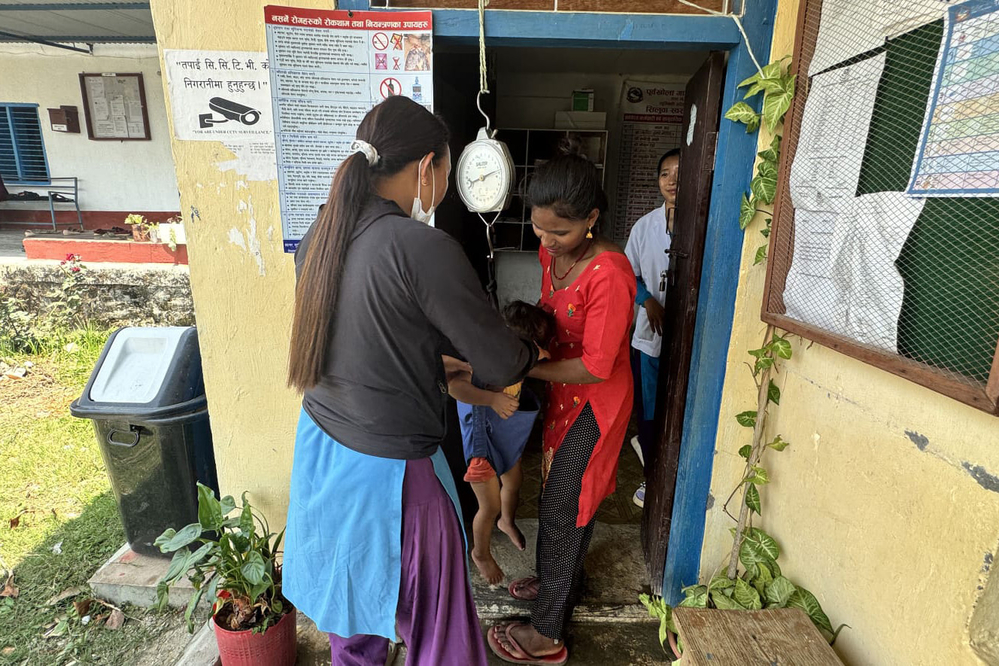
The report shows that the problem of underweight is the highest in Madhesh Province. 24.4 percent in Madhesh, 20.1 percent in Lumbini, 19.4 percent in Karnali, 18.9 percent in Sudurpaschim, 14.5 percent in Koshi, 9.9 percent in Bagmati and 9.8 percent in Gandaki Province are underweight.
Similarly, the report has pointed out that 15 percent of girls and 4 percent of boys are underweight. According to this study, which was categorized by ethnic, regional and religious groups, the highest number of underweight children was found to be 13 percent Muslim children. 12.4 percent of Madhesi and 11 percent of Dalit children are suffering from underweight. Similarly, 7 percent of Janajati and 6 percent of Brahmin/Chhetri children are underweight. This problem is more visible in rural areas than in urban areas.
According to experts, continuous price increases (inflation), falling income and limited employment opportunities have directly affected the household budget. This may be the reason for the increase in malnutrition. According to them, during economic hardship, people first cut down on food and lunch. Some people are even forced to reduce milk and other protein-rich foods.
Similarly, the increasing consumption of junk food (processed and packaged foods and sugary drinks) has further worsened the nutritional status. 'Many factors may be responsible for the deterioration of the nutritional status, said nutritionist Upadhyay, 'Similar problems may be seen in studies of people of other age groups.'
Experts have said that it is necessary to address malnutrition on time as it can seriously affect the physical health, growth and intellectual development of children. According to them, the disruption in mental development limits their productivity in adulthood. It increases the risk of infection with various diseases and ultimately affects the overall progress of the country.'
'Malnutrition is a serious public health problem, which hinders the overall development and progress of the country,' said Dr. Aruna Upreti, 'This is a political issue that has been neglected and ignored for generations. The problem of malnutrition affects not only the current generation but also future generations.'
Nepal also has an international responsibility to improve the nutritional status of children as the country has committed to achieving the Sustainable Development Goals (SDGs). These Sustainable Development Goals aim to end poverty, hunger and all forms of inequality from the world by 2030. To meet the Sustainable Development Goals, Nepal needs to reduce the current 25 percent stunting rate to 15 percent. Similarly, the current 8 percent stunting rate needs to be reduced to 4 percent, the 19 percent underweight rate to 10 percent, and the current 43 percent anemia rate to 10 percent.