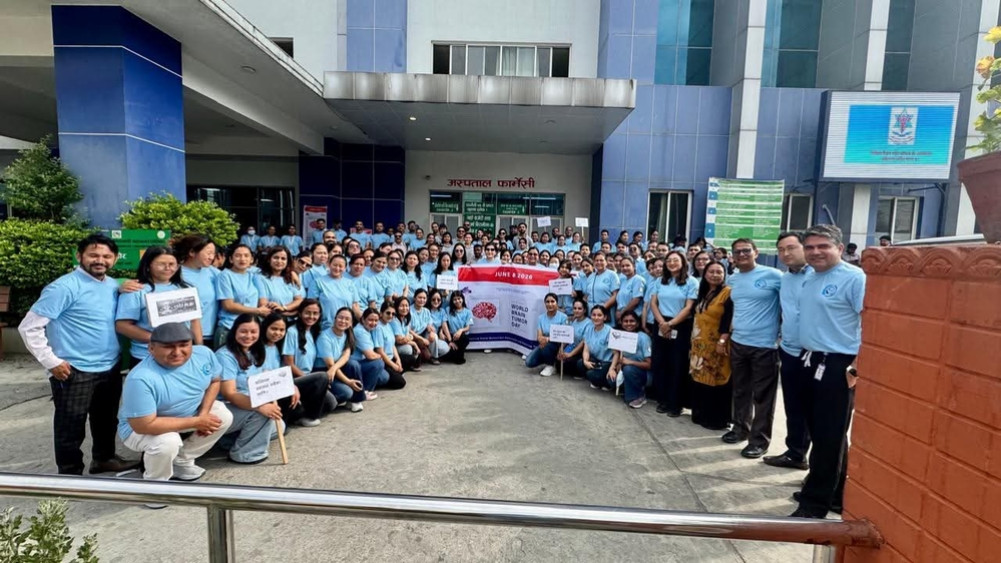
According to the National Brain Tumor Center, the number of patients has increased steadily in the last three years, with an emphasis on early detection and timely treatment.
We use Google Cloud Translation Services. Google requires we provide the following disclaimer relating to use of this service:
This service may contain translations powered by Google. Google disclaims all warranties related to the translations, expressed or implied, including any warranties of accuracy, reliability, and any implied warranties of merchantability, fitness for a particular purpose, and noninfringement.
On the occasion of World Brain Tumor Day, the National Brain Tumor Center (NBTC) has pointed out the need to pay special attention to early detection and timely treatment, saying that the number of brain tumor patients in Nepal is increasing.
According to the data released by the center, which is run by the National Academy of Medical Sciences (NAMS) at Bir Hospital, 2,000 patients with brain tumors sought treatment in 2024, while this number increased to 3,000 in 2025. More than 2,000 patients have reached the center for treatment so far in 2026, indicating that the number of patients is continuously increasing.
According to the center, out of the 3,000 patients who came for treatment in 2025, 1,802 were men and 1,198 were women. The average age of the patients was 42.32 years. The data showed that the highest number of patients were in the age group of 60 to 70 years.
The study also showed that the proportion of complex brain tumors such as high-grade glioma (HGG) is also increasing. The center has stated that the proportion of such tumors, which was 43.9 percent in 2024, has reached 55.1 percent in 2025.
Similarly, meningioma is seen as the main type of brain tumor. Its proportion, which was 37.6 percent in 2024, has reached 51.9 percent in 2025. According to the study, grade-1 meningioma is 71 percent.
The center has concluded that the ratio of male and female patients is almost equal in terms of gender and brain tumors affect both sexes equally. However, the number of patients coming for treatment from Karnali and Sudurpaschim provinces is low, so the need to expand access to services in those areas has been pointed out.
Dr. Rabin Jha, founding chairman of the National Brain Tumor Center, said that the number of brain tumor patients in Nepal is increasing and that early detection and treatment of the disease can save the lives of many patients. “The main message of World Brain Tumor Day is to expand access to early detection and treatment,” he said.
On this occasion, Dr. Chandram Budhathoki has been awarded the ‘Champion of Neuro-Oncology Care 2026’ for his contribution to neuro-oncology services.
The center has also announced plans to expand hybrid operating rooms, radiosurgery, intraoperative tumor fluorescence, and modern neuro-navigation technology to make complex brain tumor treatment more effective.
In addition, it has been announced that all brain tumor surgeries will be free of charge until the end of June, continuing the free brain tumor surgery program that has been operating at Bir Hospital for the past two years. The center has stated that it has continued such a program with the aim of ensuring that no one is deprived of treatment due to financial reasons.