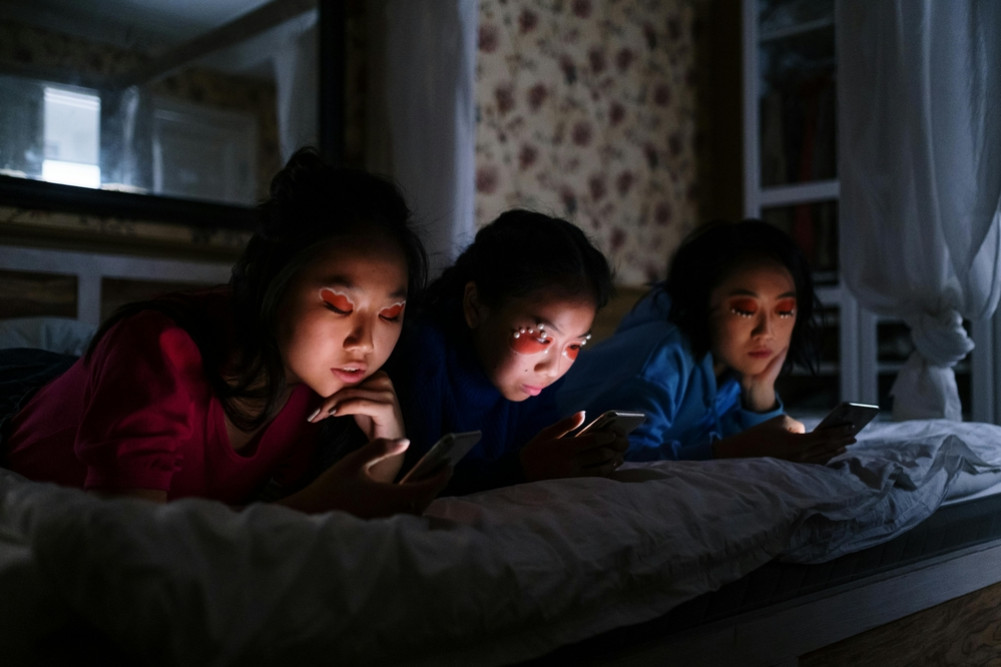
New research shows that using your phone late at night can lead to poor sleep, anxiety, fatigue, and negative effects on behavior.
We use Google Cloud Translation Services. Google requires we provide the following disclaimer relating to use of this service:
This service may contain translations powered by Google. Google disclaims all warranties related to the translations, expressed or implied, including any warranties of accuracy, reliability, and any implied warranties of merchantability, fitness for a particular purpose, and noninfringement.
Adolescence is a time of great need for sleep. However, the habit of being glued to mobile phones is causing teenagers to develop a habit of sleeping late. According to a new study, more than half of teenagers in the United States spend an hour or more on their phones between 10 pm and 6 am. However, the American Academy of Pediatrics and the American Academy of Sleep Medicine recommend that teenagers get 8 to 10 hours of sleep every night.
Jason M. Nagata, an associate professor of pediatrics at the University of California, San Francisco and the study's lead author, said that more than half of the teenagers in the study were using their phones in the middle of the night (12 am to 4 am).
Nagata and his colleagues analyzed data from the Adolescent Brain Cognitive Development Study. The study did not directly link nighttime phone use to poor sleep in teens. But previous research has shown that sleep disruption can have negative effects.
“Adolescents may find it challenging to get enough sleep when they have less sleep, and that has an impact on their morning behavior, which we’ve known for years,” says Dr. Mary A. Carskadon, a professor of psychiatry and human behavior at Brown University.
Not getting enough sleep can affect people in a variety of ways. During adolescence, the brain and body are still developing. That’s why sleep deprivation can lead to developmental problems.
When the body doesn’t get enough rest, it can interfere with memory. It’s harder to process and retain information learned throughout the day.
“Adolescents’ lives are all about learning,” says Carskadon. “Whether it’s schoolwork, sports, or how to interact with other people, there’s a lot to learn during adolescence.”
Poor sleep impairs emotional regulation. In 2013, a sleep study was conducted on a group of healthy adolescents aged 14 to 17. For the first week, they were told to sleep normally. The next week, they were allowed to sleep for just 6.5 hours. The final week, they were allowed to sleep for 10 hours.
Participants reported feeling more anxious, irritable, confused, and tired when they slept less. The adolescents and their parents reported that they were more irritable and had poorer emotional regulation during this period.
“The less sleep teens get, the more they are likely to be irritable,” Carskadon said. “Parents will tell you that this is a common finding.”
For more sensitive young people, sleep deprivation can pose mental health risks. According to Nagata, research has shown that sleep-deprived children are at higher risk of depression and anxiety symptoms. According to Carskadon, sleep deprivation can also lead to suicidal thoughts, self-harm and risky behavior in teens.
Teens are increasingly addicted to social media. It doesn’t appear that the networks are doing enough to stop this. CNN has reached out to YouTube for comment. YouTube has provided a link to its parental control information.
TikTok and Instagram did not respond to CNN's request for comment.
Carskadon said, "People need to reduce their arousal levels around bedtime. But interacting with these apps can increase your arousal and make it harder to fall asleep."
Experts say scrolling through your phone late into the night can delay your bedtime. The flood of notifications, noise, and light from your phone can disrupt your sleep throughout the night. Similarly, checking your phone as soon as you wake up in the morning creates a cycle of checking your phone.
Nagata led a separate analysis using data from the 2023 Adolescent Brain Cognitive Development Study. In the study, 17% of teens said they were woken up at least once a night by a phone call, text message, or email.
Additionally, 20% of teens said they use their phones when they wake up at night.
Nagata said, “Suddenly you see those messages and it can wake you up again, making it hard to fall back asleep.”
Family planning
Nighttime phone use is not something teens can solve alone. According to Nagata and Carskadon, instilling healthy habits starts with parents.
Parents should be role models for the behavior they want their teens to see. Since this is a family issue, it can be difficult to reduce or control the behavior if it is not consistently enforced among members.
Nagata said, “It is important for parents to model healthy screen behavior.” In our study, we found that the main factor in teens’ screen use is actually their parents’ screen use.’
The American Academy of Pediatrics recommends creating a ‘family media plan.’ It guides families in developing healthy screen habits.
Designating ‘screen-free zones’ and time limits is recommended. Parents are urged to set guidelines and set boundaries about how long devices can be used.
It is also recommended to keep phones and other devices out of the bedroom. ‘This is not just a teen problem.’ Carskadon said. ‘It’s a family problem.’