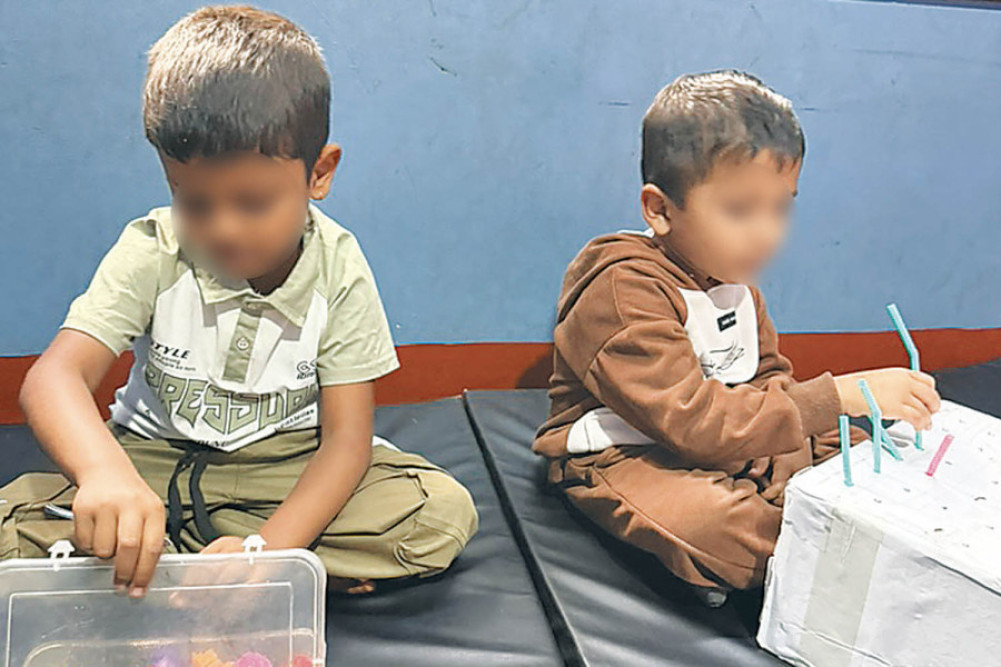
Experts are divided on the autism education model. Some believe that separate schools are necessary, while others have argued that inclusive education should be prioritized.
We use Google Cloud Translation Services. Google requires we provide the following disclaimer relating to use of this service:
This service may contain translations powered by Google. Google disclaims all warranties related to the translations, expressed or implied, including any warranties of accuracy, reliability, and any implied warranties of merchantability, fitness for a particular purpose, and noninfringement.
Shekhar Dhakal of Banasthali, Kathmandu, was diagnosed with autism when his daughter Pihu was less than 2 years old. Even though she was admitted to a regular school, her behavior was different from others. After seeing problems such as preferring to be alone and not wanting to socialize, Dhakal cleared the ground floor of his own house and started teaching his daughter with a teacher. In some time, other parents also started coming to ask for their children to stay. As the children grew up, the house became cramped.
Then, in 2019, he established the 'Nepal Autism School' through personal struggle. Currently, 25 children aged 3 to 12 are studying in the school. He says that 2 teachers take care of a maximum of 5 children. Dhakal said that the classes, which will be conducted from 9 am to 3 pm, will focus on cognitive development, social behavior, language and physical activity. The school provided free services for the first 5 years.
When the number of students reached 60, 25 are currently studying here. He said that due to financial constraints in the operation, the number of students had to be reduced. He said, ‘I am worried about where the rest of the children have gone, and I am always wondering whether they were able to study or not.’ The school uses different methods for children who can speak and those who cannot. In which, non-verbal children learn through exercises like drawing, tracing and matching.
Savita Upreti is also active in bringing about improvements in children with autism through the Special School and Rehabilitation Center. She has experienced situations where schools have even refused to admit children with disabilities. She said that she even rescued a child from Bhaktapur who was locked in a room. She said, ‘That scene shocked me – the child was eating dirty rice.’
After this, Upreti started the school using the money she had saved for her wedding. She had neither sufficient knowledge nor resources. But, she wanted children not to be deprived of education. Currently, 62 children are studying in the center she runs, and 40 teachers, therapists and psychologists are working. Upreti said that Nepal only formally recognized autism as a neurological condition in 2017. She said, ‘Earlier, there was a tendency to understand autism as a mental illness, autism is a spectrum, every child is different.’
Similarly, Sanu Subedi from Dhangadhi came to know late that her son had autism, and now she is the principal of the ‘National Autism Care Center Society Nepal’. Where 17 children are studying, she said that although most of the services are free, there is a lack of resources. She said, ‘The biggest challenge is teaching them basic skills of daily life, it is very difficult to raise them.’
The government has announced the establishment of model schools for children with autism in all seven provinces. The announcement was made in a program coordinated by the Ministry of Education on the occasion of World Autism Awareness Day (April 2) to open one autism-targeted school in each province. After the announcement, the ministry said that it has formed a six-member technical committee to study the school operation and service structure and has moved forward with the work. According to the ministry’s Deputy Secretary, Bir Bahadur Dhami, a team of experts is conducting the study under the coordination of Roshan Shrestha, Deputy Director General of the Department of Urban Development and Building Construction. However, even before the government announcement was translated into practice, parents of children with autism have been running schools on their own initiative.
There are differences of opinion among experts regarding the autism education model. Some believe that separate schools are necessary, while others have been saying that inclusive education should be given priority.
Devidatta Acharya, President of the National Federation of the Disabled Nepal, said that the government's plan to establish a model school is welcome. He believes that inclusive education should be emphasized over separate schools. He said, 'The Constitution and the law prioritize inclusive education over segregation.'
According to educationist Meenakshi Dahal, it is not appropriate to make a policy focusing only on autism. She said that a comprehensive policy is needed that includes other disabilities, including Down syndrome. She said, 'Along with education, more effective measures should be taken to make therapy services affordable, easy and accessible.'