We use Google Cloud Translation Services. Google requires we provide the following disclaimer relating to use of this service:
This service may contain translations powered by Google. Google disclaims all warranties related to the translations, expressed or implied, including any warranties of accuracy, reliability, and any implied warranties of merchantability, fitness for a particular purpose, and noninfringement.
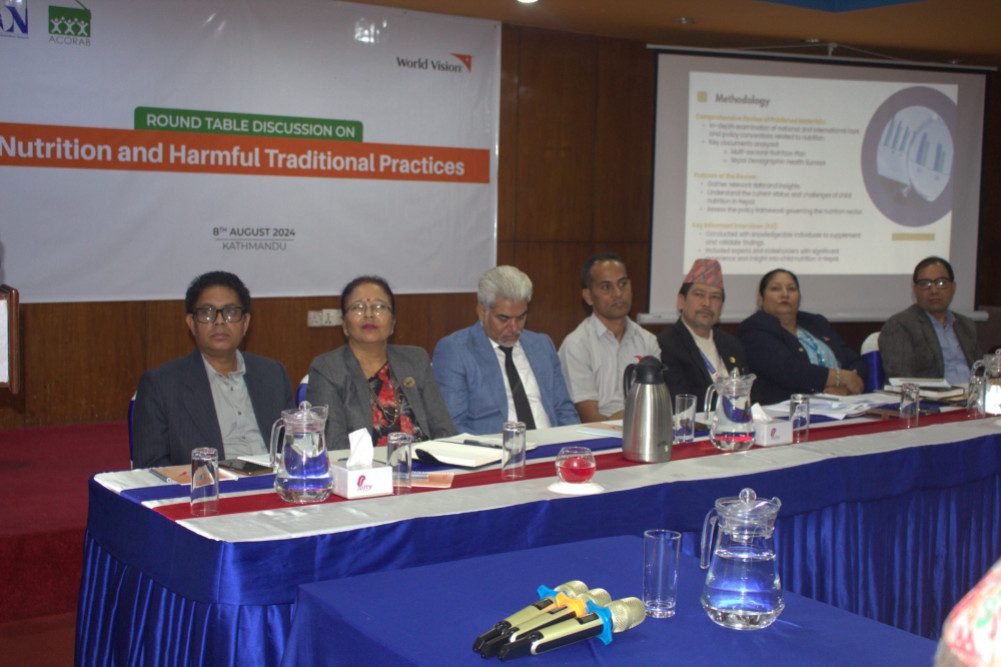
Stakeholders have pointed out that government initiatives are not enough to end malnutrition among children. Kamala Parajuli, chairperson of the National Commission for Women, said that government initiatives for child nutrition are weak.
Now working women are not forced to breastfeed. Instead of organizing it, the government is creating wrong comments,' she said, 'The government should provide enough facilities and leave so that working women can breastfeed properly.'
On Thursday, in an event organized by the Community Radio Broadcasters Association in Kathmandu under the Enough Campaign to End Malnutrition, Commission Chairperson Parajuli said that there should be a government policy to establish a baby care center in the office for the children of working mothers.
Saying that the government should take more planned initiatives for all aspects related to nutrition, she said that the proliferation of ready-made food is another important issue even in the area where Raithane crops are produced.
He said that emphasis should be placed on local food for children's nutrition. Samim Mian Ansari, Chairman of the National Muslim Commission, emphasized that the government should introduce a program to ensure nutritious food targeting the children of the poor, marginalized and backward communities, including the Dalit, Muslim and Madhesi communities.
He said that when junk food is accessible to everyone in the market, the government should make a special plan to promote nutritious food. Spokesperson of the Ministry of Health and Population Dr. Prakash Budhathoki suggested that children should be fed millet, phapar, junelo, vegetables, fruits and other local varieties of Raithane crops instead of market prepared food.
He said that the increase in the number of mothers who do not want to breastfeed even for 6 months has also increased malnutrition. According to the Nepal Population Survey, 25 percent of children aged 6 to 59 months are stunted, 8 percent are stunted, 19 percent are underweight, and 43 percent are anemic.
researcher Dipesh Ghimire said that according to studies, the effect of junk food i.e. prepared food in Nepal is more visible in villages than in cities. He expressed his concern that although the constitution and law provide for nutritious food, in practice, the practice of ready-made food is becoming dominant.
The Deputy Secretary of the Ministry of Federal Affairs and General Administration, Reshammalal Kandel, said that even though governmental and non-governmental efforts are continuing in the field of nutrition, there is a lack of coordination. Kandel says that although the nutrition policy has been released rapidly, the implementation situation is disappointing.