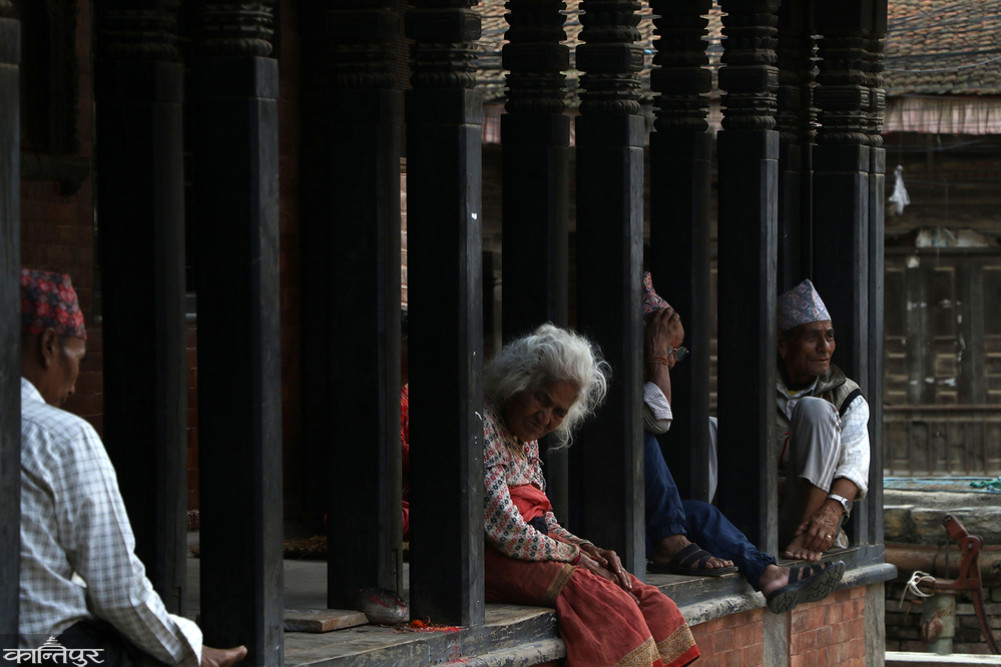
Although the feeling of loneliness has increased among parents at home due to their children being abroad, mobile phones, video calls, and social media have brought some relief to parents' daily lives.
We use Google Cloud Translation Services. Google requires we provide the following disclaimer relating to use of this service:
This service may contain translations powered by Google. Google disclaims all warranties related to the translations, expressed or implied, including any warranties of accuracy, reliability, and any implied warranties of merchantability, fitness for a particular purpose, and noninfringement.
Kamalnath Dahal from Sindhupalchowk Melamchi lives in a room in Chabahil, Kathmandu. His daily life is no different from that of an ordinary Nepali, morning prayers, cooking, reading books, listening to the news and sometimes meeting friends.
He is alone in this room after his wife died some time ago. His two sons, daughter-in-law and three-year-old granddaughter are in Japan. No matter how the day goes, in the evening he looks forward to one thing - a video call with his children in Japan. The smiles on his mobile screen and conversations with his children make him forget his loneliness for a while.
He also works a job. He tries to keep himself busy. 'That job is a way to forget my mind,' he said.
Kamalnath says that even though they talk on the phone every day, it doesn't feel like they are together at home. ‘We talk a lot on the phone. We know all the news. But the joy of sitting with family in Nepal and eating in the same kitchen, no matter what, cannot be compared to a video call,’ he said in a soft voice.
Parents always miss their children. When I see everyone's family gathered during festivals, I think how good it would have been if my sons were with me when I was alone - Kamal Nath Dahal He says that he misses his children the most during festivals. ‘Parents always miss their children. But especially when I see everyone’s family gathered during festivals, I feel how good it would have been if my sons were with me when I was alone,’ he said. However, he says that technology has made life easier. He thinks that mobile phones have done a great job as a means of connecting distant families. ‘Mobile phones have become like God to us. It brings distant people closer, it makes them talk to their sons, daughters-in-law and granddaughters,' he said, 'If you use it in a good way, you can see the world in it.'
His granddaughter is now 3 years old. He takes special care to ensure that his granddaughter, who was born in Japan, does not forget the Nepali language and words of kinship. As soon as his granddaughter appears on the screen during a video call, his first sentence is, 'Nani ba bhon ta'. The granddaughter eagerly says 'ba'.
Kamal Nath is happy. Similarly, he keeps teaching her to pronounce other words. ‘I have taught my granddaughter to say ‘ba’, ‘ama’, ‘kaka’, ‘kaaki’ over the phone,’ he says with a smile, ‘I want children not to forget their country and language no matter what.’ He said that his sons have invited him to visit Japan many times, but he has not been able to go yet. He said that he is thinking of visiting once. He says that he hopes that one day the family will return to Nepal with skills, experience and capital from abroad. ‘Abroad is a place to learn, not a place to stay forever,’ he said, ‘learn to work hard there, earn money, gain experience.’ But I have told my sons that they should invest in their own country, open industries in Nepal, create jobs, and build the country.’ Kamal Nath is now meeting his son and daughter-in-law daily on the mobile screen. But his wait is still the same. ‘May the sons return to Nepal forever, may the day come when we can eat together in the same kitchen again.’
000
Pokhara There are photos plastered all over the walls of a room on the first floor of a two-story house in a small alley in Ratnachowk. Everyone is in the photos, parents, daughters, sons-in-law, grandchildren. 69-year-old Saraswati Maharjan was sitting on a low bed in the room, using her mobile phone. She has two daughters. The eldest daughter has been in Japan for 13 years, while the younger one has reached Janakpur after marriage. ‘Even in Nepal, it would be difficult to meet up after having a job, children, and being far away. When the eldest daughter came to Nepal from Japan, the younger one also came,’ she said, ‘Even being in Nepal, it’s like being abroad. She hasn’t come since.’
Saraswati's husband was a safe in a hotel in Pokhara until a few years ago. He was hit by pressure during work. After that, both daughters came to take care of their father while he was hospitalized for 3 months, Maharjan said. After some time, they separated. Now, her husband can get up and walk around the house, but he can't speak. 'Earlier, the two of us would spend time chatting. Sometimes, we would go out for a walk during fairs and festivals,' she said. 'That's not the case now. He hasn't spoken yet. I'm waiting to see when we'll be able to talk,' she said.
She says that even though her daughters are far away, she finds it easy to talk to them on mobile. 'It's not like my daughters are far away. We talk every day in the morning and evening as soon as we have time,' she said. 'After talking on video calls, you can see everything they're doing.' We feel safe. Saraswati said that she created a group chat on Messenger to communicate with her daughters and everyone often talks on video calls. Saraswati also said that she misses her children a lot during festivals. ‘The most difficult times are Dashain, Tihar, and Teej. When a daughter comes to everyone’s house, her house is empty. It is heartbreaking at that time,’ she said. However, she understands the reason why her daughters went abroad well. ‘If they had stayed in Nepal, they would not have had good jobs. Inflation has increased. They stayed there instead of what they expected. They did not see everything in the same way, their future is also important,’ she said.
Maharjan understands that the current generation goes abroad with the idea of getting better opportunities than in Nepal. ‘We did not leave Nepal and go anywhere. We didn't study much, so we didn't want to go abroad,' she said, 'but we educated our children with struggle. They studied, and after they got wings, they had to fly. They had to see the world.'
Saraswati says that she spent her days cooking, eating, looking at her mobile phone, talking to her daughters on the phone in her free time, and giving her husband medicine on time. 'Earlier, she would weave sweaters and garlands.' Now, she can't even see much,' she said, 'I have to take care of my husband.' She said that her daughters also said that we should see why they had to suffer, so she stopped weaving sweaters,' she said. Saraswati says that she used to want her eldest daughter to return to Nepal and live with her family.
000
Foreign employment and loneliness in old age have become a common story for Nepali families. Technology has reduced the distance, but the warmth of a hug is thousands of kilometers away. Hari and Meena Gurung (name changed) from Tokha, Kathmandu have also experienced a similar experience. Hari, 64, and Meena, 61, have been living alone for 9 years. They have two daughters. One daughter went to Australia to study 9 years ago and is still there. The other daughter went to Australia in 2012 and returned to Nepal two years ago and got married.
Hari says that even though he had initially thought of sending his children to study abroad, he now wants them to stay in Nepal. ‘Back then, studying abroad was good. Our children too were excited and happy to study abroad and do better than others,’ he said. ‘After completing their studies and understanding the lifestyle there, they feel like settling down and forgetting their own country. That makes me feel a little sad.’
After their daughters went abroad one after another, Meena and Hari are spending their days reminiscing about the past. ‘First, the daughters were right in front of our eyes. There was a different kind of fun at home. One after another, they went abroad. Now the house is empty,’ they said. They wish that those who went abroad to study would have learned skills there and returned to Nepal to work in their professions and businesses.
Hari and Meena’s daily lives are mostly spent at home. They walk for one to one and a half hours in the morning and go to the gym. After coming home and having lunch, they read newspapers. After that, they spend their time doing housework, raising chickens and gardening. Hari says that they talk to their daughters on the phone whenever they have time. ‘I have a mobile phone and it is convenient to talk on the phone at any time. They make calls and leave voice messages and messages. We feel safe after that,' he said.
Hari says he talks to his daughters on video calls twice a day. 'The elder daughter talks on the way to and from work. We talk to the younger daughter in Nepal in the morning,' he said.
Hari told his wife Meena that she has a knee problem. That's why she can't walk much. 'Time is spent doing puja, cleaning the house,' she said. 'As soon as the daughters have free time, they call. The day has passed like that, talking on the phone, meeting relatives.'
Mina says that the most missing moments for her children are festivals and when they are sick. 'Now, one of her daughters has come to Nepal and things have become a little easier.' "Before, when we were the only ones, we thought that if we got sick at once, our children would be with us," she said. "Once, when we were both in bed for acupuncture, we had a heated discussion about how if we had daughters, they would have taken care of us."
But they say that their relatives have been very supportive. "Since our family is large, our brothers' children, sisters-in-law and nieces help us when we are in trouble," she said.
Their daughter, who is abroad, is a software engineer. Her daughter, who is now in Nepal, is a staff nurse. Having been abroad twice, they say that it is only good for traveling abroad. "I don't like to stay abroad for a long time." Children go to work,' she said, 'It is difficult for the elderly to stay at home, it is difficult to travel by public transport and it is not always possible for children to take them around, so it is difficult to stay for more than three months.' Experts say that as the number of Nepalis going abroad for studies, employment and permanent migration increases, the number of parents living alone in Nepal is also increasing.
Not all parents have the same view of their children living abroad.
Dr. Samjhana Dhakal, 63, of Kupandol, Lalitpur, has a son. He has been in Scotland for the past few years. She accepts her son's stay abroad as a matter of course.
Samjhana says that the distance is not particularly uncomfortable as they communicate every day. ‘I talk to my children, grandchildren every day. We have regular video calls in the morning and evening, exchange messages,’ she said, ‘I know their daily activities, they know about me. Technology has made the world smaller now. That’s why it hasn’t been particularly difficult.’
She says that during festivals, Samjhana sometimes goes abroad and sometimes her sons come to Nepal. ‘Sometimes I go there and celebrate Dashain and Tihar together, and they also come to Nepal once a year. So it’s only physical distance, there’s never been a sense of distance in the relationship,’ she said.
Even though she went to study in the early days, Samjhana said that when she got a good opportunity, she started doing the same thing. ‘They have made careers through their own hard work. Sometimes I wish they had been together,’ she said, ‘but as a parent, I didn’t just be selfish because they needed my support.’ I don't want to make decisions that will affect their future. The progress of their children is the greatest happiness of parents.' Her son is an economist, while her daughter-in-law is a computer engineer. Samjhana herself says that she easily understood her son's decision because she lived abroad for years during her studies.
'I lived in India for years while studying MBBS, and later went to America for higher studies,' she said. 'After marriage, I left my husband and young son and went to India for 4 years to study. At that time, my husband, mother and family made a lot of sacrifices. Today, I am repeating the same sacrifices for my children.'
She says that she spends her time every morning walking, in the afternoon reading books, watching the news, and talking to friends and family on the phone. 'Social media has also maintained relationships with old friends. My friends from medical school are now in countries such as the UK, America, Australia and others. But we are in regular contact,' she said, 'As people get older, they realize the importance of companionship and communication more. In that sense, technology has made our generation much easier.'