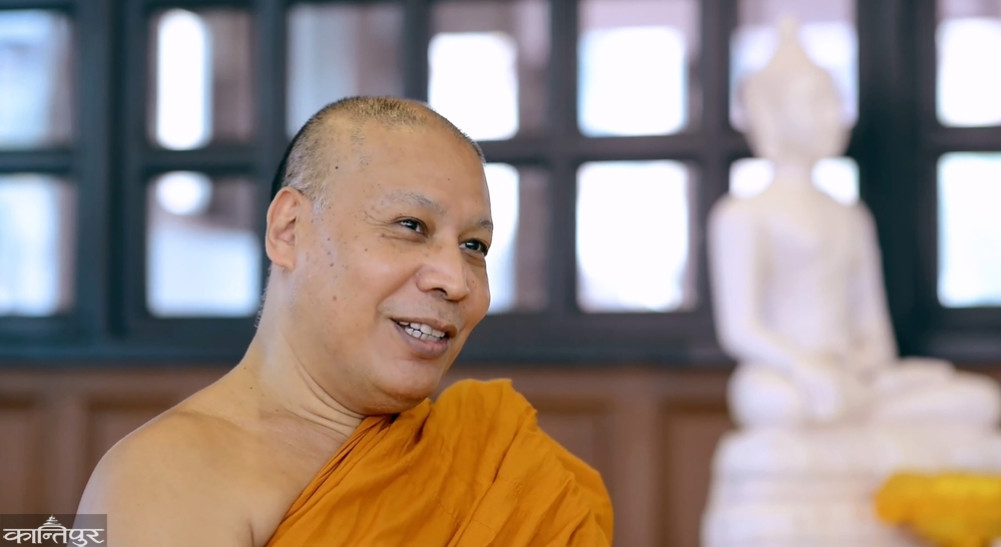
Sugandha, also known as Anilman Shakya, a monk who has been in prison in the guise of a monk, has earned a PhD in social anthropology from Brunel University in the UK. He studied on a scholarship from the Thai king and is considered one of the rare individuals to reach the highest positions in the Buddhist order there.
We use Google Cloud Translation Services. Google requires we provide the following disclaimer relating to use of this service:
This service may contain translations powered by Google. Google disclaims all warranties related to the translations, expressed or implied, including any warranties of accuracy, reliability, and any implied warranties of merchantability, fitness for a particular purpose, and noninfringement.
Anilman Shakya, 66, a follower of peace, compassion and friendship, is considered an expert on Buddhism, Sangha and Guna. Seeing him wearing a yellow robe (chibar), everyone thinks he is just a monk. However, his identity is not limited to this. He has completed his doctorate in monk's attire and teaches. He is a visiting professor at universities including Oxford in the UK and Santa Clara in the US.
Although born in Nepal, he is a renowned writer, lecturer and researcher of Theravada Buddhism living in Thailand. The monk's name is Sugandha. He is adorned with the religious title of Phra Brahma Shakyavansh Vishuddhi Shahi in Thailand. He is known as a respected and distinguished monk in Thailand. The opportunity to go to Thailand became a turning point in his life when he became a monk at the age of 14. Initially, his brother Dr. Keshavman Shakya was selected for Thailand. However, after Keshavman topped the SLC board, he got a chance to study in India on a scholarship. Then the door to Thailand opened for Anil. Diligent, curious and studious, he got a chance to work in the Thai Sangha at the beginning.
In the process, he grew close to the Thai Sangha King/Upasangha King. As he worked with humility, he started working as the assistant secretary of the Sangha King. Then his height suddenly increased. He is now a lecturer in Theravada Buddhism. He works as a sustainable development think tank under the United Nations. He is the first foreign citizen to reach the highest level of the Thai Sangha. He is the third in rank after the head of the Thai Sangha, the Sangha King and the Upasangha King. He went to Thailand in 1975 at the age of 15 and has been there for 51 years. Monk Sugandha teaches prisoners in Thai prisons how to be rehabilitated in society. In 1972, the Viceroy of Thailand, Yan Sangar, came to Bangladesh to understand the impact of floods on Buddhists. On his way back from there, he visited Nepal. In Nepal, he met Monk Amritananda. According to Anilman, the Viceroy asked Monk Amritananda, "I have heard that the place where Buddha was born and raised is not in a good condition for Buddhism, education, and preaching, and what can I do to help?" During the meeting, the Viceroy said, “Thailand is grateful to Nepal and that Thailand has been established as a country of progress and progress by following the teachings of Buddha, a follower of peace born in the Nepali climate and soil, and that Thailand is rising high on the world stage due to the grace of Buddhism and Nepal’s generosity.” 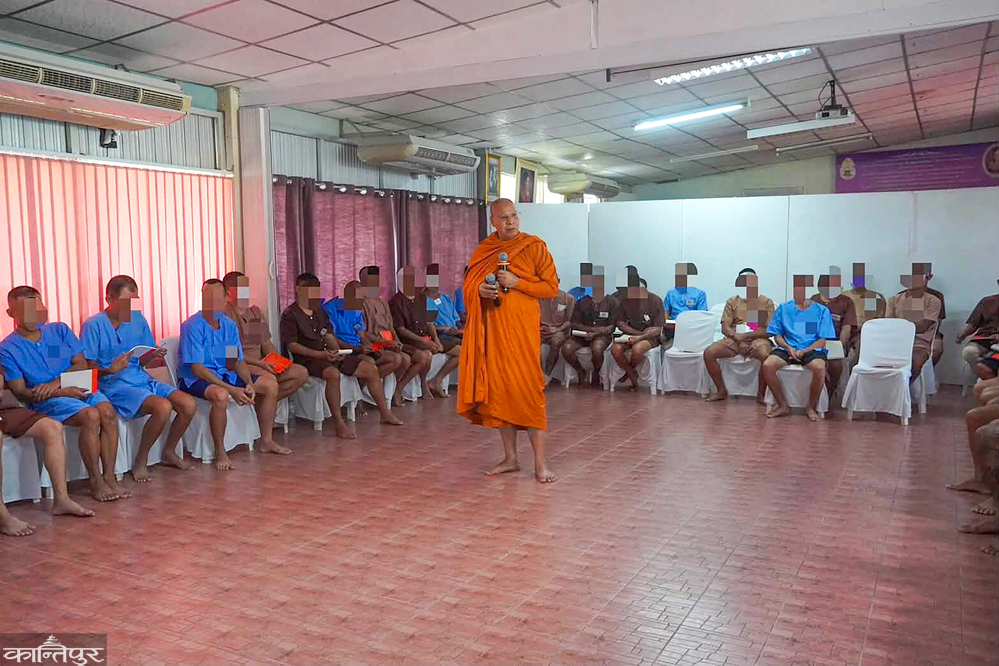 “Can I help you in this!” he asked Bhikkhu Amritananda. At that time, Anilman told this reporter that Bhikkhu Amritananda had said two things. “First, he requested that a Thai religious envoy be sent to Nepal to spread Buddhist teachings in the villages and second, he requested that some Nepali youth be taken to Thailand to impart Buddhism, education, and knowledge,” he said. The Viceroy promised to fulfill the second demand immediately, while the first demand would be taken to the Thai Sangha.
“After that, I was selected as the person to go from Nepal to Thailand,” Anilman said. After nine months of training in Nepal, three Nepalese went to Thailand with Anil. Anil was kept by the Viceroy, King Yan Sangar, with him. King Yan Sangar was the royal tutor of the Thai King Bhumibol Adulyadej. One of the two who went with Anil got married and settled in Thailand. The other returned to Nepal. The guru always kept the obedient and obedient Anil close. The king, the crown prince, the crown princess, the prime minister and the minister regularly visited the monastery. Anil caught everyone's attention when he met him frequently.
Excellent in studies
Anilman graduated from the Mahamukuta Buddhist University in Bihar in 1980. In the same year, the 19th Supreme Patriarch of Thailand, the late Phra Somdet Nyana Sambhar, became a full monk by taking the sub-property. Then, when he wanted to return to Nepal, the Guru did not allow him. ‘I was made the assistant secretary of my own monastery. That increased all-round contact and coordination,’ Anilman said. He worked there for 10 years. Anil was a disciple of Sudarshan, a renowned monk in Nepal. He had motivated Anil to study archaeology. The studious Anil was allowed to go abroad for further studies by the Thai Rajguru. He received a scholarship to study archaeology in Calcutta, India under the Colombo Plan. He went to visit the university. However, his desire to study archaeology did not come true because the living environment for monks was not good and excavations were not allowed under the Vinaya rules.
When he applied to 10 universities in America and 5 in Britain for studies, everyone responded positively. At first, the Guru said he would not let him go. After persuading him, the Guru agreed to give him a scholarship. He sent information to the royal palace that he would not stay at the secretariat of the monastery as he was going to study. ‘However, after receiving the order not to go there, I was worried,’ said monk Anilman, ‘I again pleaded with the royal palace through my guru. Then, I sent a request to the palace from one guru and another from myself for permission to study. The palace called and inquired. Thus, King Bhumibol Adulyadej agreed to provide a full scholarship.’
The king himself sent him to Cambridge University in the UK on a royal scholarship. He left the monastery and studied at Cambridge and passed his Masters of Philosophy (MPhil). Before that, he had come to Nepal from Thailand and completed his master’s degree in anthropology from Tribhuvan University. He did his Ph.D. in social anthropology from Brunel University in the UK. After becoming a profile of intellectual personality, knowledge, skills and abilities, Anilman was offered to teach in America. However, in 2000, to repay the king's kindness, he returned to Thailand. Using the knowledge, education and skills he learned abroad, he started teaching in Thailand. After that, his fame grew even more. 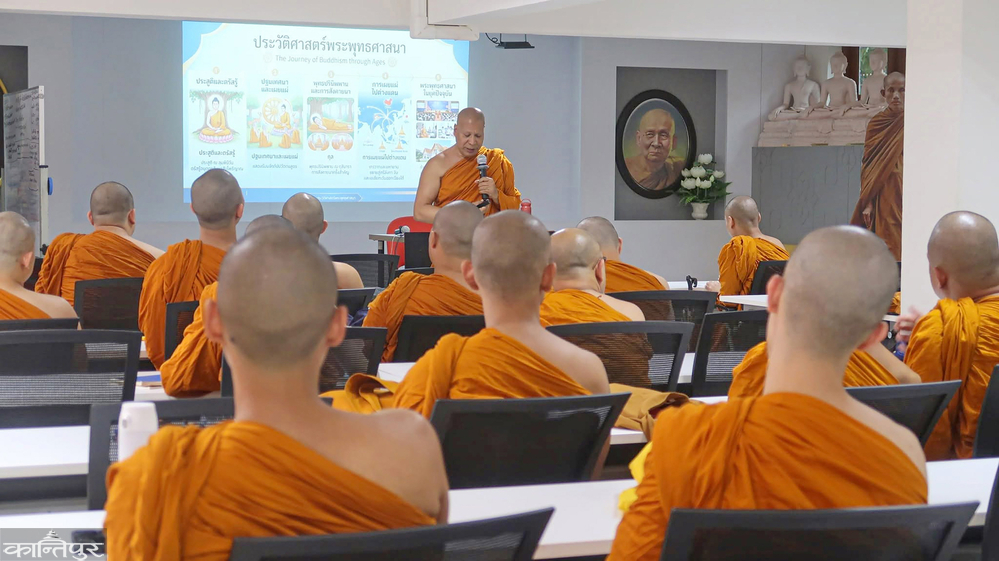
Currently, monk Animan Shakya teaches at Thailand's famous Chulalongkorn and Mahidol Universities. He is an advisor to the Mahamukta and World Buddhist University of Thailand. He is a visiting professor not only in Buddhist philosophy and education but also in humanities, economics and law. He teaches as a visiting professor at Santa Clara and California in the US and Oxford University in the UK two to four times a year. He teaches undergraduate students one year in the US and the next year in the UK. He occasionally takes classes for judges in Thailand. He also occasionally teaches at the staff college for government employees in Thailand. He teaches high-ranking officials working in decision-making positions in Thailand. He has taught 1,500 business CEOs in San Diego, USA. He continues to go to universities in Sri Lanka and Myanmar for thesis examinations.
High-ranking monk
Anilman also worked as the deputy rector of Thailand's Mahamukhu University and the rector of the World Buddhist University. After retiring at the age of 60, he joined the secretariat of the Thai Buddhist Association, the highest body in Thailand. He was assigned the responsibility of administrative work. Now, Anilman has become the first foreigner to reach the highest level of the Thai Association. He is third in rank after the Chief Sangha Raja and the Deputy Sangha Raja of the Thai Association. There are more than 40,000 monasteries in Thailand. The association is responsible for bringing them under the legal framework, making policies and regulations. After working for four years in the secretariat of the monk association, he has now become an advisor. He is currently working as the head of eight zonal regions in the north under the Thai association.
‘Foreigners’ access to the executive level of the Thai association is a difficult issue,’ said monk Anilman. ‘I was able to reach the highest level of the association due to my knowledge, honesty, passion and goodwill towards Nepal.’ He has recently received a high medal like the Dharma Chakra in Sao Sema, Thailand. Her Majesty Queen Mahachakri Sirindhorn presented him with the medal. This is a prestigious honor awarded by the Department of Religious Affairs under the Ministry of Culture of Thailand. He has received many such medals, decorations and honors.
He was a key supporter of the crime prevention, prison reform plan and life-enhancing project of the 47-year-old Thai Princess Bajrakitiyava, who passed away on June 11. At the request of the Thai Princess, he has developed a new concept called Cognitive Transformation Therapy for prison inmates. He brought a new concept related to mental processes for knowledge and understanding. 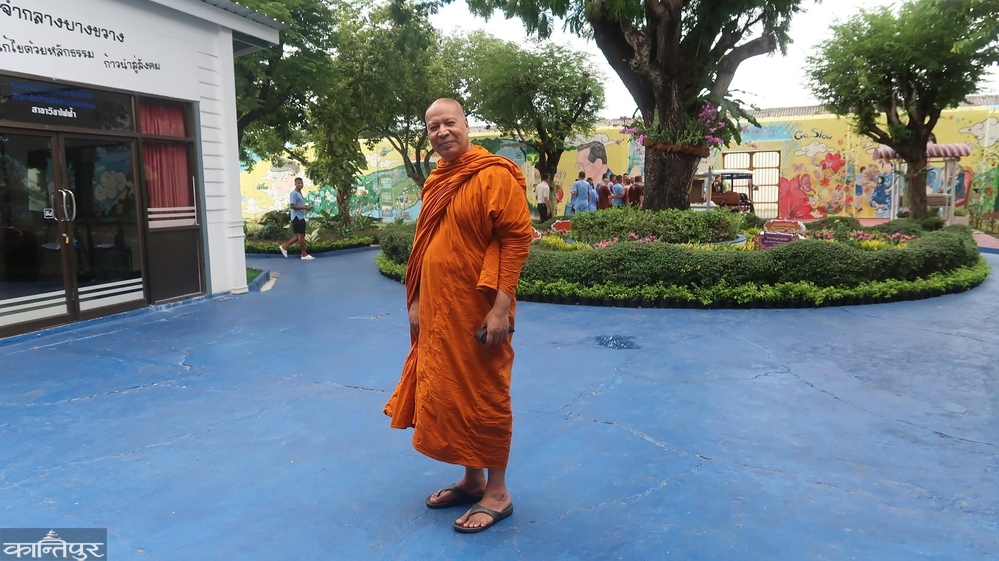
There are prisoners from all over the world in Thailand. A counseling plan targeting only one place will not be successful. That is why a counseling plan was created with diversity. In that, a program was also created targeting those who have been sentenced to death and have committed heinous crimes. They take classes on how to live and how to improve themselves and return to normal society. Thai prisons are under the Ministry of Law. The ministry coordinates the transportation of them to prison and counseling. He provides counseling inside the prison from 9 am to 3 pm one day a week. He provides counseling once a month for foreign female prisoners in the central prison and once a week for prisoners sentenced to death and those who have committed cruel and heinous crimes.
‘It was risky and scary to reach the prisoners’ beds,’ he said, ‘but I dared to go there.’ He also managed to motivate the sixth most wanted serious killer in Canada.’ He also regularly goes to Rayong Central Prison, a high-security prison with more than 7,000 prisoners, for cognitive transformation therapy. For more than 20 years, he has been featured on BBC Thailand for his good work in making the lives of prisoners in various prisons easier, changing their thinking, and helping them integrate into society after being released. Anilman said that his work gained global attention after a BBC team from the UK came to the UK in 2020 and broadcast a report for television and radio. ‘According to a study conducted in Thailand, one-third of people released from prison are involved in crime within three years,’ he said. ‘I have found that nine out of 10 people I have taught have not had to go back to prison.’
Deputy Head of Royal Monastery
He is the Deputy Head (Assistant Head) of Royal Wat Wawonibet Monastery in Bangkok. The prestigious Royal Monastery is considered important for the monarchy. The king and crown prince receive Buddhist education and training there. They regularly visit to serve the monks there. Most Sangha kings also become from here. Anilman said that a park was built in Thailand to commemorate Lumbini because the Thais have high faith and respect for Lumbini and feel proud to touch the soil of Lumbini.
‘This is also the largest park in Bangkok . Thais believe that they can accumulate wonderful spiritual energy in Lumbini,’ he said, ‘that is why they seem eager to come to Lumbini . It is believed that visiting Lumbini will bring religious merit . They are dying to come to Lumbini for the feeling of compassion, friendship and brotherhood .’ According to him, many people in Thailand want to touch the soil of Lumbini and Kapilvastu .
At a time when unrest and conflict are increasing in the world, they want to come to Lumbini and pray for world peace . They believe that if they can reach the four Buddhist pilgrimage sites of Lumbini, Sarnath, Bouddhavya and Kushinagar, they will gain merit and be happy . In Thailand, which has a three-month monsoon season, it is customary to give employees four months of paid leave . It is customary for Thai citizens to become monks for at least 15 days once in their lives .
It is a matter of pride for a Nepali citizen to be noticed by the Thai Association and to study on the king's scholarship and reach a respected and prestigious position in Thailand, said Bhikkhu Maitri Mahasthaveer, spiritual advisor to the Lumbini Development Fund. 'While working closely with the late King Bhumibol Adulyadej, I have a good acquaintance with his son and current King Vajiralongkorn,' he said, 'Due to Anil's loyalty and dedication, he is working as an advisor to the king in an unannounced manner.' He receives great honors from the Thai government every year. 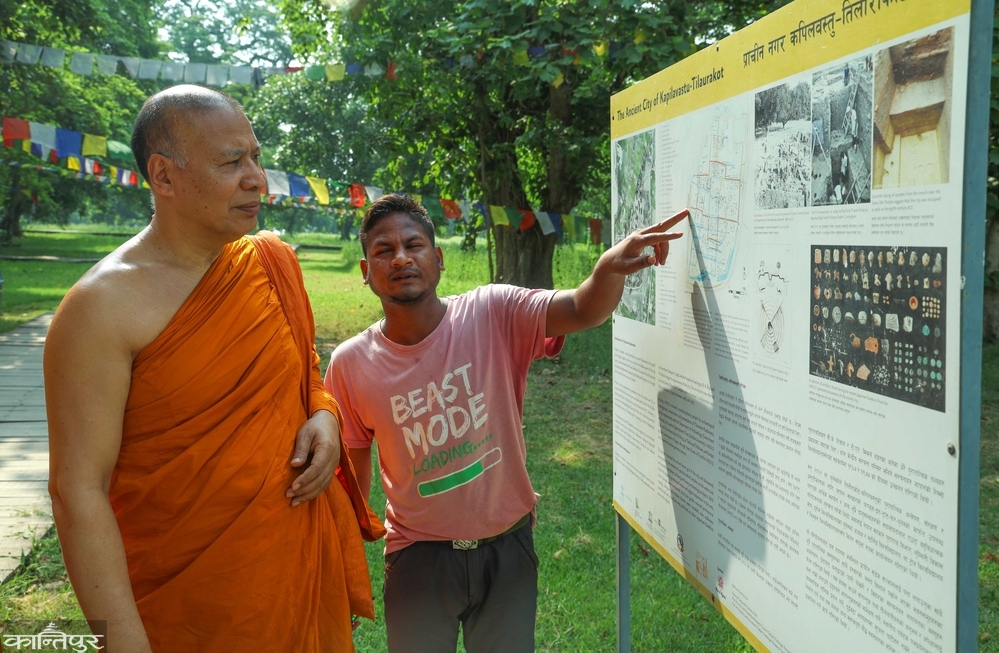
It is a matter of great honor and pride for Nepalis to have Sugandha, i.e. Anilman, work as a religious preacher (religious advisor) to the Thai royal family,' said Bhikkhu Siri Wajir, associate professor at Lumbini Buddhist University. ‘He reaches out to preach the great Dhamma that is known all over the world,’ he said, ‘This broadens the chest of Nepal and Nepalis.’
Different opinions on the inscription
He said that he is an anthropologist and has done a lot of research on human sciences, so he has different opinions on the inscription on the Ashoka Pillar in Lumbini. He claimed that the inscription is being misinterpreted due to different transformations. He said that foreigners have interpreted it with their own perspective. He said that they have interpreted it in terms of Vedic religion. He said that the problem arose when the Buddhist or Ashokan perspective was not interpreted. He said that the last word of the fourth line of the five-line Ashoka inscription, ‘Uvalikekete’, and the only word of the fifth line, ‘Athbhagiyecha’, are being misinterpreted.
Monk Sugandha with the Thai royal family.
Scholars have mentioned that since Shakyamuni was born here, the Bali (tax) of Lumbini village was reduced to only one-eighth . ‘This translation does not match,’ he said, ‘Vali means worship in Pali language . In Sanskrit and Hindu religion, Vali means tax or Vali (killing).’ He said that what he meant was negative and that not taking tax and then taking one-eighth part would not make sense . ‘How did the matter of taking it again come about after saying not to take it ?,’ he said, ‘Nowhere in the Ashoka Pillars found throughout India is there any mention of tax . How did this matter come about only in Nepal ?’ 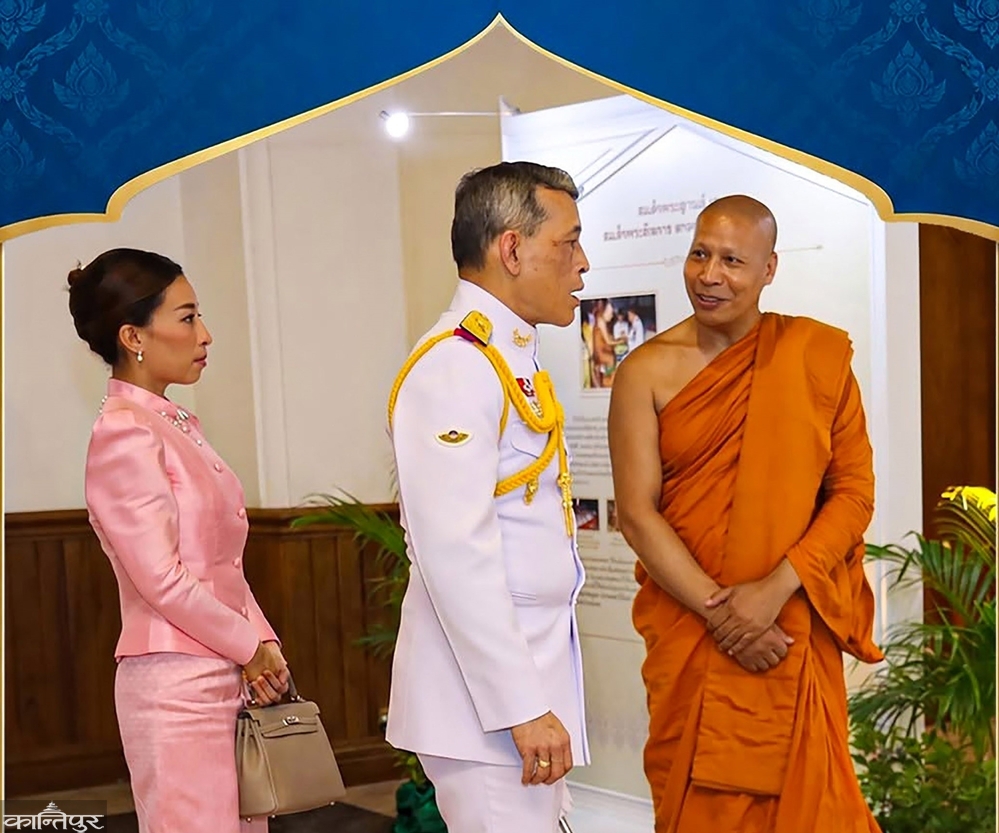 Ashoka has mentioned in his records that religion, fighting and quarreling should not be done . ‘How was the matter of tax explained in the records related to the Buddha in Lumbini?’ he said, ‘This context does not fit. There must be another meaning. Uvalikekete means do not give alms (worship) and the other word athabhagyecha means follow the Arya Ashtangik Marga.’ The Arya Ashtangik Marga is the original mantra of Lord Buddha. Even though this is the matter of tax, he said that the eighth part is not mentioned anywhere in the scriptures and books. ‘First, there was a custom of giving alms in Lumbini,’ he said, ‘that is why the record was kept saying do not give alms. On the other hand, it is not appropriate for followers of peace to talk about taxes in the place where Buddha was born.’
He said that experts, scholars and religious leaders should be brought to an international conference, draw conclusions and correct them methodically. If we can change the old stereotypes, the history of Ashoka will change. Emperor Ashoka did not mention the name of Buddha in any of the pillars he built in India. He mentioned peace, compassion, friendship and brotherhood. However, the pillar in Lumbini only says to follow the Arya Ashtangik Marga. ‘The Arya Ashtangik Marga is the main mantra of Lord Buddha. If this can be realized, the status of Nepal will change,’ he said.
Global speaker
He is a sustainable development think tank of the United Nations (UN). When Ban Ki-moon was the Secretary-General, he went to the UN General Assembly and gave his views and opinions. Not only as a monk but also as a scholar, he travels to various countries to address programs such as UNESCO, UN SCAP and UN OHCHR. He has presented his speeches, statements and working papers at the OMEP World Conference, Baisakh Day, and various regional and international forums.
His interviews, biographies, articles and writings have been published in many media and social media platforms, including the Australian Broadcasting Corporation, Financial Times, Bangkok Post Online, Radio Thailand World Service, StudyBuddhism.com and Thai Airways.