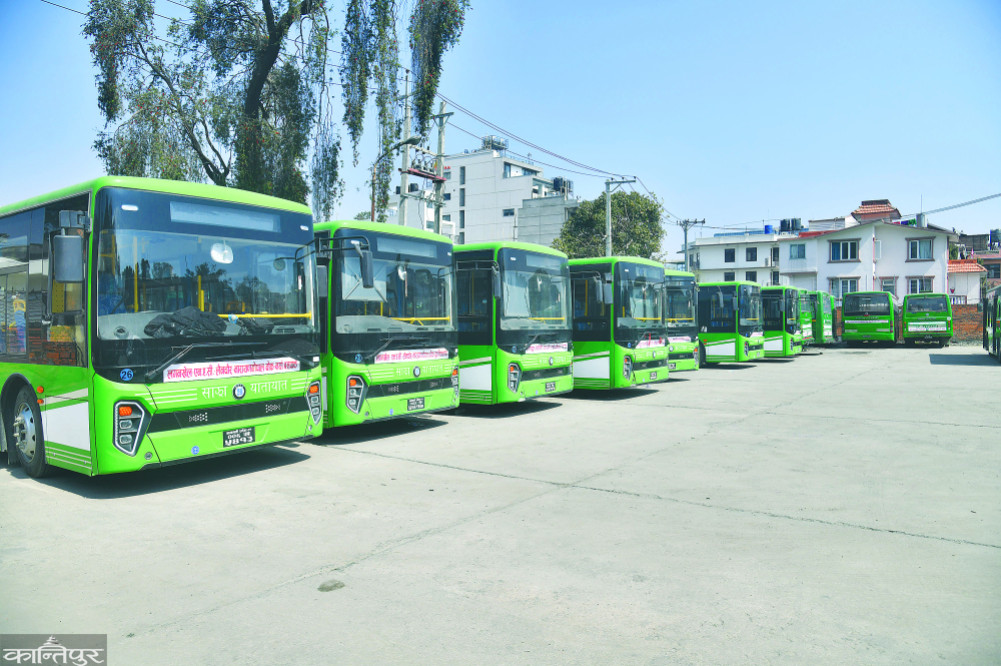
The government's concept paper on the 'Blue Bus' service, which is said to further institutionalize gender discrimination and is also deemed impractical, has sparked intense debate.
We use Google Cloud Translation Services. Google requires we provide the following disclaimer relating to use of this service:
This service may contain translations powered by Google. Google disclaims all warranties related to the translations, expressed or implied, including any warranties of accuracy, reliability, and any implied warranties of merchantability, fitness for a particular purpose, and noninfringement.
The government has announced the operation of the ‘Blue Bus’ service with the aim of ensuring safe travel for women. Following the government’s announcement, there has been an intense public debate regarding the concept and operational modality of the ‘Blue Bus’. The government included the ‘Blue Bus’ service in its 100-point governance reform action plan, which was made public on Chaitra 13, 2082 BS. According to this plan, the target is to operate at least 25 buses within the first 100 days. Presenting the budget for the upcoming fiscal year in the Federal Parliament on Jestha 15, Finance Minister Swarnim Wagle announced that the ‘Blue Bus’ service equipped with CCTV cameras would be operated for women.
In line with this announcement, the government is preparing to launch some ‘Blue Buses’ (blue buses) through Sajha Yatayat in the first phase. The government’s plan is to expand women-friendly services with female drivers, female conductors, CCTV cameras, GPS tracking, and an emergency assistance system. Accordingly, a budget of 45 million rupees has been allocated for the operation of the ‘Blue Bus’.
As the government prepares to operate the ‘Blue Bus’, questions have arisen as to why Sajha’s green color is being changed to blue. Debate has started both for and against the government’s concept, with some arguing that the ‘Blue Bus’ will further institutionalize gender discrimination and is not practical.
Some are protesting that the existing green Sajha buses are being converted to blue, while others argue that prioritizing color change would be a misuse of state resources and property. Similarly, rights activists have raised questions about the effectiveness, sustainability, and management of the service, arguing that simply operating separate buses will not make public transport safe for women. The issue has also gained significant traction on social media.
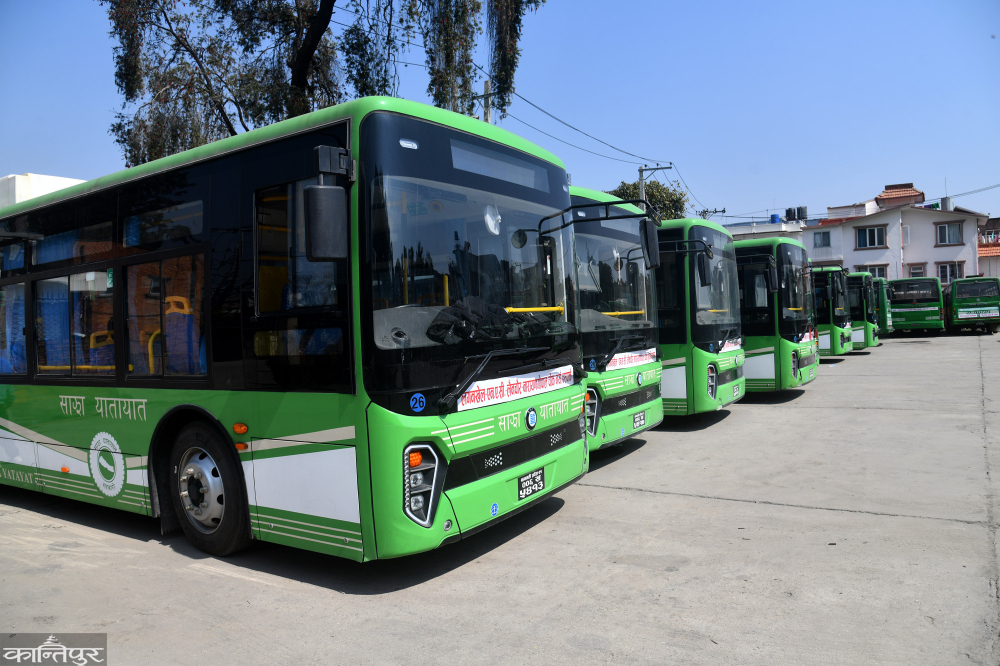
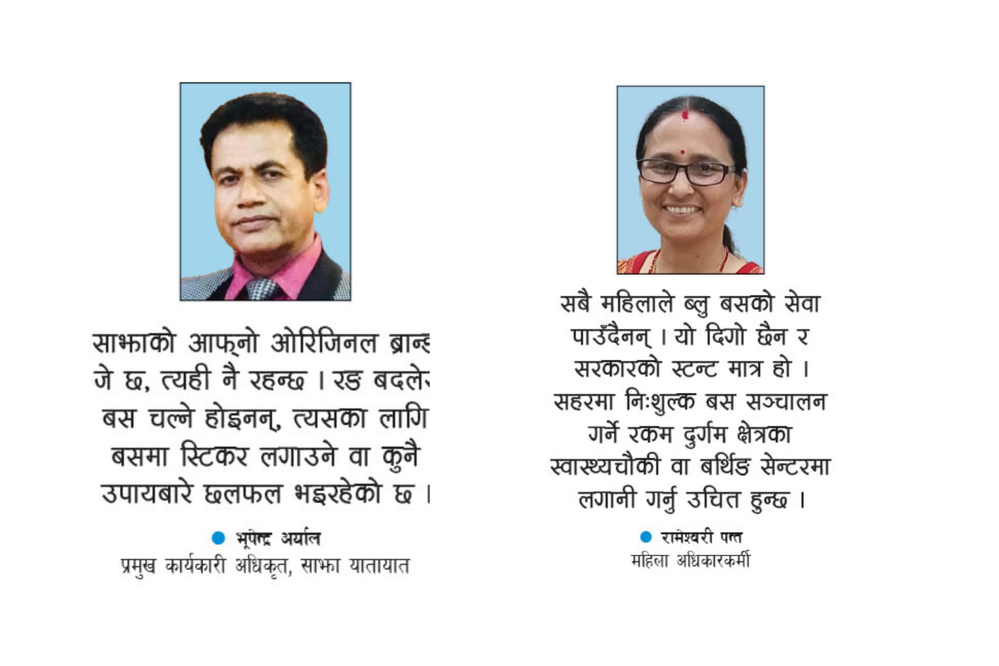
Bhupendra Aryal, Chief Executive Officer of Sajha Yatayat, stated that, contrary to what is being discussed on social media, there is no plan to simply paint the buses blue. He said, “There are all sorts of rumors circulating. Sajha’s original brand will remain as it is. Buses will not run just by changing the color; we are discussing options such as putting stickers on the buses.” According to him, although it was said that the service would start from Shrawan 1, the exact date and number of buses have not yet been finalized.
He said that the daily operating cost of an electric bus is about 10,000 to 12,000 rupees, and that about 30 million rupees would be spent for eight buses. He informed that a few buses will be operated as a pilot. According to Aryal, Sajha is preparing to operate its 26-seater electric buses as ‘Blue Buses’. The routes for the ‘Blue Bus’ service have already been determined. Accordingly, two electric buses will run from Budhanilkantha to Lagankhel–Godavari, two from Nagdhunga to the airport, and four on the Ring Road (Chakrapath). Of the four buses on the Ring Road, two will run on the Koteshwor–Gaushala–Kalanki route and two on the Koteshwor–Satdobato–Kalanki route.
Ram Hari Pokharel, spokesperson for the Ministry of Infrastructure Development, said that although Sajha will operate the buses under the government’s budget, a final budget decision has not yet been made. “Sajha will operate the buses at the government’s expense. However, the Ministry of Finance has not yet approved the budget. Once the budget is approved, operations will move forward,” he said. “Since purchasing new buses would require both time and money, the government will bear Sajha’s operating costs and provide free service to women through these buses.”
The concept of the ‘Blue Bus’ was first introduced targeting women by Rastriya Swatantra Party (RSP) President Rabi Lamichhane. The service was launched in Shrawan 2080 BS to mark the completion of his first 100 days as a Member of the House of Representatives from Chitwan-2. Operated in Bharatpur and Narayangadh via Kalika Municipality, the service was free for women.
The service was named ‘Blue Bus’ because it was operated using blue-colored buses. Lamichhane himself inaugurated the service by riding the bus, but it was discontinued after about one and a half months. At that time, issues related to passenger numbers, operating costs, and management were observed. After the service was discontinued, questions were raised about its effectiveness. Now, with the RSP holding a two-thirds majority in government, the plan is being advanced as a government initiative.
Women’s rights activists and politicians claim that the ‘Blue Bus’ concept will further institutionalize gender discrimination in society. Rights activist Rameshwari Pant said that although the government’s plan appears positive at first glance, it is politically motivated. “There won’t be buses for all women. Not all women will have access to the Blue Bus service. From this perspective, it does not seem practical,” she said. “This is not sustainable and is just a government stunt.” She suggested that instead of providing free rides for women, the fare money should be invested in health posts or birthing centers in remote areas.
Nepali Congress MP Reena Upreti said that, at a time when there is ongoing debate about women and equality, providing separate buses for women in the name of security is not practical. “If a woman is accompanied by her son, where will she board? Will they have to ride separately?” she asked. “Even if Blue Buses are operated, why should the government run them? It is wrong to operate government buses in the name of a party.” She said the government has pushed this forward based on rumors rather than making a long-term solution plan. Saroj Sitoula, president of the National Federation of Transport Entrepreneurs, said the government’s plan is not practical. He said there are practical difficulties in providing separate bus services for targeted groups. He added, “Blue Buses for women, maybe White for senior citizens, Yellow for children—if it becomes too popular, will there be a different bus for every person?”
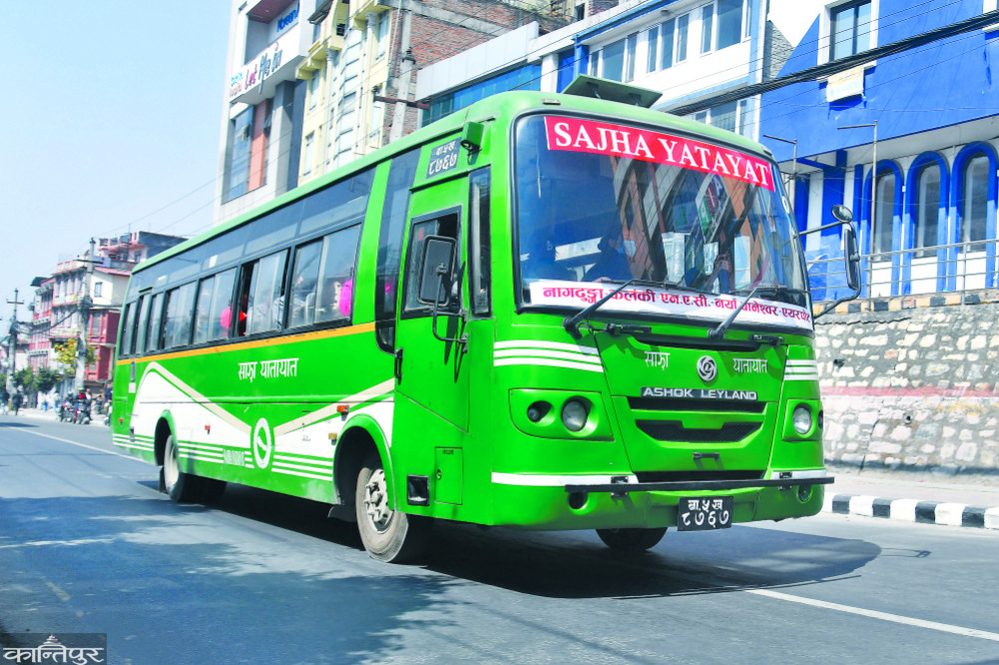
“Ride Sajha, reach safely.” The history of buses aimed at providing safe travel for women, in line with Sajha Yatayat’s slogan, is six decades old. Sajha was established as a cooperative on Magh 28, 2018 BS, and began service in the Kathmandu Valley with six buses from Shrawan 1, 2019 BS. Influenced by Israel’s cooperative system, then-King Mahendra Shah initiated the concept of operating public transport under a cooperative model, and the service was launched under the leadership of Education Minister Bishwabandhu Thapa.
According to Sajha Yatayat Chair Kanak Mani Dixit, Sajha Yatayat is not a profit-oriented institution but a campaign established to provide quality service to citizens. Although there is now talk of Sajha becoming the ‘Blue Bus’, Sajha buses were originally green. Sajha was closed for a period in 2026 BS. After that, in 2037/38 BS, Sajha imported Japanese Mitsubishi buses. In 2050/51 BS, 35 Tata Deluxe buses were brought in with Japanese grant assistance, and these were blue in color.
At that time, Sajha operated as a daytime service in almost all cities, including Biratnagar, Birgunj, Jaleshwar, Janakpur, Malangwa, Nepalgunj, Bhairahawa, Palpa, Baglung, Waling, Pokhara, and Tandi. However, from 2023 to 2061 BS, Sajha did not hold a general assembly. After restructuring, Sajha has been operating regularly. Over the course of its operation, Sajha buses have experienced many ups and downs.
Sajha was shut down on Mangsir 15, 2058 BS following a Cabinet decision. After employees and shareholders filed a writ in court, the court overturned the government’s decision on Magh 15, 2059 BS, paving the way for the institution to resume operations. After the government’s decision was overturned, Sajha resumed operations from Baisakh 1, 2060 BS. Following the court order, employees and offices were reinstated. At that time, there were only 728 permanent employees. All employees were let go with benefits by the end of Ashoj 2068 BS.
“Not only due to irregularities by drivers and conductors, but also because the government added buses received from Japan to Sajha’s debt, increased government ownership, and turned the institution into a political recruitment center, Sajha Yatayat ended up shutting down,” said Dixit. From 2070 BS, Sajha buses were reintroduced in green color in coordination with Kathmandu Metropolitan City, with an environment-friendly concept.
In recent years, Sajha Yatayat has been promoting electric buses. In the first phase, three electric buses were imported from China in Chaitra 2078 BS. After testing these buses for road conditions, gradients, and other technical aspects, they were put into regular passenger service from Asar 23, 2079 BS. Currently, Nepal’s largest electric bus charging center is in operation at Sajha Yatayat’s office premises in Pulchowk, with 14 charging ports that can charge a large number of electric buses simultaneously. As a public service provider, Sajha Yatayat has received investment from the Government of Nepal, Kathmandu Metropolitan City, Lalitpur Metropolitan City, and various local governments in the Kathmandu Valley. The government has provided Sajha with a grant of 3 billion rupees.
Currently, Sajha Yatayat has 111 buses, of which 40 are electric and 71 run on diesel. Between 30,000 and 35,000 passengers use Sajha Yatayat’s services daily. According to Aryal, not all buses are operational at all times due to accidents or engine overheating. He said, “About 10 percent break down or are involved in accidents, but 35 electric buses run regularly every day.” On the proposal of Kathmandu Metropolitan City, free travel is provided within the valley on Sajha buses for senior citizens aged 70 and above, children under 5, and persons with ‘A’ and ‘B’ category disability ID cards. Sajha currently operates on eight routes within the valley. Outside the valley, it operates in Baglung and Chitwan.
In recent years, the government has adopted a policy of promoting electric vehicles. Although the budget for fiscal year 2082/83 BS mentions providing Sajha Yatayat with an additional 100 electric buses, Aryal said the process has not moved forward. He said, “After the Gen-Z movement, the government changed. Now this process will move forward in a new way. These hundred buses may or may not arrive; we are taking the proposal forward and will make further efforts.”