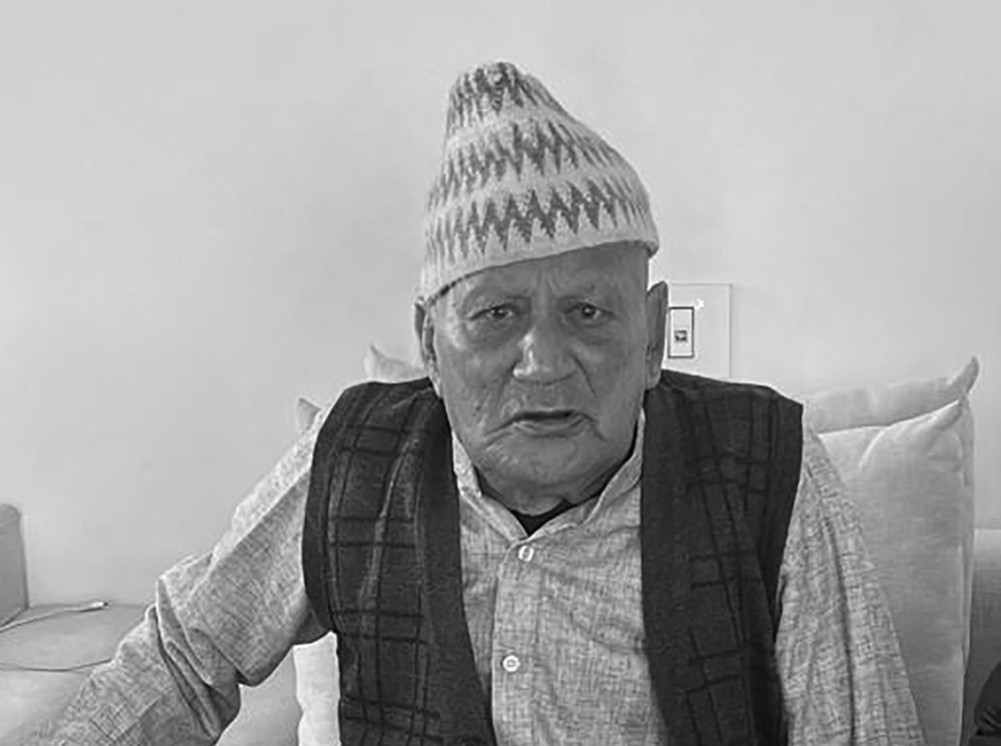
He was arrested several times in his struggle against the Panchayat system. Old Congress leaders still remember him as someone who would buy jackets for his jailed comrades in cold weather, provide them with shoes and slippers, procure medicine, and provide financial assistance when needed.
We use Google Cloud Translation Services. Google requires we provide the following disclaimer relating to use of this service:
This service may contain translations powered by Google. Google disclaims all warranties related to the translations, expressed or implied, including any warranties of accuracy, reliability, and any implied warranties of merchantability, fitness for a particular purpose, and noninfringement.
‘If I have 75 Rajendra Kharels in 75 districts, no one can stop me from restoring democracy’
Mahesh Kharel had heard this sentence repeated by Congress’s supreme leader Ganeshman Singh on various occasions before 2046 BS with his own ears many times while walking with his father. At that time, it seemed like a simple compliment to Mahesh, who is now the mayor of Panchkhal Municipality. But when he was living in Kiriya after the death of his father Rajendra Kharel, Ganeshman’s words kept coming to mind again and again. It was an expression of the extraordinary trust that the party’s top leader had in that one person.
Rajendra Kharel had joined Congress politics after being impressed by Ganeshman Singh’s courage and the honesty of saintly leader Krishna Prasad Bhattarai. In Congress circles, he was known as Bhattarai’s most trusted and true charioteer.
After the restoration of the multi-party system, he did not stop his political journey even though he was defeated in the elections of 2048 BS and 2051 BS. After being elected as a member of the House of Representatives in 2056 BS, he became the Minister of State for Education and then the Minister for Women, Children and Social Welfare. But even after reaching public office, his lifestyle did not change. Since he had his own house in Kathmandu, he did not even take the house rent benefits he would receive as an MP. He believed that it would be immoral to take personal benefits from public office. When Krishna Prasad Bhattarai was the President of the Nepali Congress, the party's central office was operated from his house in Baneshwor.
Kharel also made the simplicity, honesty and political culture of placing principles above position that Bhattarai had embraced throughout his life his philosophy of life. He always stayed away from the attraction of power, position and personal gain. He tried to establish the belief among his fellow travelers and workers that politics is a means of public service.
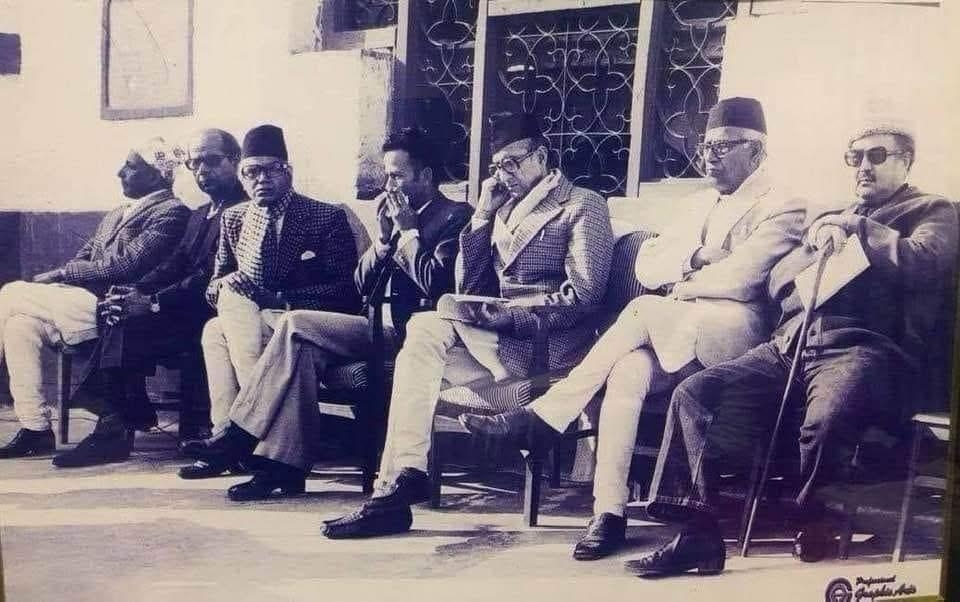
Many leaders in politics reached power, became ministers and held influential positions. But the identity of many remained limited to their positions. Kharel is one of those rare politicians whose identity was made not by position but by character.
After 2048, Bal Bahadur Rai, Bhim Bahadur Tamang, Pradeep Giri and Rajendra Kharel are considered examples of honest politicians. Pradeep Giri refused to become a minister despite getting the opportunity repeatedly. He never aspired to a position higher than that of an MP or central member. Kharel also imbibed the same political culture in his life.
His public life began with social service in his adolescence. At the age of 13-14, he established the 'Four Leaf (Charpat) Club' run with American assistance in the Baneshwor area of Kathmandu and launched social campaigns in the fields of education and health. From that time on, he concluded that social change was possible through local level activism rather than political slogans.
Later, he joined the 'Youth Introduction Seminar' led by Damannath Dhungana and became active in the campaign to spread democratic consciousness. Although formally operated as a social organization, such campaigns strengthened the then democratic movement.
He also played a leading role in social work such as forming the 'Gaun Fark Yuva Toli' in Baneshwor and establishing the Ratna Library and constructing a community building in the Bhagwati Temple premises. Student politics made him more mature. Even before the establishment of the Nepal Students' Union, he was at the forefront of the campaign to establish an independent democratic student organization at the then National College (present-day Shankardev Campus). When economist Vishwambhar Pyakurel was the president of that organization, Rajendra Kharel was the general secretary. From that time on, he established himself in organization building, leadership development and spreading democratic ideas.
He was arrested repeatedly in his struggle against the Panchayat system. Old Congress leaders still remember him as someone who would buy jackets in the cold, provide shoes and slippers to fellow prisoners, procure medicine, and provide financial assistance when needed.
He remained active from the 2036 referendum, the 2043 Satyagraha, the 2046 Jana Andolan to the 2062/63 Jana Andolan. After the 2046 Jana Andolan was successful, he was also given the responsibility of organizing the historic Vijay Sabha organized at the open stage in Kathmandu.
When he was the Minister of State for Education, he gained fame by distributing about 1,300 teacher posts across the country. Among them, his son Mahesh Kharel remembers that he took special initiative to provide significant posts for schools in Kavrepalanchok. According to him, the establishment of a polytechnic institute in Banepa, the implementation of a primary education project, and the construction of a bridge over the Matekhola River in Dolalghat are his memorable contributions.
During the conflict, the Maoists set fire to his house in Kharelthok because he was a Congress leader. But he did not ask for compensation for it. Instead, he issued a statement saying that he would consider the Maoists' abandonment of violence and return to peaceful politics as the real compensation for his house. His approach of choosing reconciliation over revenge further broadened his political stature.
Rajendra Kharel, who had been in politics for eight decades by adhering to simplicity, honesty, and democratic values, passed away on Asad 7 at the age of 80. Although he has left physically, his memory has been kept alive in the Nepali Congress and the democratic movement of Nepal as a rare example of honesty, simplicity, and principled politics in public life.