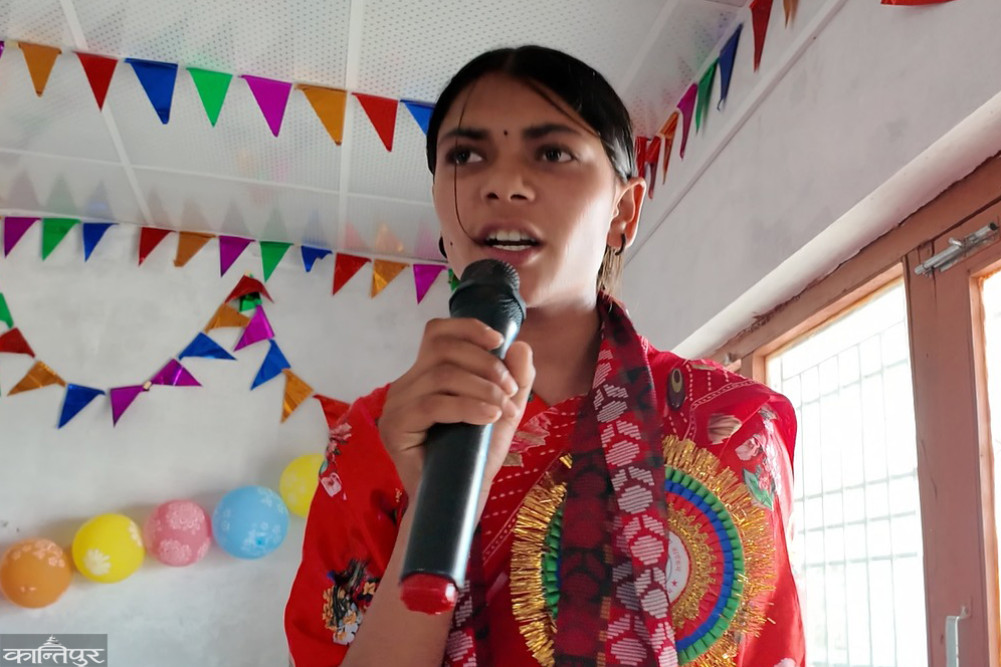
Sushil, who faced pressure from family and society to marry her brother-in-law after her sister's death, says, ”My first goal is to stop child marriage in the village.”
We use Google Cloud Translation Services. Google requires we provide the following disclaimer relating to use of this service:
This service may contain translations powered by Google. Google disclaims all warranties related to the translations, expressed or implied, including any warranties of accuracy, reliability, and any implied warranties of merchantability, fitness for a particular purpose, and noninfringement.
Sushil, a 14-year-old from Shodasha, Chautakra Tol, Mellekh Rural Municipality-6, Achham, should have childish dreams and pen and paper in her eyes at this age. However, 7 months ago, a storm came into her life that tried to destroy her golden childhood and freedom.
Her own family and society were trying to force her to become a bride at a young age and put her in the wedding hall. However, Sushil chose a courageous rebellion to protect her future and existence. She not only saved herself, but also stood as a strong guardian who protected the rights of the children of the entire municipality.
The past 7 months have been very painful for Sushil, a student in class 9 at Shodasha, Nandeshwari Secondary School. She never thought that her own parents and society would try so hard to snatch her childhood and put her in the wedding hall.
The background of this sad chapter is connected to the untimely death of Sushil's sister Tanki Nepali.
On Asoj 1, 2081, Tanki was married to Jenish Nepali from Bajura. However, fate did not allow this marital relationship to last long. Within 6 months of the marriage, on Chaitra 9 of the same year, Tanki died in Delhi, India due to both kidneys failing.
The death of the sister was not only a thunderbolt in the family, but a bigger disaster came to the life of 13-year-old Sushil. Exactly 6 months after the death of the sister, in Asoj 2082, a proposal came from the house of his brother-in-law Jenish to ask for Sushil's hand. After the death of the sister, the perverse custom of the society of giving in marriage to a sister-in-law entered their house. Sushil's 26-year-old elder sister and 22-year-old younger sister were unmarried. However, the boy's side chose the younger Sushilta, leaving behind the elder and younger sisters. According to Sushilta, it is customary for a younger sister to marry her sister-in-law after the death of her sister.
'My elder and younger sisters are also not married. It is customary for a younger sister and her family to choose the girl they like. I fell for their choice. Without informing me, my family and society decided to get me married on Baisakh 1,' Sushilta said, 'Then rumors started circulating about my marriage. After my sister passed away, society pressured me to marry my younger sister. My parents and society were on one side, and I was alone on the other.'
Amidst this extreme mental pressure and loneliness, Sushilta did not give up. She cried and pleaded in front of her parents not to get married. However, her family tried to suppress her childhood cries under the guise of tradition. ‘I cried a lot saying I would not get married. I tried to convince my parents. But no one listened to me. The closer the wedding day got, the more anxious I became,’ she said. ‘I pleaded with my friends and gentlemen to stop my wedding. Friends and gentlemen went to my house. But my family and society were not ready to stop my wedding.’
School teachers and Sushil’s friends went to her house and tried to convince her family. Sarmeet Khadka, a young man from the village, also tried hard to stop her wedding. However, the wall of social evils was so strong that no one’s words worked. Finally, on Baisakh 1, all the preparations for the wedding were completed. Sushil was being prepared to be adorned as a bride.
‘I wanted to stop my marriage at all costs. But, all my efforts failed. I was being prepared to be adorned as a bride. At that time, I told her that I was menstruating,’ says Sushil, ‘I said this thinking that menstruation does not bring good luck and the marriage will be stopped.’
She used the traditional society’s belief in menstruation as a protective shield and managed to postpone the wedding for 15 days for the time being.
The crisis of Baisakh 1 was over, but another date for the wedding was fixed for the 15th. The time in between was a fight for survival for Sushil. She had earlier taken a ‘transformation class’ run by Astha Nepal and World Vision in the village. There, she understood that child marriage is illegal and deadly.
‘In the meantime, I asked for help from everyone,’ she said, ‘I also asked for help from the sir and madam who give the conversion class. They said that we will help to stop the marriage and went to the house to explain.’
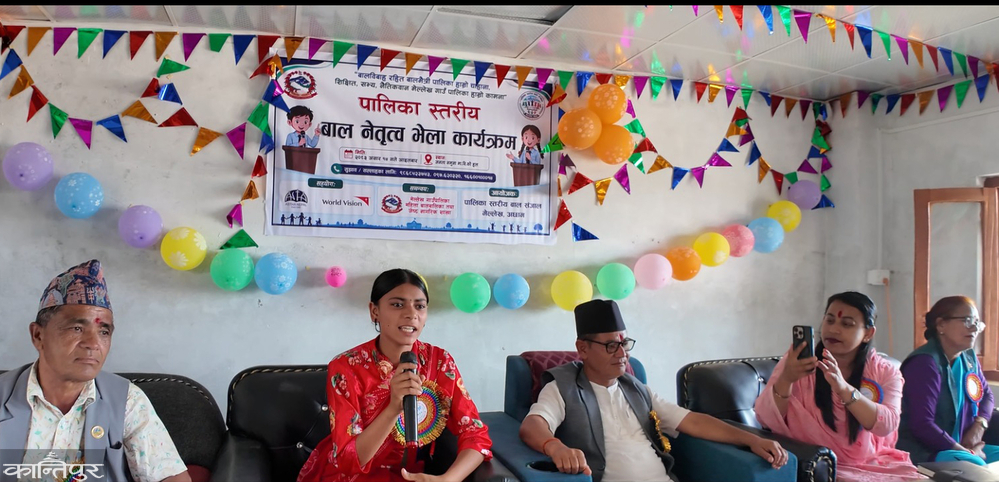
Even with the counseling of the representatives of the organization, the family had not completely dissolved. Meanwhile, on April 2, a program was set to form a ward-level children’s club in the village. Susholat reached there with her problem. ‘On April 2, a ward-level children’s club was being formed. I went there and explained all the problems. From there, I went to the representative of the municipality-level children’s club. When everyone said they would support me, I gained courage,’ she added.
Then on April 7, the process of forming a Mellekh rural municipality-level children’s network began. There was a big gathering of child representatives from all 8 wards of the rural municipality. Sushil stood up at the gathering and narrated her story, her tears and the struggles she had to stop child marriage and claimed the leadership.
‘I told the representatives from all 8 wards everything and expressed my interest in becoming the chairperson of the child network,’ Sushil said, ‘There were three candidates for the chairperson. After explaining my problems and the work I would do to stop child marriage, I unanimously became the chairperson. After that, my wedding scheduled for April 15 was canceled forever.’
Sushil, who is leading the 27-member child network, has only one resolution now – to make the municipality free of child marriage. ‘There are currently 27 members throughout the municipality. My first goal is to stop child marriage. I am now sitting in the chair of the municipal-level child network in front of my family and society, who are ready to host me in the wedding hall.’