”Public transport doesn't carry them, they dig a hole in the road they walked on the previous day and leave them stranded the next day. We had worked hard and ate as much as we could. That too is gone. What will we eat now?”
We use Google Cloud Translation Services. Google requires we provide the following disclaimer relating to use of this service:
This service may contain translations powered by Google. Google disclaims all warranties related to the translations, expressed or implied, including any warranties of accuracy, reliability, and any implied warranties of merchantability, fitness for a particular purpose, and noninfringement.
Shivraj Bishwakarma, a resident of Kupinde-11, Salyan, is blind from birth. He was studying in the first year of B.Ed. and had come to Kathmandu two years ago in search of work. Since his family's financial situation was critical, he had planned to work in the village while studying. But because he was blind, he did not get any work. After this, he said that he was forced to come to Kathmandu in search of work.
Shivraj had been earning a living by singing on the streets of Kathmandu for one and a half years. With the 8-10 thousand rupees he earned in this way, he was covering his education expenses, room rent, and food expenses. He is in trouble after the administration banned singing on the streets for a few months. He said that it was difficult to run the house. 'No matter where I live, the police, the city police, pick me up,' he lamented. 'I started singing on the streets after not finding any work. The government did not allow me to do the same job.'
He said that he tried to sing in restaurants but could not get it because he was blind. 'I sing well. I offered to sing live in many hotels and restaurants, but I got nothing. I was forced to start singing on the streets, but it stopped. Now I have not been able to think about how to make ends meet.' He says that even if he gets an allowance of 2100 rupees a month, it is not even enough to pay the rent. 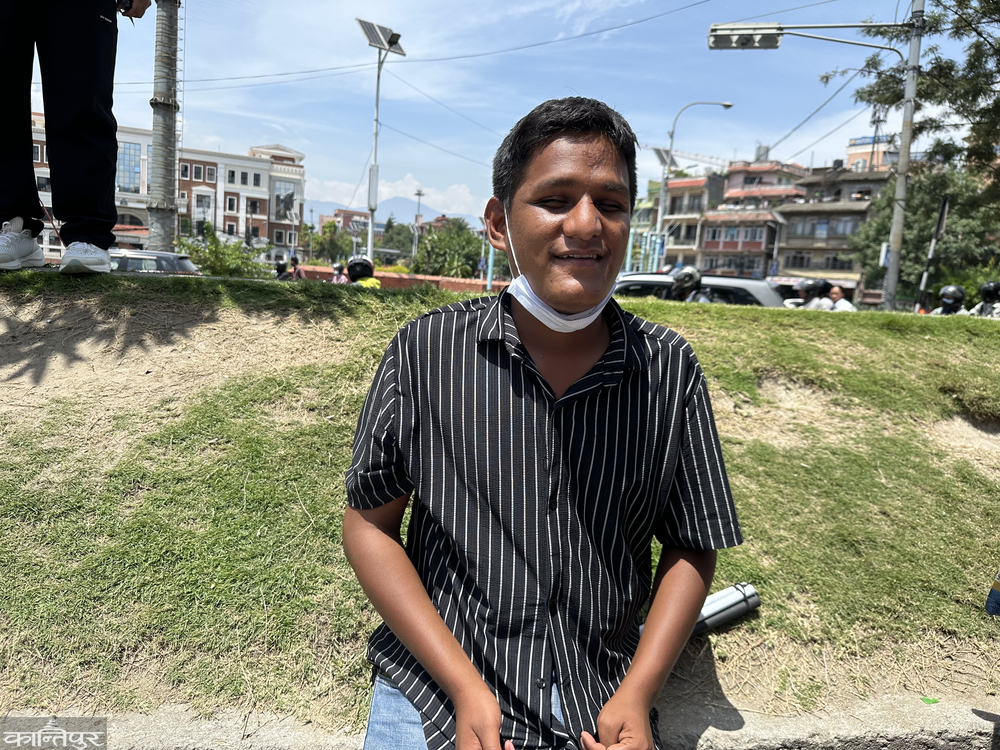
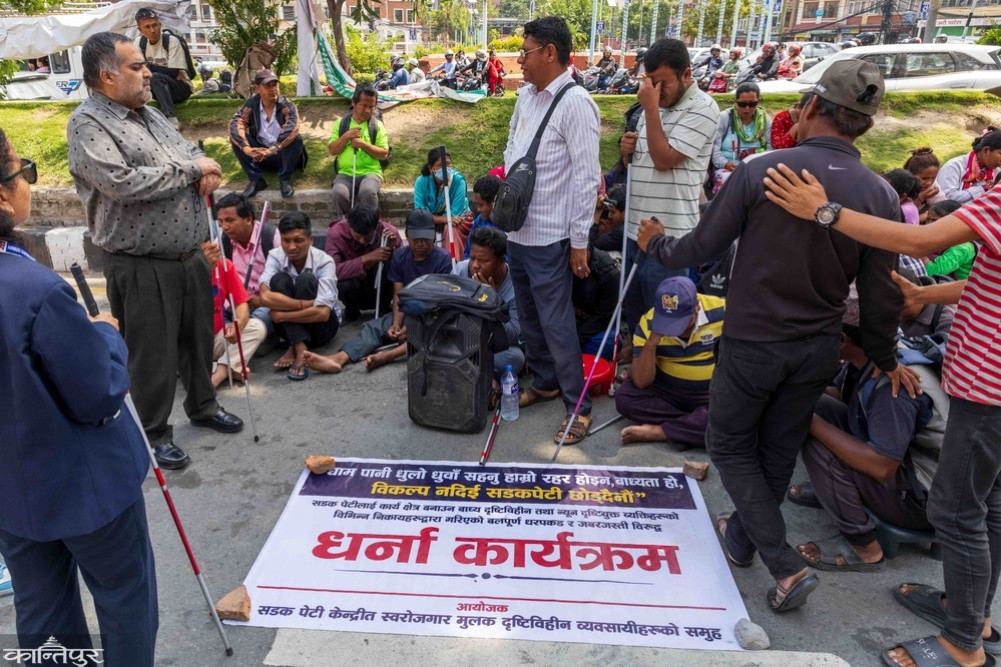
He is sitting on a dharna in protest, saying that the government has removed people with disabilities from the streets without ensuring food, shelter, and clothing. Saying, "It is not our desire to endure the heat, dust and smoke, it is a compulsion, we will not leave the road without giving an alternative," the group of self-employed blind entrepreneurs of the Central Roads and Highways has been on a dharna from 9 am to 1 pm at Maitighar in Kathmandu for the past 5 days.
000
Man Bahadur Thapa, 35, and Sarita Chaudhary, 30, a blind couple from Chandrakot Rural Municipality-4, Gulmi, were holding a dharna in the midday sun with the support of a white cane.
They had been living in rented rooms in Kirtipur, Kathmandu, and sometimes they used to sing songs and sometimes they used to sell incense. After coming to Kathmandu 7 years ago, they used to sing songs from 7 am to 9 am and from 4 pm to 7 pm at Swayambhu, Sundhara, and Lagankhel. Sometimes they would also sell incense. Man Bahadur said that he has not been able to do these jobs for some time. ‘The city police and Nepal police would pick us up because we were singing songs on the street, selling incense, and begging for food,’ he said. ‘They put us in a car up to 5 times and took us away. They kept us there for 2-4 hours.’ 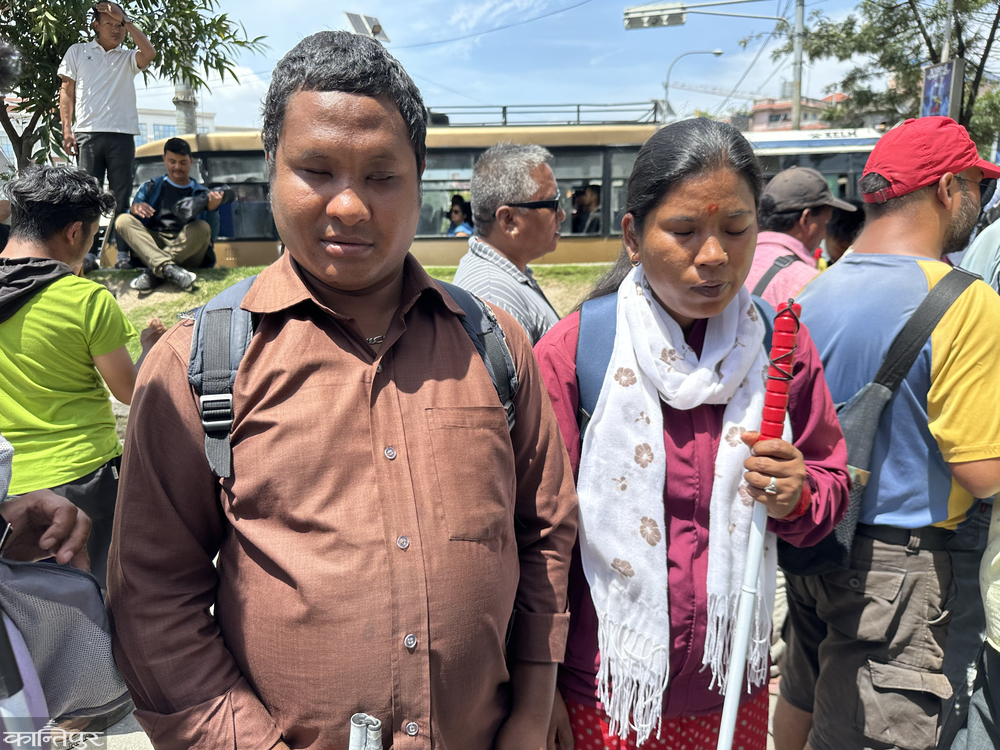
Man Bahadur complained that he was very hurt by the police’s behavior. ‘Since we were blind, our only way of earning money was by singing songs on the street and selling incense sticks and incense,’ he said. ‘The government did not give us any alternative and chased us away from this job.’
Man Bahadur’s couple used to earn 500 to 700 rupees a day by singing songs on the street. ‘It was not always a one-time loss,’ he said. ‘When we had money, we did not have to worry about household expenses. Sometimes we would send it to our mother in the village.’ Now, we even had to borrow money from others to pay for the room rent.’
Man Bahadur has passed BA. Sarita has passed 12th standard. Man Bahadur says that the government should manage people with disabilities in a proper way. ‘The International Federation of Disabled Persons Convention should be implemented. There should be proper arrangements for food, shelter, clothing and employment for the blind in the country,’ he said.
Sarita says that the daily life of the blind is very difficult. ‘Public transport does not carry them, and the next day they dig a hole in the road they walked on the previous day and leave them stranded,’ she said. ‘We used to work and eat as much as we could. That too is gone. What will we do now?’
Sarita also says that the government should have given us an option. ‘If we had been able to see, we would have done other work and eaten.’ We did it because there was no other way,' she said, 'The government should listen to our voice.'
000
42-year-old Hem Thapa Magar was demanding that the government should manage the visually impaired during the protest. Hem, who hails from Sunkoshi Rural Municipality-3, Sindhupalchowk, has been living with his family in Kirtipur, Kathmandu, for the past 10 years. Hem is worried about how he will support his family now that he is unable to work on the streets. 'I used to run a household by marketing incense sticks. I used to educate my children and pay the rent all by myself. Now that I am unable to work, what will I do to survive?' he said. Hem's wife is also blind from birth. Their two children are just starting school. Hem says he cannot sell incense alone. 'When you go to sell incense, you need a sighted friend.' 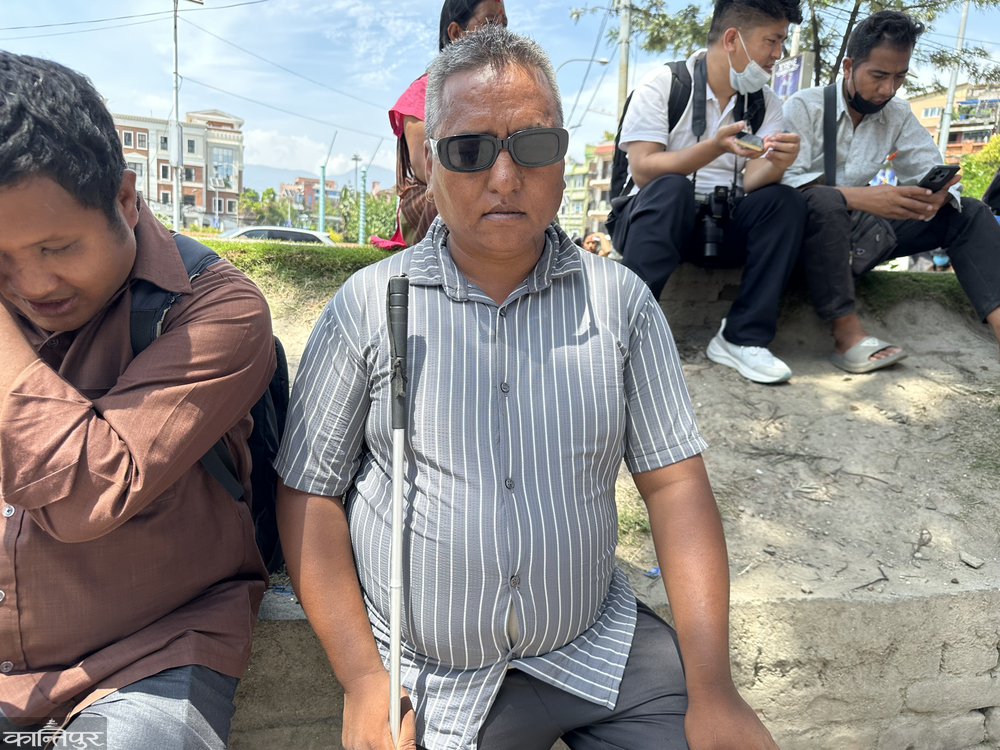
000
27-year-old Vasudev Lugenli Magar, a resident of Sindhuli Tinpatan-7, came to Kathmandu 8 months ago with many dreams. But he says that all his dreams were shattered shortly after arriving in Kathmandu. ‘I also have a teaching license at the Nimavi level. I am fighting the commission. I had to work until I could not find a job and I used to sing songs on the streets because I had to eat, and there was no point in asking my elderly parents for money,’ he said. ‘Since I cannot even sing on the streets, the stress has increased on how to earn money to pay the room rent, prepare for exams, and send what to my parents.’ 
He says that the government needs to provide work according to the ability of every person with disabilities. ‘The government should provide employment to the educated.’ "Even our illiterate friends should be provided with facilities according to their ability," he said. "It is wrong to remove them from every place without any arrangement."
000
The Maitighar movement is participating in the movement, saying that the government should not remove them from the streets without making alternative arrangements for the visually impaired. Gaurav Bohora Chhetri, 22, from Kailali, is interested in singing modern songs. He used to earn money by singing on the streets until some time ago. Chhetri says that he joined the movement after being removed from the place where he was singing. He said that the government should make arrangements for them after not allowing them to work or beg for food. "The government should have given us employment. Otherwise, we would have to pay 20 to 25 thousand rupees a month," he said. "This is our obligation. If we had eyes, we would not have had to live on the streets selling incense and singing songs. We would eat whatever we could by working.' 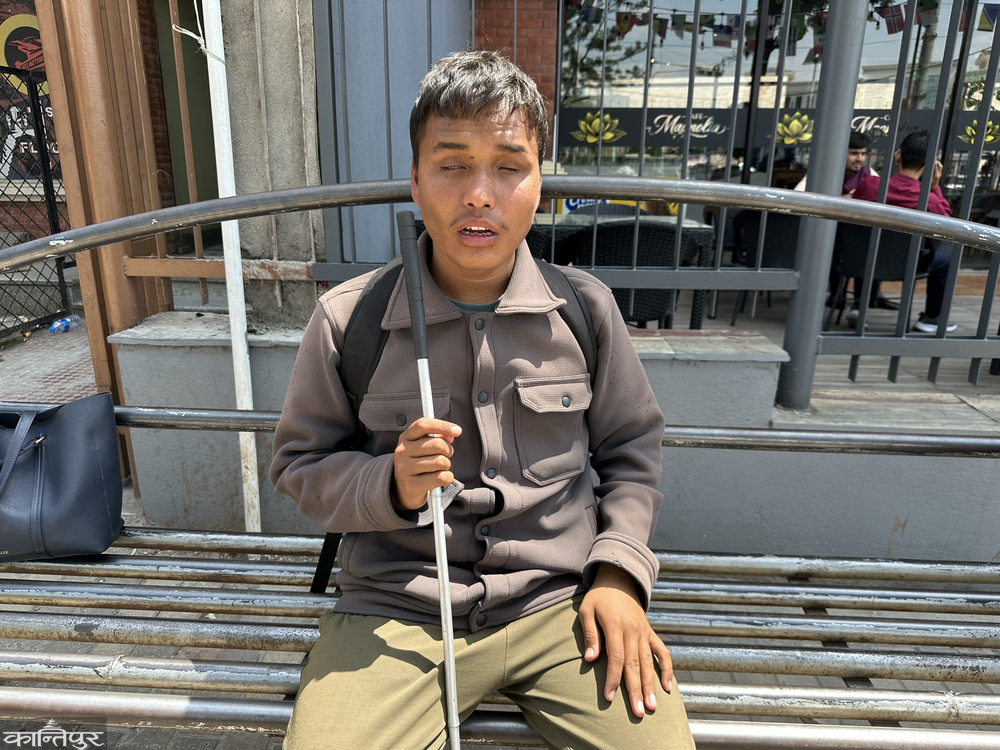
000
Coordinator Sudip Oli says that the government has closed the way for the blind to earn money by doing various jobs on the streets. 'Some friends used to sell incense. Some used to sing songs. I also used to sell incense. That is how we earned our living,' he said, 'The state has closed it. In protest against that, the state should now guarantee us food, shelter, clothing, education, health and employment. We have taken the protest program forward.' 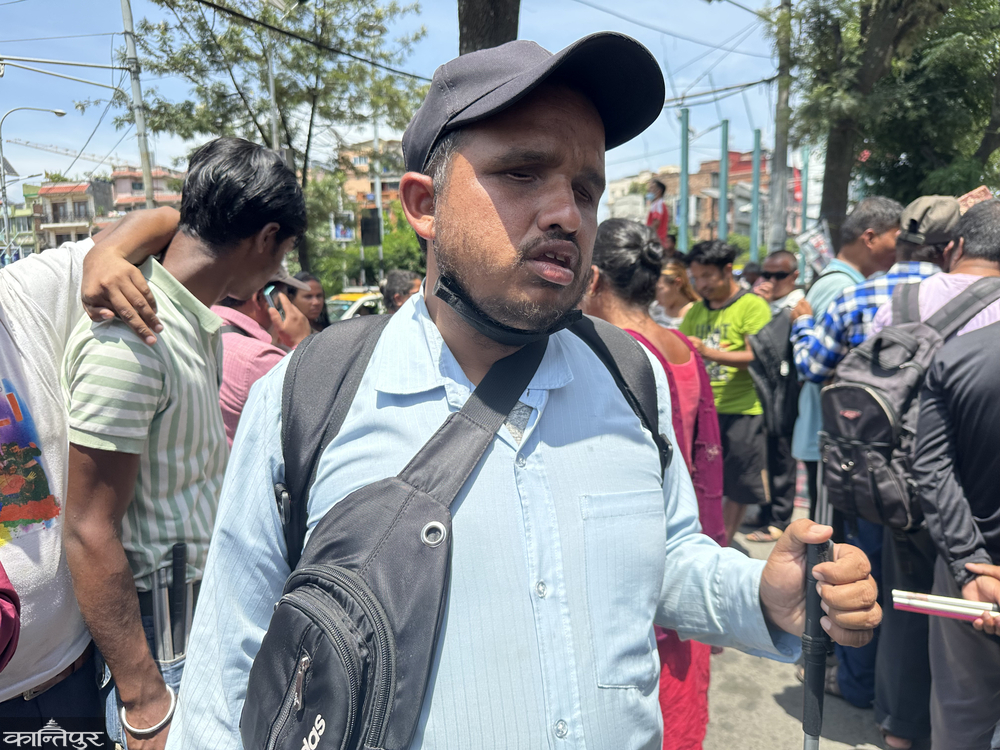
Oli says that the blind who work on the streets of various places in Kathmandu have not been able to work anywhere. 'We were arrested and expelled from Pashupati Kshetra, Jamal, Swayambhu, and Bouddha without being given any choice,' he said, 'If we had been given a choice, we would have accepted it.' But we are being chased away. Now we cannot just leave like that.’ Oli, who will continue the sit-in until the demand is met, says. ‘The government has been arrested. We have not been able to do the work we are doing,’ he said. ‘If the state does not care, we will have to starve. If any of us starve, the government will be responsible.’
Sudeep also used to run his household by selling incense. His wife is also blind. Oli has a 2-year-old son. He was earning 8-9 thousand to 13-14 thousand a month by selling incense. The 33-year-old was running his household by earning alone. But now he says he is in trouble. ‘I have not even been able to buy diapers for my child. There is only enough rice for 3 days in my house now,’ he said.
Even when arrangements are made for them to sit, they refuse to sit: Metropolitan Police Force
Kathmandu Metropolitan City Metropolitan Police Force Chief Superintendent of Police Bishnu Prasad Joshi says that even when arrangements are made for the visually impaired, they refuse to sit. ‘Begging on the roadside is for food, shelter, and clothing.’ Kathmandu Metropolitan City has made complete arrangements for food, shelter, and clothing for the visually impaired in collaboration with Manav Sewa Ashram, he said. ‘They should not be told to ignore all the arrangements and come on the road, pollute the environment, and make noise.’ He says that even when arrangements are made, they should not sit on the road. ‘The road is for vehicles, the sidewalk is for pedestrians, and those visiting temples and monasteries.’ No one can encroach on those places. Joshi says that even though the Metropolitan City has issued a notice prohibiting them from living on the streets, it has arranged food, shelter and clothing for them. “We have only arranged for them to live on the streets and not to live on the streets,” he said. “We have taken some of them to the ashram at the initiative of the Human Service Ashram, Nepal Police, and Kathmandu Metropolitan City. Some have gone and returned. Some have refused to go.” Joshi says that the Metropolitan City has worked for the comfort of the victims. “Living on the streets is bad for their health due to dust, smoke and pollution, and it hinders the movement of the general public. This is why we have worked for their comfort,” he said. The visually impaired have said that they will be kept alone in the ashram, but they also have families. Jashi says, “The federal government will manage the rest.” "The local government cannot arrange permanent housing, children, and families for everyone," he said. "We have cooperated to place the victims in the Human Service Ashram. The rest is left for the federal government to do."