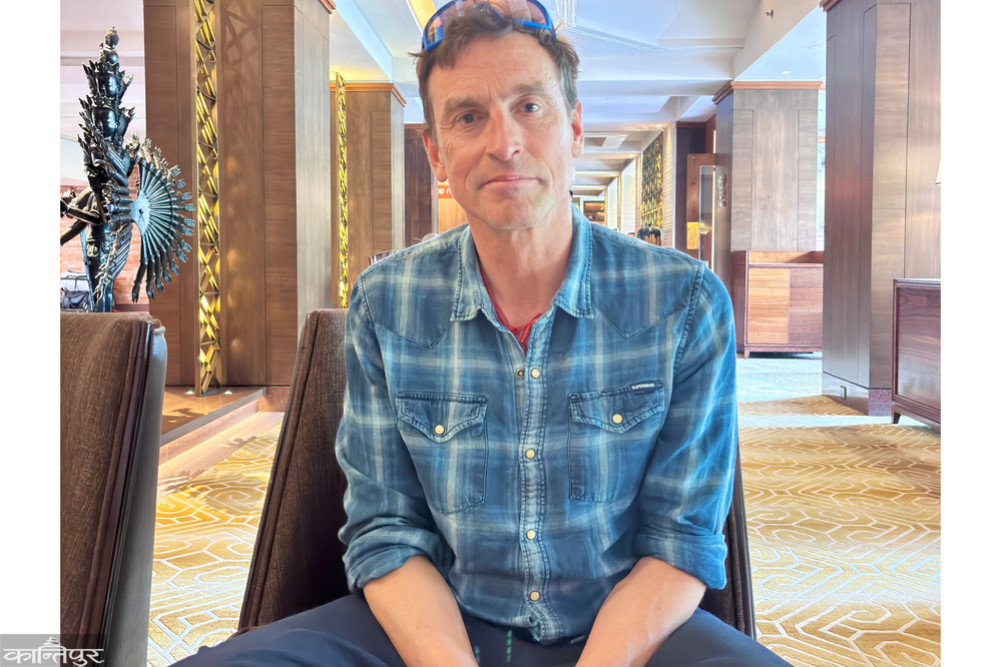
British mountaineer Kenton Kuhl has set a record for the most summits of Mount Everest by a non-Nepali mountaineer, reaching the summit 20 times.
We use Google Cloud Translation Services. Google requires we provide the following disclaimer relating to use of this service:
This service may contain translations powered by Google. Google disclaims all warranties related to the translations, expressed or implied, including any warranties of accuracy, reliability, and any implied warranties of merchantability, fitness for a particular purpose, and noninfringement.
When British mountaineer Kenton Kull first landed at Lukla Airport 33 years ago (1993), the runway there was not as paved as it is now. Just a grassy field. Like an open pasture. He was 20 years old at the time, financially weak and full of youthful courage. When he and his friends set off for the 6,367-meter-high Kusum Kanguru Himal, they had neither a tent for cooking nor a porter. Nor the huge management team that is seen in today's Himalayan expeditions. 'We were young, a little foolish and very carefree,' says Kull, recalling his first trip to Nepal, 'but that's when I fell in love with Nepal.'
Kull, 52, is known as an experienced mountaineer and guide based in Oxford. This spring season, he has successfully reached the summit of Mount Everest for the 20th time. With this, he has become the non-Nepali mountaineer to have climbed Mount Everest the most times. After the climb, he was met at the Yak & Yeti Hotel in Kathmandu and spoke openly about climate change and his affinity for Nepal before returning to the UK, rather than about his record.
This spring season was not very encouraging at the beginning. By the end of Baisakh, there was anxiety and uncertainty from Kathmandu to the Everest base camp. The work of clearing the path was stopped due to a huge serac (iceberg) and unstable conditions in the Khumbu Icefall above the Everest base camp. For about 3 weeks, the 'icefall doctors' were unable to find a safe route. Many had begun to speculate that this year's season might be canceled.
'Everyone was saying the season was over by early May,' Kul recalled on the opening day of the mountaineering season. But what happened next, Kul considers to be a historic year and the most significant achievement. Putting aside professional rivalry and personal egos, the Sherpa teams, the expedition operators and the mountaineering operators' association came together.
'If there's one positive thing to learn from this year, it's the ability of all the teams to stand together and find solutions to problems,' Kul says. The Sherpa community and the Nepali expedition operators worked together and made it a success. 'For me, that's the biggest achievement of the year. That was bigger than the 20th ascent or any new record. It took me back two decades. That's how climbing teams used to work together back then.'
I draw inspiration from Padawa and Kami Rita, not competition
After climbing Everest 20 times, the international media often compares Kul to Nepali climbers like Kami Rita Sherpa or Pasang Dawa Sherpa. But, he rejects such comparisons. 'No, I am not competing with these people. In fact, I am not competing with anyone,' he clarified. He recalled his first meeting with Padawa Sherpa on the Ama Dablam Himal 26 years ago. 'He was 26 at the time, I was 28. He had already climbed Everest before that. Padawa has climbed Everest twice in the same season and still looks very fresh. Kami Rita is an amazing person. I do not compete with them, but rather draw inspiration from them. Rather, these people are a source of inspiration for me.'
For Kul, Everest is a way to continue his relationship with Nepal. 'I love Nepal, the mountains, the people, the culture and the food. Everest gives me a reason to come here and a chance to meet people,' said Kenton Kul.
Kul, who has been coming to Nepal almost every year since 1993, has seen the rapid changes in the Khumbu region up close. He still remembers the peaceful atmosphere of the old days. He says it is natural for Nepal to make money from its most important natural asset.
He has a different view on the criticism by some foreigners about the royalty fee of US$15,000 per person for climbing Everest. 'In Britain or Europe, people can climb Mont Blanc, the highest mountain in the Alps, or Ben Nevis in the Scottish Highlands, for free,' he says. 'But Nepal is not a rich country. It has some of the best mountains in the world.' If 500 people are willing to pay $15,000 to climb Mount Everest, why shouldn't Nepal earn from it? That money goes to businesses in Thamel, hotels, Sherpa guides and the local economy. As long as the government uses it properly, I don't see any problem with it.' 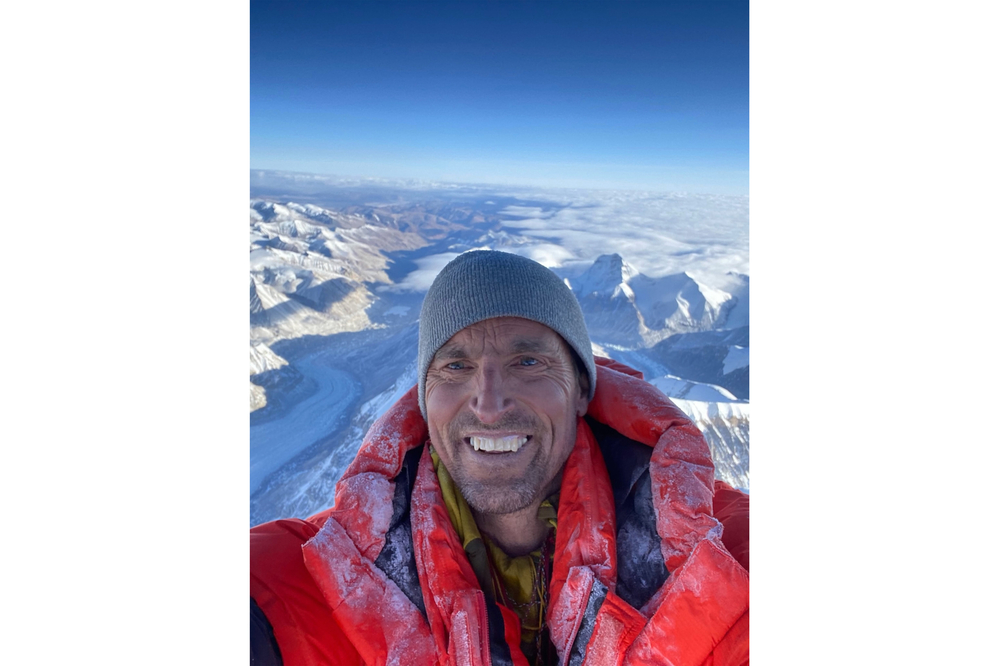
Twenty years ago, glaciers used to be frozen throughout the climbing season. Now that the season has begun, water seems to be flowing like a river from base camp to Camp-2. This is a matter of serious concern for all of us working in the mountains. But climate change is a bigger concern for him than the economy related to the mountains. 'There is now a lot of water in places that were previously covered in ice,' says Kul. 'Glaciers are melting rapidly. Twenty years ago, glaciers used to be frozen throughout the climbing season. Now, when the season starts, water flows like a river from base camp to Camp 2. This is a serious concern for all of us who work in the mountains.'
Kul's love for Nepal has now also transformed into a family relationship. In 2021, during the Covid-19 pandemic, he brought his wife and two children to Nepal. The family trekked for a month in Pokhara, Namche Bazaar and the Khumjung region. His 13-year-old son is now able to make a living at home in Oxford. The final chapter of his mountaineering journey is slowly approaching. Kul plans to lead some of his clients to Everest in 2027 and 2028 as well. But he has hinted at taking a break from Everest after that.
'Maybe my Everest journey will end after 2028,' he said quietly in the hotel lobby. 'But, I will not stop coming to Nepal. I will come to trek, meet friends and climb other mountains. Nepal is the country I have spent the most time in after the UK.' At the end of the conversation, Kul expressed his deep gratitude to the Nepali mountaineering community. 'My entire career is a gift from Nepal,' he said. 'I thank the Sherpa teams and all the people of this country from the bottom of my heart. You are so generous, so helpful and so wonderful,' he said before flying to the UK via Delhi, India. 'It is a great honour for me to be a part of this journey.'